





Black Blade Hunting Knife with Wood-Style Handle and Blue Inlay
Distinctive Outdoor Knife Styling with a Contrasting Black Blade
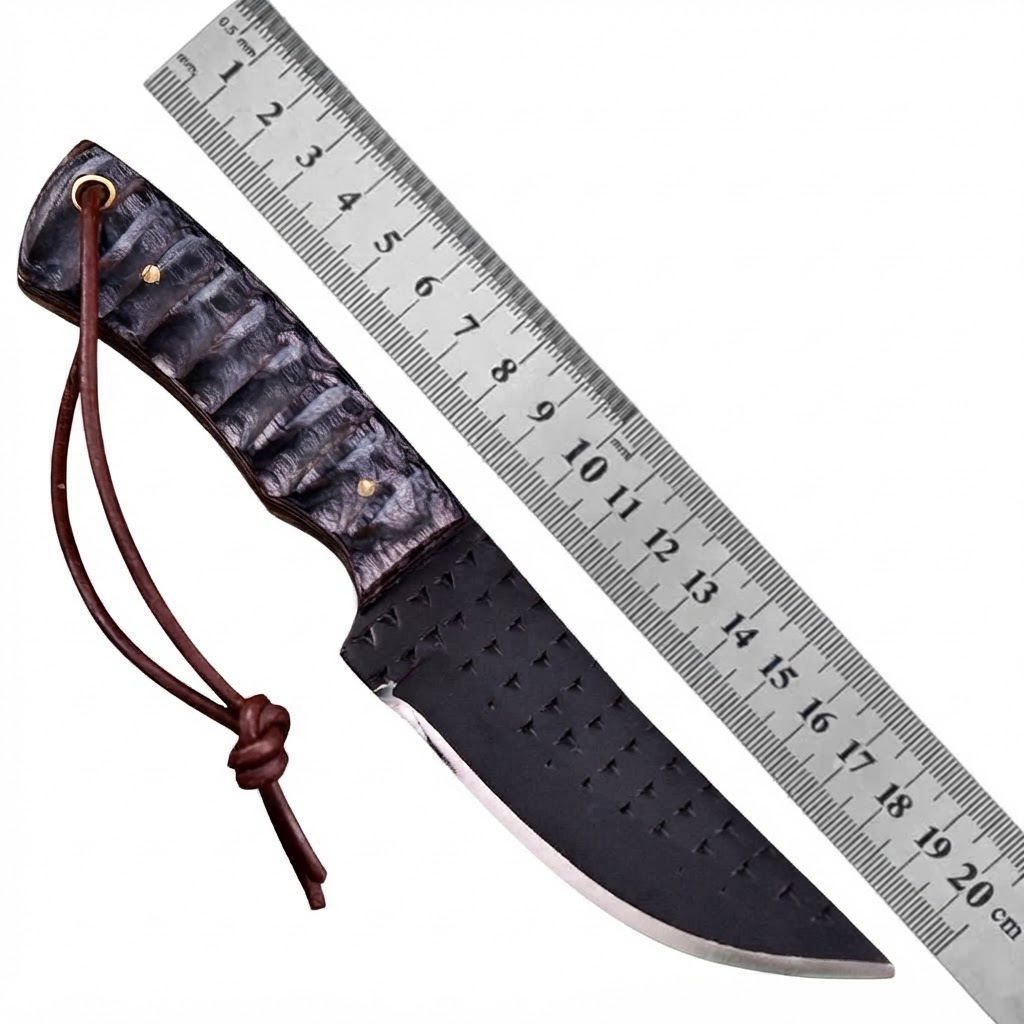
The Black Blade Hunting Knife combines a bold blade profile with a decorative handle that gives it a recognizable appearance. Its broad, dark-finished blade contrasts with a warm brown woodgrain-style grip, while a striking blue inlay adds a carefully placed accent near the center of the handle.
Designed in the familiar style of a fixed-blade outdoor knife, this model features a gently curved cutting edge, a pointed tip, and a compact-looking handle with a wrist lanyard attached at the rear.
Its design brings together traditional hunting knife proportions and decorative details that may appeal to outdoor equipment enthusiasts, specialty cutlery buyers, and collectors.
The dark blade gives the knife an understated appearance, while the handle adds color and visual warmth without overwhelming its overall design.
A series of small circular pins is visible along the handle, complementing the woodgrain-style surface. The blue marbled section provides an additional focal point that makes the knife different from conventional single-color models.
Whether viewed as part of a hunting-style knife collection or considered for general outdoor equipment, this piece offers a distinctive combination of shapes and finishes.
Before selecting it for practical cutting applications, customers should confirm its blade composition, construction, dimensions, and intended use.
Broad Blade with a Dark Surface Finish
The blade is one of the most noticeable parts of this knife.
Its main surface appears black or very dark charcoal, with fine diagonal markings visible across several areas.
These markings create a subtle textured appearance rather than a completely smooth, uniform finish.
Along the lower edge, a bright metallic strip follows the curved cutting profile, creating a clear contrast against the darker blade surface.
This visual separation helps define the shape of the blade and draws attention to its sweeping edge.
The blade is relatively broad near the handle and curves toward a defined point.
Its upper profile slopes gradually forward, while the cutting edge forms a smooth arc that gives the knife a hunting or skinner-style silhouette.
This makes the design visually different from narrow utility knives or traditional straight-backed models.
The dark surface may appeal to buyers who prefer a less reflective blade appearance, although its precise coating and actual reflectivity have not been tested.
The finish could be a black coating, oxide treatment, or another form of surface processing.
Because the manufacturing technique is unknown, no specific corrosion resistance, scratch resistance, or durability benefit should be assumed.
Hunting and Skinner-Inspired Blade Profile
The blade shape resembles profiles often associated with outdoor hunting and skinning knives.
It has a broad central section, a curved lower edge, and a pointed front that follows the overall contour of the blade.
This style creates an immediately recognizable appearance for customers familiar with hunting-oriented fixed-blade cutlery.
The forward curve of the edge is particularly noticeable, giving the knife a continuous, flowing silhouette.
Rather than introducing a large angular transition, the blade tapers gradually toward the point.
At the rear, the blade widens into the handle connection, where a dark area visually separates the cutting portion from the grip.
The knife does not have a prominent crossguard of the type commonly found on some traditional Bowie knives.
Instead, the handle and blade meet through a compact, integrated-looking transition.
This gives the knife a relatively streamlined profile.
Whether the blade is suitable for skinning, camp food preparation, utility cutting, or other activities depends on its verified edge geometry, steel quality, sharpening, and overall construction.
The photographed design should therefore be described as hunting or skinner-inspired rather than being presented as a proven professional field tool.
Brown Woodgrain-Style Handle
The handle features a rich brown color with darker flowing grain-like lines.
Its appearance resembles polished wood and provides a warm contrast to the dark blade.
The handle is relatively straight through its central portion, with a gentle curve near the front and a rounded rear end.
This shape creates a clean visual transition between the blade, grip, and attached lanyard.
Several small circular pins are visible along the handle.
Their gold-like color stands out against the dark brown surface and adds a subtle decorative detail.
The fasteners contribute to the knife’s traditional fixed-blade appearance, although their exact composition and structural function have not been confirmed.
The handle surface appears smooth in the photograph, with visible grain-like variations running along its length.
It could be natural wood, stabilized wood, laminated material, or a synthetic material made to resemble wood.
As these options have different properties and maintenance requirements, the precise material should be verified with the manufacturer.
For customers comparing knives based on appearance, the brown handle provides a familiar, classic character.
Blue Marbled Decorative Inlay
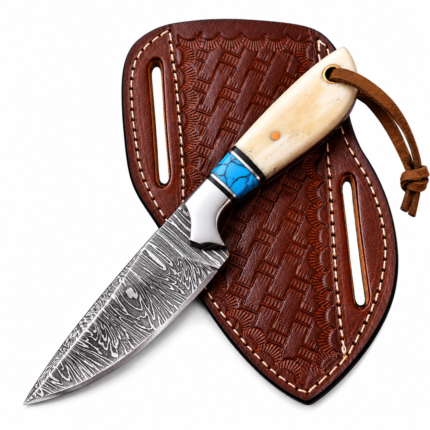
A bright blue inlay forms the most distinctive detail on the handle.
Located near the middle of the grip, this band introduces a vivid contrast against the surrounding dark brown surface.
The blue area contains darker irregular lines that give it a marbled, stone-like appearance.
The resulting effect resembles decorative turquoise, a material often associated with ornamental knife handles and accessories.
However, appearance alone does not confirm that the inlay is genuine turquoise.
It could be a synthetic stone, resin, composite, or another decorative material.
Thin boundaries visually separate the blue section from the woodgrain-style areas on either side.
This makes the inlay look intentional and well defined as part of the overall design.
The blue accent creates a recognizable point of difference without changing the knife’s fundamental fixed-blade shape.
Customers who enjoy decorative handle details may find this feature particularly appealing.
It also makes the knife visually distinguishable from outdoor knives featuring plain black polymer grips or simple wooden handles.
Attached Rear Lanyard
At the rear of the handle, a brown cord is threaded through a visible lanyard opening.
The cord forms a loop and includes a small tied section near its free ends.
This detail adds to the knife’s outdoor-inspired appearance.
Lanyards are frequently seen on recreational knives and other handheld equipment, where they may provide an additional carrying or retention option when appropriately designed and used.
The attached cord in the photograph resembles leather or a suede-like material.
Its exact composition and strength are not confirmed.
The lanyard opening appears to have a metal-rimmed edge, providing a visually distinct attachment point near the handle’s end.
Although the cord is part of the visible design, it should not be assumed suitable for load-bearing, climbing, or other safety-critical purposes.
Customers intending to use the lanyard as a retention accessory should check its construction and attachment strength.
For collectors, the cord contributes to the knife’s traditional outdoor aesthetic and complements the earthy tones of the handle.
Fixed-Blade Design and Construction Details
This product is a fixed-blade knife, meaning the blade does not fold into the handle.
Fixed-blade knives form an established category within outdoor, hunting, camping, and utility cutlery.
Their defining characteristic is the absence of a folding mechanism, making them structurally distinct from pocket knives.
The photographed product shows the blade permanently positioned in line with the handle.
The grip includes several metal pins, a decorative center inlay, and a lanyard attachment point at the rear.
Although the visible design suggests a conventional fixed-blade handle assembly, the internal tang construction cannot be established from the image.
It would be inaccurate to label the knife full tang without confirmation.
Similarly, the blade thickness, overall length, edge hardness, steel grade, heat treatment, and handle attachment method remain unknown.
These are important technical details when evaluating a knife for regular use.
Customers seeking specific performance characteristics should request the manufacturer’s specifications rather than relying on the knife’s appearance.
Contrasting Colors and Subtle Surface Details
The knife’s visual character comes from the relationship between its dark blade and warm-colored handle.
The main blade surface is predominantly charcoal-black, while the cutting edge appears bright silver.
Fine diagonal marks across the blade add detail to the otherwise subdued surface.
The handle introduces deep brown tones with visible grain-like variations.
Small metal pins punctuate the grip, while the blue marbled inlay provides a striking central accent.
At the rear, the brown cord lanyard extends the natural-looking color palette.
The combination creates a design with several distinguishable elements without making the knife appear overly elaborate.
Its overall appearance is practical in style but decorative in execution.
Collectors who appreciate subtle contrasts between blade finishes, handle surfaces, and inlays may find this combination especially interesting.
The knife can also be distinguished from other products in a catalog through its blue handle accent and attached lanyard.
These details provide useful visual identification points for online shoppers.
An Interesting Option for Knife Collectors
Knife collecting often involves comparing different blade profiles, handle designs, decorative details, and construction styles.
This model offers several features that make it recognizable within a broader collection.
Its blackened-looking blade provides a different appearance from brightly polished stainless steel models.
The gently curved blade profile gives it a hunting-inspired silhouette.
The woodgrain-style handle adds a traditional element, while the blue decorative inlay introduces a more individual character.
The attached cord lanyard provides another distinguishing feature.
Together, these details create a design that may appeal to collectors interested in outdoor knives with decorative accents.
Customers interested in particular makers, limited editions, authentic natural materials, or specialist steel grades should request supporting information before purchasing.
The photograph does not establish the knife’s manufacturer, production history, authenticity, or collectible rarity.
Potential Outdoor and Recreational Uses
The knife’s shape places it within the broad category of hunting-style and outdoor fixed-blade knives.
These categories are commonly considered by people assembling camping equipment, outdoor collections, or general recreational gear.
However, a knife’s appearance is not enough to establish suitability for a specific task.
Practical cutting performance depends on the blade’s steel composition, hardness, thickness, sharpening, and edge geometry.
The strength and comfort of the handle also matter.
For this reason, the pictured model should not be advertised as a tested heavy-duty survival knife or professional skinning tool without product-specific evidence.
Customers planning regular outdoor use should first verify the manufacturer’s intended applications.
They should also check for a suitable sheath or protective case.
None is visible in the supplied image, so sheath inclusion cannot be assumed.
When choosing equipment for a particular environment, customers should consider all confirmed specifications rather than selecting by design alone.
Features Visible in the Product Image
The following characteristics can be identified from the supplied photograph.
Product type: Fixed-blade outdoor hunting-style knife.
Blade profile: Broad blade with a curved edge and pointed tip.
Blade appearance: Dark charcoal or black surface with fine diagonal markings.
Cutting edge appearance: Bright silver-colored edge.
Handle appearance: Dark brown woodgrain-style surface.
Decorative insert: Blue marbled band with dark vein-like markings.
Handle fasteners: Multiple circular gold-like metal pins.
Lanyard: Brown looped cord attached at the rear.
Overall design: Hunting or skinner-inspired fixed-blade style.
Cleaning and Routine Maintenance
Proper care helps preserve the appearance of a fixed-blade knife.
After handling or using the knife, carefully wipe the blade with a clean cloth to remove moisture, fingerprints, and surface residue.
Avoid leaving the knife in wet or humid conditions.
The appropriate cleaning method depends on the type of steel and surface finish.
If the blade contains carbon steel, the manufacturer may recommend periodic application of a suitable protective oil.
For coated blades, abrasive cleaners and harsh chemicals should be avoided unless the manufacturer specifically approves them.
Clean the handle using a method compatible with its confirmed material.
Natural wood, stabilized wood, resin, and composite grips may require different care.
The blue decorative inlay should also be treated gently until its exact composition is known.
If the lanyard becomes wet, allow it to dry according to the care requirements of its material.
The blade should be kept protected during storage.
A properly fitted sheath or protective case can reduce accidental contact with the cutting edge.
Always store the knife securely and away from children.
What to Confirm Before Ordering
When comparing this knife with other outdoor fixed-blade models, check the full product specifications.
Start with the blade material and surface finish.
Confirm whether the black appearance results from a protective coating, another treatment, or the underlying blade surface.
Next, review the blade length, overall length, thickness, weight, and edge condition.
Check whether the handle is made from natural wood or a wood-effect material.
Ask whether the blue inlay is genuine turquoise, synthetic stone, resin, or another decorative insert.
The tang construction and pin assembly should also be confirmed.
If the knife will be carried or transported, verify whether a sheath is provided.
For wholesale orders, ask about packaging, product consistency, minimum order quantity, and permitted customization options.
Do not assume that the manufacturer offers engraving, private labeling, or alternative handle colors unless these services are explicitly confirmed.
Customers should also review applicable laws concerning knife purchase, possession, transportation, and importation.
A Distinctive Addition to an Outdoor Knife Collection
The Black Blade Hunting Knife offers a clear combination of dark blade styling, a classic brown grip, and a striking blue decorative accent.
Its broad curved blade creates a recognizable hunting-style silhouette, while the woodgrain-effect handle and attached lanyard give it a traditional outdoor character.
The contrast between the silver-colored cutting edge and the dark blade adds definition, and the marbled blue inlay makes the handle immediately recognizable.
For customers looking for a fixed-blade knife with understated colors and thoughtful decorative detailing, this model is worth exploring.
Review the verified specifications and consider adding this distinctive black blade hunting knife to your outdoor cutlery selection or personal collection.




Reviews
There are no reviews yet.