





Amber Brown Handle Damascus-Patterned Tanto Knife – Design Reference
Introduction
The Amber Brown Handle Damascus-Patterned Tanto Knife is a fixed-blade object with a distinctive angular blade, detailed silver-gray surface patterns, and a two-section brown handle. Its appearance brings together metallic textures, warm amber tones, and traditional-looking sheath decoration.
One of the most recognizable characteristics is the blade’s layered-looking pattern. Thin, flowing lines extend across its surface, forming repeating waves and irregular curves. These markings resemble the decorative patterns commonly associated with Damascus steel. However, the photographs do not establish the blade’s actual metallurgy or manufacturing process.
The handle provides another important visual feature. Its front section has a brown wood-grain-like appearance, while the rear section contains a darker, glossy amber pattern. A narrow red decorative band separates the two areas.
The accompanying sheath is reddish brown with yellow-gold stitching and a scalloped embossed border. Together, these details create an object with contrasting colors, textures, and decorative influences.
This reference examines the knife’s visible design, blade geometry, surface patterns, handle details, and sheath construction. It also identifies technical specifications that require independent verification.
1. Overall Fixed-Blade Configuration
The knife has a fixed-blade configuration, meaning the blade remains extended rather than folding into the handle.
Its silhouette is defined by a relatively broad metallic blade, an angular tip, and a gently contoured handle.
The handle appears longer and narrower than the blade’s widest section. It also widens slightly near its rounded rear end.
Unlike knives with a prominent crossguard, this design has a comparatively simple transition between the blade and handle.
The overall form is visible in the complete product photographs.
Its exact proportions cannot be calculated accurately because no calibrated scale is provided.
2. Angular Tanto-Style Blade Profile
The blade has an angular tip that resembles a tanto-style design.
Rather than ending in a continuously curved point, the blade’s front section changes direction near its tip.
This geometric transition creates a pronounced angular silhouette.
The blade has a broad main face with a distinct tip section.
Its shape is particularly visible in the complete side-view photographs.
The word tanto-style describes the visible geometry and does not establish a particular historical origin or manufacturing tradition.
3. Damascus-Style Surface Patterns
The blade displays intricate, wave-like markings.
These lines vary in thickness and direction.
Some areas contain closely spaced, nearly parallel bands, while other regions form rounded and swirling patterns.
The visual effect resembles the layered patterns associated with Damascus steel.
However, genuine pattern-welded construction cannot be established from photographs alone.
Surface etching and other decorative techniques can produce visually similar results.
For that reason, the blade is accurately described as Damascus-patterned until its material composition is verified.
4. Silver and Gray Blade Coloration
The blade combines lighter silver-colored areas with darker gray lines.
The contrast makes its surface pattern easy to distinguish.
Different photographic angles reveal subtle changes in brightness.
In some images, the patterns appear more prominent near the edge.
In others, the lighter central region attracts more attention.
The visible finish contributes to the object’s decorative identity.
No specific coating, polishing method, or alloy grade can be confirmed from the supplied images.
5. Layered-Looking Blade Texture
The blade’s decorative lines resemble layers flowing across a metallic surface.
These patterns form repeated curves and irregular bands.
Some appear almost parallel, while others turn sharply and reconnect.
The visual arrangement creates an impression of movement across the blade.
The pattern continues through much of its visible length.
Although this appearance may suggest layered metalworking, the actual production technique remains unknown.
6. Darker and Lighter Metallic Regions
The blade contains several visually distinct regions.
The brighter areas reflect light more strongly.
The darker areas emphasize the narrow, repeated patterns.
These differences create depth across an otherwise flat photographed surface.
The boundary between the blade’s main face and its angled surfaces can also be seen.
This relationship between surface geometry and coloration is an important part of the design.
7. Brown Wood-Grain-Style Front Handle Section
The portion of the handle nearest the blade has a warm brown appearance.
Fine darker markings run through this section.
They resemble natural wood grain.
The surface includes amber, reddish-brown, and deeper brown tones.
Two silver-colored circular details are visible near this region.
The photographs do not establish the wood species or confirm that the material is natural wood.
Its visible appearance can nevertheless be documented as wood-grain-style.
8. Glossy Amber Rear Handle Section
The rear handle section has a darker, more complex appearance.
It combines amber, golden brown, dark brown, and nearly black areas.
The colors form an irregular marbled pattern.
Some sections look partly translucent or resin-like under the photographed lighting.
However, the actual material cannot be determined from appearance alone.
The glossy surface distinguishes this region from the more natural-looking front section.
9. Red Decorative Accent Band
A narrow red accent separates the two brown handle sections.
This strip creates a visible dividing line.
Its reddish tone contrasts with the surrounding amber and darker brown surfaces.
The band is bordered by thin, light-colored spacer lines.
These details establish a layered decorative transition.
The exact band and spacer materials are unverified.
10. Silver-Colored Circular Handle Details
Several small circular silver-colored features are visible on the handle.
They occur at different positions along its length.
Their bright appearance contrasts with the darker brown material.
The circular elements resemble fastening pins.
However, their internal construction and composition cannot be established from the images.
Describing them as silver-colored circular details is therefore more accurate than assigning an unverified material.
11. Decorative Mosaic-Style Pin
A small circular ornament appears within the darker amber section.
It contains a cream-colored background with several red circular elements.
A gold-colored border surrounds the decorative pattern.
This feature resembles a mosaic-style pin.
Its detailed appearance creates a focal point within the handle design.
The photographs do not reveal the exact materials used to produce the ornament.
12. Handle Shape and Contours
The handle has a gently curved outline.
Its front section narrows near the blade.
The central area follows a smooth inward curve.
Toward the rear, the handle widens slightly before finishing with a rounded end.
The surface decoration follows this overall shape.
These visible contours help distinguish the handle from a straight-sided design.
Claims concerning grip performance or ergonomic measurements would require additional evidence.
13. Contrasting Handle Finishes
The handle contains multiple visual finishes.
The front region resembles polished wood.
The rear region has a glossy, amber-marble appearance.
The red accent band introduces a uniform color.
Small metallic circles add reflective points.
These different surface appearances create variation across the handle without changing its overall brown color palette.
14. Decorative Material Composition
The handle’s appearance suggests the use of differently colored decorative sections.
This is a visual observation rather than a confirmed manufacturing specification.
The darker material could resemble resin, composite material, or finished natural material.
The lighter section resembles wood.
A manufacturer specification sheet would be necessary to identify the actual materials.
A factual catalog should avoid presenting visual similarities as verified material claims.
15. Reddish-Brown Sheath
The accompanying sheath has a warm reddish-brown exterior.
Its appearance resembles finished leather.
The covering follows an elongated outline that tapers toward the end.
The surface displays subtle variations in color and texture.
It also includes a decorative border and visible stitching.
The exact composition of the sheath cannot be verified from photography.
16. Scalloped Embossed Border
The sheath features a series of repeated curved motifs.
These shapes resemble small overlapping arches.
Fine triangular-looking markings appear within the decorative border.
The pattern follows part of the sheath’s lower edge.
This ornamentation adds texture without introducing a strongly contrasting color.
The design is especially visible in the photographs showing the sheath from above.
17. Yellow-Gold Stitching
The sheath has a line of contrasting stitching near its outer perimeter.
The thread appears yellow or gold-colored.
Individual stitches remain visible against the darker brown background.
The stitching follows the sheath’s long edge and curves around its tapered end.
This border creates a clear visual separation between the sheath’s surface and edge.
Its thread composition and construction method are unknown.
18. Sheathed Product View
The first photograph presents the knife inside its sheath.
The blade is covered, while the handle remains visible.
The image emphasizes the relationship between the dark amber handle and reddish-brown covering.
The decorative mosaic pin can be seen above the sheath opening.
This perspective documents the object’s enclosed appearance.
It also provides a clear view of the sheath’s full outline.
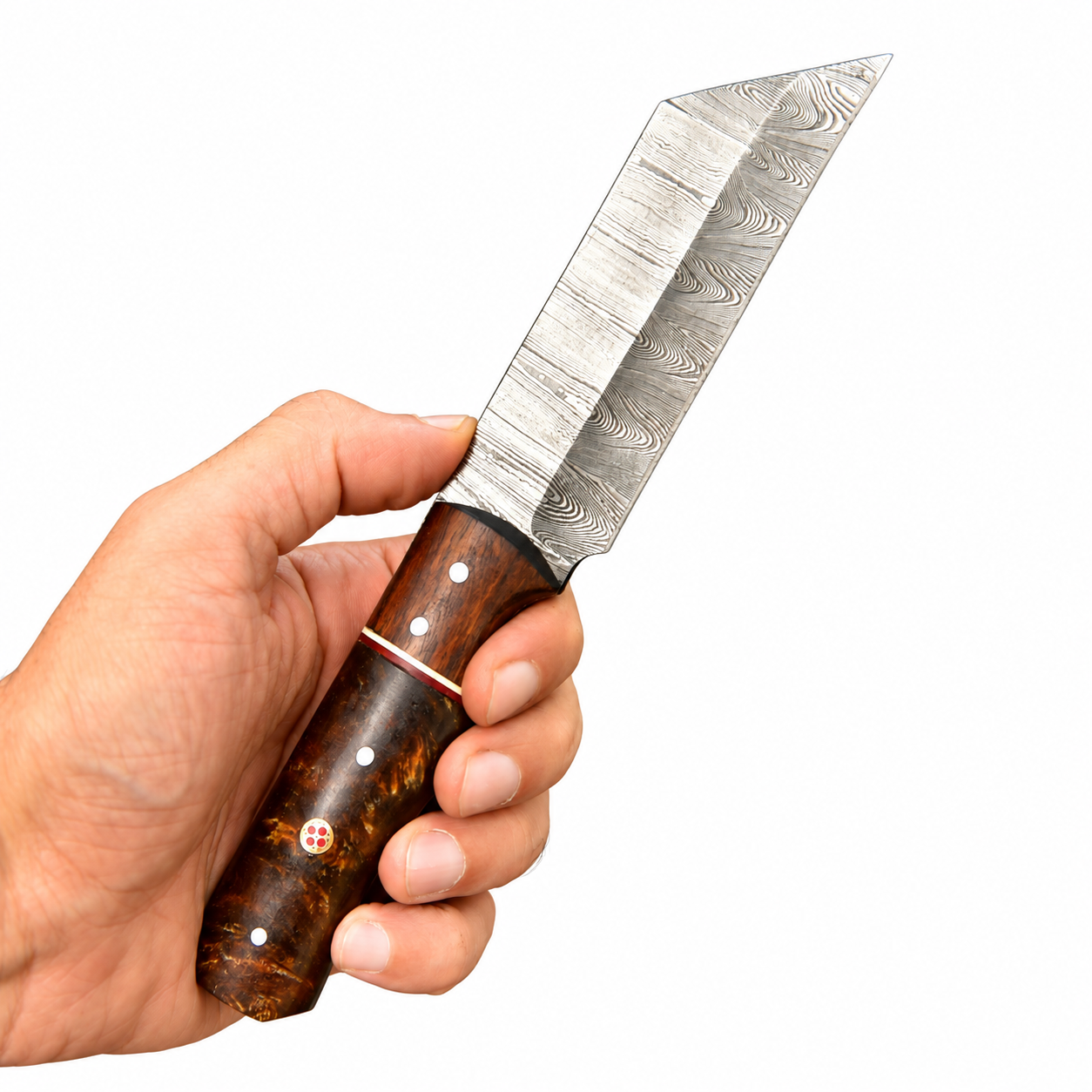
19. Blade Close-Up Photograph
Another image concentrates on the blade’s patterned metallic surface.
A hand is visible holding the handle.
The photograph reveals numerous closely spaced lines across the blade face.
Some lines form sweeping curves, while others have a more linear appearance.
The image is useful for examining decorative metalwork.
It does not provide laboratory evidence of the blade’s metallurgical composition.
20. Complete Knife in Hand
The hand-held photograph shows most of the knife’s overall structure.
The angular blade profile and patterned handle are clearly visible.
The hand provides a general visual comparison of scale.
However, human hand dimensions vary significantly.
The image therefore cannot be used to establish accurate blade length or object weight.
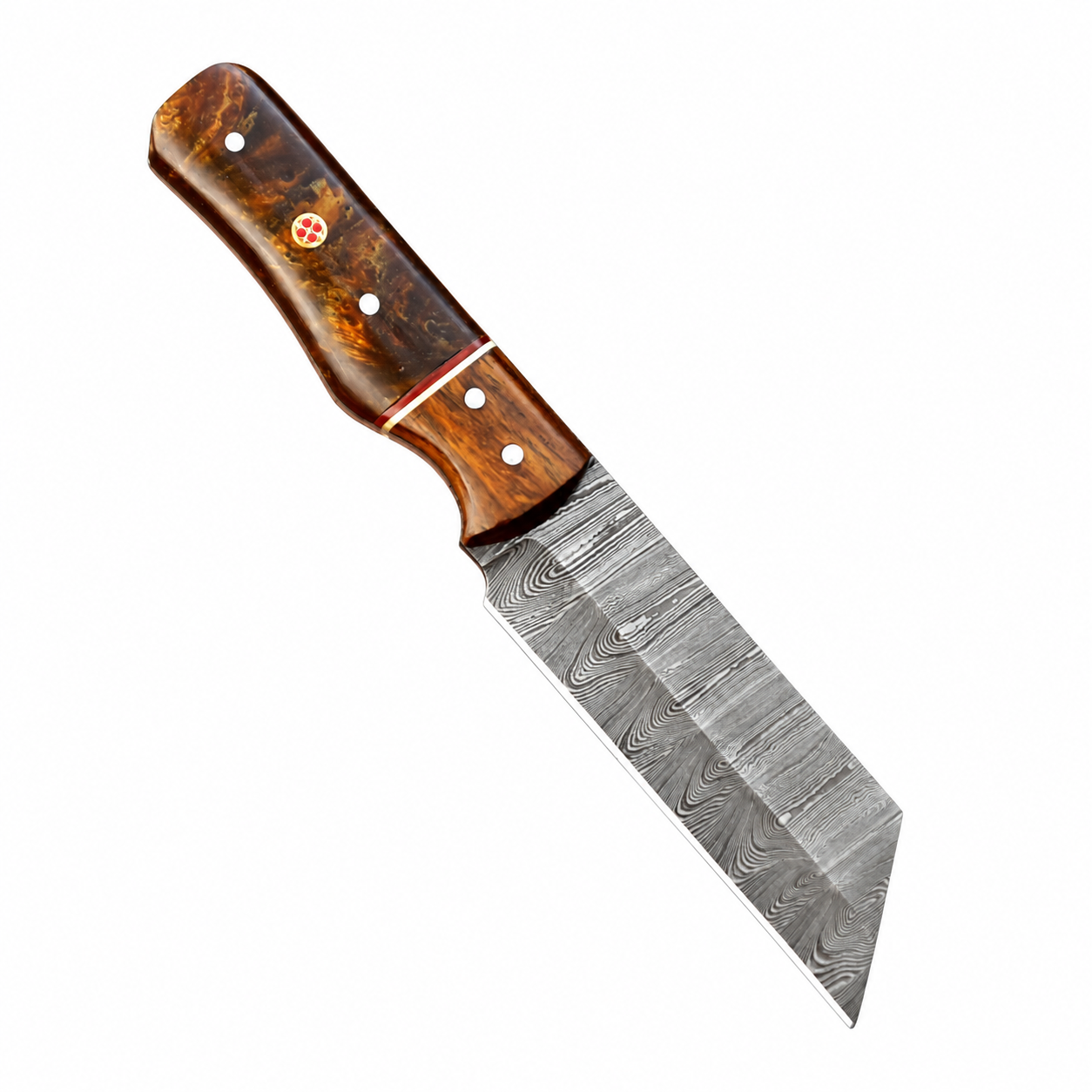
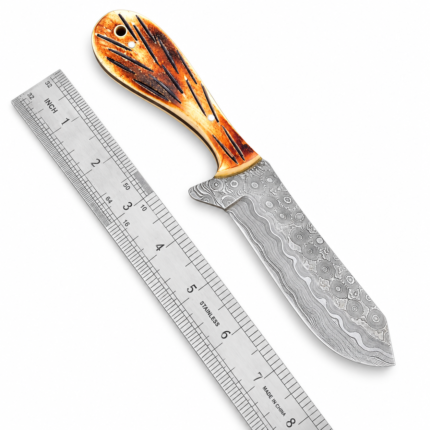
21. Full-Length Isolated Photograph
The isolated photograph presents the complete knife against a white background.
It clearly displays the blade silhouette and handle coloration.
The decorative pattern continues across much of the blade.
The red band separates the lighter and darker handle sections.
The white background helps distinguish the outer contours.
This image is particularly useful for an objective visual description.
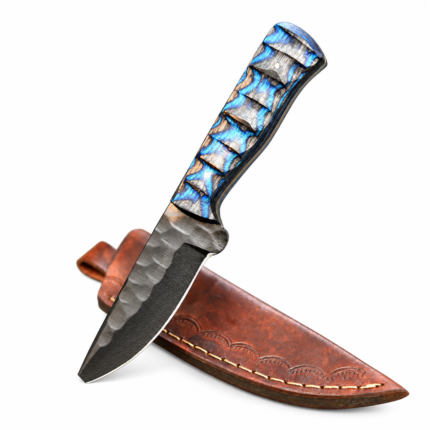
22. Knife and Sheath Arrangement
The final photograph shows the knife positioned across its accompanying sheath.
The silver-gray blade contrasts with the warm brown accessory.
The handle’s amber colors remain visible.
The sheath’s stitching and embossed decoration can also be examined.
This arrangement documents the visual relationship between the two objects.
23. Decorative Metalworking Influences
Layered-looking metal patterns have appeared in various historical and contemporary craft traditions.
They are often associated with pattern-welded blades and decorative metal finishing.
The object’s blade resembles this broader visual tradition.
However, resemblance alone does not establish a particular historical production method.
The design should therefore be described using terms supported by its visible appearance.
24. Brown and Metallic Color Palette
The object combines several principal colors.
Silver and gray dominate the blade.
Warm brown defines the front handle section.
Dark amber and black appear toward the rear.
A red accent band separates the handle regions.
Small silver-colored and multicolored details add contrast.
The reddish-brown sheath visually connects with the handle’s warmer tones.
Together, these colors create a coordinated decorative composition.
25. Design Consistency Across Views
The same principal features remain visible throughout the photographs.
The blade has an angular tip and patterned surface.
The handle contains two brown decorative sections.
The red accent band forms a consistent dividing line.
The mosaic-style ornament remains visible in the rear region.
The sheath features a repeated curved border and contrasting stitching.
These recurring details support a consistent description of the object.
26. Surface Appearance Under Different Lighting
The blade appears brighter in certain photographs.
Its darker lines become more prominent under different viewing conditions.
The amber handle also changes in apparent brightness.
Some areas look almost black, while others display golden tones.
These differences may result from lighting, camera angle, or image processing.
A standardized physical color reference would be required for precise color matching.
27. Visible Construction Details
The photographs reveal the blade, handle, decorative spacers, and several circular details.
They also show a transition between the blade and handle sections.
However, the internal structure is not visible.
The photographs cannot independently establish full-tang construction, specific fastening methods, or other concealed engineering details.
A reliable technical description would require manufacturer documentation.
28. Material Identification Limitations
Several materials resemble familiar substances.
The blade resembles Damascus-patterned metal.
The front handle resembles polished wood.
The rear handle resembles amber-colored resin or decorative composite.
The sheath resembles leather.
These descriptions are visual comparisons.
They should not be presented as confirmed specifications unless supported by documentation.
29. Technical Specifications Requiring Verification
A complete technical record would normally include:
- Manufacturer and model identification
- Exact blade alloy
- Confirmation of pattern-welded or surface-patterned construction
- Overall dimensions
- Blade dimensions
- Handle material
- Pin and spacer composition
- Product weight
- Sheath material
- Manufacturing origin
- Production date
None of these details can be conclusively established from the supplied photographs alone.
30. Accurate Product Documentation
Accurate catalog descriptions should distinguish appearance from verified specifications.
“Damascus-patterned blade” identifies the visible metal pattern.
“Angular tanto-style tip” describes the blade silhouette.
“Amber-brown marbled handle” communicates the handle’s coloration.
“Red decorative spacer” identifies the narrow band.
“Reddish-brown stitched sheath” documents the accompanying covering.
These terms help readers recognize the object without introducing unsupported claims.
Conclusion
The Amber Brown Handle Damascus-Patterned Tanto Knife combines a patterned silver-gray blade, angular tip, and contrasting brown handle sections.
The lighter front handle has a wood-grain-like appearance, while the darker rear section features glossy amber marbling.
A red accent band, pale spacers, silver-colored circular details, and a decorative mosaic-style pin contribute to the handle’s distinctive appearance.
The accompanying reddish-brown sheath features yellow-gold stitching and scalloped embossed decoration.
Together, the supplied photographs provide a useful record of the object’s external form, surface finishes, and decorative characteristics.
Exact materials, dimensions, manufacturing processes, and technical specifications remain unverified.





Reviews
There are no reviews yet.