





Damascus Pattern Hunting Knives with Distinctive Blades and Decorative Handles
For collectors and outdoor knife enthusiasts, the appearance of a knife can be just as interesting as its shape and construction. Damascus Pattern Hunting Knives combine recognizable fixed-blade profiles with decorative surface patterns and handles that feature a mixture of natural-looking textures and colorful details.
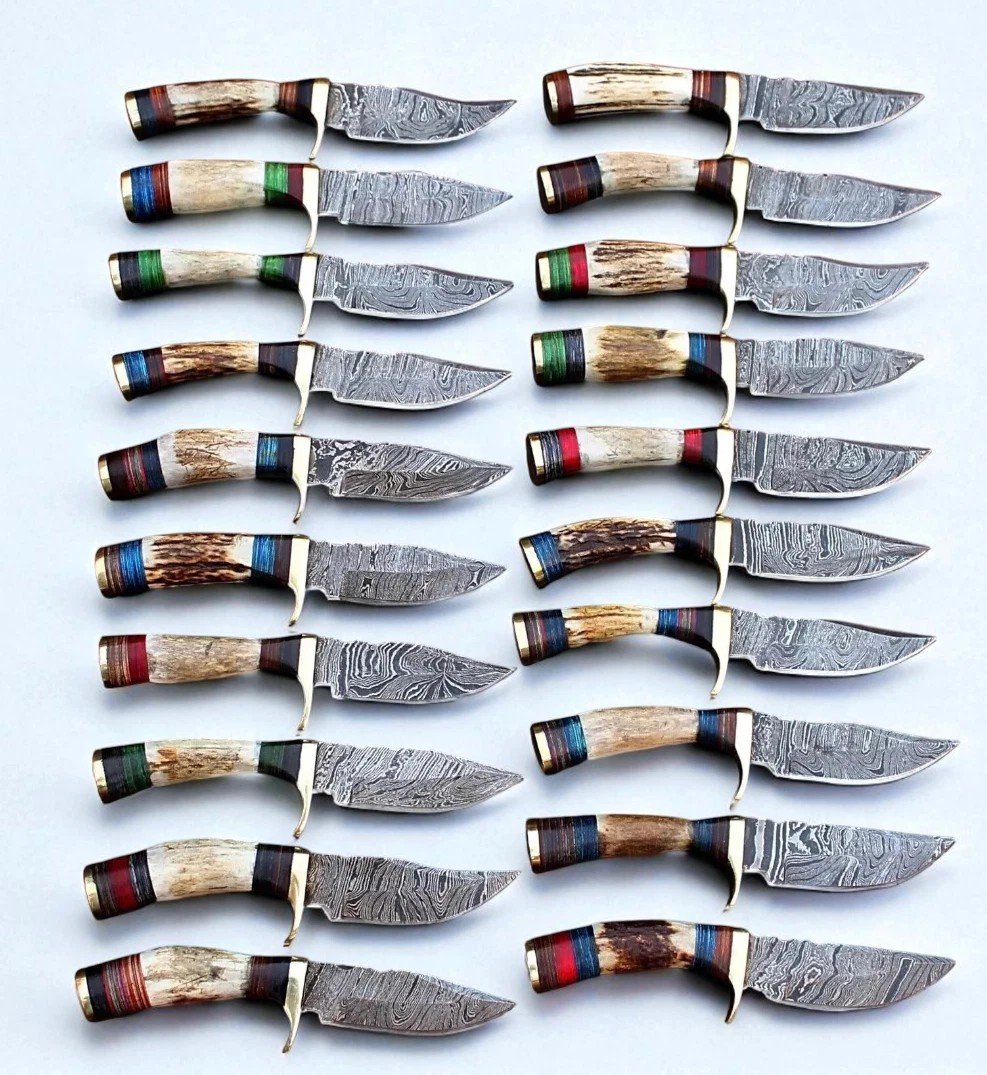
The photographed assortment contains 20 different knives arranged in two organized columns. Each features a patterned metallic blade, a prominent curved guard, and a shaped handle with contrasting bands near the ends.
The most noticeable feature is the variety of patterns across the blades. Some knives show flowing, wave-like lines, while others display tighter curves, irregular swirls, and more angular formations. These differences create a distinctive look that makes each knife visually interesting.
The handles add another decorative element. Their light cream and brown surfaces resemble natural antler or bone, although the exact material remains unverified. Dark sections and colored bands in red, green, and blue provide contrast against the lighter handle bodies.
These fixed-blade knives are particularly appealing for customers who appreciate traditional hunting knife styles, patterned metalwork, and decorative outdoor equipment. They may also be attractive additions to a collection of handcrafted-style knives.
1. Distinctive Damascus-Style Blade Patterns
Flowing Metallic Lines That Make Each Knife Stand Out
One of the main reasons these Damascus Pattern Hunting Knives attract attention is the appearance of their blades.
The photograph shows silver-gray blade surfaces decorated with irregular lines and curves. The patterns vary from one knife to another, creating a collection with different visual characteristics.
Several blades feature broad flowing waves, while others show closely spaced lines that resemble layered metal. Some patterns form complex swirls across the blade face.
These details are especially noticeable against the relatively simple background of the image.
Rather than relying on bright blade coatings or large engraved graphics, the designs use metallic contrast to create their decorative appearance.
This makes the knives particularly interesting to collectors who appreciate patterned steel finishes.
Understanding the Damascus Appearance
The term Damascus is frequently used to describe metal surfaces with a layered or patterned appearance.
Modern genuine Damascus steel may be produced through pattern welding, in which different steels are joined and processed to create visible patterns.
However, Damascus-style appearances can also be created through surface treatments or decorative etching.
Because the photograph does not establish the manufacturing method, it would be inaccurate to claim that these knives contain a particular number of steel layers.
The visible product feature is the Damascus-style appearance, not a verified metallurgical specification.
Customers who specifically want genuine pattern-welded Damascus steel should request material and manufacturing confirmation before ordering.
2. Traditional Fixed-Blade Hunting Knife Design
A Recognizable Outdoor Knife Profile
All 20 knives appear to use fixed-blade construction, meaning their blades are shown extending from the handles rather than folding into them.
This design is commonly associated with hunting, camping, and general outdoor knives.
The blades have moderately broad profiles and curved cutting-edge shapes. Most narrow toward a pointed tip, although the exact curvature differs across the assortment.
Some blades have more prominent bellies, while others feature slightly straighter upper sections.
The photographed knives also show a transition between the blade and the handle, where a gold-tone guard is positioned.
This gives the knives a recognizable traditional hunting knife appearance.
Fixed-blade designs can be suitable for different practical applications when manufactured and assembled to appropriate specifications. However, the photograph alone does not establish that these particular knives have been tested for demanding outdoor tasks.
Their actual working performance depends on factors such as blade material, heat treatment, edge geometry, tang construction, and handle security.
Curved Blade Profiles
The blades visible in the photograph have an assortment of curved profiles.
The cutting edges generally form smooth arcs that extend toward the tips.
This shape is commonly encountered in hunting-style knives and other fixed-blade tools.
For buyers comparing knife profiles, the curvature is an important visual characteristic.
A broad blade belly can influence how a knife is used, but functionality cannot be guaranteed without knowing the dimensions and cutting-edge specifications.
For customers selecting these knives primarily for collecting or display, the curved profiles contribute to their traditional appearance.
3. Antler-Look Handles with Natural Color Variations
Decorative Light and Brown Handle Sections
The handles are among the most distinctive parts of this assortment.
Most feature a light cream-colored central section with brown markings or irregular surface textures.
Some look relatively smooth, while others display a more rugged, antler-like exterior.
These differences create a varied appearance across the collection.
The handles resemble natural antler or bone materials, but their composition cannot be confirmed from the image.
They may be manufactured using natural materials, imitation materials, or combinations of different components.
For that reason, this listing describes the handle appearance rather than promising a particular animal-derived material.
Shaped Handle Construction
The handles are not completely straight.
Most have a gently curved outline with a slightly wider rear section and a narrower front area near the guard.
This shaping contributes to their traditional hunting knife design.
The image suggests that the handles are intended to be held by hand, although comfort and grip security cannot be assessed reliably from a photograph.
Factors such as handle size, texture, balance, and fit vary according to individual users.
Buyers interested in functional use should confirm the handle dimensions and construction details.
4. Colorful Spacer Bands for a Distinctive Finish
Red, Green, Blue, and Dark Accents
The Damascus Pattern Hunting Knives shown in the image feature colorful bands that distinguish individual handle designs.
These accents are visible near the rear ends of the handles and around the front handle sections.
The dominant decorative colors include blue, green, red, and dark brown or black.
Some knives combine blue and red details, while others emphasize green and darker sections.
These variations provide customers with different visual styles while maintaining a consistent overall knife design.
The bands appear to be separate decorative sections, but their exact materials and assembly methods are unknown.
They should therefore be described as colored spacer-style accents rather than verified leather, wood, or resin components.
A Traditional Appearance with Colorful Details
The combination of pale handles, dark sections, and colored bands produces a distinctive decorative effect.
The brighter accents contrast with the relatively muted metallic blades.
This balance makes the knives look different from designs that use entirely black or plain wooden handles.
Collectors who enjoy decorative knife handles may appreciate the range of color combinations.
The assortment also allows different blade patterns and handle finishes to be compared side by side.
5. Gold-Tone Curved Finger Guards
A Prominent Feature Between Blade and Handle
Each knife in the image features a curved guard positioned between the handle and blade.
The guards have a gold-tone metallic appearance.
Their shape extends downward in a noticeable curve, creating a consistent design element throughout the assortment.
Guards of this general type are often incorporated into traditional hunting knife designs.
They visually separate the blade from the handle and can serve a protective function when properly engineered.
However, the actual material, attachment method, and protective effectiveness of these guards have not been verified.
Coordinated Decorative Appearance
The gold-tone guards complement the light-colored handles and patterned blades.
Their warm metallic appearance contrasts with the cooler gray tones of the blade surfaces.
This gives each knife a balanced combination of light, dark, and metallic details.
The curved guard also helps define the overall outline, making the knives recognizable as traditional fixed-blade hunting-style designs.
6. An Interesting Assortment for Knife Collectors
Twenty Visible Design Examples
The uploaded image presents 20 knives rather than a single knife photographed from multiple angles.
The arrangement makes it easy to compare the differences in blade patterns, handle colors, and decorative finishes.
Some knives have darker brown handles, while others feature lighter, more uniform-looking surfaces.
The colored bands also vary across the assortment.
For collectors interested in knife design, these differences provide an opportunity to appreciate several variations of a similar product category.
A retailer could potentially present these knives as individual design variants if the supplier confirms that each design can be purchased separately.
However, the image does not establish individual availability or whether the knives are sold in a complete collection.
Customers should be told clearly which knife or knives are included with an order.
Display Appeal
The assortment has a strong decorative quality.
The combination of patterned blades, curved guards, and detailed handles makes these knives suitable for consideration as collection pieces.
A secure display can help highlight their individual patterns and differences.
Any display arrangement should keep the blades protected and inaccessible to children.
Because the cutting edges may be sharp, all items should be handled as potentially hazardous until their condition is confirmed.
7. Traditional Hunting Knife Style for Outdoor Enthusiasts
Inspired by Familiar Outdoor Knife Designs
These Damascus Pattern Hunting Knives feature a style commonly associated with traditional outdoor and hunting knives.
The curved blades, shaped handles, and prominent guards create a recognizable profile.
Outdoor enthusiasts may appreciate this appearance, particularly if they prefer designs that incorporate decorative metalwork.
However, the intended application of a knife should always be confirmed with the manufacturer.
A knife designed for decorative collecting is not necessarily suitable for heavy-duty outdoor use.
Similarly, a functional hunting knife should be evaluated according to its verified construction and performance specifications.
Choosing a Knife for the Intended Purpose
Customers considering a knife for camping, fieldwork, or other legitimate utility tasks should check more than the blade pattern.
Important considerations include the steel composition, blade dimensions, edge condition, grip security, and overall assembly.
The hardness and heat-treatment process also influence the performance of a working blade.
None of these technical characteristics can be established from the supplied photograph.
For that reason, the knives are best introduced as hunting-style fixed-blade designs until their functional specifications have been confirmed.
8. Decorative Craftsmanship and Pattern Variety
A Different Appearance on Every Blade
The assortment demonstrates how surface patterns can change the appearance of similar knife shapes.
Even when two blades share approximately the same overall outline, their patterns may make them look quite different.
One knife may show wide, flowing lines, while another features a denser arrangement of curves.
This variety adds visual depth to the collection.
For people who enjoy metalcraft and decorative blade design, the patterns may be the most interesting feature.
If the steel is genuinely pattern welded, variation could result from manufacturing and finishing processes.
If the designs are etched, pattern differences may instead reflect different surface treatments.
The supplier should clarify which construction applies to the products being sold.
Details That Work Together
The blade patterns do not appear in isolation.
They are combined with contrasting handles and curved metallic guards.
The resulting design has several coordinated features: patterned blades, pale handle sections, dark front and rear accents, and occasional bright-colored bands.
These visual elements create a consistent traditional style despite the differences between individual knives.
This information should help buyers understand what is visible while avoiding inaccurate technical claims.
9. Caring for Patterned Knife Blades
Cleaning After Handling
Patterned knife blades can have finishes that require appropriate maintenance.
To help preserve their appearance, remove fingerprints and moisture with a clean, soft cloth.
Avoid leaving the blades wet for extended periods.
The appropriate cleaning method depends on the specific steel and surface treatment.
If the knives are made from corrosion-prone steel, the manufacturer may recommend an appropriate protective oil.
Do not assume that every patterned blade has the same corrosion resistance.
Protecting Decorative Handles
The handles should also be cared for according to their confirmed material composition.
Natural antler, bone, wood, and synthetic handle materials may require different maintenance methods.
Avoid exposing them to unnecessary heat, moisture, or harsh cleaning chemicals.
A soft, dry cloth is generally a sensible starting point for removing ordinary surface dust.
Before using any polish or conditioner, confirm that it is suitable for the particular handle material.
Safe Storage
Store the knives securely in a dry, protected location.
Blade edges should be covered by appropriate protective storage equipment where available.
The image does not show leather sheaths or other protective accessories, so these should not be advertised as included.
Avoid stacking unprotected knives in a way that allows their blades or decorative handles to rub against one another.
10. Selecting the Right Design
Consider the Blade Pattern
Customers who value visual detail may want to compare the blade patterns carefully.
Some of the knives feature large flowing curves, while others have tighter, more detailed lines.
The preferred appearance will depend on personal taste.
A close-up photograph of each individual knife would make selecting a specific design easier.
Compare Handle Colors
The red, green, and blue spacer-style bands create several different handle combinations.
A customer looking for a subtle appearance might prefer darker accents.
Someone who enjoys more colorful decorative details may prefer one of the brighter combinations.
The photographed assortment offers several visible options, but the availability of each design should be confirmed.
Confirm the Actual Item Being Purchased
If the product is listed online as a single knife, the customer should know exactly which variation will be supplied.
If designs are supplied at random, that should be stated clearly.
If customers can choose a particular knife, individual variation photographs and selection options are recommended.
The image alone cannot determine the supplier’s fulfillment method.
11. Suitable Customers and Collection Interests
Traditional Knife Collectors
Collectors interested in hunting-style knives may appreciate the consistent fixed-blade shapes and varied decorative finishes.
The assortment offers multiple examples of patterned blade aesthetics.
Patterned Steel Enthusiasts
Customers who enjoy Damascus-style patterns may find the flowing metal lines especially appealing.
The variety makes it possible to compare several different surface appearances.
Outdoor Equipment Enthusiasts
People interested in traditional outdoor equipment may appreciate the general design.
Any practical use should depend on verified material and performance information.
Decorative Gift Buyers
A knife with a patterned blade and distinctive handle may also interest an adult collector as a decorative gift.
The seller should confirm the exact design, packaging, accessories, and applicable shipping restrictions.
12. Why These Designs Stand Apart from Plain Hunting Knives
Decorative Blade Surfaces
The blades feature visible patterns rather than a uniformly plain metallic finish.
This gives each knife a more detailed appearance.
Contrasting Handle Materials and Colors
The combination of cream-colored centers, darker ends, and colored accents adds variety across the assortment.
Recognizable Curved Guards
The gold-tone guards contribute to the traditional hunting knife silhouette.
Multiple Visible Variations
The photograph displays 20 designs with different handle treatments and blade patterns.
These visible differences can be useful for a product variation gallery or a collection display.
13. Important Information Before Purchasing
Because the photograph does not include a technical specification sheet, several details still need supplier verification.
Customers should confirm whether the blade material is genuine Damascus steel or a decorative patterned finish.
The handle composition should also be established, particularly where natural antler or bone is claimed.
Dimensions, blade thickness, weight, tang construction, and edge condition should be provided before the knives are promoted for specific practical tasks.
It is also important to confirm whether the product includes a sheath, presentation box, or other accessories.
For international orders, customers and sellers should check applicable knife import, possession, and shipping regulations.
Clear specifications and accurate product photography can reduce misunderstandings and help customers select the appropriate knife.
14. Explore the Distinctive Damascus Pattern Hunting Knives Collection
The appeal of these Damascus Pattern Hunting Knives comes from their combination of traditional silhouettes and decorative details.
Their silver-gray patterned blades create an interesting contrast with the pale, natural-looking handles, while the colorful bands and curved gold-tone guards give each knife its own character.
With 20 examples visible in the photograph, the assortment showcases a range of patterns and handle combinations without losing its consistent hunting-style appearance.
For collectors, decorative metalwork enthusiasts, and buyers who appreciate distinctive fixed-blade knife designs, this collection offers plenty of visual variety.
Explore the available designs and confirm the materials, specifications, and exact item included before placing your order.








Reviews
There are no reviews yet.