






Damascus Pattern Knife with Colorful Handle and Sheath
Discover a distinctive combination of traditional cutlery styling and vibrant handle designs with this Damascus Pattern Knife. Featuring a patterned silver-gray blade, a two-tone decorative handle, and a matching brown sheath design, this knife brings visual character to a hunting-style cutlery collection.
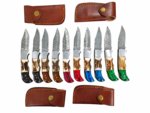
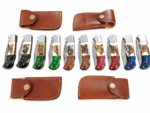
The collection shown in the product image includes ten knives with similar blade shapes and several handle color combinations. Each knife features flowing blade markings, a curved pointed tip, a polished-looking metal bolster, and a handle with contrasting light and dark sections.
One of the most recognizable details is the decorative upper handle area. Its cream-colored surface features dark brown irregular markings that resemble the appearance of stag antler. Below this section, contrasting black, brown, red, blue, or green finishes add a more contemporary touch.
The photographs also show brown leather-look sheaths with bright stitching and snap closures. These accessories complement the knives’ appearance, although their inclusion and quantity must be confirmed with the supplier.
For collectors, specialty cutlery enthusiasts, and customers interested in decorative outdoor-style knives, this collection offers a visually distinctive design with several available-looking color options.
The image does not confirm blade steel composition, handle materials, dimensions, or tested cutting performance. The description therefore focuses on visible details rather than unsupported technical specifications.
Damascus Pattern Knife with Distinctive Blade Design
The most noticeable feature of each knife is its patterned blade.
The blades display flowing, layered-looking markings that resemble the appearance commonly associated with Damascus-style cutlery.
Silver-gray metal surfaces contrast with darker curved lines, producing decorative patterns across the visible blade faces.
The markings vary slightly between knives, giving each blade an individual appearance.
Some blades feature closely grouped wave-like lines, while others display broader circular and layered formations.
These differences contribute to the collection’s visual character.
The blades have relatively narrow profiles with gently curved cutting-edge outlines.
Their upper sections taper toward pointed tips, creating silhouettes consistent with certain small hunting and outdoor-style knives.
A brighter metal section near the base of each blade provides contrast against the patterned surface.
The photograph does not establish whether these knives are made from genuine pattern-welded Damascus steel or another material with a patterned finish.
For accurate product information, the blade steel grade, construction method, and manufacturing process should be confirmed before publication.
Traditional Fixed-Blade Construction Appearance
The knives shown in the image have a fixed-blade appearance.
Each blade extends directly from a polished-looking metal bolster into the handle.
No visible folding mechanism or pivot appears in the photograph.
This arrangement resembles the configuration used in traditional fixed-blade outdoor knives.
The relatively compact-looking blade profiles and curved handles create a balanced visual design.
However, the photograph does not include a measurement scale.
The actual blade length, handle length, overall size, and weight remain unknown.
Likewise, the internal construction cannot be determined.
Details such as full-tang construction, hidden tang, handle attachment, and steel hardness require supplier documentation.
Customers considering practical use should review these specifications before choosing a particular knife.
Eye-Catching Stag-Antler-Style Handle
One of the collection’s strongest visual features is the light-colored upper handle section.
This area has a cream or ivory-like base with irregular dark brown markings.
The appearance resembles the natural variation commonly associated with stag antler.
Some handles display larger dark patches, while others feature closely grouped, smaller markings.
These variations create a natural-looking finish that contrasts with the colorful lower handle sections.
The light section also helps connect the metallic bolster to the darker or brighter handle colors.
Its decorative appearance provides a traditional element within the overall design.
However, the photograph does not establish whether this section is genuine antler, bone, resin, or another material.
It should therefore be described as stag-antler-style until the actual composition is confirmed.
This distinction is particularly important for customers who prefer specific materials or need accurate product information for purchasing decisions.
Colorful Handle Variations
The knives in the photograph feature several different lower-handle finishes.
These colors make it easier for customers to choose a style that matches their preferences.
The visible options include black, brown, red, blue, and green.
Each color produces a different visual effect when combined with the light upper handle and patterned blade.
Black Handle Variation
The black lower handle has a dark marbled appearance.
Its understated coloring complements the silver-gray blade and cream-colored upper section.
This combination creates a traditional-looking design with strong contrast.
Brown Handle Variation
The brown lower section features warm wood-like tones.
Its appearance works naturally with the darker markings on the upper handle.
This variation may appeal to customers who prefer earthy colors and classic cutlery styling.
Red Handle Variation
The red lower handle introduces a brighter appearance.
Dark marbled markings create contrast within the colored surface.
The result is a more noticeable combination that stands apart from traditional brown or black knife handles.
Blue Handle Variation
The blue option has a vivid finish with darker flowing markings.
Its bright color contrasts strongly with the silver blade and light upper handle.
This design may appeal to collectors interested in colorful specialty cutlery.
Green Handle Variation
The green lower handle features a similarly vibrant appearance.
Dark irregular markings provide additional visual texture.
Its color combination creates a distinctive alternative to the other available-looking variations.
Although these colors are visible in the photograph, the supplier should confirm the exact availability of each option before creating WooCommerce product variations.
Polished Metal Bolster Design
Each knife features a silver-colored section between the patterned blade and decorative handle.
This component resembles the bolster commonly found on traditional hunting-style knives.
Its smooth, reflective appearance contrasts with the layered blade markings.
The bolster also separates the light handle section from the patterned metal blade.
From a design perspective, this creates a clear transition between the different materials and colors.
The polished-looking surface provides a relatively simple detail that complements the more decorative sections.
The photograph does not establish the bolster’s exact material or structural purpose.
It should not be described as stainless steel, nickel silver, or another specific metal without verification.
Decorative Handle Pins and Fittings
Several small, gold-colored circular fittings are visible along the handles.
These details create bright accents against the darker colored surfaces.
Their positions vary slightly according to the handle design.
The fittings resemble the decorative or structural pins commonly used in fixed-blade knife construction.
They help create a traditional cutlery-inspired appearance.
The handle profiles also include gently curved sections and a rounded lower end.
Some handles feature more pronounced finger contours than others.
These features add visual character to the collection.
However, the photograph cannot establish how the handles feel in use or whether the fittings serve a particular structural function.
Grip performance, balance, and comfort should be evaluated using the manufacturer’s measurements and product specifications.
Brown Sheath with Contrasting Stitching
The image shows four brown sheath views positioned above and below the knives.
Their surfaces have a reddish-brown leather-like appearance with subtle texture.
The edges feature bright yellow-orange stitching.
This stitching creates a visible border around the sheath panels.
Each sheath also shows a flap-style closure with a round gold-colored snap button.
The combination of brown material, contrasting stitching, and gold-tone hardware contributes to a traditional outdoor-accessory appearance.
The sheaths appear suitable in style for the knives displayed nearby, but actual compatibility must be confirmed.
The image does not establish whether the same sheath fits every handle variation or whether different sheath sizes are supplied.
It also does not confirm genuine leather construction.
Until the supplier verifies the material, the accessory should be described as a leather-look sheath.
Why Choose This Damascus Pattern Knife?
The primary appeal of this collection is its combination of decorative blade patterns and distinctive handle colors.
Customers who appreciate traditional knife designs may be attracted to the stag-antler-style upper handle sections.
Those interested in contemporary styling may prefer the brighter red, blue, or green lower sections.
The black and brown options provide more restrained alternatives.
This variety gives the collection a recognizable identity while maintaining a consistent overall design.
The patterned blades provide another point of interest.
Their flowing surface markings contrast with the smooth-looking metal bolsters.
The visible sheath designs add further traditional styling.
Together, these details make the knives an interesting option for customers comparing decorative hunting-style cutlery.
Their suitability for specific cutting tasks must still be determined through verified manufacturer information.
Suitable for Specialty Knife Collections
Knife collectors often appreciate differences in blade profiles, decorative finishes, and handle materials.
This collection offers several visible variations within a consistent knife style.
The blades share similar shapes, while the handles use different color combinations.
For customers who enjoy comparing cutlery designs, this provides an interesting selection.
The cream-and-dark upper handle sections also display variations in their patterns.
These markings help give each knife a distinctive appearance.
The metal bolsters, small handle fittings, and sheath designs provide additional details that can be appreciated in close-up photographs.
These knives could be considered for an adult specialty cutlery collection.
Secure storage is important, particularly if the blades are sharpened.
The actual edge condition, weight, and dimensions should be confirmed before choosing a display arrangement.
Understanding the Blade Pattern
The term Damascus is commonly associated with knives featuring layered, flowing patterns.
Modern knives can achieve similar appearances through different manufacturing methods.
Some use pattern-welded steel, while others use surface treatments.
The photograph clearly shows decorative Damascus-style patterns on the blades.
However, the image alone cannot prove a particular manufacturing process.
Steel grade, layer count, hardness, and heat treatment must be established using supplier documentation.
These characteristics are important for customers who intend to use knives regularly.
A patterned surface does not automatically indicate superior sharpness, corrosion resistance, or durability.
For accurate e-commerce content, verified technical information should be separated from visible design features.
This helps shoppers understand what they are purchasing without relying on unconfirmed claims.
A Traditional and Contemporary Design Combination
The collection combines several design elements.
The patterned blades bring traditional metalwork aesthetics.
The cream-colored upper handle sections introduce natural-looking tones.
The polished silver-colored bolsters provide clean transitions.
The colorful lower handles add contemporary visual contrast.
Meanwhile, the brown sheaths feature classic-looking stitching and snap closures.
This combination creates a distinctive style that differs from plain, single-color knives.
The collection may appeal to customers who appreciate decorative craftsmanship, even when the manufacturing process itself has not been verified.
For an online store, the color variations can also help customers explore different appearances within a single product family.
Before offering selectable variations, each color should be matched to an actual supplier SKU.
Choosing the Right Handle Color
Selecting a handle color is primarily a matter of personal preference.
The black variation offers a restrained look.
Brown provides a warmer appearance that complements the antler-style pattern.
Red creates a stronger visual contrast.
Blue offers a bright alternative with dark marbled markings.
Green brings another distinctive color combination.
These differences can be presented clearly using individual variation photographs.
Customers should be able to see the exact appearance of the selected color before ordering.
A product gallery showing each knife separately would also help shoppers compare the handle patterns.
Because the photograph includes several knives together, the supplier should confirm which colors are available and whether the products are sold individually.
If sold separately, the website should not suggest that all ten knives are included in the purchase.
Product Photography and Presentation
The uploaded image provides a useful overview of the collection.
Ten knives are arranged in a row with their blades facing upward.
This makes the patterned blade finishes and colored handles easy to compare.
Four sheath views appear around the knives.
The white background keeps attention on the products and accessories.
For a complete e-commerce product page, individual photographs of each color would be beneficial.
A closer view of the blade could show the flowing pattern more clearly.
Another image could highlight the transition between the metal bolster and handle.
Separate sheath photographs would help shoppers understand the closure and stitching details.
A size-reference image would also be useful.
The current photograph does not establish exact product dimensions.
Any measurement chart should therefore be prepared using confirmed supplier specifications rather than estimated from the picture.
General Cleaning and Maintenance
Proper maintenance can help preserve the appearance of decorative knives.
The following guidelines are general recommendations.
Manufacturer-specific instructions should take priority.
Clean the Blade Carefully
Remove visible residue with a soft cloth.
If compatible with the confirmed materials, mild soap and water may be used.
Avoid aggressive abrasive cleaning methods that could damage the decorative blade pattern.
Dry Thoroughly
Dry the blade and handle after cleaning.
Pay attention to the area around the bolster and handle fittings.
Moisture may collect around joined components.
Protect the Patterned Finish
Avoid harsh polishing compounds unless approved by the manufacturer.
The exact surface treatment is unknown.
Certain products may alter decorative finishes.
Care for the Handle
Avoid prolonged water immersion.
Different natural and synthetic handle materials require different maintenance methods.
Do not apply oils, waxes, or chemical treatments until the supplier confirms the material.
Maintain the Sheath
Keep the sheath clean and dry.
Avoid applying leather conditioners until genuine leather construction has been verified.
Check the snap closure and stitching periodically for visible wear.
Store Securely
Store knives in suitable protective covers or secure storage.
Keep sharp edges away from children and unauthorized users.
Use appropriate precautions during handling and transportation.
Important Specifications to Confirm
Before publishing the final technical details, verify the following information with the supplier:
- Exact blade steel grade
- Pattern-welded or surface-patterned construction
- Blade length and overall length
- Blade thickness and product weight
- Steel hardness
- Factory edge condition
- Handle material composition
- Tang and handle attachment design
- Available color variations
- Exact product quantity per order
- Sheath material and fit
- Whether a sheath is included with each knife
- Country of manufacture
- Customization availability
- Packaging details
- Manufacturer warranty
These details are important for providing reliable product information.
The image alone does not establish genuine antler, bone, handmade production, full-tang construction, or a specific steel hardness.
Such claims should only be published after confirmation.
Explore the Damascus Pattern Knife Collection
The Damascus Pattern Knife with Colorful Handle and Sheath combines flowing blade patterns, traditional antler-style handle details, and several contrasting color finishes.
Its silver-gray blade, polished-looking bolster, decorative fittings, and brown sheath design create an attractive overall appearance.
Explore the available-looking black, brown, red, blue, and green handle styles, and confirm the selected variation, materials, dimensions, and included accessories before purchasing.







Reviews
There are no reviews yet.