



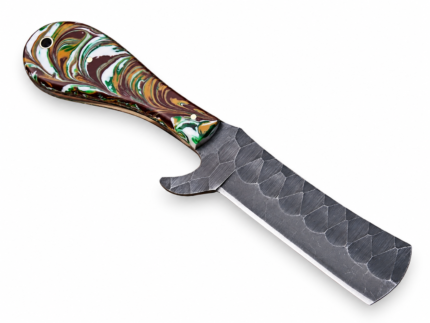

Black Textured Fixed Blade Knife – Olive-Grain Handle Design
Product Overview
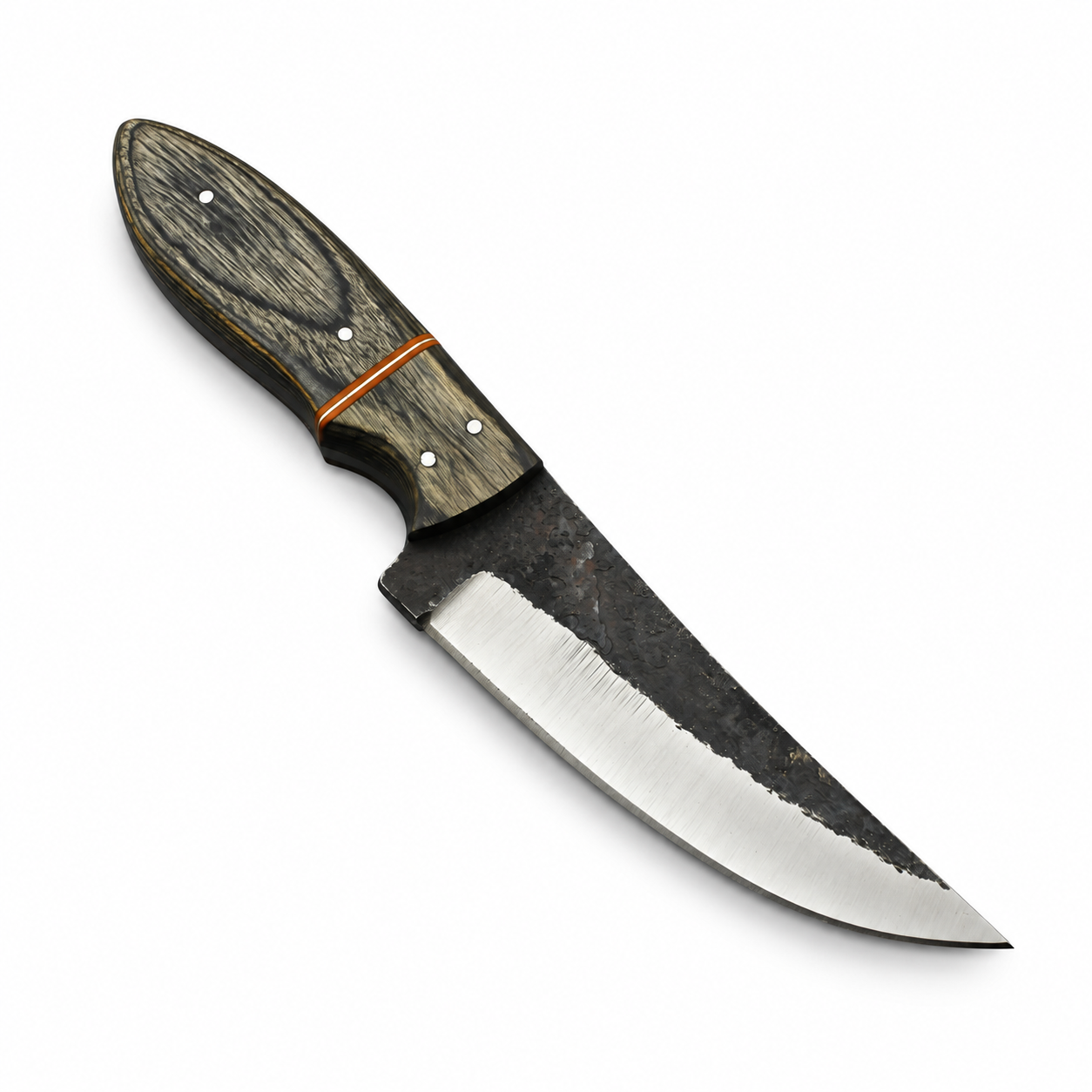
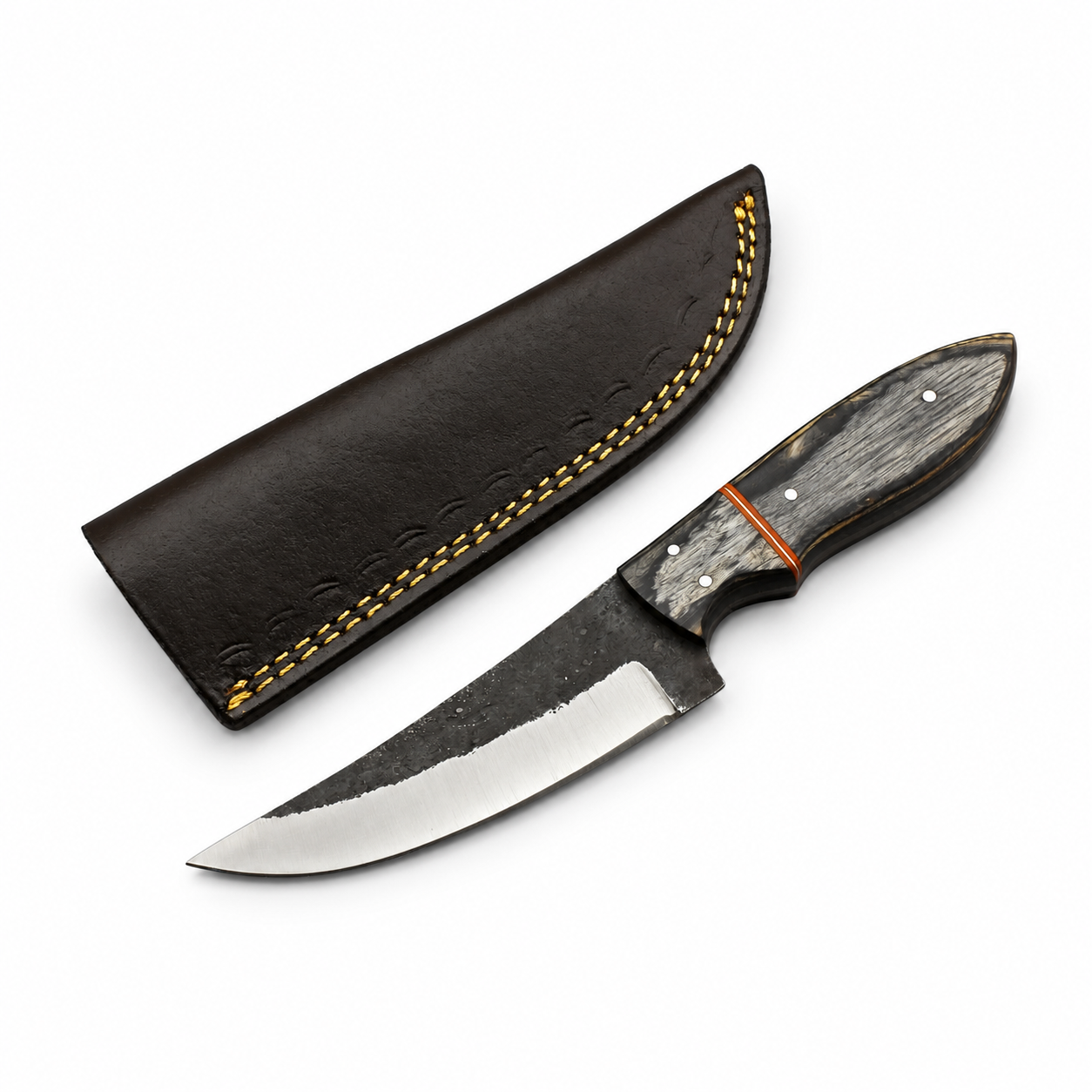
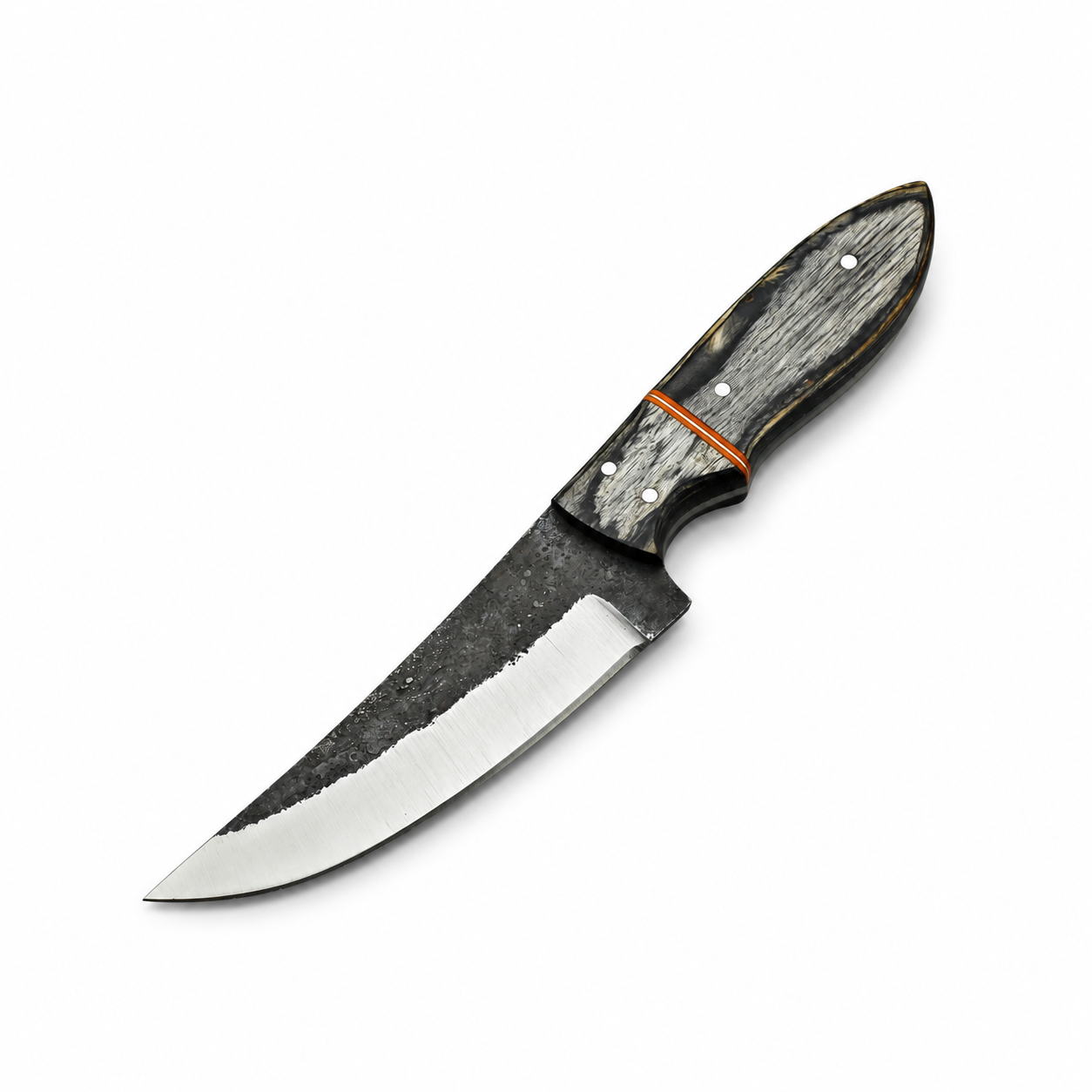
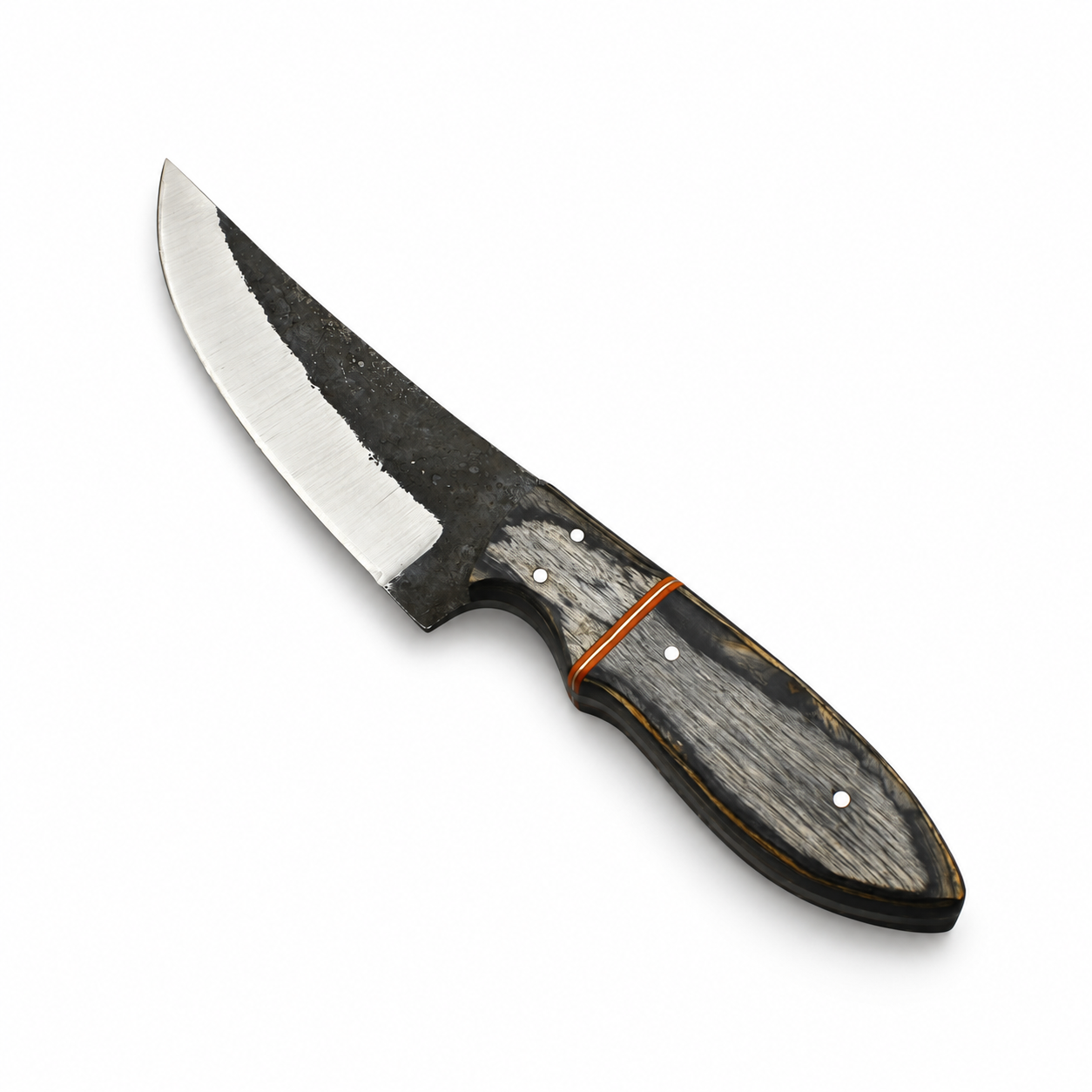
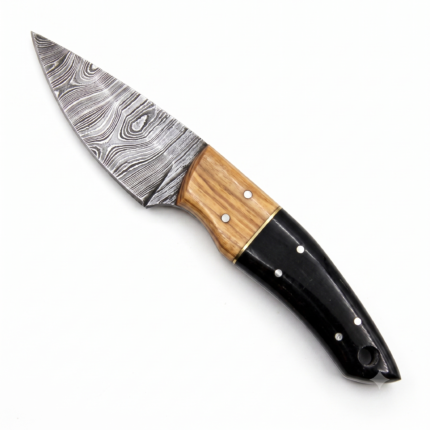
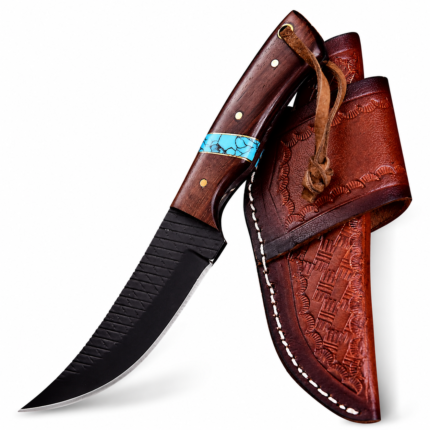
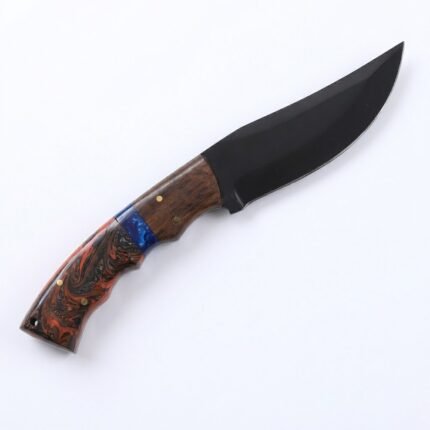
The Black Textured Fixed Blade Knife features a distinctive combination of dark metallic surfaces, a bright silver-colored blade section, and a contrasting olive-and-black wood-grain-style handle.
Its traditional fixed-blade silhouette is complemented by decorative finishing details, including four visible metallic pins and a narrow orange accent near the handle’s central section.
The blade displays two noticeably different surface appearances. The upper portion has a rugged, dark textured finish, while the lower section features a smoother, silver-colored surface. These contrasting areas create a recognizable two-tone design.
The handle introduces additional visual detail through its irregular grain-like markings, dark borders, and gently curved profile.
The photograph presents the knife against a plain white background, making the product’s outline and decorative characteristics easy to distinguish.
Although the image clearly establishes its appearance, the exact steel grade, handle material, dimensions, weight, and manufacturing specifications remain unverified.
1. Distinctive Black Textured Blade
One of the most noticeable features of this Black Textured Fixed Blade Knife is its dark, irregular blade finish.
The upper blade section displays a charcoal-black surface with subtle gray variations.
Small raised-looking markings and uneven patterns give the surface a rugged appearance.
These markings are particularly noticeable around the wider area near the handle.
The dark finish continues along the upper blade, gradually narrowing toward the pointed end.
This creates a strong visual contrast with the smooth silver-colored section below.
The surface resembles traditional forged-style metalwork, but its actual manufacturing process cannot be determined from the image.
The finish may result from different production or decorative techniques.
For an accurate product description, it is best identified as a black textured metallic surface rather than a confirmed hand-forged finish.
2. Contrasting Silver-Colored Blade Section
The lower portion of the blade features a bright silver-colored finish.
This section appears smoother than the textured area above it.
Fine linear markings are visible across parts of the lighter metallic surface.
The polished-looking appearance reflects light differently from the darker upper section.
A visibly irregular boundary separates the two finishes.
The transition follows a slightly uneven line that extends along much of the blade.
This contrast is one of the most recognizable characteristics of the design.
The silver-colored section gradually narrows toward the blade’s pointed end.
Although its appearance suggests a refined metallic finish, the photograph does not establish the precise finishing process, steel composition, or cutting-edge specifications.
3. Traditional Fixed-Blade Silhouette
The Black Textured Fixed Blade Knife follows a recognizable fixed-blade profile.
Its blade extends continuously outward from the handle.
The blade is broader near the handle and gradually becomes narrower toward the tip.
The lower outline features a gentle curve that continues toward the pointed end.
The upper outline follows a different contour, giving the blade a slightly asymmetrical appearance.
The combination of these shapes creates a traditional-looking design.
Unlike a folding knife, the visible blade is not shown attached to a folding mechanism.
The photograph provides a clear view of the overall silhouette.
However, the exact blade length, thickness, edge condition, and internal construction remain unknown.
4. Dark Olive Wood-Grain-Style Handle
The handle is another defining feature of this fixed-blade knife.
It displays a combination of dark olive, muted gold, brown, and nearly black tones.
Irregular grain-like markings extend across the handle surface.
Some areas feature lighter streaks, while others have darker, closely spaced patterns.
This variation creates a natural-looking decorative appearance.
The handle’s overall finish appears relatively smooth, contrasting with the textured metallic blade.
Its darker edges help frame the lighter grain-like sections.
The exact handle material cannot be confirmed from the photograph.
Although the surface resembles wood, it could be manufactured from a natural, stabilized, composite, or synthetic material.
The term wood-grain-style accurately describes its visible appearance without asserting a particular material composition.
5. Decorative Grain Pattern
The Black Textured Fixed Blade Knife features a distinctive handle pattern that changes along its length.
Near the rounded end, the grain-like lines form curved and irregular shapes.
The central portion contains darker streaks mixed with lighter olive-gray sections.
Closer to the blade, the markings become more closely arranged in certain areas.
These variations give different portions of the handle slightly different appearances.
The contrast between lighter and darker lines creates a layered visual effect.
The pattern is particularly noticeable against the plain white photographic background.
Although it resembles natural grain, the manufacturing method used to create these markings has not been established.
This detail should therefore be presented as an appearance-based characteristic rather than a verified material feature.
6. Four Visible Metallic Handle Pins
Four small silver-colored circular pins are visible on the handle.
Two are positioned toward the wider rear section, while two additional pins appear closer to the blade.
Their light metallic appearance creates contrast against the darker handle surface.
The pins are relatively small compared with the overall handle.
This allows them to complement the grain-like pattern without becoming the dominant decorative feature.
Their arrangement also contributes to the traditional styling of the knife.
The photograph establishes their position and appearance.
However, their exact material, dimensions, and internal construction cannot be verified.
They should be described as metallic-looking pins rather than assigned an unconfirmed alloy or construction purpose.
7. Contrasting Orange Spacer Detail
A narrow orange-colored accent is positioned between two handle sections.
This detail is located closer to the upper portion of the grip.
The orange accent is accompanied by a thin light-colored line.
Together, these create a noticeable border across the darker handle.
The warm orange color contrasts with the muted olive, gray, and black grain-like markings.
It also visually separates the handle into two distinct sections.
The accent introduces a small amount of brighter color without changing the product’s overall dark appearance.
Its precise material is unknown.
The photograph does not establish whether this feature is made from a separate spacer material or another decorative construction element.
8. Gently Contoured Handle Shape
The handle follows a gently curved profile.
Its rear section has a broad, rounded shape.
The central section gradually narrows before widening slightly toward the blade.
Near the junction with the blade, an inward curve defines part of the handle’s lower outline.
These changing contours create a recognizable shape.
The handle is not a simple rectangular or cylindrical design.
Its edges have a rounded appearance, while the visible surface displays subtle variations in contour.
The photograph clearly establishes the side profile.
However, it does not provide enough information to confirm the handle’s thickness, exact cross-sectional shape, or ergonomic performance.
Such characteristics would require additional measurements.
9. Rounded Handle End
The rear end of the Black Textured Fixed Blade Knife has a broad, rounded profile.
Its outer contour curves smoothly rather than ending in a straight line.
The wood-grain-style markings continue into this section.
A small silver-colored pin is visible near the upper portion of the rounded end.
The surrounding grain pattern includes lighter streaks that contrast with the dark border.
This combination creates a distinctive handle-end appearance.
The photograph does not show any large opening or separate fitting at the end.
Additional views would be necessary to confirm whether the reverse side contains other decorative or construction details.
10. Blade and Handle Transition
The junction between the blade and handle creates a clear visual separation.
The dark metallic blade begins immediately beyond the contoured handle section.
Its textured appearance contrasts with the relatively smooth wood-grain-style surface.
Near this transition, the blade has a broader profile.
The upper and lower blade outlines extend outward in different directions.
The dark metallic area continues along the upper portion of the blade.
This creates a continuous visual connection between the base and the pointed end.
The image does not establish the internal connection between the blade and handle.
Claims about full-tang construction, hidden hardware, or structural reinforcement would require manufacturer confirmation.
11. Black and Silver Two-Tone Appearance
The knife’s blade features a distinctive two-tone color combination.
The upper section is predominantly charcoal black.
The lower section has a bright silver-colored appearance.
The boundary between these two areas is irregular rather than completely straight.
This creates a noticeable visual transition.
The darker finish appears more textured, while the lighter finish has a comparatively smooth surface.
These differences make the blade’s overall profile easy to distinguish.
The two-tone combination is a central part of the product’s decorative appearance.
Although the surface may resemble traditional blackened metalwork, the exact finishing process remains unknown.
12. Natural-Looking Handle Colors
The handle introduces a separate color palette.
Its dark olive and muted brown tones contrast with the black-and-silver blade.
Lighter grain-like markings create additional variation across the surface.
The orange spacer adds a small warm accent.
Silver-colored pins provide further contrast.
The resulting design combines neutral metallic colors with natural-looking handle tones.
The colors are distributed in a relatively balanced arrangement.
The blade remains visually prominent, while the handle adds detail without introducing large printed graphics or logos.
This combination gives the knife a recognizable appearance.
13. Decorative Metal Surface Details
The black textured region contains irregular surface markings.
Some areas appear darker and relatively flat.
Other areas feature small variations in shading and texture.
The markings are especially noticeable where the dark surface meets the silver-colored portion.
The transition line contains a series of small irregular shapes.
These visual details contribute to the rugged appearance of the blade.
The photograph does not establish whether the markings are raised, recessed, or produced through surface treatment.
Likewise, the texture does not independently confirm a specific forging or finishing technique.
The visible appearance can be described accurately without making those technical assumptions.
14. Product Photography and Presentation
The Black Textured Fixed Blade Knife is photographed diagonally against a plain white background.
The handle extends toward the upper-left portion of the image.
The blade points toward the lower-right.
This arrangement provides a clear view of the handle’s outer shape and the blade’s curved profile.
The white background also helps emphasize the contrasting blade finishes.
The orange spacer and silver-colored handle pins remain visible against the darker grip.
There are no visible brand markings, measurement labels, or retail packaging elements in the photograph.
Only one side of the knife is shown.
The reverse-side appearance cannot therefore be confirmed.
15. Materials and Construction Verification
The product photograph provides useful visual information but does not establish its complete technical specifications.
The blade looks metallic and displays two different finishes.
The handle resembles dark patterned wood or another wood-grain-style material.
Several circular metallic-looking pins are visible.
However, these appearances do not establish exact material composition.
The blade’s steel grade, hardness, manufacturing process, and surface treatment remain unknown.
The handle’s material composition and finish are also unverified.
Different products can have similar visual characteristics while using different materials.
For this reason, the listing avoids unsupported claims about premium steel grades, handmade construction, or specialized performance characteristics.
16. Dimensions and Weight
The uploaded photograph does not contain a measurement scale.
The overall length of the knife is therefore unknown.
The blade length, handle length, thickness, and weight have not been provided.
Although the photograph clearly shows the relative proportions of the blade and handle, these proportions cannot be converted into accurate physical measurements.
Camera angle, image cropping, and photographic scaling can influence perceived dimensions.
Verified measurements should come from manufacturer documentation or direct physical measurement.
Until those details are available, the product listing should avoid introducing exact numerical specifications.
17. Product Specification Overview
Product Type: Fixed Blade Knife
Blade Color: Black and silver
Blade Appearance: Dark textured upper section with bright silver-colored lower section
Blade Profile: Curved outline with pointed end
Handle Appearance: Dark olive-and-black wood-grain-style finish
Handle Shape: Gently curved and contoured
Handle Details: Four visible silver-colored pins
Spacer Appearance: Orange with a narrow light-colored accent
18. Product Identification and Documentation
The Black Textured Fixed Blade Knife is most easily distinguished by its dark textured blade, bright silver-colored lower blade section, and olive-grain-style handle.
The four circular pins and orange spacer provide additional identifying features.
Together, these details create a distinctive appearance.
The photograph does not establish a particular manufacturer, model number, or manufacturing origin.
Additional images showing the reverse side and close-up views of the blade and handle would provide more information.
Manufacturer specifications would also be needed to verify the materials, dimensions, and construction details.
Keeping these distinctions clear helps maintain an accurate product catalog.
19. Care and Storage Information
Specific maintenance requirements depend on the blade’s actual metal composition and the handle materials.
Because these specifications remain unknown, material-specific cleaning treatments and protective coatings should not be recommended without manufacturer guidance.
The knife should be stored securely and kept away from children.
Its exact edge condition and other technical properties should be verified through appropriate product documentation.
Photographs can establish visible features, but they cannot independently confirm performance, safety ratings, or long-term durability.
Accurate technical information should accompany any material-specific claims.
20. Final Product Overview
The Black Textured Fixed Blade Knife combines a dark textured metallic blade, a contrasting silver-colored lower section, and a distinctive olive-and-black grain-style handle.
Its curved blade profile and contoured handle create a recognizable traditional appearance.
Four visible metallic pins and a narrow orange spacer introduce additional decorative detail.
The combination of neutral metallic finishes, natural-looking handle patterns, and small color accents gives the knife a coordinated design.
The product image clearly establishes these visible characteristics.
However, exact dimensions, steel grade, handle composition, manufacturing process, and technical performance remain unverified.
These details provide a factual foundation for cataloging the knife without relying on unsupported material or construction claims.



Reviews
There are no reviews yet.