



Damascus Ring Handle Hunting Knife – A Distinctive Outdoor Knife Design
The Damascus ring handle hunting knife brings together an eye-catching patterned blade, a colorful handle, and a practical fixed-blade layout. Designed with attention to its visual details, this knife stands out from more traditional outdoor cutting tools through its unusual handle shape, decorative blade features, and circular opening at the end of the grip.
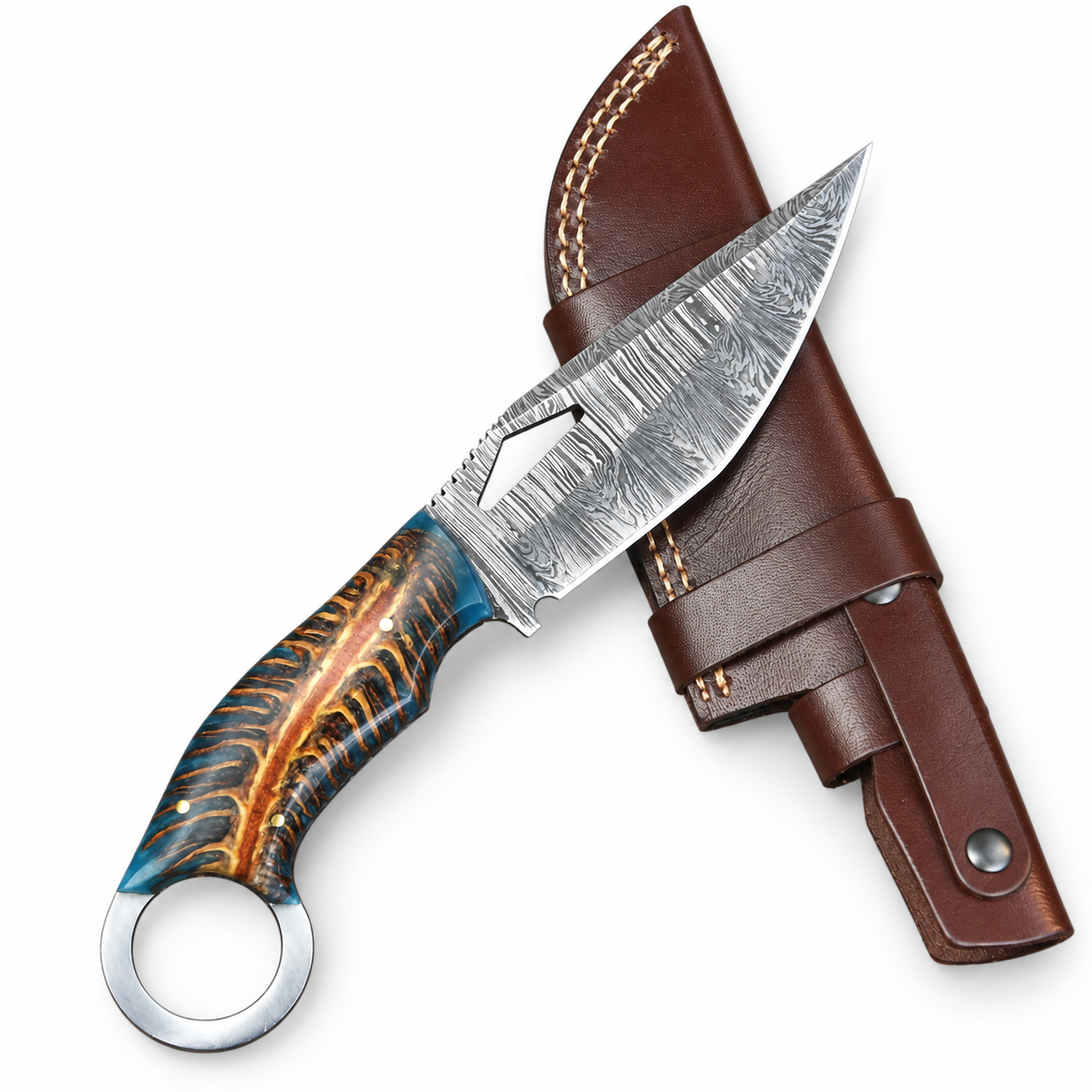
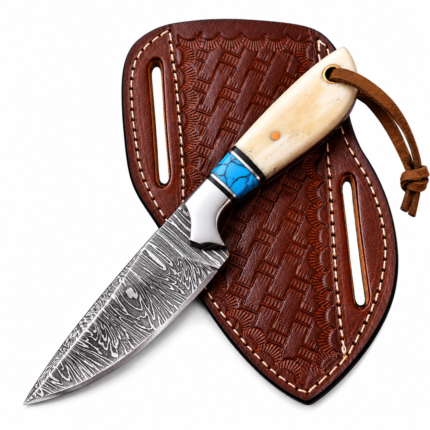
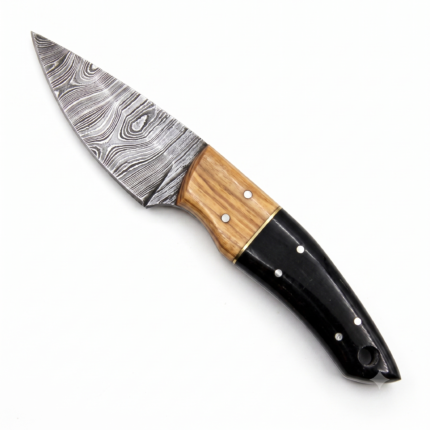
At first glance, the blade’s flowing silver and gray pattern draws attention. The surface shows closely spaced lines and curved formations that give it the recognizable appearance of Damascus-style steel. These markings extend across much of the visible blade, creating a layered visual effect that contrasts with the brighter, smooth cutting edge.
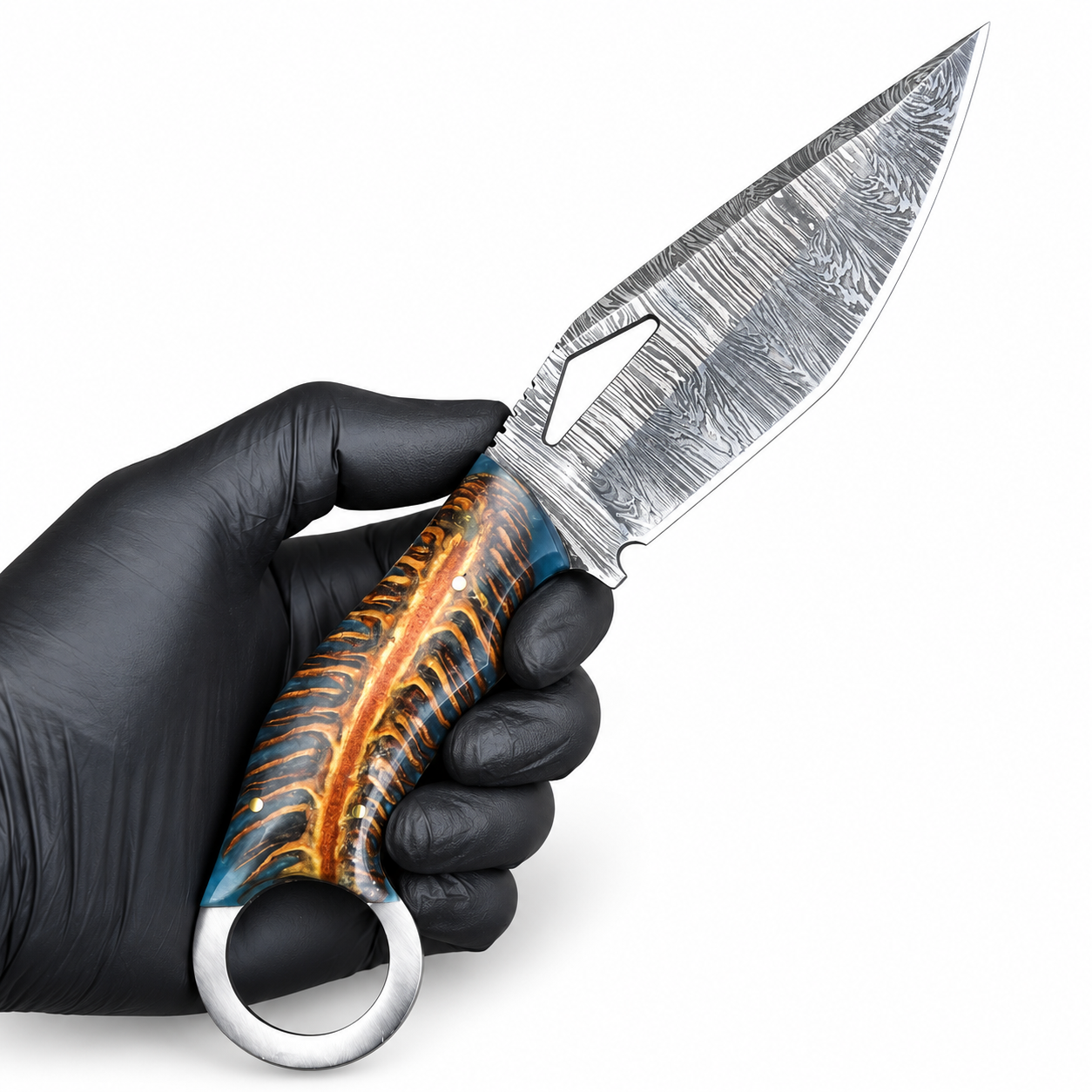
The handle gives the knife an equally distinctive character. Its blue, amber, brown, and dark-toned sections create a marbled appearance, while small light-colored pins add subtle detail. A rounded metal ring forms the end of the handle, completing a design that feels different from an ordinary straight-handled hunting knife.
The photographed product is accompanied by a brown sheath with visible stitching and a retaining strap. Together, these details make the knife an interesting option for outdoor knife collections, gift selections, and buyers who appreciate unusual fixed-blade designs.
Distinctive Damascus-Style Patterned Blade
One of the main attractions of this Damascus ring handle hunting knife is its patterned blade.
The visible surface has an intricate arrangement of flowing lines that resemble layered steel. Some markings run lengthwise, while others curve around irregular shapes near the middle and tip. The combination creates a decorative finish that makes the blade the most recognizable part of the knife.
Unlike a plain polished blade, this patterned surface offers a more traditional and artistic appearance. It suits buyers interested in knives that combine practical shapes with ornamental detailing.
The blade has a pointed tip and a curved cutting edge, giving it a hunting-style profile. Its relatively broad base gradually narrows toward the tip, creating a balanced-looking outline.
A small elongated opening near the upper portion of the blade contributes to its distinctive appearance. Several notches are also visible along the spine close to the handle. These are design details rather than proof of any particular cutting, gripping, or tactical performance.
The photograph does not establish the blade’s steel grade, hardness, edge retention, or corrosion resistance. Buyers seeking specific technical properties should request the manufacturer’s material and testing information before ordering.
An Eye-Catching Blue and Amber Handle
The handle is another important feature of this knife.
Instead of a conventional single-color grip, it has a striking mixture of blue, amber, brown, and dark tones. The pattern appears to have irregular shapes and curved lines that create visual depth.
These colors give the knife a distinctive personality without making the overall design excessively complicated.
The grip also has a gently curved profile. Its shape follows the natural outline of the handle, with slight changes in width that make it visually different from a straight cylindrical design.
Small metallic-looking pins appear along the handle, adding contrast and suggesting multiple visible attachment points.
The surface looks smooth and polished in the photograph. However, the specific handle material cannot be determined reliably from appearance alone. It may resemble a decorative composite or resin-finished material, but its actual construction should be confirmed with the supplier.
For buyers choosing a knife based on aesthetics, the blue and amber handle provides an attractive alternative to standard black, brown, or plain wooden grips.
Circular Ring Handle Design
A particularly noticeable feature of the Damascus ring handle hunting knife is the large circular opening at the end of its handle.
This opening is surrounded by a silver-colored metal ring, creating a distinctive pommel design.
The ring gives the knife an unusual silhouette and may appeal to collectors looking for unconventional handle styles.
It is important to distinguish this knife from a traditional karambit. Although both designs can feature a ring, a conventional karambit typically has a strongly curved, claw-like blade. The knife shown here has a comparatively straight hunting-style blade profile.
For this reason, describing the product as a ring-handle hunting knife is more accurate than presenting it as a conventional karambit.
The ring also provides a recognizable detail for product photography and display.
Buyers should assess the actual handle dimensions and comfort before purchasing, since the photograph alone cannot establish how the handle will fit different hand sizes.
Decorative Spine Notches and Blade Cutout
The blade includes several noticeable design details beyond its Damascus-style pattern.
A series of short notches runs along a section of the spine near the handle. These small cutouts give the upper blade a textured visual appearance.
There is also an elongated opening positioned slightly farther along the blade.
These features distinguish the knife from simpler hunting knife designs that use a completely smooth spine.
They contribute to the product’s decorative character and may be particularly appealing to customers interested in detailed knife construction.
However, their presence does not independently confirm improved control, additional cutting functions, or greater structural strength.
A customer comparing knives should consider these details as visible design characteristics unless the manufacturer provides specifications explaining their intended function.
Fixed-Blade Construction
This knife has a fixed-blade configuration rather than a folding mechanism.
A fixed-blade knife maintains its blade in an extended position and does not require the user to open it before use.
This design is widely associated with outdoor knives, camping tools, and hunting equipment.
The photographed knife has a visible metal transition between the blade and handle. A separate metallic-looking ring forms the handle’s end.
While the overall knife clearly has a fixed-blade layout, its internal tang construction cannot be confirmed from the image.
The photograph does not show whether the blade extends through the entire handle or how the internal components are secured.
Those details are important for evaluating mechanical durability and should be obtained from the manufacturer when required.
For customers exploring different knife styles, a Damascus ring handle hunting knife offers an alternative to folding pocket knives and conventional straight-handled fixed blades.
Brown Stitched Sheath Included in the Product Presentation
The photograph shows a brown sheath positioned beside the knife.
Its surface has a leather-like appearance, while the edges feature visible light-colored stitching.
A retaining strap crosses the sheath and includes a dark metal-looking snap fastener.
The sheath’s shape follows the general outline of the blade, offering a traditional outdoor knife presentation.
Its brown color also complements the warmer shades found in the handle.
A sheath can serve several useful purposes when properly matched to a knife, including covering the cutting edge during storage and reducing accidental contact with the exposed blade.
However, the image alone does not confirm the sheath’s exact material, belt attachment configuration, or retention strength.
The supplier should confirm whether the photographed sheath is included with every order.
Customers should never assume that a sheath will provide complete protection without inspecting its fit and condition.
A Unique Addition to an Outdoor Knife Collection
Knife collectors often look for details that distinguish one design from another.
Some prefer traditional wooden handles and polished blades. Others are interested in layered metal patterns, decorative bolsters, contrasting colors, or unusual handle shapes.
This Damascus ring handle hunting knife combines several of those visual elements.
The blade’s patterned surface gives it a traditional appearance, while the bright handle provides a more contemporary contrast.
The metallic blade, colorful grip, circular pommel, and brown sheath work together to create a distinctive presentation.
This combination makes the knife an interesting choice for a collection focused on modern hunting-style blades, decorative fixed knives, or unusual outdoor equipment.
A display collection can include different blade shapes and handle configurations, allowing enthusiasts to compare their construction and visual characteristics.
This particular knife would stand out because of its curved grip and ring-shaped handle end.
Suitable for Outdoor Knife Enthusiasts
The knife has the appearance and overall configuration of an outdoor hunting-style fixed blade.
It may appeal to camping enthusiasts, hunting knife collectors, and buyers interested in traditionally inspired cutting tools.
Its pointed blade and curved edge are consistent with shapes commonly encountered in outdoor knives.
Actual suitability for demanding cutting tasks depends on factors not visible in the product image, including blade thickness, steel composition, heat treatment, sharpening quality, handle security, and tested durability.
For that reason, it would be inappropriate to promise particular cutting performance without supporting manufacturer specifications.
Customers planning to use the knife outdoors should first verify its dimensions, condition, and intended applications.
The knife should be handled responsibly and used only where permitted by local law.
For collectors, its visual features can be appreciated independently of any unverified technical performance claims.
An Interesting Gift for Knife Collectors
Choosing a gift for someone interested in knives can be difficult when many products look similar.
The Damascus ring handle hunting knife offers a memorable design through its patterned blade and colorful grip.
Its combination of silver-gray blade markings, bright blue handle accents, warm amber tones, and polished metal details creates a recognizable appearance.
The brown sheath adds another traditional element to the product presentation.
This makes the knife worth considering for someone who collects unusual fixed-blade designs or appreciates decorative metalwork.
Before purchasing it as a gift, the buyer should confirm the recipient’s preferences, local knife ownership rules, and the manufacturer’s product specifications.
Collectors who prefer traditional hunting knives may appreciate the fixed-blade profile, while those interested in decorative designs may be drawn to the contrasting handle colors.
The knife can also be displayed as part of an appropriately secured collection.
Understanding the Damascus-Style Finish
The term Damascus is commonly used for blades displaying distinctive layered or flowing patterns.
Modern knives sold under this description can vary significantly in their actual materials and production methods.
Some blades are manufactured from layered steels, while others may have surface patterns produced through different finishing processes.
A photograph cannot reliably establish which manufacturing method was used.
The pictured blade has a clearly visible Damascus-style surface, but that appearance should not be treated as confirmation of a particular number of layers, specific steel combination, or forging process.
These characteristics can affect the manufacturer’s description, product pricing, and customer expectations.
A supplier may provide additional documentation detailing its steel grades and production method.
For buyers interested mainly in the appearance, the patterned surface remains an important part of the design.
For customers prioritizing technical cutting performance, verified steel information is essential.
Handle Color and Material Considerations
The colorful handle is one of the strongest visual selling points of this product.
Blue and amber tones are not particularly common in basic outdoor knife designs, making this combination distinctive.
The darker sections help separate the brighter colors, while the small metallic pins contribute additional contrast.
The handle also appears to include a brown-and-gold patterned area that enhances its decorative quality.
Although it resembles a composite or resin-treated material, a buyer should not assume that it is made from stabilized wood, natural stone, or any specific resin formulation without supplier confirmation.
If the product is manufactured in different color combinations, actual appearance may vary between units.
Buyers should request photographs of the exact available variation when color matching matters.
For online sales, showing the handle from both sides can help customers make a more informed purchasing decision.
Practical Storage Considerations
Proper storage is important for any knife, especially one with a patterned blade and decorative handle.
After handling or permitted use, the blade should be cleaned according to the manufacturer’s instructions.
Moisture, dirt, and residues should not be left on the surface for extended periods.
The knife should be dried carefully before storage.
If the blade contains carbon steel, additional corrosion prevention may be appropriate, but the actual steel composition must be confirmed first.
The sheath should also be checked for moisture and debris.
Long-term storage conditions depend on the sheath material, humidity, and blade finish. If the sheath is genuine leather, prolonged damp storage may require additional precautions.
Avoid exposing the handle to unnecessary heat, harsh chemicals, or extended direct sunlight until its material properties are known.
Store the knife securely and out of children’s reach.
Choosing the Right Knife for Your Needs
A knife should be selected based on more than appearance.
The Damascus ring handle hunting knife has several attractive visible details, but the right choice depends on what the customer intends to do with it.
For decorative collections, the blade pattern and colorful handle may be the main considerations.
For occasional outdoor cutting tasks, the customer should also review blade dimensions, edge geometry, steel composition, and handle comfort.
For frequent or demanding use, verified technical information becomes even more important.
The photograph provides a useful overview of the design, but it does not replace actual product specifications.
Customers should confirm the precise blade length, overall length, weight, thickness, and included accessories before purchasing.
It is also sensible to ask whether replacement sheaths, maintenance instructions, or spare components are available from the supplier.
Why This Knife Stands Out
The strongest appeal of this Damascus ring handle hunting knife comes from the combination of different design elements.
Its blade presents a traditional-looking metal pattern, while the grip incorporates bright contemporary colors.
The elongated blade cutout and spine notches provide additional visual detail.
The circular pommel creates a distinctive ending to the handle.
Finally, the brown stitched sheath completes the outdoor knife presentation.
Together, these characteristics produce a product that looks different from many conventional hunting knives.
The design makes it suitable for customers who enjoy comparing different blade shapes, handle finishes, and decorative details.
Explore a Distinctive Hunting Knife Design
The Damascus ring handle hunting knife offers an appealing combination of decorative blade markings, a vibrant handle, an unusual pommel ring, and a traditional-looking brown sheath.
Whether you are expanding a knife collection or comparing fixed-blade designs for your outdoor equipment, this knife is worth exploring for its distinctive appearance. Review the confirmed specifications and available options to decide whether it suits your needs.




Reviews
There are no reviews yet.