






Wide Blade Damascus Pattern Hunting Knife – Classic Design with Dark Wood Handle
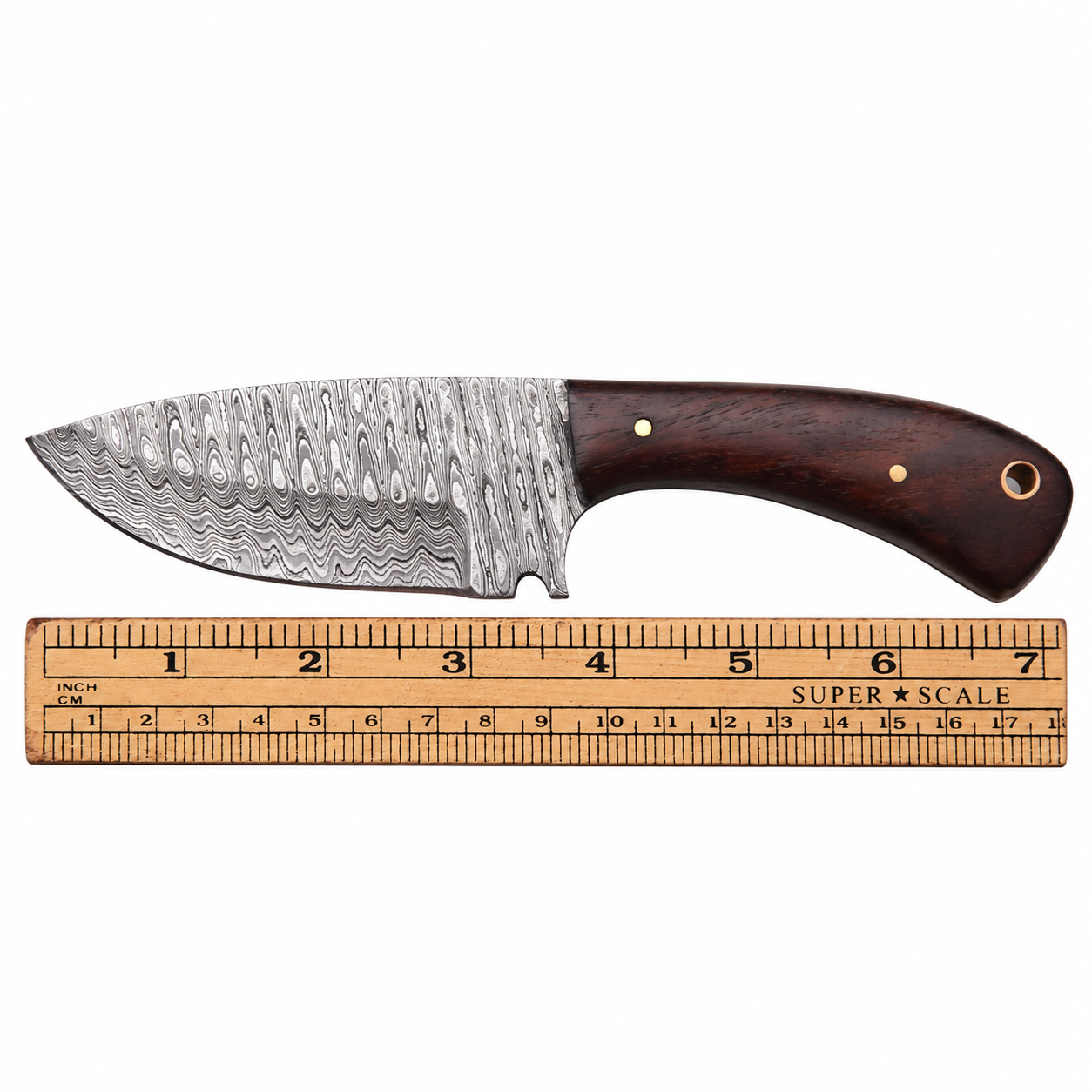
The Wide Blade Damascus Pattern Hunting Knife combines a broad cutting profile, detailed patterned metalwork, and a classic dark wooden handle. Designed in the style of traditional fixed-blade outdoor knives, it offers a distinctive appearance for collectors, outdoor enthusiasts, and people who appreciate decorative cutlery.
Its most noticeable feature is the wide blade with flowing silver and charcoal-colored lines. The pattern includes layered waves, circular formations, and irregular bands that extend across the blade’s visible surface. This gives the knife a striking visual character without the need for additional decorative accessories.
The blade has a broad belly, a pointed tip, and a gently curved cutting edge. Its outline resembles the profiles commonly associated with hunting and skinning knives. The handle extends from the blade in a sweeping curve, with a wider end and a narrower section toward the front.
A rich, reddish-brown wood-grain finish provides a warm contrast to the patterned metal. Gold-tone fittings add small decorative highlights, while a circular opening at the end of the handle gives the knife another recognizable detail.
The combination of these features makes this knife visually suitable for a collection of outdoor knives, fixed-blade designs, and traditional hunting accessories.
Distinctive Damascus-Style Blade Pattern
The blade features an intricate Damascus-style pattern formed by alternating light and dark lines.
Across the visible surface, these lines create repeated waves, flowing curves, and oval formations. The patterns become particularly noticeable near the center of the blade, where they form rounded shapes that resemble overlapping layers.
The blade’s appearance differs from a conventional plain-finished knife. Instead of a smooth, uniform metallic surface, it displays a decorative arrangement of contrasting lines.
This patterned finish gives the knife an individual visual identity and complements the natural-looking wooden handle.
The silver sections reflect the surrounding light, while the darker areas emphasize the detailed pattern. Together, they create a finish that draws attention to the knife’s broad profile.
Patterned blades are popular among collectors who appreciate traditional metalworking aesthetics. They are also frequently found in decorative hunting knives and custom-style cutlery.
The uploaded photograph clearly shows the pattern, but it does not confirm the underlying steel construction.
A Damascus-style appearance may result from different manufacturing processes. The blade should only be described as genuine forge-welded Damascus steel once that specification has been verified by the manufacturer.
Until then, the term Damascus pattern accurately communicates the visible appearance without claiming a particular manufacturing method.
Broad Blade with Curved Cutting Edge
One of the defining characteristics of this knife is its broad blade geometry.
The blade gradually widens from the handle before forming a sweeping cutting edge that curves toward the pointed tip.
This profile is visually similar to blade shapes found on certain outdoor and skinning knives.
The broad surface provides substantial room for the patterned finish, allowing the intricate lines to remain visible throughout the blade.
The cutting edge appears smoother and more polished than the adjacent patterned sections.
This distinction highlights the outline of the blade and creates a recognizable contrast between its cutting profile and decorative surface.
A curved blade belly is a common feature in knives designed for controlled slicing applications. However, actual cutting performance depends on material composition, blade thickness, edge geometry, sharpness, and the intended use specified by the manufacturer.
The photograph does not provide sufficient information to confirm those technical properties.
The point is comparatively narrow in relation to the broad central portion of the blade, giving the knife a balanced combination of visual width and a defined tip.
Customers looking for a hunting-style blade with an eye-catching outline may find this design particularly appealing.
Classic Dark Wooden Handle
The handle is another prominent feature of this knife.
It displays a dark reddish-brown finish with visible natural-looking grain and subtle darker markings.
The grain runs along the length of the handle and creates an attractive contrast against the silver-and-black blade.
Its curved shape follows the overall appearance of the knife and becomes wider toward the rear.
This gives the handle a classic outdoor cutlery appearance rather than the straight profile found on some utility knives.
The handle also features two small gold-tone circular pins positioned along its visible surface.
These fittings contribute to its decorative construction and complement the warm brown tones.
The exact species of wood cannot be determined from the photograph. The image also does not establish whether the handle is solid wood, stabilized wood, laminated wood, or another wood-look material.
For customers who appreciate traditional-looking knife handles, the brown grain provides a timeless appearance.
The surface looks relatively smooth, while the slight curvature adds visual character to the design.
The handle’s actual grip properties and suitability for prolonged use would require physical inspection or confirmed manufacturer specifications.
Gold-Tone Lanyard Hole
At the rear of the handle is a circular opening with a gold-colored metal border.
This resembles a lanyard hole commonly used in outdoor knife handles.
Lanyard holes may accommodate a compatible cord or carrying loop, depending on their dimensions and construction.
In this design, the opening also acts as a decorative element.
Its gold-colored border coordinates with the two smaller fittings along the handle.
The circular detail is positioned near the rounded end of the handle, where it remains clearly visible.
The opening’s internal diameter and compatibility with particular cords are not confirmed.
Customers planning to attach a lanyard should check the actual dimensions and use a suitable accessory.
No lanyard is visible in the uploaded image, so one should not be advertised as included.
Integrated Finger Guard Design
The front section of the knife features a small projection where the blade meets the handle.
This detail resembles an integrated finger guard.
The projection creates a visible separation between the cutting portion and the handle.
Finger guards are commonly incorporated into fixed-blade knife designs to help define the gripping area.
On this model, the guard is relatively compact and follows the natural lines of the blade.
Rather than introducing a large separate crossguard, the design uses a subtle projection that complements the knife’s broad cutting profile.
This contributes to the clean appearance of the overall product.
The guard appears to be part of the metal blade section, but the image does not establish the internal construction or connection method.
Its effectiveness and suitability for any particular grip or task cannot be confirmed without examining the actual product.
The knife should always be handled according to appropriate cutting-tool safety practices.
Fixed-Blade Hunting Knife Profile
The product has the external appearance of a fixed-blade knife.
Fixed-blade designs are characterized by blades that do not fold into the handle.
This knife has no visible pivot, hinge, or folding mechanism.
Its continuous blade-and-handle profile places it within the general fixed-blade hunting knife category.
Fixed-blade knives are available in a wide variety of materials, sizes, and cutting configurations.
Some are intended for outdoor utility applications, while others emphasize decorative appearance or collectible value.
This model combines a hunting-style blade shape with detailed surface patterning and a traditional-looking handle.
The internal tang construction is not visible, so it would be inaccurate to describe the knife as full-tang without additional confirmation.
Likewise, its strength, impact resistance, and suitability for demanding field tasks cannot be established from the photograph.
Customers should review the manufacturer’s specifications before selecting a knife for a particular application.
Traditional Appearance with Decorative Metalwork
The visual appeal of this knife comes from its combination of contrasting materials and shapes.
The blade features flowing silver and dark gray patterns, while the handle has a warm brown finish.
The gold-tone fittings introduce a subtle decorative contrast.
These elements work together to create a design inspired by traditional outdoor cutlery.
The patterned blade is particularly noticeable against the darker handle.
Its layered appearance gives the knife a recognizable character without adding excessive ornamentation.
The handle’s wood-grain surface balances the intricate blade pattern, resulting in a design that feels visually cohesive.
For knife collectors, the combination of blade shape and surface decoration may be more interesting than a conventional plain-finished model.
The curved handle and broad blade also create a distinctive silhouette when displayed.
This makes the knife relevant to customers who value the appearance of specialized cutlery as much as its intended function.
Suitable for Outdoor Knife Enthusiasts
The Wide Blade Damascus Pattern Hunting Knife is relevant to people interested in traditional hunting knives, specialty outdoor tools, and collectible fixed-blade designs.
Its blade shape resembles those commonly associated with skinning and general outdoor cutting applications.
However, the manufacturer’s intended use and performance specifications should be confirmed before practical use.
The knife’s decorative finish may be especially appealing to enthusiasts who appreciate patterned metal blades.
Its broad cutting profile also provides a different appearance from narrow utility knife designs.
Customers building a collection of fixed-blade hunting knives may find this model a suitable visual addition.
It can be compared with other outdoor knife styles based on its broad blade, pointed tip, curved handle, and distinctive steel pattern.
For buyers primarily interested in practical use, blade quality and material specifications are important considerations.
The decorative pattern alone does not determine edge retention, corrosion resistance, or overall durability.
These characteristics depend on the actual steel composition and manufacturing process.
An Interesting Choice for Collectors
Collectors often look for knives with distinctive blade patterns, handle materials, and recognizable shapes.
This model incorporates several details that may appeal to those interests.
The patterned blade uses prominent wave-like lines, while the handle provides a contrasting wood-grain appearance.
Its compact-looking finger guard and gold-tone lanyard opening add further visual interest.
The relatively clean construction avoids excessive accessories, keeping attention on the blade and handle.
This design may also appeal to customers searching for a display knife inspired by classic outdoor cutlery.
The image shows only the knife itself.
It does not confirm whether a protective sheath, display stand, presentation box, or additional accessories are supplied.
Any included accessories should be listed separately after verification.
The photograph also does not show both sides of the handle or blade, so the exact appearance of the reverse side remains unconfirmed.
For collectors, accurate descriptions and additional product photographs can make it easier to evaluate the knife before purchase.
Handle and Blade Care
Proper care can help preserve the appearance of a patterned blade and wood-grain handle.
The appropriate maintenance routine depends on the knife’s verified materials.
After suitable use, the blade should be cleaned and thoroughly dried according to the manufacturer’s recommendations.
Leaving moisture on certain steel surfaces can contribute to staining or corrosion.
If the knife contains carbon steel, the manufacturer may recommend a suitable protective oil for storage.
However, the exact steel type has not been confirmed for this model.
The handle should be protected from prolonged exposure to water and excessive heat, particularly if it is made from natural wood.
Harsh cleaning chemicals and abrasive materials may also affect some decorative finishes.
Avoid attempting to polish the patterned blade aggressively without knowing how its surface was produced.
Abrasive treatment could change the appearance of certain blade finishes.
Store the knife in a secure location where the cutting edge is protected.
A compatible sheath or protective case may be appropriate, but none is shown in the supplied image.
The knife should also be kept away from children and handled with suitable care.
Important Details to Check Before Buying
When choosing a fixed-blade hunting knife, customers should consider its specifications as well as its outward design.
Blade length and overall length are particularly important.
These measurements help determine whether the knife is appropriate for a customer’s intended purpose.
Blade thickness, weight, and balance can also influence handling.
The steel composition affects factors such as hardness, corrosion resistance, and sharpening requirements.
Because these specifications are not visible in the image, they should be obtained from the manufacturer rather than estimated.
The handle material should also be confirmed, especially for buyers who prefer particular wood species or finishes.
Other relevant details include tang construction, blade grind, country of manufacture, and included accessories.
Customers seeking a knife for practical outdoor applications should evaluate these verified details before making a purchasing decision.
Customers interested primarily in decorative or collectible value may place greater importance on the blade’s pattern and overall appearance.
A Distinctive Addition to an Outdoor Knife Collection
The Wide Blade Damascus Pattern Hunting Knife combines a flowing patterned blade with a traditional dark wood-grain handle.
Its broad cutting edge, pointed tip, compact finger guard, and gold-tone fittings create an attractive fixed-blade profile.
The visible design brings together classic outdoor cutlery styling and detailed decorative metalwork.
For collectors and outdoor knife enthusiasts who prefer patterned blades and wood-grain handles, this model offers a distinctive alternative to more conventional knife designs.
Explore the product’s appearance and confirm its specifications to determine whether it is the right addition to your collection.





Reviews
There are no reviews yet.