






Black Grooved Handle Knife with a Distinctive Patterned Blade
This black grooved handle knife brings together a broad, curved blade, a dark textured handle and a small decorative accent. Its appearance is defined by contrast: flowing silver-grey lines cover the blade, while irregular grooves break up the black handle surface. Two gold-tone pins and a circular red-and-gold mosaic-style detail add colour without overwhelming the otherwise dark design.
The knife has a fixed-blade configuration and a profile associated with hunting and skinner-style knives. Its curved cutting edge rises toward a pointed tip, creating a recognisable outline. For customers drawn to patterned blades and understated handle colours, the design offers both an immediately distinctive silhouette and smaller details that become apparent on closer inspection.
The description below reflects the visible product. Exact materials, dimensions and performance specifications require confirmation, so the patterned appearance is described as Damascus-style rather than verified Damascus steel.
A Broad Blade with a Sweeping Outline
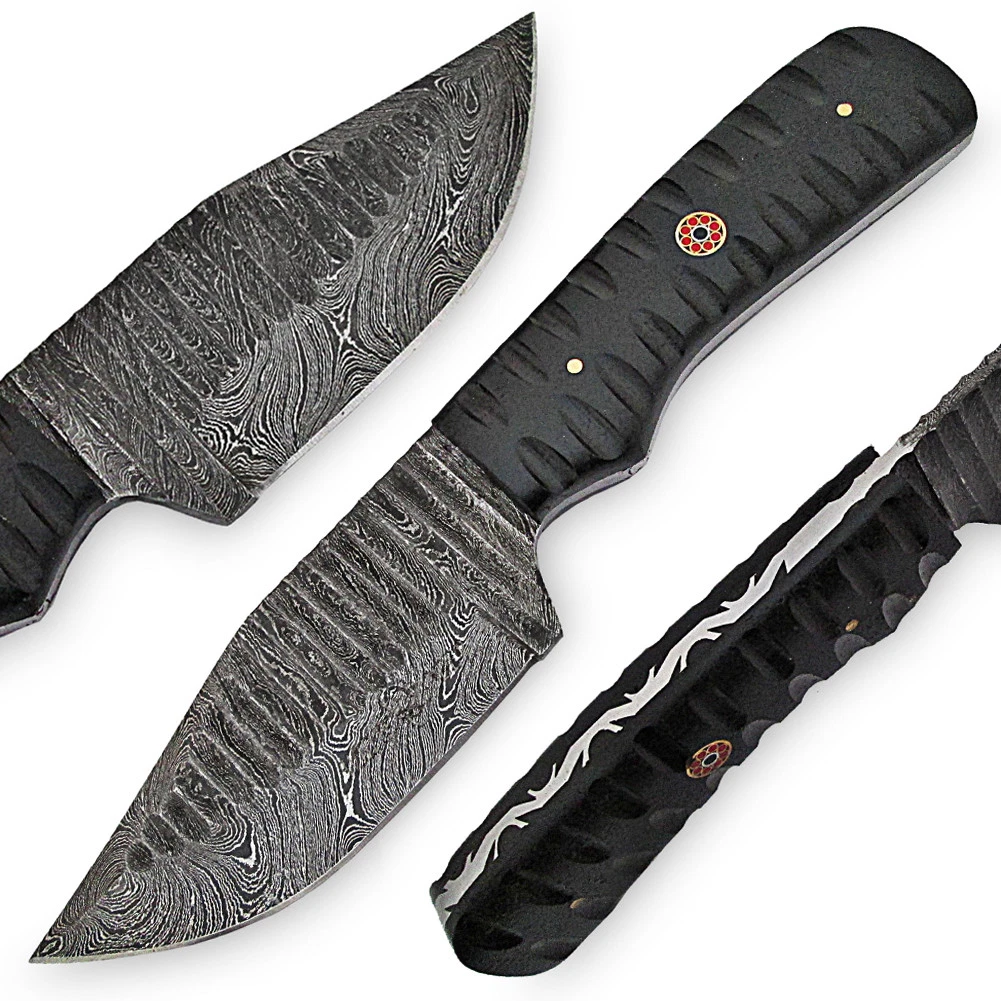
The blade is noticeably broader than the handle near their junction. From this wider section, the lower edge follows a continuous curve toward the tip. The resulting shape gives the knife a substantial visual presence without the rectangular outline of a cleaver or the long, narrow proportions of a fillet knife.
Its broad face also provides space for the surface pattern to remain clearly visible. The lighter lines can be followed across several areas of the blade rather than appearing only as a narrow decorative strip.
Customers comparing blade shapes may appreciate this combination of width and curvature. However, the profile alone does not establish cutting performance. Blade thickness, edge geometry, steel composition and heat treatment would all help determine how the knife performs in a particular task.
Flowing Damascus-Style Surface Detail
The blade displays an intricate arrangement of light and dark lines. Some travel in narrow, closely spaced bands, while others curve around wider shapes. Together, they create a layered, flowing appearance across the dark grey blade face.
This is one of the product’s strongest visual features. The pattern introduces movement and detail to an otherwise simple fixed-blade form, giving customers something to examine beyond colour and overall shape. It also creates a clear contrast with the handle’s deeper, more widely spaced grooves.
The term Damascus-style refers specifically to this visible appearance. A photograph cannot confirm the steel’s manufacturing process, alloy composition or number of layers. Those details should come from the product’s own specifications rather than from another knife that happens to display a similar pattern.
A Curved Plain Edge
The visible cutting edge is plain rather than serrated. It follows a broad curve along the lower blade before meeting the point. There is no visible gut hook, saw section or separate secondary cutting feature.
This gives the knife a relatively uncluttered blade outline. Customers who prefer the appearance of a continuous edge may find that it complements the flowing surface pattern, since neither teeth nor additional cut-outs interrupt the lower profile.
Plain-edge knives are commonly considered for controlled cutting and slicing tasks, but suitability depends on the individual knife’s construction and sharpening. The image does not establish whether this product arrives sharpened to a particular standard. Anyone choosing it for regular use should review the confirmed edge specification alongside the photograph.
A Pointed Tip within a Broad Profile
The blade tapers to a defined point while retaining considerable width through much of its length. This combination distinguishes it from knives with a very narrow blade throughout, as well as designs with a rounded or squared-off end.
Visually, the point completes the sweeping curve of the lower edge. It gives the knife a clear direction and keeps the broad blade from appearing block-like. The patterned lines continue close to the tip, so the decorative finish remains part of the overall outline.
Tip strength and precision cannot be determined from the side view alone. Those characteristics depend partly on thickness and geometry that are not fully shown. The photograph is most useful for assessing the shape, proportions and finish that attract the buyer to this particular design.
A Black Handle with Irregular Grooves
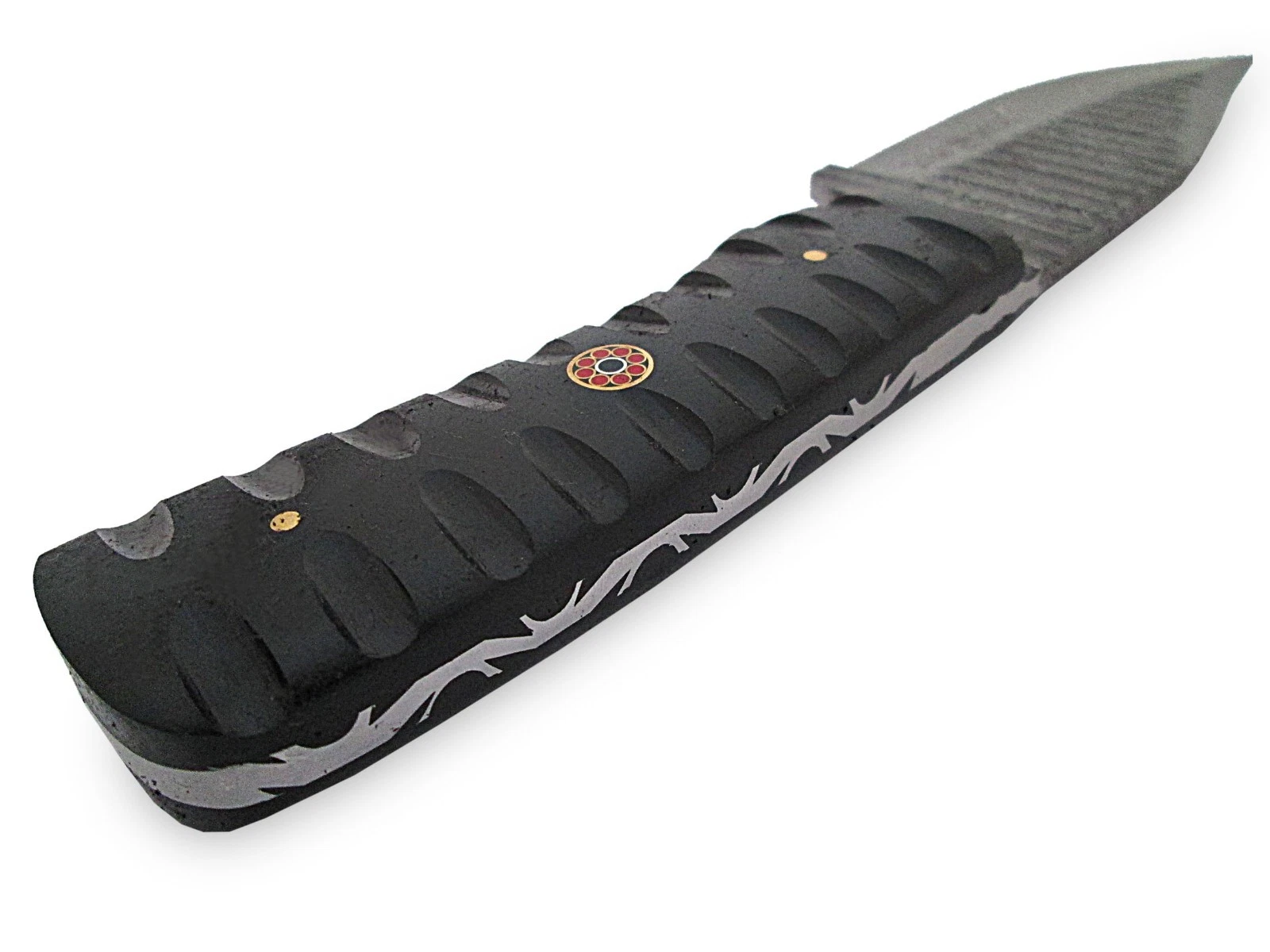
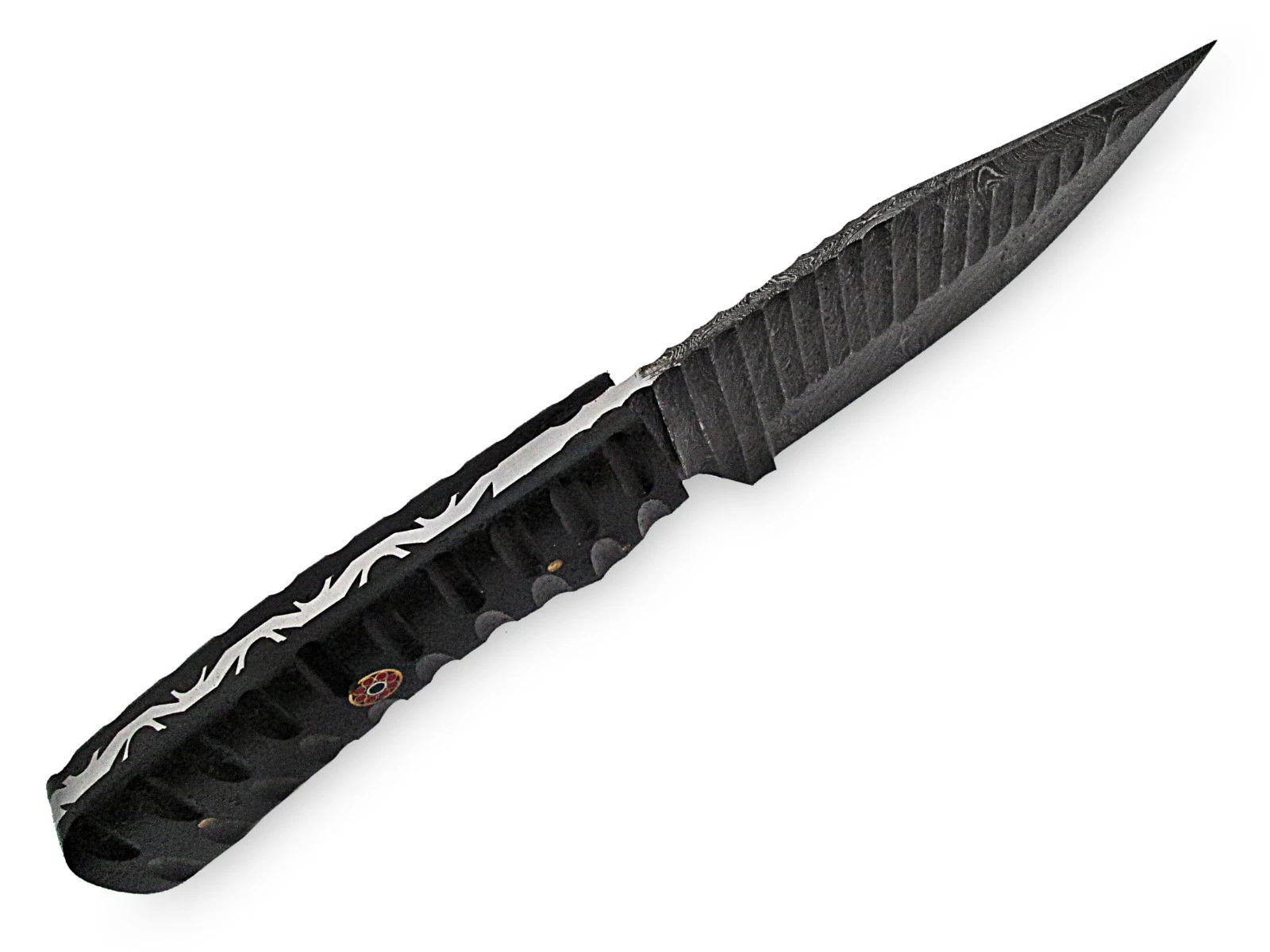
The handle features a series of grooves that run across its visible face at varying angles. They create alternating raised and recessed areas, giving the surface more definition than a smooth, uninterrupted black handle.
Because the grooves are irregular rather than perfectly uniform, they contribute to the knife’s individual visual character. Some appear shorter and narrower, while others extend farther across the handle. Light catches the raised sections differently, making the texture noticeable even within the dark colour.
The image confirms the presence of this surface texture, but it does not establish a tested non-slip rating. Actual grip depends on the handle material, finish, dimensions and conditions of use. The texture should therefore be understood as a visible design feature rather than a guarantee of handling performance.
Shaped Handle Proportions
The handle has a rounded rear end and a shaped lower outline. It narrows through part of its length before widening toward the blade junction. This creates a more contoured appearance than a straight-sided slab handle.
The shaping also gives the grooved surface a changing outline to follow. Rather than appearing as a separate decorative panel, the texture extends across the main visible handle section and works with its overall form.
For a buyer, the important distinction is between visible shape and confirmed fit. A handle may look comfortable yet feel different depending on its thickness and the size of the user’s hand. Measurements and, where possible, handling experience are more informative than the photograph alone when comfort is a primary purchasing consideration.
A Decorative Mosaic-Style Centre Pin
A circular ornament sits between the smaller handle pins. It has a gold-tone outer boundary and a red, gold-tone and dark centre arrangement that resembles a small floral mosaic.
This detail adds a focused touch of colour to the black handle. Because it occupies only a small area, it does not compete with the blade pattern or the deeper grooves. Instead, it gives the eye a point of interest within the handle’s otherwise restrained palette.
The ornament may appeal to customers who enjoy small decorative touches rather than large logos or bright handle panels. Its appearance can be described clearly from the photograph, but the exact materials and construction of the insert are not confirmed. It should not be advertised as a particular metal or stone without supporting information.
Gold-Tone Accents and a Visible Metallic Border
Two smaller gold-tone pins are visible along the handle, positioned on either side of the central decorative insert. Their simple circular shapes contrast with the more intricate mosaic-style detail.
A thin silver-grey metallic border is also visible along part of the handle’s lower edge. This separates the dark handle from the white background and helps define its shape. Together, the border and pins introduce lighter accents without changing the predominantly black-and-grey appearance.
The image does not fully establish the internal tang construction. Although the metallic edge is visible, a confirmed construction specification is needed before describing the knife as full tang. Likewise, the gold-tone colour should not be treated as proof that the pins are brass.
A Fixed-Blade Configuration
The knife is shown with a continuous fixed-blade layout, without a folding pivot or opening mechanism. The blade remains extended from the handle, giving the product a straightforward overall form.
For customers comparing knife types, this distinguishes it from a pocket folder. Storage requirements, carrying arrangements and overall dimensions will differ from those of a knife that closes into its handle. The photograph shows the knife itself, with no separate storage accessory alongside it.
A fixed-blade configuration does not automatically establish heavy-duty capability. Construction quality, materials and dimensions remain relevant. Buyers should choose the product according to its confirmed specifications and intended use, rather than assume that every fixed blade is suitable for the same workload.
A Hunting and Skinner-Style Appearance
The broad belly and curved edge give this knife an appearance associated with hunting and skinner-style designs. That makes it relevant to customers browsing this category, especially those who prefer a patterned blade over a plain finish.
Here, “skinner-style” identifies the visible form rather than a verified performance claim. The photograph does not demonstrate field use, edge retention or suitability for processing game. Those aspects require information about the actual product and its intended application.
For someone comparing designs, the useful starting point is the combination of a broad cutting profile and a relatively compact-looking handle-to-blade arrangement. Actual size remains unknown, so the proportions should not be mistaken for proof that the knife is small, lightweight or easy to carry.
Choosing It for a Knife Collection
Collectors often look for a combination of overall shape and distinctive details. This knife offers both: a broad patterned blade creates the main impression, while the handle grooves and circular ornament provide smaller features to inspect.
Its restrained colours may suit a collection centred on dark handles, patterned steel appearances or traditional fixed-blade forms. The red accent adds some individuality while remaining less prominent than a brightly coloured handle.
The visible design can be appreciated without attaching unsupported claims about rarity, origin or craftsmanship. No production quantity or manufacturing method is confirmed. Customers considering it as a collection piece can assess how its appearance complements their existing knives while checking any provenance or material details that matter to their purchase.
An Option for Adult Knife Enthusiasts
For an adult enthusiast who enjoys examining different blade profiles and handle finishes, this design offers several points of interest. The blade’s flowing lines and the handle’s deeper grooves create two distinct types of pattern within one product.
The smaller gold-tone details help connect the handle sections visually. They also make the knife more than a simple black-handled design without requiring extensive decoration across every surface.
Individual preferences will influence its appeal. Someone who favours minimalist, smooth handles may prefer a plainer option, while a customer attracted to textured surfaces and decorative pins may find this design more suitable. The product photograph makes those aesthetic differences clear, helping buyers choose according to their own taste.
Considering the Knife as a Gift
The combination of a patterned blade and a decorative handle insert may make this knife worth considering as a gift for an adult collector or knife enthusiast. Its appeal rests on the visible design rather than on a personalised name or a branded presentation.
Before selecting it as a gift, consider the recipient’s preferences. Blade shape, handle colour and decorative details can matter as much as the overall category. A customer who appreciates darker finishes may respond differently from someone who prefers polished metal or colourful handles.
Gift packaging, engraving and a sheath are not established by the supplied image. These should be confirmed through the selected product option. Doing so helps ensure that the final presentation matches what the buyer expects to receive.
Assessing It for Practical Cutting Tasks
If the knife is being considered for use rather than collection, the next step is to review its functional specifications. The blade profile is visible, but a side photograph cannot show every detail that affects cutting behaviour.
Relevant information includes blade length, thickness, edge angle, material and the maker’s intended applications. The handle’s width and thickness are also important because they influence how the knife fits the hand.
A visually substantial blade should not be assumed to handle chopping, prying or other demanding work. Likewise, a patterned finish does not establish corrosion resistance or edge retention. A practical purchase is best based on the confirmed capabilities of this exact model, with its appearance serving as one part of the decision.
Dimensions and Handling Preferences
The image does not provide a ruler, dimension labels or another dependable scale reference. As a result, overall length, blade length and handle length cannot be measured accurately from the photograph.
Those measurements are useful when comparing this knife with another model. A difference in handle length can affect fit, while blade length and width can change how suitable a knife feels for a particular task. Weight also contributes to handling and cannot be inferred reliably from a substantial-looking profile.
For customers who already own a knife they find comfortable, comparing confirmed dimensions can be more useful than comparing photographs alone. This approach helps translate a visual preference into a purchase that also suits the intended handling requirements.
Handle Material and Blade Specification
The black handle cannot be identified confidently as wood, horn, resin, rubber or a composite from the image. Its colour and grooves are visible, but several materials can share a similar appearance.
The same limitation applies to the blade. The flowing pattern is clear, yet the photograph does not confirm a steel grade, layer count, hardness rating or manufacturing process. Terms such as handmade, hand-forged and stainless require separate verification.
These distinctions matter because materials influence maintenance, feel and performance. A buyer interested mainly in the design may focus first on the photograph, while someone selecting for regular use will need the specification as well. Neither should have to rely on assumptions drawn from another supplier’s similar-looking product.
Accessories and Storage Compatibility
Only the knife is shown in the supplied image. No sheath, storage box, belt attachment, sharpening accessory or presentation stand is visible.
If a sheath is available, its compatibility should be confirmed for this exact blade profile and overall size. A broad, curved blade may require a different fit from a narrow straight blade, even when two knives have a similar overall length.
Package contents should therefore be checked independently of the product’s category. A knife advertised elsewhere with a sheath does not establish that this listing includes one. Confirming the supplied accessories also helps buyers compare prices fairly, since a complete package and a knife-only offer are different purchasing options.
Care Information for the Actual Materials
Care instructions should match the confirmed steel, handle material and finish. Those details are not yet established for this product, so a material-specific cleaning or maintenance routine cannot be supplied accurately.
The seller’s guidance should explain suitable cleaning methods, drying requirements, storage conditions and any recommended maintenance products. This is particularly relevant when a decorative blade finish or textured handle forms part of the product’s appeal.
Sharpening guidance should also relate to the actual edge geometry. The blade’s pattern does not indicate the correct sharpening angle or method. Customers planning regular use should obtain the care information for this model rather than apply instructions intended for a different knife with a similar appearance.
Bringing the Design Together
The overall character of this knife comes from the relationship between its features. The broad blade provides a large surface for the flowing pattern, the black handle keeps the colour scheme restrained, and the grooves add definition without introducing another bright colour.
The decorative insert and smaller pins provide a final point of contrast. They draw attention to the handle while leaving the blade as the main visual feature. This balance may appeal to buyers who want a patterned fixed-blade knife with a dark handle and a modest ornamental detail.
Explore the product image and confirmed specifications to decide whether this black grooved handle knife suits your collection, gift plans or intended use. Its combination of shape, texture and pattern gives you a clear starting point for choosing a design that fits your preferences.





Reviews
There are no reviews yet.