






Green Pinecone Handle Damascus-Pattern Hunting Knife – A Distinctive Outdoor Design
The Green Pinecone Handle Damascus-Pattern Hunting Knife brings together an eye-catching blade finish and an unusual handle design. With its silver-gray patterned blade, copper-toned decorative details, and rich green handle, this knife offers a striking appearance for collectors and outdoor knife enthusiasts.
Unlike simple fixed-blade knives with plain handles and polished blades, this design places considerable emphasis on its visual details. The combination of organic-looking handle inclusions and flowing blade patterns gives the knife a distinctive character.
Whether you are exploring additions to a knife collection, looking for a display piece, or comparing fixed-blade designs for outdoor equipment, this model has several features worth considering.
Distinctive Damascus-Style Blade Pattern
One of the most noticeable elements of this knife is its patterned blade.
The blade features intricate silver-gray lines that follow the surface in irregular, flowing formations. These decorative markings resemble the layered patterns commonly associated with Damascus steel knives.
Alongside the gray and silver areas, copper-colored sections create an additional contrast. These warm-toned accents follow parts of the blade’s surface, giving it a distinctive look.
The blade has a broad profile that gradually narrows toward a pointed tip. Its cutting edge appears to have a gently curved shape, while the spine runs toward the tip with a more angular profile.
This configuration is typical of many hunting-style fixed blades, although the exact cutting performance depends on specifications that cannot be assessed through photographs alone.
The pattern’s appearance is clearly visible; however, the steel grade, layering process, hardness, and edge-retention properties require manufacturer confirmation.
Green Handle with Pinecone-Inspired Detailing
The handle is arguably the most distinctive part of this knife.
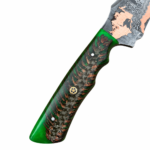
It features a deep green finish with dark brown, textured inclusions that resemble the structure of a pinecone. These details run along much of the handle and create a natural-looking contrast against the surrounding green material.
The design gives the handle an unusual appearance compared with traditional plain wood, black synthetic, or polished horn-style knife handles.
The dark inclusions form organic-looking patterns, while the surrounding green sections have a translucent or resin-like appearance.
Although the design resembles a stabilized pinecone-and-resin handle, the exact materials have not been independently verified. Buyers interested in particular handle compositions should confirm the specifications before ordering.
The handle also includes small circular metal-colored fasteners and a decorative mosaic-style pin.
These details contribute to the finished appearance and help distinguish it from simpler handle designs.
Contoured Handle Shape
The knife has a shaped handle rather than a straight cylindrical grip.
Its profile includes gentle curves and an extended rear section. A recessed area near the blade creates a noticeable transition between the handle and cutting portion.
This design gives the knife a recognizable hunting-style appearance.
Contoured handles are commonly chosen because their shape can follow the natural position of the hand. However, actual comfort, grip security, and suitability for prolonged use depend on the user’s hand size, the handle dimensions, surface finish, and overall balance.
For this reason, grip performance should not be assumed from appearance alone.
Decorative Copper-Toned Blade Accents
A particularly noticeable feature is the copper-colored detailing incorporated into the blade’s patterned appearance.
These accents are visible across several sections, including near the upper portion and along the blade’s face.
The warmer metallic tone contrasts with the darker gray and silver pattern, creating a layered visual effect.
For collectors who appreciate unusual blade finishes, this combination is an attractive alternative to conventional monochrome designs.
It also pairs naturally with the green and brown handle, making the complete knife visually cohesive.
The copper-colored areas are described as a visual feature only. Their actual composition and whether they represent copper-bearing construction, surface finishing, or decorative treatment have not been confirmed.
Fixed-Blade Construction
This is a fixed-blade knife, meaning the blade does not fold into the handle.
Fixed-blade knives differ from folding models because they have no folding pivot or locking mechanism.
This makes them a distinct category within hunting, outdoor, and collectible cutlery.
The uploaded photograph shows a single-piece knife silhouette with the blade extending directly from the handle.
The blade-to-handle transition is visible, although the tang construction cannot be determined from this angle.
It would therefore be inaccurate to advertise this knife as full tang, hidden tang, or through tang without additional photographs or manufacturer specifications.
Suitable for Knife Collectors
The design will likely appeal to collectors interested in knives with distinctive finishes and decorative handles.
Its combination of patterned metal, rich green coloring, and organic-looking inclusions sets it apart visually from ordinary fixed-blade models.
Collectors who enjoy comparing handle designs may find the combination especially interesting.
The decorative fasteners, patterned surface, copper-colored details, and curved handle all contribute to its display appeal.
Because the knife’s precise steel and handle materials remain unverified, buyers should distinguish between its confirmed visual qualities and any performance-related specifications advertised separately.
Outdoor Knife Design
The knife follows a style associated with outdoor and hunting cutlery.
Its pointed blade and fixed construction place it in the broader category of outdoor knives.
Potential applications for appropriately specified knives in this category include general outdoor cutting tasks and preparation of materials during camping or similar activities.
Actual suitability depends on blade hardness, edge geometry, dimensions, manufacturing quality, and applicable safety requirements.
Before using the knife for demanding outdoor tasks, the manufacturer should confirm the blade specifications and intended-use recommendations.
A photograph alone cannot establish corrosion resistance, cutting efficiency, impact tolerance, or durability.
A Distinctive Addition to a Collection
Collectors often look beyond blade shape when choosing knives. Handle colors, decorative patterns, material combinations, and overall presentation can all influence their preferences.
This model stands out through its combination of natural-looking inclusions and contrasting metal finishes.
The green handle provides a strong visual identity, while the patterned blade introduces additional texture.
The knife could be displayed alongside other hunting-style fixed blades, patterned steel knives, or decorative outdoor cutlery.
For collectors interested in variation, the individual arrangement of its decorative features is an important aspect to examine.
Any claims that each knife is individually handmade or unique should be verified with the manufacturer rather than assumed from the pattern.
Blade Shape and Appearance
The blade has a broad base near the handle and narrows toward its tip.
The cutting edge appears gently curved. Above it, the blade surface features several distinct regions of patterning.
The tip has a relatively pronounced point, completing the hunting-style silhouette.
This combination produces a visually balanced design in which the blade contrasts with the longer, richly colored handle.
The actual blade length, thickness, weight, and sharpening angle are not provided in the photograph and should be added to the product specifications only after confirmation.
Handle Details and Finish
Several smaller features contribute to the handle’s appearance.
Circular pins are visible at different positions along the grip, while a decorative mosaic-style pin provides a central accent.
The green material appears polished, revealing dark inclusions below or within its surface.
The rear of the handle has a curved profile, and the lower edge features a shaped contour rather than a completely straight line.
These details make the handle recognizable even without viewing the entire knife.
The finished appearance may appeal to customers who prefer outdoor knives with more distinctive styling.
Care and Maintenance
Appropriate maintenance can help preserve the appearance and condition of a knife.
After normal handling or permitted use, wipe the blade with a soft, clean cloth.
If cleaning is necessary, use care appropriate to the confirmed blade material and dry the knife thoroughly before storage.
Avoid leaving moisture on the metal surface, particularly until its corrosion-resistant properties have been established.
Do not use abrasive cleaning products on decorative blade finishes without guidance from the manufacturer.
For the handle, avoid exposure to aggressive solvents, prolonged heat, and unnecessary moisture until the material has been confirmed.
Store the knife securely, with the blade protected from accidental contact and damage.
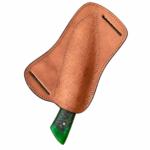
If a sheath is supplied separately, confirm that it fits the exact blade dimensions and shape before use.
Important Specifications to Confirm
Before publishing this product with technical claims, obtain the manufacturer’s confirmed material specifications.
The blade may have a Damascus-style appearance, but that does not independently establish whether it is pattern-welded Damascus steel, layered steel, or another patterned finish.
The handle resembles a pinecone-resin composite, although the actual composition remains unverified.
Other important specifications include blade length, overall length, blade thickness, tang construction, steel hardness, country of manufacture, and whether a sheath is included.
Providing these details will help customers evaluate the product more accurately and compare it with similar knives.
Why Choose This Design?
For customers interested in the visual character of a knife, this model offers several appealing details.
Its patterned blade differs from an ordinary polished finish. The copper-colored accents add warmth, while the green handle introduces an unusual decorative element.
The pinecone-inspired design contributes a natural-looking texture, and the small metal-colored pins provide further finishing details.
The result is a fixed-blade knife with a distinct combination of colors, shapes, and surface patterns.
It is especially suitable for customers who appreciate decorative outdoor cutlery and collectible fixed-blade designs.
Explore the Green Pinecone Handle Damascus-Pattern Hunting Knife
The Green Pinecone Handle Damascus-Pattern Hunting Knife combines an expressive blade finish with an unusual green and brown handle design.
Its pointed fixed blade, contoured grip, decorative pins, and contrasting metallic accents make it a distinctive option for customers exploring collectible and hunting-style knives.
Review the confirmed specifications and explore this design as a potential addition to your knife collection.




Reviews
There are no reviews yet.