






Five coordinated knives with a distinctive blue finish
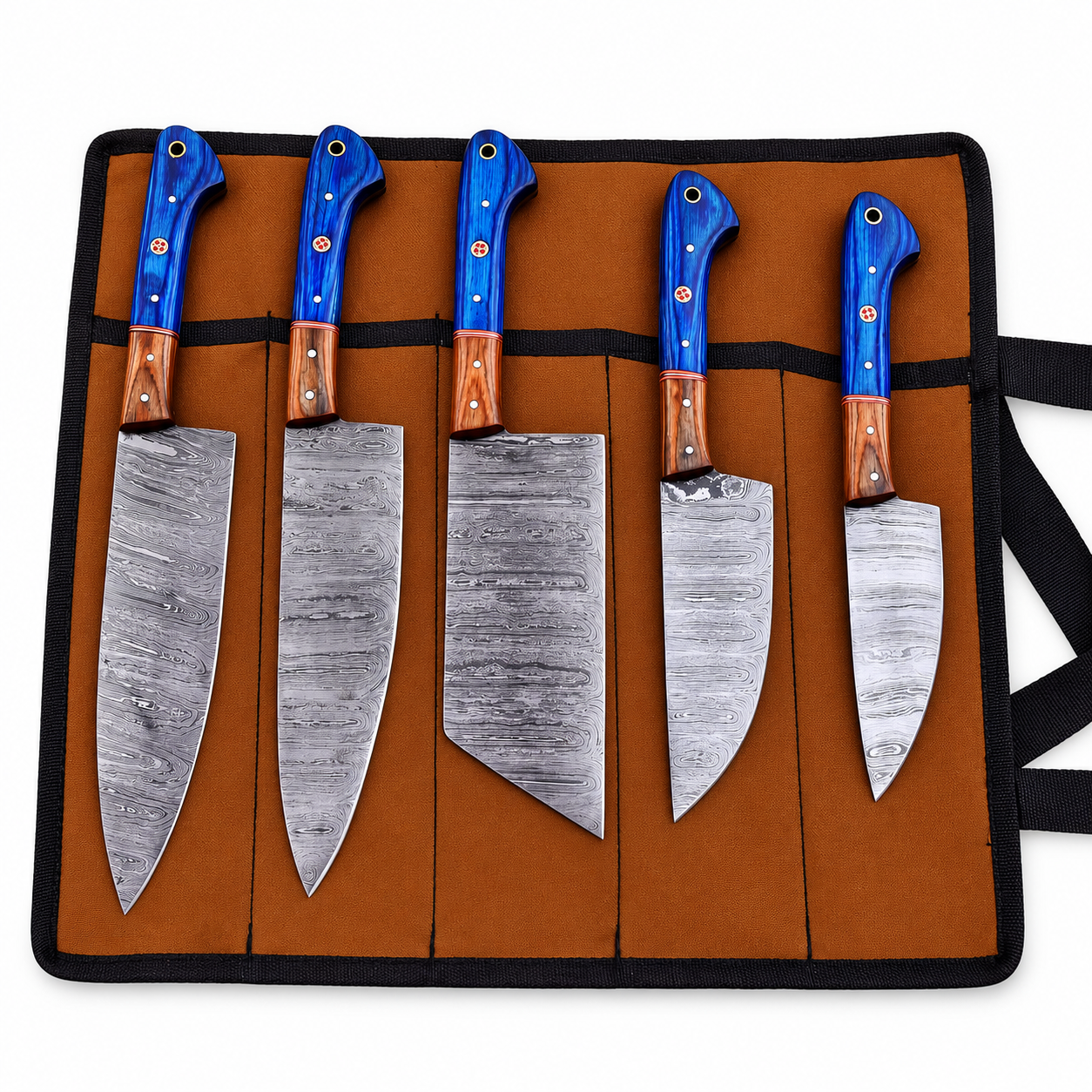
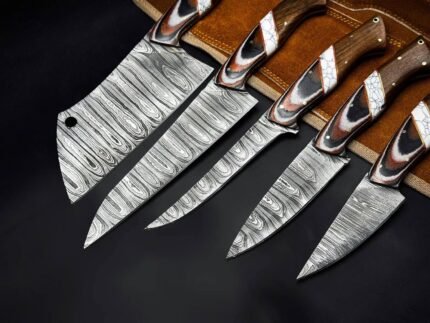
This blue handle kitchen knife set brings together five coordinated knives with flowing blade patterns, vivid blue handle sections, and warm brown accents. The pictured collection includes longer pointed blades, shorter broad blades, and a wide cleaver-style profile. Each knife shares the same handle design, giving the group a consistent appearance while allowing the different blade shapes to stand out.
The combination is visually striking without relying on a single decorative feature. Silver-gray blades provide a neutral background for dark, swirling lines. Deep blue handles introduce color, while brown sections near the blades add warmth. Small silver-tone fasteners, round red-and-gold decorative details, and gold-tone rear openings finish the handles.
For customers who enjoy kitchen tools with a coordinated appearance, the set offers a clear visual theme across all five pieces. Its appeal lies in the relationship between the varied blade profiles and matching handles. Before choosing it for particular cooking tasks, review the confirmed measurements, materials, and intended uses for each knife.
A kitchen knife collection with varied blade profiles
The five knives pictured are arranged in alternating directions, making their different outlines easy to compare. Two have relatively long blades with pointed tips. Two others have shorter, broad, pointed profiles. The center knife has the widest blade, with a cleaver-like outline and an angled front section.
These differences are useful when assessing the collection. A kitchen knife set should be considered by the individual tools it contains, as well as by its overall appearance. Blade length, depth, curvature, thickness, and weight all influence how a knife feels and which preparation tasks it suits.
The photograph establishes that this collection contains varied shapes. It does not establish precise knife sizes or a manufacturer-approved task for each piece. The descriptions below therefore identify the visible profiles without assigning unverified specialist names or performance claims.
Two longer pointed blades
The two longer knives give the collection an unmistakably culinary appearance. Each has a broad blade near the handle and a cutting-edge outline that curves toward a pointed tip. Their extended profiles contrast with the shorter knives and the wide central blade.
Longer kitchen knives are commonly considered for food preparation involving larger ingredients or longer slicing movements. Whether either pictured knife suits a particular ingredient depends on its actual dimensions, edge geometry, sharpness, and manufacturer guidance. Those details should be checked before treating either as a dedicated carving, slicing, or chef’s knife of a specific size.
Visually, the longer blades also provide the largest uninterrupted areas of the flowing pattern. The lines remain prominent from the heel toward the point, giving these two pieces a strong presence within the collection.
A broad cleaver-style centerpiece
The central knife is distinguished by its wide blade face. Its outline is more rectangular than the surrounding pointed knives, although the front narrows into an angled lower corner. This gives it a cleaver-style appearance and makes it easy to distinguish from the other four pieces.
A broad blade can be an appealing option for customers who prefer this shape for suitable kitchen preparation. However, blade width alone does not establish chopping strength or suitability for hard ingredients. The photograph cannot confirm whether this knife is intended for vegetables, boneless meat, or another specific purpose.
Its intended use deserves particular attention when reviewing the set. A cleaver-shaped knife should not automatically be treated as a bone cleaver. Confirm the blade thickness and the supplier’s guidance before selecting it for heavy cutting tasks.
Two shorter, broad-bladed knives
The two shorter knives continue the same design in more compact-looking proportions. Both have pointed tips, broad blade faces, and curved cutting-edge outlines. Their handles repeat the blue-and-brown color scheme seen on the longer pieces, keeping the collection visually consistent.
These knives may interest buyers who like having a choice of blade lengths during meal preparation. A shorter blade can be preferable for some tasks and personal working styles, but the image does not provide enough scale information to establish how compact either knife feels in the hand.
They should not be advertised as paring knives, boning knives, or a named Japanese knife type without supporting specifications. Their visible shapes are clear; their exact sizes and designated roles remain details to confirm.
Flowing patterns across the blade faces
All five blades display dark and light lines across a silver-gray surface. Some areas contain long, closely spaced waves, while others show tighter loops and curved formations. The resulting appearance gives each blade visual texture without changing the shared color palette.
The patterns are particularly noticeable on the wider blade faces. On the central knife, they extend across a large surface. On the longer knives, they follow the length of the blade and help emphasize its tapered outline.
This appearance is often associated with Damascus-style knives, but a photograph cannot establish the underlying steel construction. The set is therefore described here as having patterned blades. Genuine layered Damascus steel, a particular steel grade, and any claimed layer count would require separate verification.
Rich blue handles with grain-like detail
The blue sections are the most immediately recognizable feature of the handles. Their color varies between bright blue highlights and darker navy or near-black areas. Visible streaks give the surface a grain-like appearance, adding depth to the color.
This makes the handles more visually detailed than a plain, single-color finish. Their patterns contribute to the set’s decorative character and help connect the five knives even though their blade shapes differ.
The appearance does not establish the handle material. Dyed wood, laminated materials, resin composites, and other constructions can produce similar visual effects. Until a specification is available, “blue handle” accurately describes the product without making an unsupported claim about pakkawood, stabilized wood, or a particular wood species.
Warm brown sections near the blades
Each handle includes a brown section positioned closest to the blade. These sections show lighter and darker streaks with a wood-grain appearance. Their warm tones contrast with the blue portions and provide a visual transition between the patterned metal and colored grip.
The brown sections also make the handle design feel coordinated from piece to piece. Rather than changing the color arrangement according to knife size, the pictured collection repeats the same sequence throughout: blade, brown section, narrow accent band, and blue rear section.
This repeated arrangement helps the knives read as a matching collection. The specific material and construction of the brown sections are not confirmed, so the description focuses on their visible color and grain-like detail.
Fine accent bands and decorative pins
A narrow reddish band with pale metallic-looking borders separates the blue and brown handle sections. Although small, this detail makes the color transition more defined. It also introduces a third warm accent alongside the brown sections and gold-tone fittings.
Each blue section contains a round decorative detail with a gold-colored border and a red patterned center. These circular accents resemble decorative mosaic pins, although the image alone does not establish their construction or structural role.
Small silver-tone fasteners are visible along the handles as well. Together, these details give the collection a consistent finish. They are most useful as design descriptions; their presence does not prove a particular assembly method, handmade production, or a higher level of durability.
Curved handle outlines
The handles have shaped outlines rather than simple straight-sided forms. Their sides curve, and the rear ends broaden into rounded, slightly flared profiles. The same general shape appears across the collection.
Handle shape is an important part of choosing kitchen knives, but appearance is only one part of fit. The photograph does not reveal handle thickness, surface friction, balance, or how the curves sit against the palm. Those details affect comfort and are best assessed through measurements or handling a sample.
For this reason, the curved design is presented as a visible feature rather than a guarantee of ergonomic comfort. Customers comparing sets should consider their preferred grip and usual preparation routine alongside the appearance of the handles.
Gold-tone openings at the rear
Each handle has a circular opening near its rear end with a gold-tone rim. These openings repeat the warm metallic color of the decorative pins and add another recognizable detail to the collection.
Their placement is visible, but their intended use is not documented. They should not be treated as proof that a hanging system, cord, or other accessory is included. Likewise, the image does not demonstrate an approved storage method using these openings.
As a design feature, they help complete the handles and reinforce the matching presentation. Their consistency across all five knives is part of what gives the collection its coordinated appearance.
A coordinated look for the kitchen
The set may appeal to customers who want their kitchen knives to share a clear visual identity. Blue and brown work together here as contrasting colors, while the silver-gray blades keep the overall palette connected to familiar kitchen cutlery.
In a kitchen with blue accessories, the handles could repeat an existing accent color. Against neutral surfaces, they would provide a stronger point of contrast. The brown sections may also complement the appearance of wooden boards or other warm-toned kitchen accessories.
These are styling possibilities rather than claims about included accessories. The photograph shows the knives on a plain background, without a block, board, storage rack, or countertop setting. Any display or storage arrangement would need to be selected separately unless the seller confirms otherwise.
Choosing the set around your cooking routine
When considering a five-piece collection, think about the knives you use most often. Some cooks prefer a longer blade for much of their preparation, while others reach for a shorter knife whenever possible. A collection with varied profiles gives you several shapes to assess against those preferences.
Typical kitchen preparation can involve slicing produce, trimming ingredients, portioning boneless foods, and other cutting tasks. The appropriate knife for each job depends on its verified design and condition. The photograph cannot confirm that every knife in this set is suitable for every common kitchen task.
The most useful next step is to compare the individual blade measurements and intended uses. That information will show whether the set covers your actual routine or includes shapes you would use less frequently.
Assessing the collection as a gift
The matching handles and patterned blades give this collection a distinctive appearance that may interest someone who enjoys cooking and kitchen equipment. Its coordinated design could make it a candidate for a cooking-related gift, particularly for someone who likes blue accessories.
A successful knife gift also depends on the recipient’s preferences. Handle size, blade weight, maintenance requirements, and available storage matter just as much as the visual presentation. Confirming those details helps establish whether the collection is a practical match for its intended owner.
No gift box, protective case, knife roll, or presentation packaging is visible in the supplied image. If presentation is important to the purchase, ask for confirmation of the packaging before ordering.
What the photograph shows
The image shows five separate knives with a shared handle design. It clearly establishes the blade patterns, the blue-and-brown color combination, the decorative circular handle details, and the variety of blade outlines.
It also shows that the pictured cutting edges are not visibly serrated. No bread knife with a toothed edge appears in this arrangement. No sharpening tool, scissors, sheath, stand, or storage block is shown alongside the knives.
The five-piece description refers to the five knives pictured. The seller should confirm that the purchased option includes all five of these pieces, rather than an individual knife selected from a larger product range. This is especially useful when comparing supplier listings that use collection photographs for several buying options.
Measurements that help you compare
Blade lengths are essential for understanding the difference between the two longer knives and the shorter pieces. Overall lengths are useful too, especially when checking whether the knives will fit an existing drawer insert, protective cover, or knife roll.
Handle length and thickness can help you assess fit, while individual knife weights offer a better sense of how substantial each piece may feel. The wide central blade may look heavier than the others, but its actual weight cannot be established from the photograph.
Blade thickness is another important specification, particularly for the cleaver-style knife. Asking for these measurements gives you a more useful comparison than relying on the apparent proportions in a styled product image.
Materials and maintenance information
The blade alloy and handle materials should be confirmed before deciding on a maintenance routine. Different steels and handle constructions can require different approaches to cleaning, drying, storage, and sharpening.
No product-specific care instructions have been verified for this pictured set. Dishwasher suitability, corrosion resistance, oiling requirements, and recommended sharpening angles therefore remain unconfirmed. Follow the manufacturer’s instructions once the exact product and materials are established.
This information is particularly relevant for customers choosing between decorative patterned knives and other kitchen cutlery. The visible pattern explains the appearance; it does not establish how much maintenance the blades need or how long they retain an edge.
Storage and accessory compatibility
If you already own knife storage, compare its dimensions with the measurements of this set before purchasing. The widest blade may require more space than a narrow slot provides, and the longer knives may need deeper protection than shorter kitchen blades.
The photograph does not establish compatibility with a particular block, sheath, drawer organizer, or magnetic holder. Choosing storage should follow confirmation of the knife dimensions and any guidance supplied with the product.
Accessories should also be considered separately from the five visible knives. A storage solution, edge guards, or sharpening equipment may be useful additions, but none is shown or confirmed as part of this offer.
A clear basis for choosing
The strongest confirmed features of this collection are its coordinated appearance and variety of visible blade shapes. Five patterned blades, matching blue-and-brown handles, narrow accent bands, decorative pins, and gold-tone rear openings create a consistent design.
Customers who value that combination can use the photograph to assess the style, then use verified specifications to decide whether the set meets their cooking needs. This keeps the buying decision grounded in both appearance and practical information.
Explore the five-piece blue handle kitchen knife set, compare its blade profiles, and review the confirmed specifications to choose a collection that suits your kitchen and personal preferences.






Reviews
There are no reviews yet.