





Reddish Brown Handle Damascus Hunting Knife – Traditional Style and Patterned Blade
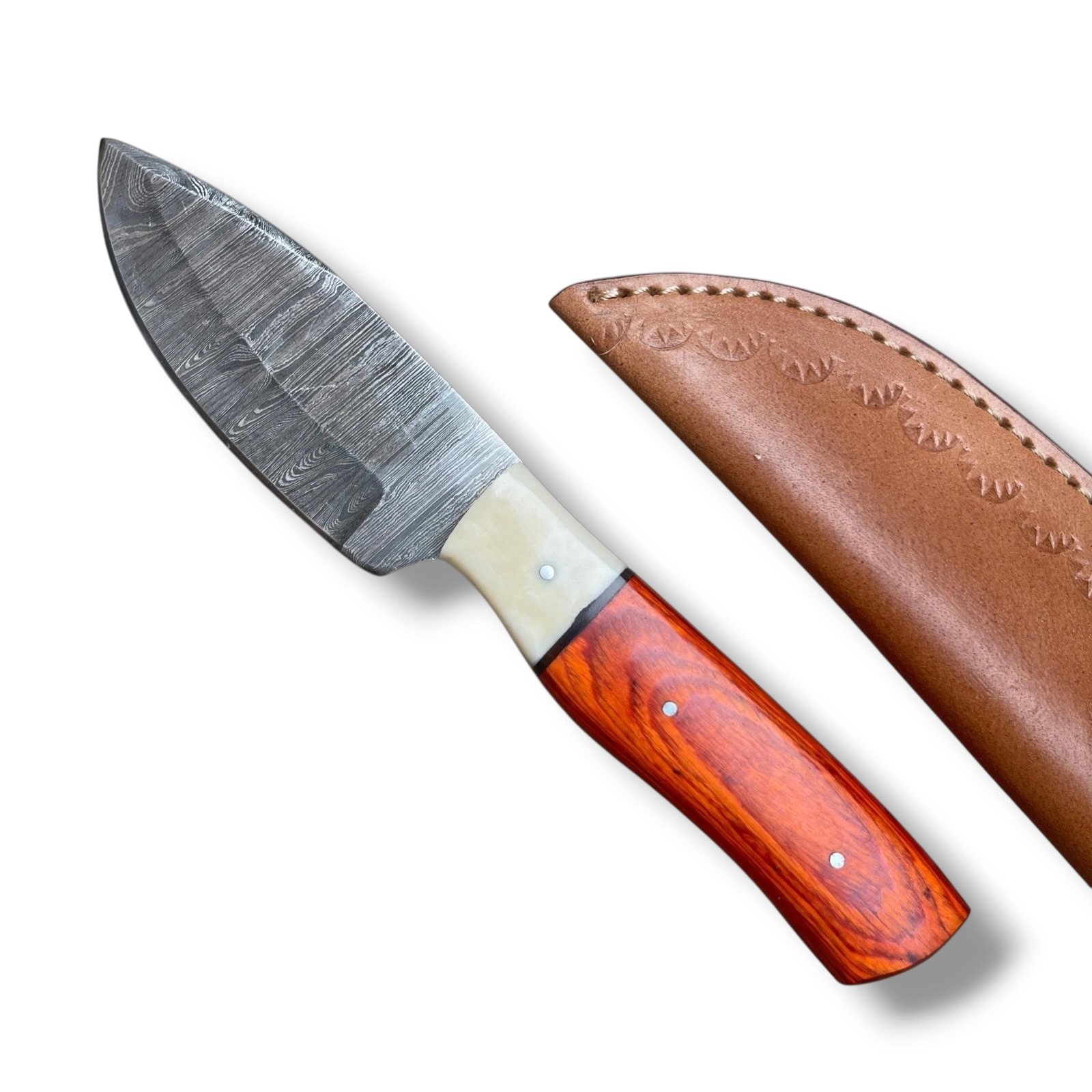
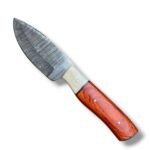
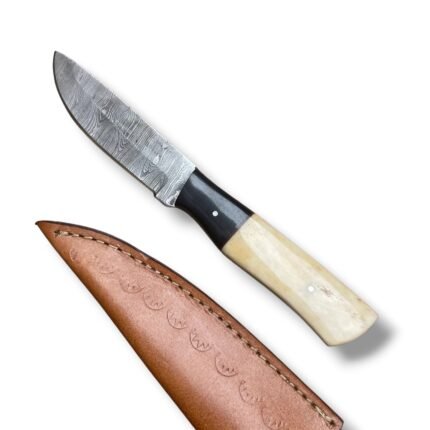
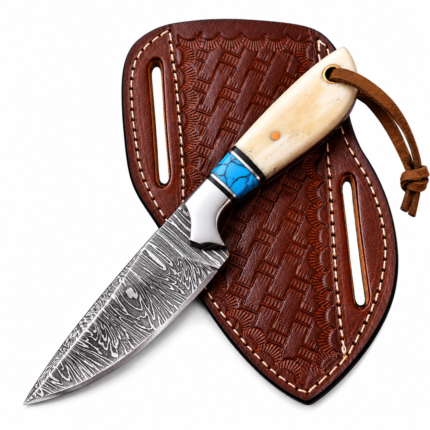
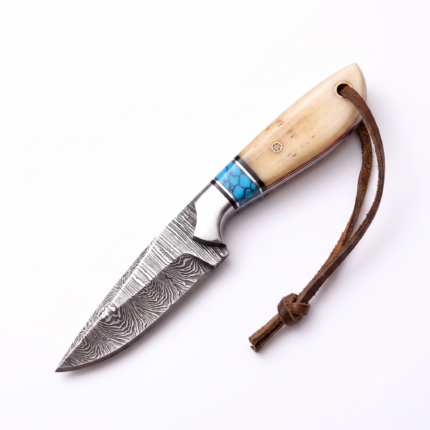
The reddish brown handle Damascus hunting knife features a distinctive combination of patterned metalwork, warm woodgrain-style colors and a traditional fixed-blade design. Its broad pointed blade displays flowing silver-gray lines that resemble layered Damascus steel, while the handle combines a rich reddish-brown finish with a contrasting cream-colored front section.
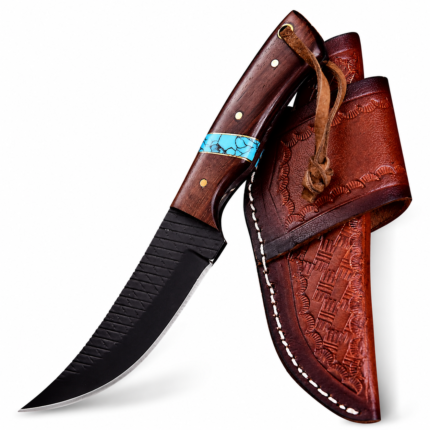
A brown sheath is also pictured beside the knife, completing its traditional outdoor-inspired presentation. The sheath includes visible stitching and decorative impressions, giving it an appearance that complements the warm colors of the handle.
This knife is especially interesting for adult collectors who appreciate decorative steel patterns, classic hunting-knife shapes and contrasting handle materials. Its design brings together several recognizable visual elements without excessive ornamentation.
The curved cutting-edge profile, dark-to-light blade pattern and polished-looking handle create an attractive overall appearance. Whether viewed as part of a knife collection or compared with other traditional fixed-blade models, this product stands out through its combination of color, blade shape and decorative finish.
Distinctive Damascus-Style Blade Pattern
One of the most noticeable characteristics of this reddish brown handle Damascus hunting knife is its patterned blade.
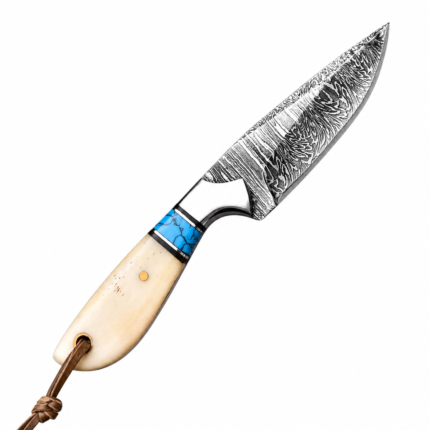
The blade displays numerous fine lines, flowing curves and layered-looking markings. These patterns run across the silver-gray metal surface, creating an appearance commonly associated with Damascus steel.
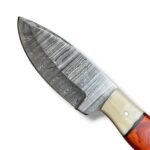
Near the tip, the markings curve into irregular shapes. The central blade section shows longer, closely spaced lines, while the area near the handle contains smaller curved patterns.
The combination creates visual depth and texture.
The darker metal tones contrast with lighter silver-colored lines, allowing the decorative details to remain visible across much of the blade.
The appearance is particularly distinctive because the markings are not completely uniform. Different sections display variations in line thickness and direction.
It is important to distinguish the appearance from verified material composition. Genuine pattern-welded Damascus steel is manufactured using particular metalworking processes, but similar patterns may also be created through surface finishing.
The image confirms the decorative appearance, not the exact manufacturing technique.
Before describing the blade as genuine forged Damascus steel, the supplier should verify its composition and construction.
Broad Hunting-Style Blade Design
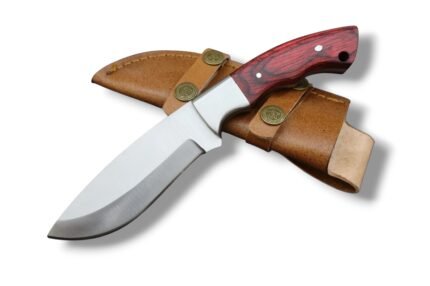
The knife features a broad blade that narrows toward a pointed tip.
Its lower cutting-edge outline has a noticeable curve, producing a wide belly near the central section.
This shape resembles traditional hunting and skinning-style knife profiles.
The upper portion slopes toward the tip, while the blade becomes wider near the handle.
The profile creates a visually substantial blade with a relatively compact-looking transition into the grip.
A small curved area near the blade base provides a distinct change in shape between the blade and handle.
This detail contributes to the overall knife silhouette.
Although the shape resembles knives intended for outdoor cutting tasks, the photograph does not establish its actual cutting performance, blade thickness or sharpening condition.
Those characteristics depend on steel composition, edge geometry, heat treatment and manufacturing quality.
For an accurate product listing, the blade should be described through its visible shape and finish until further technical information is available.
Reddish Brown Woodgrain-Style Handle
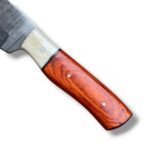
The handle features a deep reddish-brown color with darker flowing grain-like markings.
Its surface appears smooth and polished, showing variations in the pattern along the length of the grip.
The color includes warm orange-brown tones and deeper reddish areas.
These variations create an appearance resembling natural polished hardwood.
However, the exact material is not confirmed.
Laminated wood, dyed wood, stabilized wood and synthetic materials can all produce similar visual effects.
The description therefore identifies the grip as having a reddish-brown woodgrain-style appearance.
The handle’s outline is gently curved and tapers slightly toward the blade.
Its rear end is rounded and angled rather than perfectly square.
Two small silver-colored circular pins are visible along the reddish section.
These fittings create subtle visual contrast against the darker grain pattern.
The woodgrain-style finish gives the knife a traditional appearance that complements the decorative blade.
Cream-Colored Front Handle Section
A cream-colored section is positioned between the patterned blade and the reddish-brown grip.
This area provides one of the knife’s most distinctive design details.
Its pale ivory-like color contrasts with both the darker handle and the gray blade.
The cream section appears smooth, with slight variations in tone.
A small silver-colored pin is visible near its center.
Between this light-colored section and the reddish handle is a thin dark band.
The separation creates a clear visual transition between the two areas.
Similar handle designs sometimes incorporate bone, horn, resin or another contrasting material.
However, these materials cannot be reliably distinguished from the image.
Until verified, the correct description is a cream-colored front handle section.
Its main confirmed characteristic is visual contrast rather than a particular material property.
A Classic Two-Tone Handle Combination
The combination of reddish brown and cream gives the handle an attractive two-tone appearance.
The front section introduces a light accent, while the remaining grip features darker woodgrain-looking lines.
The contrast makes the transition between the blade and handle more noticeable.
Silver-colored pins add small decorative details.
The overall handle shape remains relatively simple.
There are no large engraved symbols, complex external fittings or bright metallic ornaments visible.
Instead, the design emphasizes the natural-looking colors and grain patterns.
This makes the knife visually different from models that use uniform black or plain brown grips.
For collectors interested in classic knife styling, the warm color combination may be an important distinguishing feature.
Fixed-Blade Hunting Knife Configuration
The reddish brown handle Damascus hunting knife uses a fixed-blade configuration.
The blade is positioned directly in line with the handle and does not appear to fold into it.
This distinguishes the product from folding pocket knives.
The visible design consists of a patterned metal blade, a contrasting front handle section and a reddish-brown rear grip.
The blade and handle form a continuous overall silhouette.
However, the photograph does not establish the internal tang design.
For example, full-tang and hidden-tang constructions may look different internally even when the external appearance is similar.
No particular tang construction should be advertised without manufacturer confirmation.
Likewise, the blade’s exact dimensions and weight should be obtained from a verified specification sheet.
Brown Sheath with Decorative Stitching
A brown protective sheath is displayed alongside the knife.
Its curved outline resembles the general shape of a fixed-blade knife sheath.
The surface features decorative impressions, including a repeating pattern near its upper section.
A row of stitching follows the curved edge.
The brown finish has a warm tan appearance that complements the reddish-brown handle.
The sheath gives the product photograph a coordinated traditional style.
Its appearance resembles leather, although genuine leather composition cannot be confirmed from the photograph.
The supplier should identify whether the material is natural leather, synthetic leather or another suitable material.
The image shows only part of the sheath, so details such as a belt loop, retaining strap, internal lining or fastening method cannot be verified.
Customers should also confirm whether the sheath is included with the knife as standard.
Silver-Gray Blade and Warm Handle Colors
The contrast between the blade and handle is central to the product’s appearance.
The blade displays cool silver and gray tones.
The handle introduces warm reddish-brown and cream colors.
Together, these contrasting finishes create an attractive traditional look.
The darker blade markings complement the grain-like lines in the handle.
The cream-colored section provides a softer transition between them.
The brown sheath adds another warm color element.
Instead of relying on a single uniform finish, the knife combines several visually distinct surfaces.
This makes the product suitable for presentation in a decorative knife collection.
Its appearance can be appreciated independently of any unverified technical specifications.
Blade Surface Detail and Texture
The patterned blade has several recognizable areas.
The point is defined by a gradual taper.
The upper edge slopes forward, while the lower edge forms a broader curved outline.
The layered-looking lines continue toward the blade tip.
Some markings follow the direction of the blade, while others form more irregular shapes.
The finish appears relatively dark in certain areas and brighter in others.
This contrast may be influenced by lighting, surface treatment and the pattern itself.
The uploaded photograph does not establish whether the markings are physically raised, etched or part of the underlying steel.
The seller should avoid claiming that the surface texture provides specific mechanical benefits without supporting information.
Its confirmed value in the image is its distinctive visual appearance.
Traditional Craft-Inspired Appearance
The knife’s design resembles a traditional outdoor cutlery style.
Its broad blade, warm handle colors and brown sheath create an appearance associated with classic hunting knives.
The cream-colored section also introduces a decorative transition commonly seen in some heritage-inspired knife designs.
The blade pattern adds another traditional metalwork element.
Together, these features produce a knife that looks different from modern minimalist designs.
The visual style may appeal to customers interested in rustic accessories, decorative metalwork and collectible cutlery.
However, the image does not establish whether the knife was individually handcrafted, forged by hand or produced using industrial manufacturing methods.
Those claims require supplier documentation.
The most reliable description focuses on its traditional design and visible finishes.
A Distinctive Choice for Adult Collectors
Adult knife collectors often compare blade patterns, handle finishes, overall shapes and presentation accessories.
This model offers several identifiable visual characteristics.
The Damascus-style patterned blade creates an intricate appearance.
The reddish-brown handle introduces warm coloring and grain-like detail.
The cream front section provides contrast.
The visible metal pins add small accents.
The brown sheath contributes to the traditional overall presentation.
These elements make the knife visually recognizable among other outdoor-style cutlery products.
Collectors who prefer patterned metal and classic colors may find the design particularly interesting.
Before purchase, the actual materials and manufacturer specifications should be reviewed to ensure that the product meets the buyer’s expectations.
Damascus-Pattern Steel Considerations
The term Damascus steel is widely used in the knife industry, but products sold under this description may have different constructions.
Genuine modern pattern-welded Damascus generally involves layers of steel joined through a controlled metalworking process.
Other products may feature decorative patterns applied through alternative methods.
The image does not provide enough information to distinguish between these possibilities.
Consequently, the knife’s exact steel composition should be verified before technical claims are published.
A proper supplier specification should identify the blade material.
If a Damascus layer count is advertised, the manufacturer should provide supporting information.
Blade hardness should also be confirmed if it is included in the final product listing.
These details help customers evaluate the knife accurately.
They are more reliable than attempting to determine construction from decorative surface markings alone.
Understanding Handle Materials
The reddish-brown section looks similar to polished wood.
The cream section resembles a contrasting natural or synthetic handle material.
However, visual appearance does not conclusively establish either composition.
Different materials can be colored, laminated or polished to achieve similar finishes.
Handle material may affect maintenance, weight and long-term appearance.
For example, genuine wood may require different care from a synthetic resin composite.
The supplier should provide exact material details for both handle sections.
Until those details are available, the listing should use descriptive visual terms.
This avoids misleading customers while still communicating the product’s attractive appearance.
Size, Dimensions and Weight
The photograph does not include a measurement scale.
For this reason, the knife’s actual size cannot be measured accurately.
Its overall length is unknown.
The blade length, blade width and thickness also remain unverified.
Handle dimensions and total product weight are not available.
These specifications are important for customers comparing different fixed-blade designs.
The supplier should provide a dimension chart with measurements in millimeters and inches.
Weight should be provided in grams or ounces.
If the sheath is supplied with the knife, its approximate dimensions can also be included.
Accurate measurements make the listing more useful and reduce uncertainty about product proportions.
Care and Maintenance Guidelines
The appropriate care method depends on the actual steel and handle materials.
As a general precaution, keep the metal surface clean and dry.
Moisture and residue should not be allowed to remain on the blade for extended periods.
Avoid aggressive abrasive cleaning products that may alter the decorative finish.
Use a cleaning method approved for the blade’s verified material.
The reddish-brown handle should be cleaned according to its actual composition.
Avoid prolonged exposure to extreme heat, strong solvents or other conditions that could damage the finish.
If the sheath is made from natural leather, use suitable leather-care practices recommended by its manufacturer.
Store the knife securely with its cutting edge protected.
Keep the product away from children and follow all applicable safety requirements and local laws.
Product Presentation and Photography
The supplied photograph shows the knife and sheath against a white background.
The knife is positioned diagonally, allowing the blade pattern and handle colors to remain visible.
The silver-gray blade occupies the upper-left portion of the composition.
The reddish-brown handle extends toward the lower-right.
The cream front section is clearly visible between them.
The brown sheath appears along the right side of the image.
This presentation highlights the knife’s main visual characteristics.
For a more complete product gallery, additional photographs would be helpful.
A close-up of the blade could show the pattern more clearly.
An opposite-side image would help buyers examine the handle and blade construction.
Another image could show the complete sheath, including any rear fittings.
A photograph with a measurement scale would also help communicate the product dimensions.
Details to Confirm Before Purchase
The reddish brown handle Damascus hunting knife has several features that can be identified visually, but additional information is needed for a complete technical specification.
The actual blade steel grade should be confirmed.
The manufacturer should specify whether the Damascus-style pattern comes from genuine pattern welding or another finishing method.
Both handle materials should be identified.
The overall length, blade dimensions, hardness and weight should be documented.
The supplier should confirm the actual sheath material and whether it is included.
Any available customization options, packaging details or accessory choices should be supported by supplier information.
Accurate specifications allow buyers to make more informed comparisons.
Why Choose This Reddish Brown Handle Damascus Hunting Knife?
The reddish brown handle Damascus hunting knife offers a distinctive combination of layered-looking blade patterns, warm woodgrain-style coloring and traditional fixed-blade proportions.
Its cream front handle section creates a clear contrast with the reddish-brown grip.
Small silver-colored pins add subtle detail.
The broad, pointed blade displays intricate silver-gray markings.
A brown stitched sheath is pictured alongside the knife, complementing the overall appearance.
For adult collectors who appreciate decorative outdoor-style cutlery, these design elements make the product worth exploring.
Review the manufacturer’s verified materials, measurements and included accessories before ordering, and discover this reddish brown handle Damascus hunting knife for its patterned blade and classic two-tone styling.



Reviews
There are no reviews yet.