







Basket Weave Handle Folding Knife with Distinctive Detail
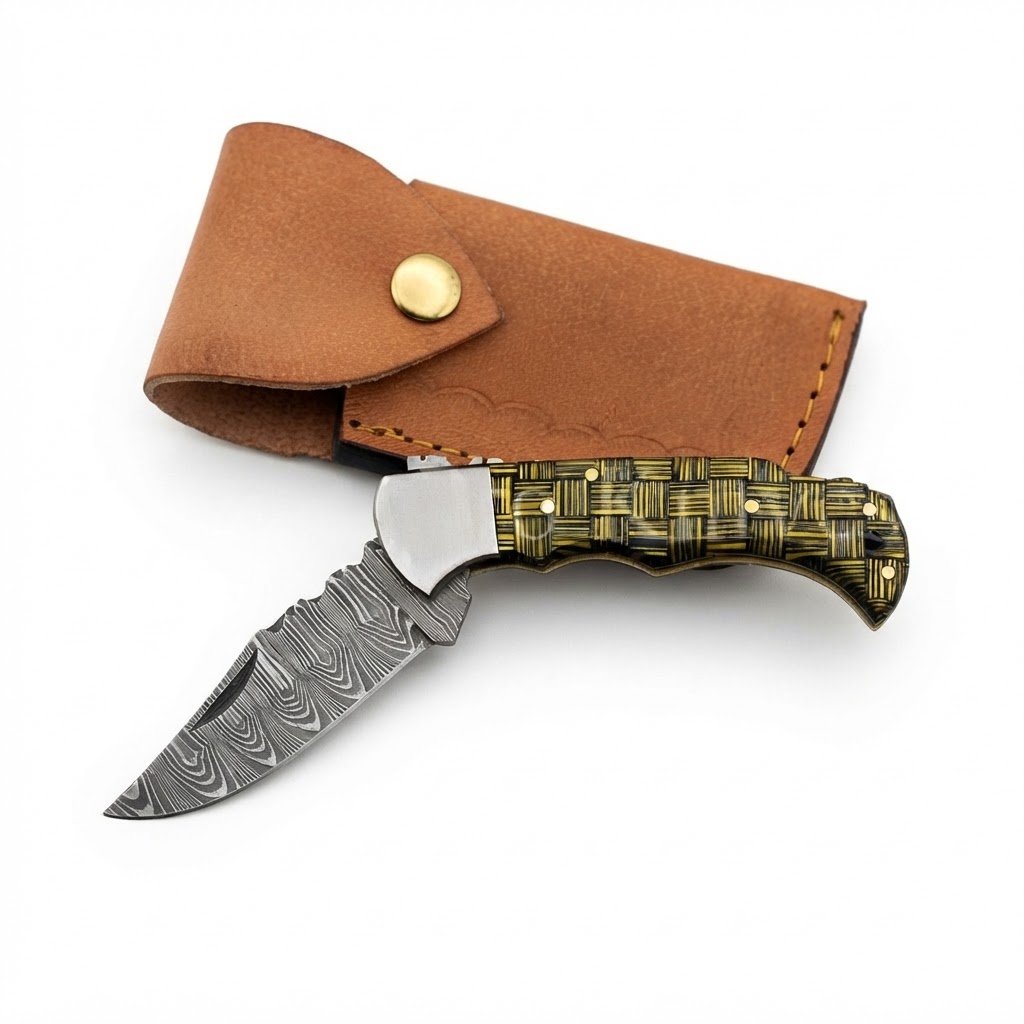
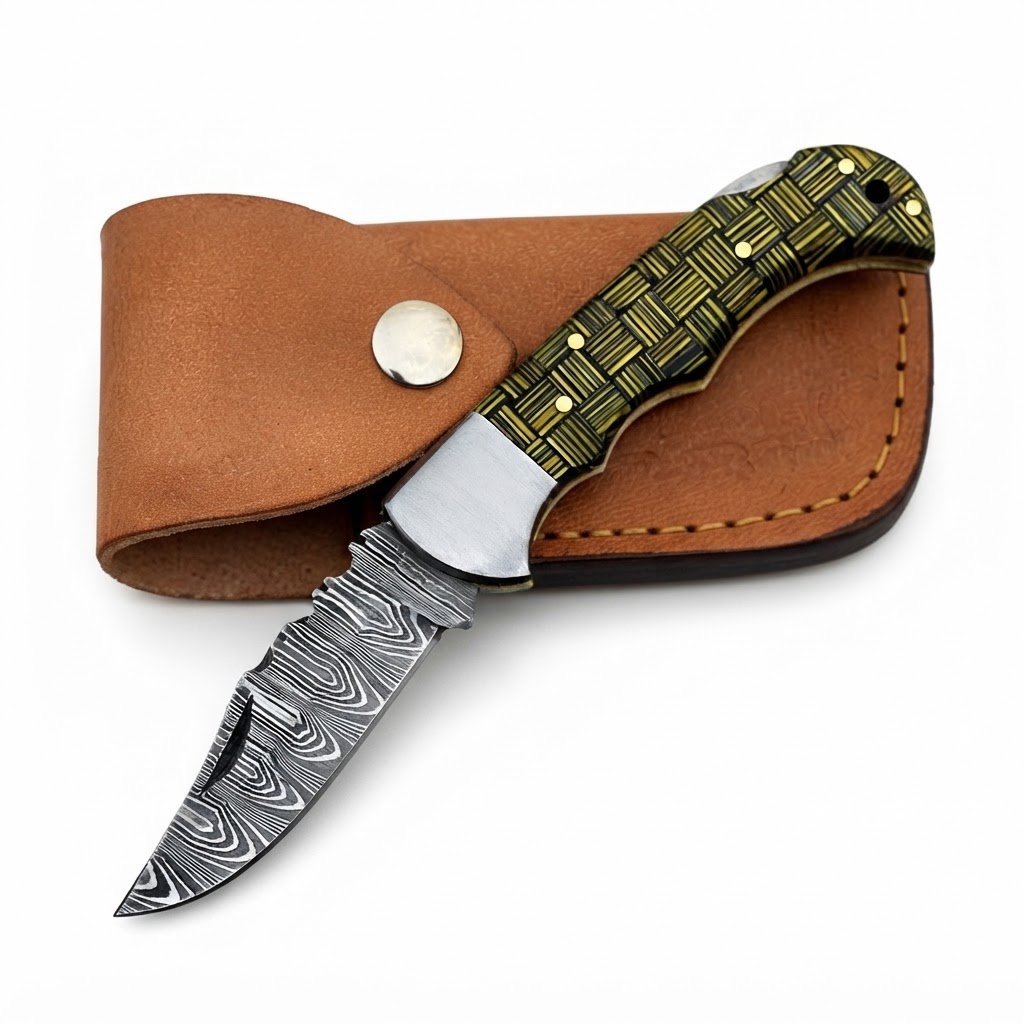
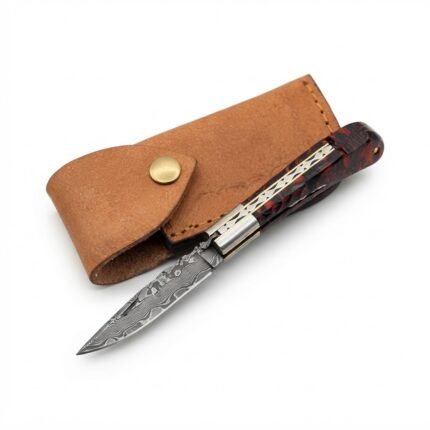
This basket weave handle folding knife brings together a geometric handle pattern, a flowing gray blade design, and a broad silver-tone bolster. The combination gives it a distinctive appearance while retaining the familiar outline of a traditional folding pocket knife. A brown snap-fastened pouch is pictured behind the knife, adding a warm contrast to the darker handle and patterned blade.
The handle is the most immediately recognizable feature. Narrow gold-yellow lines alternate direction within dark rectangular sections, creating a basket-weave effect. Small gold-tone pins complement the pattern, while a round opening near the rear provides another visible detail. The handle’s curved outline gives the geometric arrangement a softer overall shape.
Across the blade, light and dark lines form repeated waves and nested contours. These markings extend through much of the visible face, creating a different kind of pattern from the orderly blocks on the handle. The plain silver-tone bolster sits between the two, giving each surface room to stand out.
For customers who enjoy decorative pocket knives, this design offers several details to appreciate in one piece. Its visual appeal is clear from the photograph. Practical qualities such as weight, blade composition, locking action, and dimensions should be assessed using the confirmed product specifications before purchase.
A Folding Pocket-Knife Design
The knife is shown with its blade open. Its handle arrangement, blade junction, and visible nail nick are consistent with a folding pocket-knife design. This makes Folding Pocket Knives the appropriate website subcategory and helps customers distinguish it from a fixed-blade knife with a similar handle.
A folding format allows the blade to close into the handle for storage. However, the photograph shows only the open position, so it does not establish the closed dimensions or how much of the blade remains visible when folded. Those details are useful when comparing the knife with an existing pouch or storage space.
The folding action itself cannot be assessed from a still image. Opening resistance, blade alignment, and the feel of the mechanism require either direct inspection or reliable product information. The design should therefore be presented as a folding knife without promises about exceptionally smooth action or a particular opening speed.
Customers who prefer a traditional pocket-knife appearance may find this arrangement appealing. The broad bolster, pinned handle, and nail nick give it a different visual character from modern folders with exposed pivot screws and large thumb studs. Choosing between those styles is largely a matter of preference alongside the practical specification.
Black-and-Gold Basket-Weave Handle Pattern
The handle face is covered with a repeating arrangement of narrow gold-yellow stripes on a dark background. Groups of lines run in alternating directions, creating the impression of interwoven sections. The pattern is geometric and structured, with clear changes in direction from one block to the next.
“Basket weave” describes the appearance rather than the material. The photograph does not establish that the handle contains actual woven fibers, metal threads, or a particular composite. It also does not confirm whether the pattern is formed within the material or applied to its surface.
The dark sections provide definition around the lighter stripes. This contrast makes the design visible across the handle, including near the curved rear and the front bolster. Depending on lighting and screen settings, the lighter areas may appear yellow, gold, or slightly olive-toned.
For shoppers comparing patterned handles, this arrangement offers a useful point of distinction. It differs from flowing wood grain, marbled resin effects, and plain solid colors. Customers who prefer orderly geometric detail can identify that preference immediately without needing to rely on broad descriptions such as decorative or premium.
A Curved Handle Outline
The handle has a gently arched upper edge and a more shaped lower contour. Shallow recesses along the underside break up the outline, while the rear curves into a rounded end. These details give the grip a recognizable shape beyond the surface pattern alone.
The basket-weave design follows the visible face right up to much of the perimeter. A narrow contrasting border can be seen along portions of the lower edge, helping separate the handle from the brown pouch behind it. The overall effect is clearly defined rather than visually flat.
The shaped outline may suit customers who prefer contoured handles over straight-sided designs. Actual comfort depends on grip length, thickness, surface feel, and hand size. A photograph can show the contour, but it cannot demonstrate how comfortably the knife fits a particular person.
Before selecting the knife for regular use, compare its confirmed handle measurements with a pocket knife that already feels comfortable. The view supplied here is useful for judging the side profile. Additional top and rear views would provide the missing information about thickness and cross-sectional shape.
Gold-Tone Pins and Rear Opening
Five small gold-tone circular pins are visible across the handle face. Their warm color works with the lighter stripes in the basket-weave pattern, keeping the hardware visually consistent with the surrounding design. The pins add detail without introducing a new contrasting color.
Two pins sit relatively close to the front, one is positioned farther along the handle, and two appear near the rounded rear. Their placement follows the shape of the grip rather than forming a single straight row. This gives the handle a traditional pinned appearance.
Near the rear, a separate dark circular opening is visible. It resembles a lanyard hole, although the photograph does not confirm its diameter or compatibility with a particular cord. No lanyard is shown, and one should not be assumed to form part of the package.
The pins’ color does not establish their metal composition. Brass, plated metal, and other materials can look similar in a photograph. Customers interested in the construction should use the confirmed specification, while the visible description can accurately identify the number, shape, and gold-tone appearance of the pins.
Broad Silver-Tone Bolster
A broad silver-tone bolster sits between the patterned handle and the blade. Its relatively plain surface provides a visual pause between the two more detailed areas. This is an important part of the design: the handle and blade remain distinct instead of blending into one continuous pattern.
Fine surface lines are visible on the bolster, giving it a satin-like appearance in the photograph. Its outer edge curves toward the lower part of the handle, while the top follows the blade junction. The shape complements the surrounding contours without adding elaborate decoration.
The image does not identify the bolster material. It should not be labeled stainless steel, nickel silver, or another specific alloy without confirmation. “Silver-tone” describes its appearance accurately and keeps the material information separate.
For customers who enjoy traditional folding knives, the broad front fitting may be an attractive detail. It gives the front of the handle a substantial visual presence. Whether it affects balance or durability in a particular way depends on construction details that are not available from the image.
Flowing Gray Blade Pattern
The blade face displays closely spaced light and dark lines. These form waves, elongated loops, and nested shapes that repeat along the length of the blade. The flowing pattern contrasts with the squared, alternating arrangement on the handle.
This appearance is often associated with Damascus-style blades, but the photograph cannot establish how the pattern was made. It does not confirm pattern-welded steel, the number of layers, or the alloys used. The accurate product description at this stage is a gray patterned blade.
The visible pattern remains detailed near the blade’s base and continues toward the pointed front. Changes in direction give different sections their own appearance, so the blade does not look like a uniform field of parallel stripes.
For a buyer choosing partly on design, this surface provides much of the knife’s visual interest. For a buyer prioritizing cutting performance, the relevant questions are different: blade material, heat treatment, hardness, and edge geometry. The pattern can be appreciated on its own while those practical details are checked separately.
Pointed Blade and Curved Cutting Edge
The blade narrows toward a pointed tip, with a plain cutting edge that curves upward near the front. This creates a familiar pocket-knife silhouette. The blade is neither rectangular like a cleaver nor strongly hooked like a karambit.
The visible edge is not serrated. That distinction is useful for customers who are comparing plain-edge and serrated folders. The image establishes the basic outline, but it does not show the exact edge angle or provide a test of sharpness.
The proportions suggest a blade intended to fold into the pictured handle, although no reliable size reference is present. Its actual length and thickness should therefore be confirmed rather than estimated from the photograph. Product images can make different-sized knives appear similar when each fills the frame.
Customers considering the knife for ordinary utility tasks should check the maker’s intended-use guidance and specifications. A familiar blade shape is a starting point for comparison, but it does not prove suitability for every material or task. The exact construction remains relevant to the purchasing decision.
Nail Nick and Detailed Spine Profile
An elongated dark nail nick is visible on the blade face. This feature is consistent with a traditional manual-opening folder and adds another recognizable detail to the product. It is separate from the flowing blade pattern and can be seen clearly in the supplied view.
Near the bolster, the upper blade outline includes several stepped or scalloped sections. These create a more detailed profile around the blade’s base. The shaping contributes to the appearance, particularly where the patterned blade meets the plain front fitting.
The photograph does not establish whether those contours are decorative, intended as a contact surface, or part of another design feature. They should not be advertised as a tested grip enhancement or safety benefit without supporting information.
Likewise, the nail nick does not confirm the complete opening or locking system. The knife should not be labeled assisted-opening, automatic, liner-lock, or lockback solely from this image. Customers with a mechanism preference should confirm the exact type before choosing the product.
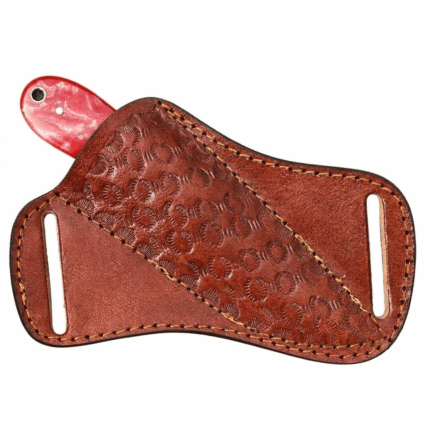
Brown Snap-Fastened Pouch Pictured
Behind the open knife is a brown pouch with a broad flap and a round silver-tone snap. The warm color contrasts with the knife’s gray blade and black-and-gold handle. The pouch also helps show the product in a familiar storage presentation.
Light tan stitching follows the visible lower and right-hand perimeter. Darker edges define the pouch’s outline, while the front flap curves across part of the opening. The surface has a leather-like appearance, but the photograph does not confirm genuine leather or a specific grade.
Only one side of the pouch is visible. A belt loop, clip, or other attachment cannot be verified from this view. Its lining, internal dimensions, and retention also remain unknown, so it should not be described as compatible with other knives.
Pouch inclusion needs confirmation. It may be supplied with the knife, offered separately, or used in the product photograph. Until the package contents are established, the accurate wording is that a brown snap-fastened pouch is pictured.
A Coordinated Visual Presentation
The knife combines several finishes without relying on a large logo or printed branding. The gold-yellow handle detail and pins share a similar warm tone. The bolster and lighter blade markings provide cooler silver-gray accents, creating a balanced contrast.
The brown pouch introduces another warm surface, but its plain appearance keeps the focus on the knife. Its stitching and snap are simple enough to complement the detailed handle and blade rather than compete with them.
This combination may appeal to customers who prefer a decorative pocket knife with a traditional presentation. The interest comes from pattern, shape, and contrasting finishes rather than brightly colored blade coatings or oversized hardware.
The photograph does not establish that every unit will have an identical blade pattern or color tone. If the precise appearance matters, customers should check whether the image represents the actual item or a typical example. That information is particularly useful when selecting a visually distinctive knife as a gift.
For Collectors of Patterned Folding Knives
Collectors often compare knives by more than their basic function. Handle design, blade markings, bolster shape, and small construction details can all influence the choice. This model brings several of those visible features together in a single folding design.
The handle’s basket-weave effect is its clearest distinguishing attribute. Paired with the flowing blade pattern, it creates a contrast between geometric and organic-looking lines. The plain bolster helps connect the two without interrupting the overall outline.
A collection organized around decorative folders, patterned blades, or traditional pocket-knife styling could accommodate this design. That is a matter of visual preference rather than a claim about rarity, age, or historical importance.
No maker’s mark or documented provenance is supplied with the image. The knife should therefore be evaluated on its confirmed features rather than presented as a limited edition or investment piece. Buyers who value a specific maker or production method should request that information separately.
Comparing Size, Weight, and Fit
The photograph does not include a ruler or another dependable scale reference. Overall open length, closed length, blade length, and weight are unknown. These measurements should be checked before describing the knife as compact, lightweight, or suitable for a particular pocket.
Closed length is especially relevant for a folding knife because it determines the space required for storage. Handle thickness also matters, particularly when comparing the product with a slim folder or an existing pouch.
Weight and balance cannot be inferred reliably from the broad bolster or the visible handle pins. Materials and internal construction can produce different handling characteristics in knives that look similar. A numerical weight provides a more useful basis for comparison.
For customers ordering online, comparing the confirmed dimensions with a familiar knife is a practical way to understand the scale. The supplied image explains the appearance well; measurements provide the context needed to judge everyday fit and convenience.
Specifications That Complete the Purchase Decision
Several important details remain outside what the image can confirm. These include the blade alloy, handle composition, hardness, locking mechanism, and sharpening angle. They should be supplied for this exact model rather than copied from a visually similar product.
Handle material is particularly easy to misidentify when a surface has a woven or geometric appearance. The pattern does not prove carbon fiber, G10, micarta, or any other specific material. An accurate material description helps customers understand both feel and maintenance requirements.
The blade’s layered-looking markings also need to be kept separate from its material specification. Customers interested in genuine pattern-welded construction should look for reliable information about the manufacturing process and alloys, rather than treating the photograph as proof.
These missing details do not change the visible design. They simply form the practical side of choosing the product. The strongest buying decision combines an appearance the customer likes with specifications that support the intended purpose.
Care, Storage, and Included Accessories
Care instructions should be appropriate to the actual blade, handle, and pouch materials. Since those materials are not confirmed here, product-specific cleaning, lubrication, and protective-treatment instructions should come from the manufacturer or seller.
The folding mechanism may also have maintenance requirements that differ from those of a fixed-blade knife. Customers should follow guidance for the actual mechanism rather than assume that all folders can be cleaned or adjusted in the same way.
If the pictured pouch is included, its care instructions should be provided separately where necessary. A leather pouch and a synthetic leather-look pouch can require different treatment, despite appearing similar in a photograph.
No sharpening stone, oil, lanyard, presentation box, or maintenance tool is shown. Those accessories should only be listed as included when confirmed. Clear package contents make the purchase easier to understand and prevent a decorative photograph from being mistaken for a complete inventory.
Selecting This Basket Weave Handle Folding Knife
This design is most likely to appeal to someone who enjoys visible detail: a black-and-gold handle pattern, small matching pins, a broad silver-tone bolster, and a blade covered in flowing gray lines. Its shape remains recognizable as a pocket knife, while the finishes give it a more individual character.
The pictured brown pouch supports the traditional presentation, although its material and inclusion need confirmation. The knife itself offers enough visual detail for customers to decide whether the style suits their collection or personal preference.
Before purchase, review the confirmed dimensions, mechanism, materials, and package contents alongside the photograph. Those details provide the practical context that appearance alone cannot supply.
Explore the product’s pattern and profile, and choose this basket weave handle folding knife if its distinctive design and confirmed specifications match what you are looking for.







Reviews
There are no reviews yet.