





Patterned Handle Damascus Skinning Knife with Brown Leather-Style Sheath brings together a compact hunting-style blade, distinctive layered metal patterns, and an eye-catching multicolored handle. Designed with the appearance of a traditional skinner knife, this fixed-blade model features a broad, curved cutting edge and a carefully detailed exterior that gives it a recognizable character.
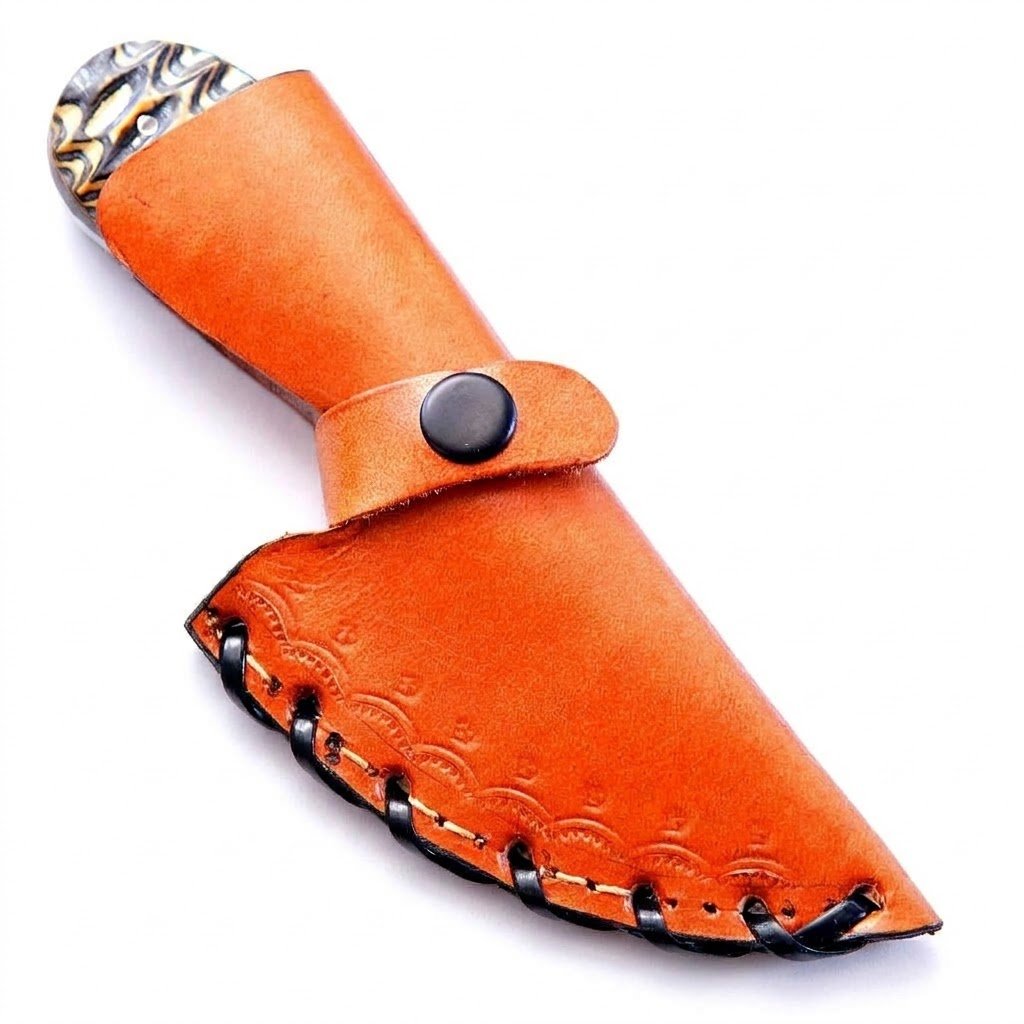
The knife is shown with a warm orange-brown sheath, creating a classic combination of patterned metal, contrasting handle colors, and traditional outdoor styling. Its distinctive appearance makes it an interesting option for knife enthusiasts, collectors, and customers searching for a visually unique hunting-style blade.
Patterned Handle Damascus Skinning Knife Design
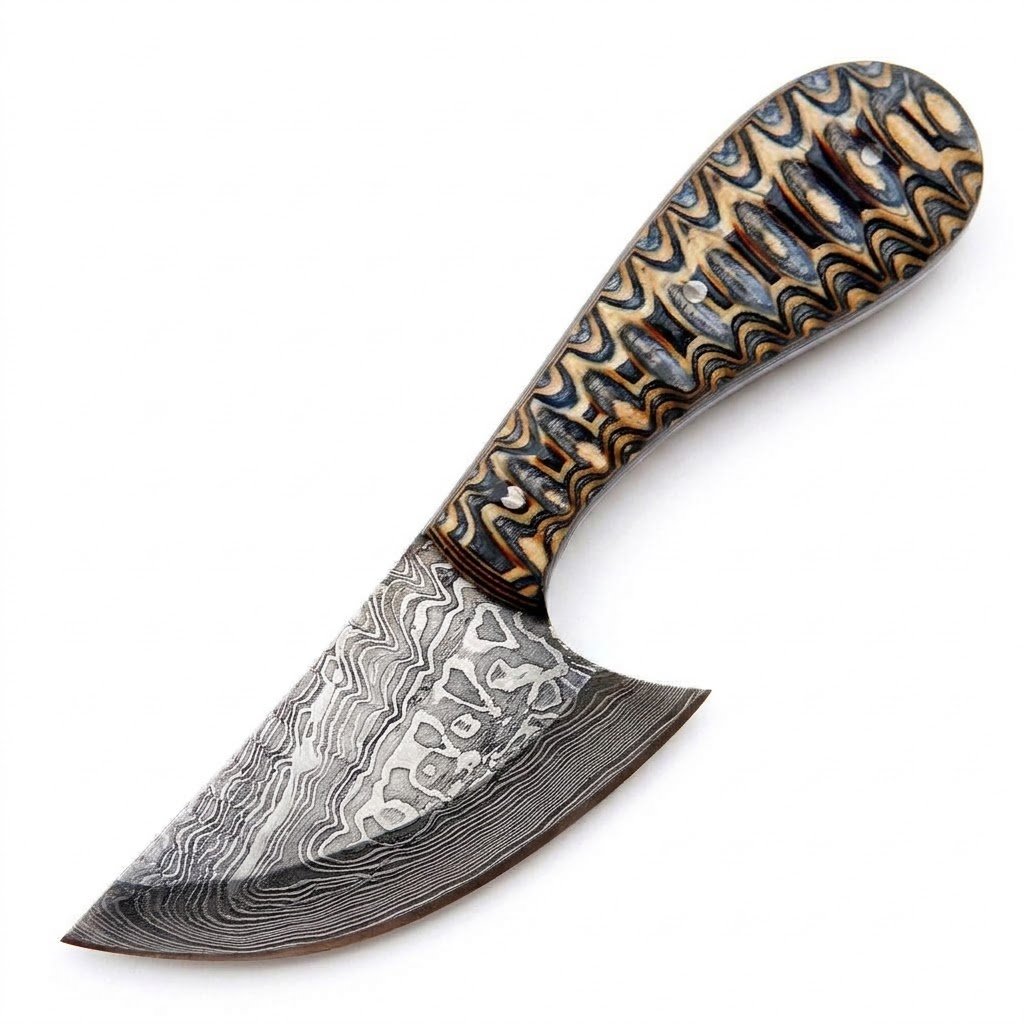
The first noticeable feature of this knife is its broad blade with a pronounced curve along the cutting edge. This blade profile resembles traditional skinning knives, which are recognized by their sweeping edge and rounded front portion.
The steel-colored surface features intricate dark and light lines that flow across the blade. These patterns create the familiar appearance associated with Damascus-style knives.
The upper section features irregular shapes and layered-looking formations, while the lower section displays closely spaced flowing lines that follow the blade’s curved profile.
This contrast creates a distinctive visual finish without adding unnecessary decorative hardware to the blade.
The blade transitions into a striking patterned handle that combines several contrasting tones. The brown sheath complements the overall design and provides a matching accessory for the knife.
Distinctive Damascus-Style Blade Pattern
The patterned blade is one of the most recognizable elements of this product.
Its surface displays multiple flowing lines in dark gray and silver tones. The patterns vary across the blade, creating a combination of irregular shapes and closely arranged waves.
Near the center, the lines form rounded and swirling designs. Toward the cutting edge, the pattern becomes more continuous and follows the blade’s sweeping profile.
These details create an attractive contrast between the patterned surface and the visible edge.
Damascus-patterned knives are appreciated for their decorative appearance, but the term can describe different manufacturing methods. Some blades are produced using layered steels, while others feature patterns created through surface finishing.
The actual manufacturing method of this knife has not been confirmed.
Its material composition, layer count, hardness, and heat treatment should be verified with the manufacturer before being included as product specifications.
For customers interested in decorative blade finishes, this knife offers a visually detailed alternative to plain metal designs.
Broad Curved Skinning-Style Blade
The knife features a broad blade that curves toward a slightly raised point.
This style is commonly associated with skinning knives and other traditional outdoor cutting tools.
The pronounced belly of the blade gives it a distinct shape compared with straight-edged utility knives.
Its front portion curves smoothly into the tip, while the upper spine narrows toward the front.
The blade appears relatively compact in relation to the handle, although its actual dimensions cannot be determined accurately from the image.
The curved profile is an important part of the knife’s appearance and contributes to its traditional hunting-knife character.
Actual cutting performance depends on factors such as blade thickness, edge geometry, steel composition, and sharpening condition.
These details should be checked against the manufacturer’s specifications before selecting the knife for a particular task.
Decorative Multicolored Handle
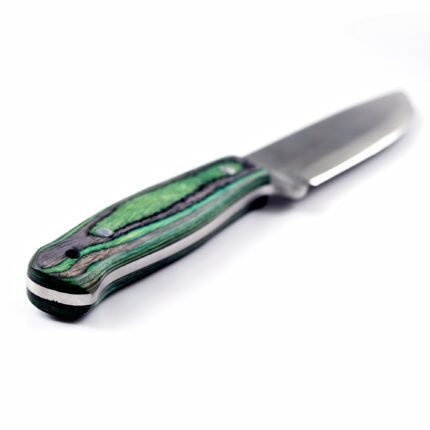
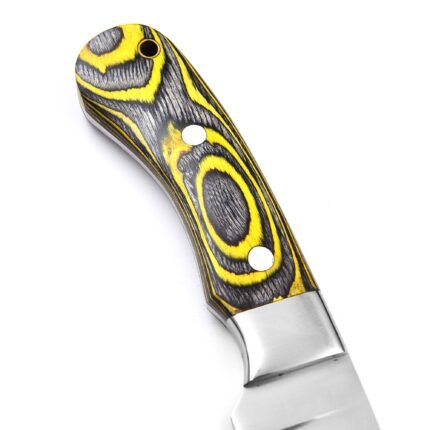
A major feature of this knife is its unusual patterned handle.
The handle combines cream, tan, brown, and black tones in a continuous decorative design.
Its surface includes repeating curved shapes, darker oval-like markings, and flowing lines that create a detailed appearance.
The dark areas contrast with the lighter background, producing a distinctive pattern that stands out against the silver and gray blade.
Unlike a plain wooden handle, this design places considerable visual emphasis on the grip.
The pattern extends along most of the handle, from the area near the blade to its rounded rear end.
The exact handle material cannot be identified from the image. It may be a decorative composite or another material with a patterned finish.
It should not be advertised as natural bone, wood, horn, or resin without supplier confirmation.
Contoured Handle Profile
The handle has a slightly curved shape that follows the overall design of the knife.
Its upper and lower edges are shaped rather than completely straight, creating a sculpted appearance.
The front portion narrows toward the blade, while the rear section becomes more rounded.
This shape visually complements the curved cutting edge.
Small circular metal-colored fittings are visible on the handle, adding subtle decorative details to the surface.
The grip’s suitability for different hand sizes cannot be established from the photograph alone.
Handle thickness, surface texture, balance, and overall dimensions influence how a knife feels during use.
Customers should confirm these measurements when comparing this model with other fixed-blade knives.
Traditional Fixed-Blade Construction
The knife has a fixed-blade design, meaning the blade does not fold into the handle.
Fixed-blade knives are recognized by their straightforward structure and are available in many styles, from outdoor cutting tools to decorative collector models.
This product follows a traditional skinning-knife silhouette rather than a folding pocket-knife design.
The visible transition from blade to handle is relatively simple, keeping attention on the decorative finish and curved edge.
The image does not reveal the internal handle structure or the full length of the tang.
Consequently, the knife should not be described as having a full tang unless the manufacturer confirms that construction.
Similarly, blade thickness, weight, and precise dimensions should be listed only after they are verified.
Brown Leather-Style Sheath
The knife is photographed with a warm orange-brown sheath that complements its decorative handle.
The sheath has a smooth leather-like surface with decorative tooling and visible stitching.
Its outer edge includes darker reinforcement and contrasting stitching details.
A short fastening strap extends across the upper section and features a large black snap fastener.
The sheath’s rich brown color creates a traditional appearance associated with outdoor knife accessories.
Its shape appears designed to accommodate the broad curved blade.
The sheath provides an attractive presentation when displayed beside the knife.
However, the exact sheath material is not confirmed by the photograph. Genuine leather, synthetic leather, and other leather-like materials can have similar appearances.
Before publication, confirm the material and whether the sheath is included as standard with every order.
Traditional Hunting Knife Appearance
The combination of a curved blade, patterned grip, and warm brown sheath gives this knife a recognizable hunting-style appearance.
The design takes inspiration from traditional outdoor cutlery while adding a more decorative finish.
The blade’s dark and silver pattern contrasts with the lighter cream and brown areas of the handle.
The orange-brown sheath introduces another complementary color without overwhelming the overall presentation.
These visual elements give the product a coordinated, traditional character.
The design may appeal to people who appreciate unusual handle finishes and patterned blades.
It can also complement a collection of decorative fixed-blade knives and classic outdoor accessories.
Ornamental Blade and Handle Combination
Many knife designs emphasize either the blade finish or the handle material.
This model gives considerable attention to both.
The blade features intricate layered-looking patterns, while the handle displays a bold decorative surface.
The two patterns are different but visually complementary.
The darker handle markings echo the dark lines across the blade, creating a consistent appearance.
The lighter cream-colored portions balance the gray and silver blade tones.
A small number of metal-colored fittings introduce another subtle detail.
The result is a knife with an intricate appearance that remains recognizable as a traditional skinning-style blade.
For customers comparing different collectible knife designs, this combination is one of its most distinguishing visual characteristics.
Suitable for Knife Collectors
Collectors often consider the shape, decorative detailing, finish, and overall presentation of a knife.
This model offers several distinctive features in those areas.
The broad blade creates a recognizable silhouette, while its flowing metal pattern adds visual interest.
The patterned handle provides a contrasting design that distinguishes it from plain wood-finished or black-handled knives.
The sheath also contributes to the traditional character of the product.
These features may appeal to customers interested in decorative knife collections, traditional hunting styles, and patterned cutlery.
As with any collectible cutting tool, the buyer should verify the manufacturing details, materials, and origin rather than relying on appearance alone.
Outdoor-Style Design Considerations
Skinning-style knives are commonly associated with outdoor activities and field dressing.
Their broad, curved blades distinguish them from narrow utility knives.
This product shares that visual profile, but the photograph does not verify its suitability for particular outdoor cutting tasks.
Its actual application depends on the confirmed blade specifications and construction.
Before buying for practical use, customers should consider the blade steel, edge condition, handle material, dimensions, and sheath fit.
Customers should also determine whether the knife’s decorative finish requires special maintenance.
The appearance alone cannot establish corrosion resistance, durability, or cutting performance.
The manufacturer should provide those details where available.
Compact and Distinctive Proportions
The blade and handle appear proportioned to form a relatively compact knife.
The broad blade is balanced visually by a longer, rounded handle.
The cutting edge curves smoothly, giving the knife a flowing profile.
The handle narrows toward the front before widening at the rear.
This arrangement gives the product a distinctive silhouette when photographed from the side.
The blade appears wider than the handle in certain sections, which is characteristic of many skinning-style designs.
Its actual overall length and blade-to-handle measurements should be confirmed before describing the knife as a specific size.
Photographs without a measurement reference cannot establish exact dimensions.
An Attractive Display Piece
The decorative blade and patterned handle make this model visually interesting.
The contrasting materials and finishes are noticeable even when viewed against a simple background.
Its curved edge gives the blade a recognizable outline, while the patterned surface creates additional detail at closer viewing distances.
The handle includes a repeating decorative design with both light and dark areas.
Together, these features provide an attractive appearance for a traditional knife collection.
The brown sheath creates a coordinated presentation when placed alongside the knife.
Collectors who appreciate unusual handle patterns and classic fixed-blade shapes may find this design particularly appealing.
General Cleaning and Maintenance
Proper care is important for maintaining the appearance of a patterned knife.
After handling, wipe the blade with a clean, dry cloth.
Remove moisture and visible residue before storing it.
Avoid leaving the knife in damp conditions for prolonged periods.
The appropriate cleaning products depend on the actual steel composition and surface finish.
For decorative blade patterns, avoid harsh abrasive materials that could affect the finish.
Clean the handle with a method suitable for its confirmed material.
Some decorative handle materials may be sensitive to strong cleaning chemicals or excessive heat.
The sheath should also be kept clean and dry.
If the manufacturer confirms genuine leather construction, use care products intended for that type of leather.
Store the knife securely with its cutting edge protected, and keep it away from children and unauthorized users.
Important Product Specifications to Confirm
Before purchasing or publishing technical details, confirm the following information with the manufacturer:
- Actual blade steel and manufacturing method
- Overall length and blade length
- Blade thickness and weight
- Edge type and blade hardness
- Handle material and construction
- Tang configuration
- Sheath material and included accessories
- Available product variations
- Manufacturer’s intended applications
- Care and maintenance requirements
These specifications can help buyers compare this knife with other hunting-style models.
They are also important when ordering custom products or evaluating supplier quotations.
Until confirmed, the product should be described using its visible characteristics rather than unsupported performance claims.
A Distinctive Addition to a Traditional Knife Collection
The Patterned Handle Damascus Skinning Knife combines a broad, curved blade with a visually detailed pattern, sculpted multicolored handle, and matching brown sheath.
Its overall appearance reflects traditional hunting-style cutlery while introducing decorative elements that distinguish it from simpler fixed-blade designs.
The contrasting patterns across the blade and handle create a memorable visual combination.
For collectors and enthusiasts who appreciate patterned blades, unusual handle finishes, and classic outdoor knife styling, this model offers an appealing design worth exploring.
Discover this distinctive skinning-style knife and its traditional decorative character.




Reviews
There are no reviews yet.