


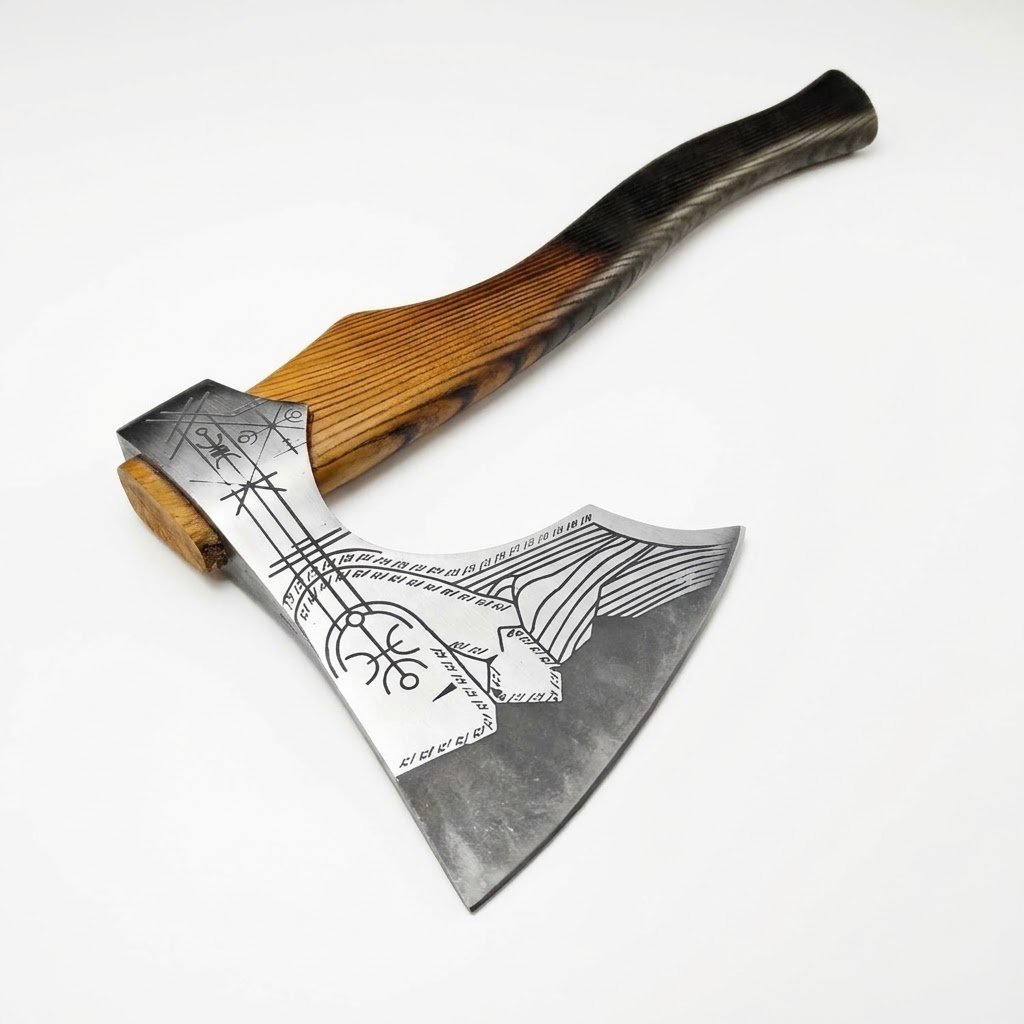
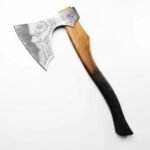
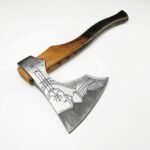

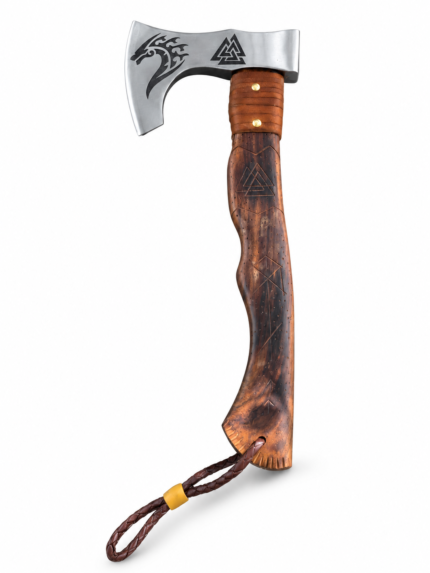
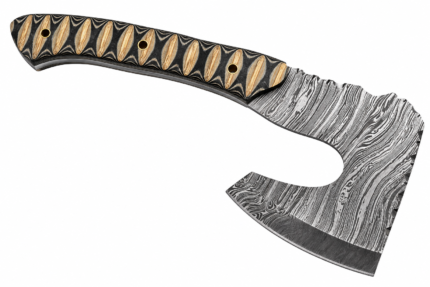
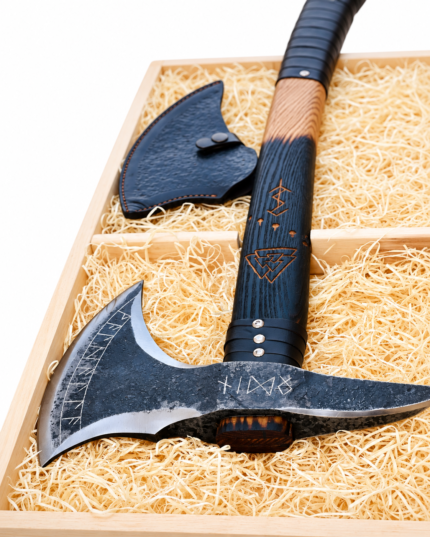
Engraved Viking Axe with Two-Tone Wooden Handle is a Nordic-inspired axe featuring a distinctive silver-toned head, intricate geometric markings, and a long curved handle with contrasting natural wood and dark finishes. Designed with traditional Viking-style influences, this axe combines a recognizable historical-inspired silhouette with decorative detailing.
Its broad curved cutting edge, polished-looking metal surface, and patterned axe head create an attractive appearance for collectors and enthusiasts of traditional axe designs. The warm wooden handle and darker lower section complete the classic aesthetic.
Whether displayed in a collection of Nordic-inspired equipment or considered for a historical-themed presentation, the axe offers a distinctive combination of decorative metalwork and traditional wooden-handle styling.
Traditional Engraved Viking Axe Design
The Engraved Viking Axe stands out for its unusual head profile and contrasting handle finish.
The axe head has a wide, curved cutting edge that extends downward from a narrower upper section. This creates a shape associated with certain traditional Nordic and bearded-style axe designs.
Its silver-colored surface features dark geometric engravings arranged across the head.
The decoration includes intersecting lines, circular forms, and angular symbols reminiscent of Nordic-inspired artwork.
These markings provide visual contrast against the lighter metal background.
The handle extends below the head in a long, gently curved shape.
The upper section displays natural-looking golden-brown wood grain, while the lower section gradually transitions into a darker, almost black finish.
Together, these features create an axe with an eye-catching appearance and a clear traditional influence.
Distinctive Silver-Toned Axe Head
One of the most noticeable features of this axe is its decorative metal head.
The surface appears silver-gray with a combination of smooth-looking sections and darker engraved patterns.
The markings cover portions of the axe cheek and extend toward the upper head.
These geometric details give the product a unique appearance compared with plain axe designs.
The lower section of the head curves downward, forming an extended cutting-edge profile.
This broad shape is commonly associated with bearded axes, although the exact classification of this model should be confirmed by its manufacturer.
The edge appears brighter than several surrounding portions of the head.
However, the photograph alone cannot establish the steel composition, edge sharpness, hardness, or heat-treatment quality.
Before publishing technical claims, these specifications should be confirmed with the supplier.
Nordic-Inspired Decorative Engravings
The axe head includes several decorative markings that contribute to its traditional appearance.
Fine intersecting lines create angular patterns near the top.
Circular and branching forms appear across the central section.
Additional linear patterns continue toward the lower portion of the axe head.
Together, these elements resemble the geometric ornamentation often used in modern Viking-inspired products.
The markings should be described as Nordic-style or Viking-inspired designs rather than authenticated historical runes.
The symbols’ precise meanings and historical accuracy have not been established.
For collectors who appreciate decorative metalwork, the engraved appearance is one of the product’s main visual attractions.
The combination of dark lines and silver-colored metal gives the head a distinctive finish without relying on bright colors or excessive ornamentation.
Long Wooden Handle with Two-Tone Finish
The handle is another prominent feature of this axe.
It appears to be constructed from wood and displays a clearly visible grain pattern throughout much of its length.
The upper portion has a golden-brown color that highlights the natural-looking grain.
The handle gradually becomes darker toward the lower section.
This dark finish extends over the lower grip and ends in a slightly widened base.
The contrast between the natural golden-brown surface and dark lower finish gives the axe a recognizable appearance.
The shaft also has a gently curved profile rather than a completely straight shape.
This curvature contributes to its traditional style.
The photograph does not confirm the type of wood used.
Specific descriptions such as ash, hickory, oak, or rosewood should only be added after checking the manufacturer’s material specifications.
Traditional Curved Handle Profile
The axe features a long handle with a slight outward curve toward the lower end.
This design gives the product a classic silhouette.
The handle appears relatively narrow around the upper section and follows a gradual curve toward the bottom.
The base has a widened, rounded shape.
This profile visually complements the broad metal head.
For customers interested in traditional axe design, the shaft shape is an important distinguishing feature.
Actual handling comfort, balance, and suitability for practical use depend on dimensions, weight distribution, material quality, and head attachment.
These details cannot be verified from a photograph.
Customers who intend to use the axe for outdoor work should confirm the manufacturer’s intended-use guidance.
Contrasting Natural and Dark Wood Appearance
The two-tone finish creates a distinctive visual effect.
The upper section features warm golden and honey-brown tones.
Visible grain lines extend along the handle, creating a striped appearance.
The middle portion gradually transitions into deeper brown.
The lower part appears dark brown to black.
This color transition gives the handle a decorative finish while preserving the appearance of wood grain.
It also creates a clear contrast with the silver-colored head.
The photograph does not establish whether the darker section was stained, burned, painted, or treated using another finishing process.
For accurate product information, the finishing method should be confirmed before making specific manufacturing claims.
Broad Curved Cutting Edge
The axe head features a relatively broad cutting-edge profile.
The edge curves outward from the upper corner and extends downward toward the lower point.
This shape contributes to its Viking-inspired appearance.
The darker body and lighter edge create visible contrast across the metal surface.
Broad axe-head profiles have appeared in various historical and modern cutting-tool designs.
However, the actual cutting characteristics of this model depend on factors such as edge geometry, metal composition, head thickness, and heat treatment.
The image does not establish those characteristics.
Customers considering the axe for practical woodcutting should verify that it is manufactured and rated for that purpose.
A decorative or display-oriented axe should not automatically be considered suitable for chopping or other high-impact work.
Classic Historical-Inspired Appearance
This axe takes visual inspiration from traditional Nordic and Viking-era equipment.
Its broad head, curved shaft, and dark decorative markings produce a recognizable historical-style appearance.
The design does not need excessive ornamentation to stand out.
Instead, its visual character comes from the relationship between the metal head and natural-looking handle.
The geometric engravings introduce decorative detail.
The contrasting wooden finish adds warmth.
The overall shape resembles the historical-inspired axes commonly collected by enthusiasts of medieval and Nordic equipment.
This makes the model particularly relevant for customers exploring decorative Viking axes and traditional axe designs.
It should not be advertised as an authentic historical reproduction without supporting documentation.
Attractive for Axe Collectors
Collectors often look for distinctive design features when comparing axe models.
The Engraved Viking Axe offers several visual details worth considering.
The broad silver-colored head contrasts with the wooden shaft.
The dark engravings create intricate patterns across the metal surface.
The curved handle adds an unusual silhouette.
The transition from golden-brown wood grain to a darker finish creates another identifying feature.
Together, these details give the axe a recognizable decorative style.
It may appeal to collectors who appreciate traditional designs, Nordic-inspired artwork, and distinctive metalwork.
The model can also complement a collection featuring other engraved axes, historical-style hatchets, and Viking-themed accessories.
Decorative Display Potential
Because of its distinctive appearance, the axe may be suitable as a display piece when mounted and secured appropriately.
Its silver head and contrasting handle offer a combination of light and dark surfaces.
The geometric markings provide additional visual interest when viewed closely.
A secure display arrangement can make these details easier to appreciate.
The product may suit themed collections, decorative displays, or historical-inspired presentations.
However, any wall mount or display fixture should be appropriate for the axe’s verified weight and dimensions.
Sharp edges must remain protected.
The axe should be kept away from children and stored securely.
Design Features Visible in the Image
The uploaded image clearly shows the following characteristics:
- A single silver-colored axe head
- A broad, curved cutting-edge profile
- Dark Nordic-inspired geometric decorations
- A long, gently curved handle
- Visible golden-brown wood grain
- A gradual transition into a dark lower handle
- A slightly widened lower handle end
- A contrasting silver, brown, and black color combination
- A traditional Viking-inspired overall silhouette
These visible details provide a useful foundation for the product listing.
The photograph does not establish the axe’s dimensions, exact weight, steel composition, or manufacturing process.
A protective sheath is also not visible in the uploaded image.
The seller should confirm whether any protective cover or additional accessory is included.
Understanding the Axe Head Material
The metal head is an important part of any axe.
Different metal grades and heat-treatment processes can influence the way an axe performs.
However, the visible silver-colored head does not identify a particular alloy.
It should not automatically be classified as high-carbon steel, stainless steel, or Damascus steel.
The photograph also does not confirm whether the head was forged, cast, machined, or produced using another process.
For customers interested in practical use, these details matter.
A complete specification sheet should identify the metal grade, manufacturing method, heat treatment, and recommended application.
Until that information is available, the most accurate description is a silver-toned metal axe head featuring decorative geometric engravings.
Handle Material and Finish
The handle appears wooden and includes clearly visible grain.
Its warm upper color and dark lower section create the product’s two-tone appearance.
Wooden handles are commonly associated with traditional axes because of their familiar appearance and historical use.
However, material composition and finishing methods vary between manufacturers.
The exact handle material should be confirmed before making claims about strength, durability, flexibility, or moisture resistance.
The photograph also does not reveal how the head is secured to the handle.
Head attachment should be inspected and verified before any practical use.
General Care and Maintenance
Proper care helps preserve the appearance of decorative axes.
Keep the metal head clean and dry.
After handling, remove dust, fingerprints, and moisture using a suitable soft cloth.
Avoid aggressive polishing methods that could damage engraved details or surface treatments.
If the manufacturer confirms a carbon-steel head, follow its recommended corrosion-prevention procedure.
The wooden-looking handle should also be kept clean and protected from excessive moisture.
Do not expose the handle to unnecessary heat or harsh chemicals.
The appropriate cleaning products will depend on the confirmed wood species and surface treatment.
Inspect the head-to-handle connection regularly if the axe is rated for practical use.
Keep any cutting edge covered during storage or transport.
Store the axe securely in a dry location.
Important Specifications to Confirm
Customers considering this axe should have access to accurate technical specifications.
The manufacturer should confirm the overall length, head width, cutting-edge length, head weight, and total weight.
The metal grade and hardness should also be documented if the axe is intended for practical use.
Handle material, finishing method, and head attachment construction are other useful details.
Information about included accessories should be provided separately.
These specifications help customers compare products and understand whether a model is intended for decoration, collection, or practical outdoor use.
Accurate technical information is more useful than unsupported claims about strength or performance.
Why Choose This Engraved Viking Axe?
The most attractive feature of this design is the combination of its traditional silhouette and decorative finish.
The broad curved head features intricate Nordic-style markings.
The silver surface contrasts with darker engraved sections.
The long wooden-looking handle displays warm golden-brown grain and a dark lower finish.
Together, these features give the product a distinctive appearance.
For collectors and enthusiasts who enjoy historical-inspired axe designs, these details make the model worth exploring.
Explore the Engraved Viking Axe Collection
The Engraved Viking Axe with Two-Tone Wooden Handle combines a decorative silver-toned head, traditional broad cutting-edge profile, distinctive geometric engravings, and a long curved shaft with contrasting natural and dark finishes.
Its classic Nordic-inspired appearance makes it an attractive addition to a collection of decorative axes and traditional equipment.
Explore this model for its engraved detailing, distinctive wooden-handle finish, and recognizable Viking-inspired style.








Reviews
There are no reviews yet.