





Engraved Viking Bearded Axe with Curved Wooden Handle
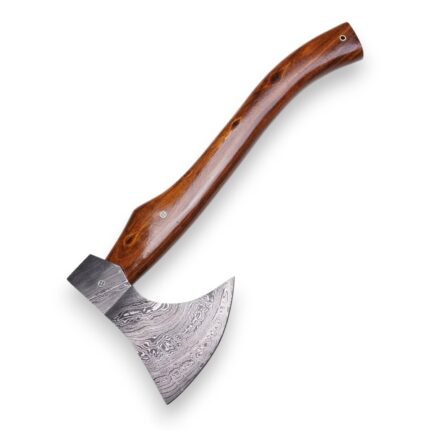
The Engraved Viking Bearded Axe with Curved Wooden Handle combines an eye-catching Nordic-inspired design with a distinctive axe-head profile and richly contrasting wood tones. Featuring an intricate Celtic-style pattern across its metal head, a curved cutting-edge silhouette, a pointed rear spike, and a long wooden-looking handle, this axe offers an attractive traditional aesthetic for collectors, historical-style displays, and enthusiasts of Viking-inspired craftsmanship.
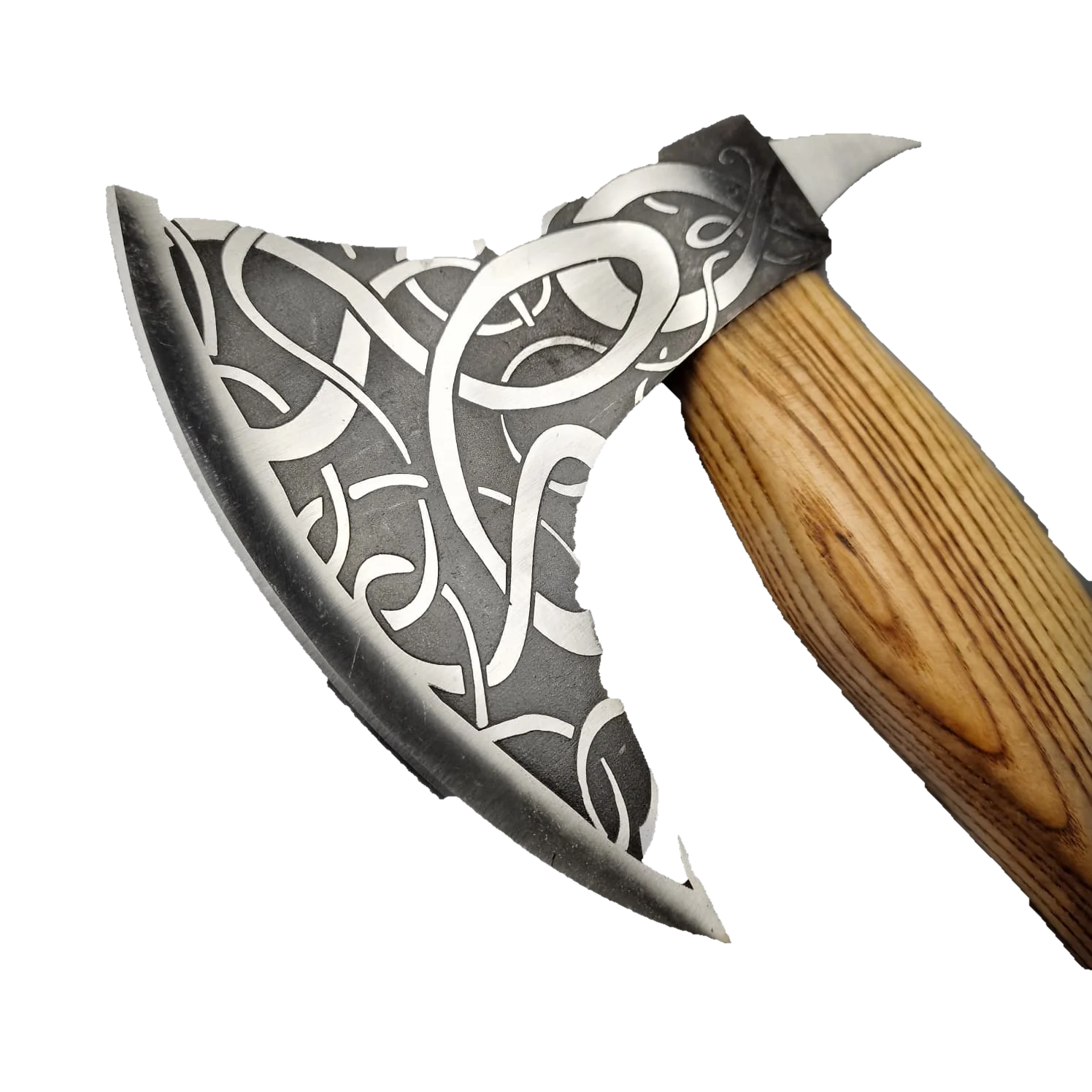
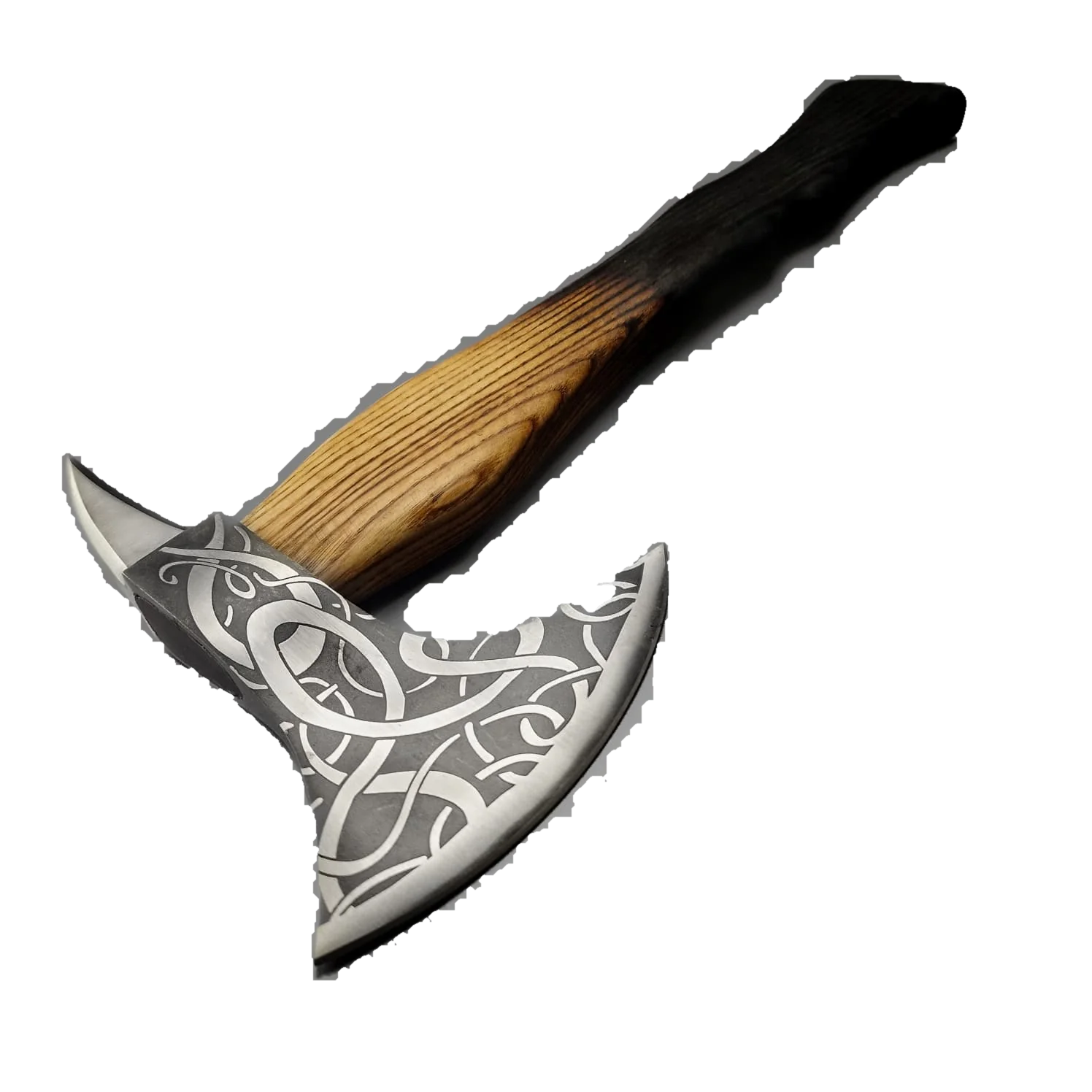
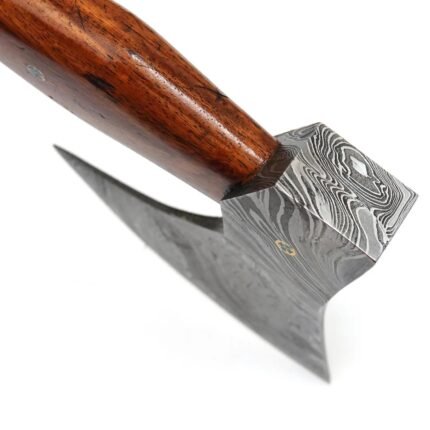
The most noticeable feature is the ornamental axe head. Its dark gray surface carries flowing silver interlaced patterns that resemble Celtic knotwork. These decorative lines extend across the main body of the head, creating an elaborate visual texture that contrasts with the smooth silver-colored cutting edge.
A rear projection curves upward to form a pointed spike-like shape, giving the axe a more dramatic silhouette than a conventional woodcutting hatchet.
The handle adds another distinctive element. Its upper section has a golden-brown wood-grain appearance, while the lower section becomes progressively darker. This transition gives the handle a naturally aged, burnt-wood style.
Together, the decorative head and curved two-tone handle create a striking Viking-inspired axe design.
A Distinctive Viking-Inspired Axe Design
Viking-style axes are recognized for their association with historical Scandinavian craftsmanship and their characteristic axe-head shapes.
Modern interpretations often combine traditional silhouettes with elaborate ornamental elements.
This design follows that decorative tradition.
Its wide blade extends downward below the head’s central mounting area, creating a bearded-style appearance. The blade has a strongly curved cutting edge that widens from the upper corner before tapering toward the lower tip.
The result is a pronounced, sweeping profile.
Unlike an ordinary utility hatchet with minimal surface detail, this axe emphasizes its decorative metalwork and the contrasting appearance of its handle.
Its curved wooden-looking shaft also gives the design a distinctive form.
The overall presentation suits customers interested in traditional Nordic aesthetics, historical-inspired accessories, and ornamental metalwork.
While the visual design is Viking-inspired, the photograph does not establish that the axe is a historically accurate reproduction.
Intricate Celtic Knot Engraving
The axe head features a decorative arrangement of interlaced silver-colored lines against a darker metal background.
These lines loop, overlap, and curve around one another, creating an intricate Celtic-style knotwork appearance.
The design spreads across the broad blade face and continues toward the upper head.
This consistent arrangement gives the ornamentation a unified look rather than making it appear as several unrelated decorative elements.
The pattern is especially noticeable because of the contrast between the lighter lines and dark metal finish.
The curved sections follow the overall shape of the blade, emphasizing its broad cutting-edge profile.
Customers who appreciate traditional decorative metalwork may find these details particularly attractive.
The exact manufacturing process used to create the pattern is not visible.
It may involve engraving, etching, or another surface-decoration technique.
Until confirmed by the manufacturer, it is best described as an engraved-looking or etched-looking Celtic knot pattern.
Broad Bearded Axe Blade
The axe features a wide head with a distinctively extended lower cutting section.
This shape resembles the bearded-axe profile traditionally associated with certain historical axe designs.
The cutting edge follows a broad curve, with the lower part extending farther downward than the narrow section near the handle.
The shape gives the head a recognizable outline.
A bright silver-colored band runs along the visible cutting edge.
This contrasts with the darker patterned section and makes the blade outline especially prominent.
The silver finish also provides a visual boundary between the decorated face and the edge.
The photograph does not establish the sharpness, thickness, hardness, or exact cutting-edge dimensions.
These characteristics would need to be confirmed through manufacturer specifications.
The axe should not be described as suitable for heavy-duty cutting or woodworking without appropriate verification.
Pointed Rear Spike Detail
Behind the main axe head, a narrow metallic projection extends upward and backward.
The projection has a pointed, curved shape.
This creates a distinctive rear-spike appearance that contributes significantly to the design.
The bright upper portion contrasts with the darker patterned metal near the center.
Together with the broad front blade, the rear projection produces a balanced but dramatic silhouette.
This detail distinguishes the axe from conventional flat-backed hatchets.
The projection also gives the product a more ornamental, fantasy-influenced Nordic appearance.
Its actual intended purpose and functional strength cannot be determined from the image.
For accurate product information, customers should rely on verified manufacturer descriptions rather than assumptions based on its appearance.
Contrasting Silver and Dark Metal Finish
The axe head combines different metallic shades to create visual depth.
The darker areas appear charcoal gray to nearly black.
Silver-colored decorative patterns cross these dark sections.
The cutting edge has a lighter finish, which makes the outer curve stand out.
The rear spike also features a reflective silver-toned section.
These contrasting finishes emphasize the shape and decorative details of the head.
The result is a visually detailed axe with a traditional ornamental character.
Because the surface contains both dark and bright areas, the metalwork remains noticeable against a simple background.
The photograph shows the external finish but does not identify the underlying metal composition.
The exact steel grade, protective coating, and surface treatment should be confirmed with the supplier.
Long Curved Wooden-Look Handle
Another prominent feature is the long, gently curved handle.
The handle extends downward from the head and gradually changes direction, giving the axe a sweeping overall profile.
Its surface has visible wood-grain lines running along its length.
Near the axe head, the handle displays warm golden-brown and amber tones.
These colors become darker farther down the shaft.
The lower section appears deep brown to nearly black.
This gradual transition provides a strong contrast against the silver-and-black head.
The handle also widens slightly toward its lower end, creating a flared appearance.
These details make the handle an important visual element rather than simply a support for the head.
The actual wood species, finishing method, and construction are not verified from the image.
Two-Tone Wood-Grain Finish
The two-tone finish contributes to the axe’s rustic appearance.
The lighter upper section displays highly visible grain lines in shades of gold, brown, and amber.
Toward the middle, darker streaks become more prominent.
The lower section has a nearly black finish while retaining the appearance of longitudinal grain.
This combination creates an aged or scorched-wood aesthetic.
It also complements the dark background of the axe-head engraving.
The gradual tonal transition appears intentional and gives the handle a cohesive visual design.
A two-tone finish can be especially appealing to collectors who prefer rustic styling over uniformly colored handles.
However, the image cannot confirm whether the darker section was created through wood burning, staining, paint, or another finishing process.
For accuracy, the product should be described as having a burnt-wood-style or dark-gradient finish.
Curved Handle Profile
The shaft does not follow a perfectly straight line.
Instead, it curves gently from the head toward the lower grip section.
Its contours give the overall axe a flowing shape.
The handle is relatively narrow near the head, fuller through its central portion, and slightly flared toward the end.
This adds visual balance to the broad axe head.
The curved profile contributes to the traditional-looking appearance.
It also makes the product more visually distinctive than a basic straight-handled hatchet.
Although the shape may influence how the axe feels when held, actual grip comfort and balance cannot be established through a product image.
Those characteristics depend on dimensions, weight distribution, surface finish, and construction.
Customers seeking a functional working axe should confirm these specifications before purchasing.
Traditional Nordic and Celtic Visual Influences
The axe combines several design elements commonly associated with modern Viking-inspired products.
The broad bearded-style head references a recognizable historical axe silhouette.
The interlaced pattern resembles Celtic knotwork.
The curved wooden-looking handle adds a rustic character.
The pointed rear spike introduces an additional dramatic detail.
These features create a decorative interpretation of a traditional Nordic-style axe.
Celtic knotwork is frequently used in ornamental metalwork because its interwoven lines create continuous patterns.
On this axe, those patterns provide contrast against the darker metal surface.
The design may appeal to customers who enjoy Viking-themed decorative items or historical-style collections.
It is important, however, to distinguish modern Nordic-inspired styling from verified historical authenticity.
Without manufacturing documentation, the product should not be presented as an exact replica of a particular historical weapon.
A Decorative Addition to a Collection
Collectors often look for pieces that have distinctive silhouettes and memorable decorative details.
This axe offers several elements that can make it visually interesting.
Its wide blade and rear spike create an unusual head profile.
The silver Celtic-style pattern provides detailed surface decoration.
The curved handle introduces a natural-looking material contrast.
The golden-brown and dark wood tones complement the head’s metallic finish.
Together, these elements give the axe a coordinated appearance.
It may be suitable for consideration as part of a Viking-inspired decorative collection, provided it is stored and displayed safely.
A secure display stand or enclosed cabinet can help keep the axe stable.
The design also works visually with other rustic or Nordic-style decorative objects.
The specific mounting and display arrangements should be chosen according to the product’s actual weight and dimensions.
Suitable for Historical-Style Display
A themed display can benefit from objects that have recognizable design characteristics.
The axe’s silhouette makes its Viking-inspired character immediately visible.
Its ornate head provides a decorative focal point.
The handle contributes a contrasting warm and dark finish.
These features may make it attractive for private collections, themed interiors, and carefully managed exhibitions.
The product should be displayed in a secure position that prevents accidental contact with any sharp surfaces.
If the axe is being used as a historical-style display item, its description should remain accurate about its modern design influences.
It should not be advertised as an archaeological reproduction without evidence supporting that classification.
The exact dimensions and weight should also be confirmed before planning wall-mounted displays.
An Interesting Gift for Axe Collectors
For customers who appreciate decorative axes and traditional metalwork, this product offers a distinctive visual presentation.
The engraved-looking head immediately attracts attention through its contrasting pattern.
The wood-grain handle adds natural-looking texture.
The curved profile creates a recognizable silhouette.
These details may appeal to collectors who enjoy Viking-inspired designs.
It can also be considered as a collectible gift where possession and sale are lawful.
When selecting such an item as a gift, customers should consider the recipient’s collecting interests and available safe storage.
The presentation and any included packaging should be confirmed before purchase.
No gift box, sheath, mounting accessory, or other additional item is visible in the uploaded photograph.
Therefore, these accessories should not be claimed as included.
Understanding the Axe Head Material
The photograph shows a metallic axe head with decorative surface markings.
However, visual appearance alone is insufficient to determine the metal grade.
Similar-looking axe heads may be made from different steel alloys.
They may also use different finishing and manufacturing processes.
The exact head material can affect corrosion resistance, maintenance requirements, and performance.
For this reason, the seller should confirm the steel specification before publishing technical claims.
If the supplier identifies a particular carbon steel or stainless steel grade, that information can be added to the product specifications.
The same applies to any stated hardness rating or heat-treatment process.
Until these details are verified, the accurate description is a metal axe head with a silver-and-dark decorative finish.
Understanding the Handle Material
The handle has a natural wood-grain appearance.
Its surface displays multiple visible grain lines and variations in color.
The warm upper section and dark lower section create a distinctive visual effect.
Nevertheless, the photograph does not confirm the wood species.
Different woods can vary significantly in density, hardness, grain structure, and maintenance requirements.
It would therefore be inappropriate to advertise the handle as ash, oak, hickory, or another specific wood without documentation.
The attachment method between the head and handle is also not visible.
Manufacturer confirmation is important for anyone considering functional use.
Accurate material information helps customers understand both the appearance and maintenance needs of the product.
Product Care and Maintenance
Proper care can help preserve the external appearance of decorative metal and wooden components.
After handling, wipe the metal head carefully with a soft, dry cloth.
Avoid allowing moisture to remain on the surface for extended periods.
The correct protective treatment depends on the actual metal composition and finish.
Do not use abrasive products that could remove or damage the decorative pattern.
The wooden-looking handle should also be cleaned gently.
Avoid prolonged exposure to water, direct heat, or extreme humidity.
If the handle is genuine wood, follow the manufacturer’s recommended care method for the specific wood species and finish.
For long-term preservation, the axe should be stored in a dry and secure environment.
Safe Storage and Responsible Handling
An axe should always be treated as a potentially sharp object.
Keep the head away from accidental contact.
Do not leave it unsecured on shelves, tables, or walls.
If displayed, use an appropriate stand or mounting system that can safely support its weight.
Keep the product away from children and unauthorized users.
Inspect the head and handle for signs of loosening or damage before handling.
Do not use the axe for chopping, splitting, or other demanding tasks unless the manufacturer confirms that it is designed and tested for those applications.
If a protective blade cover is supplied, use it according to the manufacturer’s instructions.
Always follow applicable local laws concerning possession, transportation, and display.
Specifications to Confirm Before Purchase
For a complete and accurate product listing, the manufacturer should confirm the following information:
- Overall axe length
- Axe-head width and height
- Cutting-edge length
- Total weight
- Head material and steel grade
- Handle material and wood species
- Manufacturing and surface-decoration method
- Blade hardness, if applicable
- Head attachment construction
- Intended functional or decorative use
- Protective cover or sheath availability
- Packaging specifications
- Available customization options
- Country of manufacture
These details can help customers make informed purchasing decisions.
Why Choose This Engraved Viking Bearded Axe?
The Engraved Viking Bearded Axe with Curved Wooden Handle offers a distinctive appearance through its combination of traditional-looking shapes and elaborate decorative elements.
Its broad axe head features intricate silver-colored Celtic-style patterns against a dark metal background.
The polished-looking cutting edge creates additional contrast.
A pointed rear projection adds to the unusual silhouette.
The long curved handle displays warm golden-brown grain near the head and a dark finish toward the lower end.
These elements work together to create an attractive Nordic-inspired design.
The product may appeal to collectors who appreciate traditional-style axes, decorative metalwork, and rustic wooden finishes.
Explore This Distinctive Viking-Inspired Axe
The Engraved Viking Bearded Axe with Curved Wooden Handle brings together a sweeping blade profile, Celtic-style ornamentation, contrasting metallic finishes, and a distinctive two-tone handle.
Its traditional-inspired appearance makes it an interesting addition to a collection of decorative axes and historical-style objects.
Explore this Viking-inspired axe to discover its distinctive design and request complete specifications for its construction, materials, and available configurations.





Reviews
There are no reviews yet.