


Rasp Steel Hunting Knife with Decorative Handle and Leather Sheath
Introduction to the Rasp Steel Hunting Knife
The Rasp Steel Hunting Knife combines traditional fixed blade styling with an eye-catching patterned steel blade, a decorative green and gold handle, and a beautifully detailed leather sheath. Designed with a broad curved cutting profile and distinctive finishing elements, this knife offers a recognizable appearance for outdoor equipment collections, traditional knife enthusiasts, and specialty product displays.
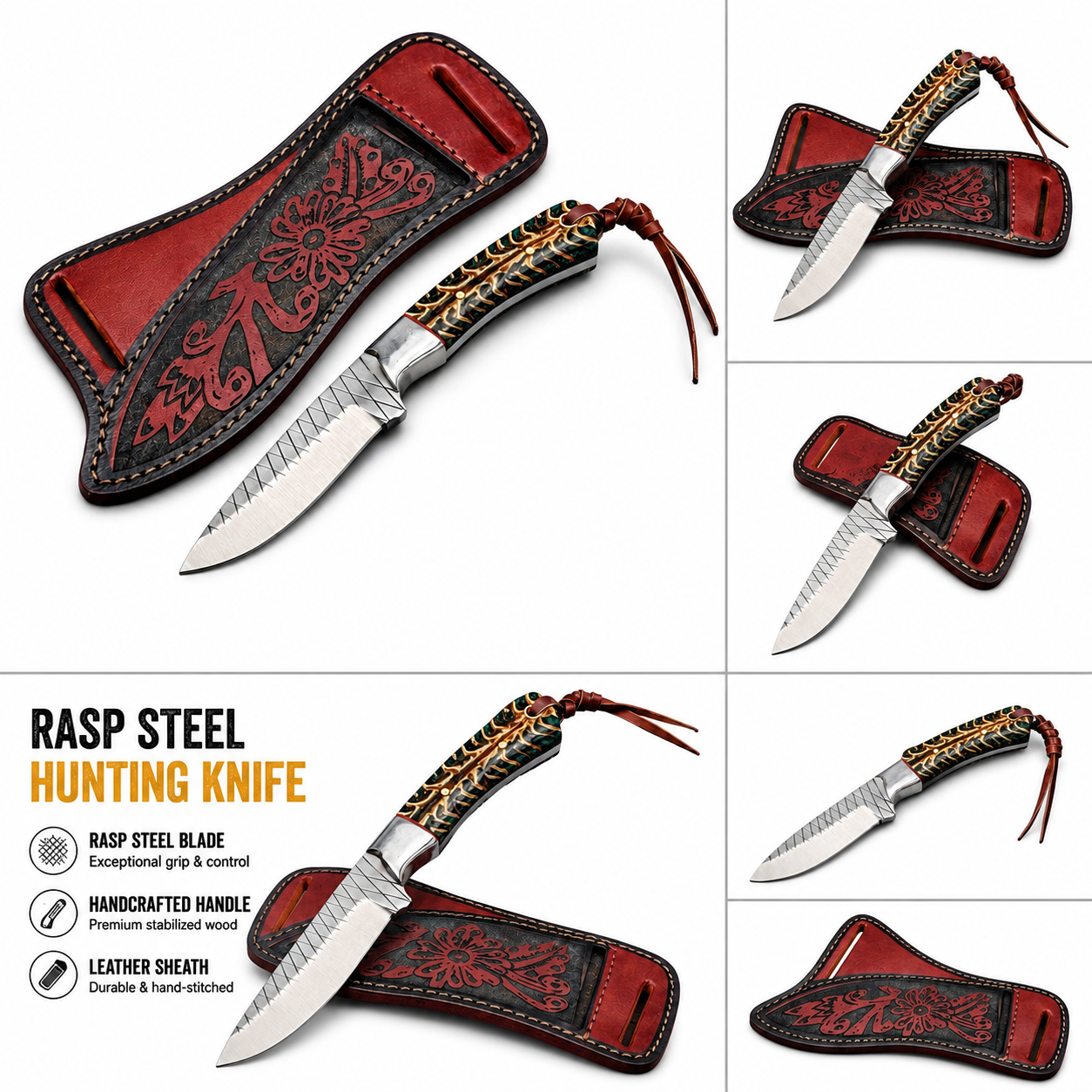
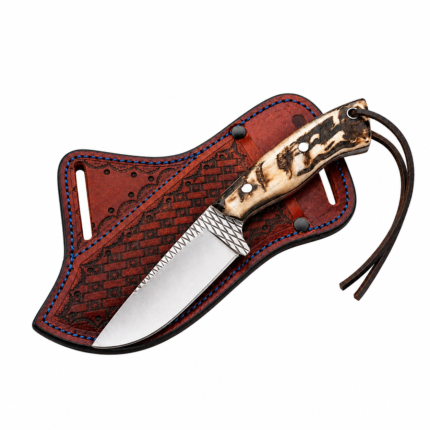
The knife features a satin silver blade with a repeated diagonal pattern positioned near the spine. Its handle incorporates dark green, black, and gold-toned decorative patterns that contrast with the polished steel bolster. A brown leather lanyard extends from the end of the handle, completing the traditional outdoor-inspired design.
Another important feature is the accompanying leather sheath. The sheath combines reddish-brown and black panels with ornamental floral detailing, contrasting stitching, and two elongated openings for a belt-style attachment arrangement.
Together, these visible features create a distinctive hunting-style knife set that balances decorative craftsmanship-inspired details with a straightforward fixed blade format.
The Rasp Steel Hunting Knife is particularly appealing to customers who appreciate unusual handle finishes, patterned blade surfaces, and decorative leather accessories.
1. Distinctive Rasp-Patterned Steel Blade
The main characteristic of this knife is its decorative rasp-style steel blade.
The blade displays a clean satin silver surface with repeated angular markings along the upper section. These diagonal details form a recognizable pattern that distinguishes the knife from conventional smooth-bladed outdoor tools.
The pattern extends from the area near the handle toward the blade tip, producing a consistent decorative effect.
The blade’s broad metallic surface provides an attractive contrast with these darker geometric markings.
This combination gives the knife an appearance associated with traditional rasp-style cutting tools.
The supplied product showcase identifies the blade as rasp steel. However, whether the blade was manufactured from a repurposed rasp or simply incorporates rasp-inspired detailing should be confirmed through supplier documentation.
The exact steel composition and heat-treatment process also require verification.
For customers comparing decorative fixed blade designs, the combination of a smooth cutting section and patterned upper surface is an important visual characteristic.
2. Satin Silver Blade Finish
The steel blade features a smooth metallic appearance with subtle directional finishing marks.
Its satin-style surface reflects light softly rather than producing the highly reflective effect of a mirror-polished blade.
This restrained finish emphasizes the knife’s shape and creates a balanced appearance alongside the ornate handle.
The steel surface is relatively plain across the main cutting section, allowing the decorative angular pattern to remain noticeable.
A polished-looking bevel follows the curved cutting edge and contributes to the blade’s overall geometry.
The satin appearance is particularly suitable for clean product photography because it highlights the knife’s metallic finish without relying on excessive surface decoration.
A satin finish describes the blade’s appearance, but it does not independently establish corrosion resistance, durability, or edge-retention performance.
Those characteristics depend on the actual steel grade and manufacturing process.
3. Traditional Hunting-Style Blade Profile
The Rasp Steel Hunting Knife features a broad blade that gradually narrows toward a pointed tip.
Its cutting edge follows a gently curved profile, creating a familiar outdoor knife silhouette.
The blade is wider near the handle and transitions smoothly toward the front.
This shape contributes to the overall visual balance between the blade and the curved grip.
The silver surface, decorative spine markings, and defined cutting edge create three visually distinct sections.
For collectors, these features make the knife interesting to examine from different perspectives.
For practical use, the suitability of a blade depends on its exact dimensions, steel characteristics, and intended applications.
Buyers should confirm blade length, thickness, edge geometry, and construction before selecting the product for a particular task.
The hunting-style designation describes the knife’s visible design and product category rather than guaranteeing suitability for every hunting or field activity.
4. Fixed Blade Construction
Unlike a folding pocket knife, this model has a permanently extended blade.
The fixed blade configuration creates a continuous external profile from the handle to the cutting edge.
This construction is common in traditional hunting-style knives, camping knives, and other outdoor cutting-tool categories.
A fixed blade knife does not require a folding hinge or opening mechanism.
However, the actual strength of a fixed blade model depends on important construction characteristics.
These include tang design, steel composition, heat treatment, blade thickness, and handle attachment.
Such specifications cannot be determined reliably from the supplied photographs alone.
Customers considering the Rasp Steel Hunting Knife for particular cutting applications should obtain accurate technical information from the manufacturer.
The visible fixed blade format remains an important part of its traditional outdoor styling.
5. Decorative Green and Gold Handle
One of the most attractive features of this knife is its unusual decorative handle.
The grip features a combination of dark green, black, gold, and subtle brown tones.
The ornamental pattern contains flowing lines and irregular shapes that create visual depth across the handle surface.
Gold-toned details appear to weave through the darker sections, producing a striking contrast.
This decorative finish makes the knife immediately recognizable.
The handle differs considerably from conventional plain black or brown grips.
Its pattern is especially noticeable when the knife is viewed from the side.
The product showcase identifies the handle material as stabilized wood. Stabilized wood is typically treated to improve its dimensional stability, but the exact material, treatment, and manufacturer specifications should be verified.
For buyers interested in decorative outdoor knives, the handle is a major visual selling point.
Its unusual pattern complements the angular blade detailing without repeating the same design.
6. Stabilized Wood Handle Appearance
The handle is labeled as stabilized wood in the supplied product showcase.
Stabilized wooden materials are commonly associated with decorative knife handles and may incorporate resins or other treatments.
Such treatments can influence appearance and material properties, depending on the manufacturing process.
The photographed handle displays a richly patterned finish with dark green sections and contrasting metallic-looking lines.
Its appearance is particularly distinctive because the pattern continues along much of the grip.
The exact species of wood, stabilization process, and surface coating have not been provided.
Customers should therefore rely on verified manufacturer specifications when comparing material durability or care requirements.
The visible handle offers an attractive combination of traditional wood-inspired styling and contemporary color treatment.
This makes it suitable for knife enthusiasts who appreciate decorative handles with individual character.
7. Polished Metallic Bolster
Between the blade and handle is a smooth silver-colored bolster.
This component creates a clear visual transition from the patterned steel blade to the colorful grip.
Its polished appearance contrasts with the darker decorative handle sections.
The bolster also contributes to the knife’s traditional silhouette.
A narrow colored spacer is visible near the junction between the handle and metallic section.
This small accent provides additional separation between the materials.
The bolster’s smooth curved shape follows the handle’s overall profile.
In close-up photographs, it is one of the most noticeable finishing elements.
The exact metal composition and construction method should be verified through supplier documentation.
For product presentation, the bolster can be highlighted as a decorative metal fitting that complements the blade and handle.
8. Comfortable Contoured Handle Profile
The handle features a gently curved form with a wider rear section and a narrower area near the bolster.
This gives it a recognizable traditional fixed blade shape.
The underside follows a smooth contour, providing a clearly defined gripping surface.
The decorative finish continues across the curved handle, maintaining a consistent appearance.
Handle design is an important consideration for outdoor cutting tools.
Buyers commonly evaluate handle length, thickness, surface texture, and grip shape when comparing products.
Although the handle appears contoured, actual comfort depends on the physical dimensions and the individual user’s hand size.
The decorative surface should not be assumed to provide a particular grip performance without testing.
Nevertheless, the overall profile contributes significantly to the Rasp Steel Hunting Knife’s attractive design.
9. Decorative Handle Pins
Small gold-toned circular pins are visible on the handle.
These details contrast with the green and black decorative surface.
Their simple round shape introduces a traditional metallic accent.
The pins complement the gold-colored elements visible throughout the grip.
Depending on the actual construction, similar fittings may be used for decorative or structural purposes.
The specific role of these pins should be confirmed with the manufacturer.
For product photography, the metallic details provide useful points of interest in close-up images.
They also help distinguish this knife from designs featuring completely uninterrupted handle surfaces.
The combination of decorative pins and patterned stabilized-wood styling creates a recognizable visual identity.
10. Brown Leather Lanyard
A brown cord is attached near the rear of the handle.
The cord appears to pass through a small attachment opening and is tied into a decorative knot.
Two loose ends extend beyond the handle, creating a traditional lanyard-style finish.
This accessory adds visual interest and complements the brown tones of the sheath.
Leather lanyards are frequently associated with outdoor knife styling.
Their intended function and suitability for particular applications depend on the product’s design.
Customers should avoid using a lanyard in any way that interferes with safe handling.
The brown cord is particularly noticeable in photographs showing the complete knife against a white background.
It adds another traditional detail to the knife’s overall presentation.
11. Beautiful Decorative Leather Sheath
The accompanying sheath is one of the most distinctive components of the product set.
Its reddish-brown outer sections contrast with a darker black central panel.
The central panel features an ornamental floral design with flowing decorative shapes.
Contrasting stitching follows the perimeter and highlights the sheath’s unusual profile.
The sheath has a broad form with angled sides and two elongated openings.
Unlike a simple straight protective cover, this model uses a visually detailed design.
The supplied showcase identifies the accessory as a leather sheath.
The exact leather grade, thickness, tanning method, and production process should be confirmed with the manufacturer.
Its decorative appearance makes the sheath particularly appealing for collectors and specialty knife displays.
12. Red and Black Floral Tooling
The sheath’s central panel features an intricate floral-inspired pattern.
The design combines curved lines, petal-like shapes, and ornamental extensions.
Its reddish-brown decorative sections contrast with the dark central background.
The outer reddish-brown panels create a coordinated border around the ornamentation.
This combination gives the sheath an appearance associated with traditional leather tooling.
The floral design is especially noticeable in the full product photographs.
The pattern enhances the sheath’s visual appeal without requiring additional accessories.
For accurate product descriptions, it is appropriate to call the surface decorative or tooled-style.
Claims of hand-tooling or individual handcrafted production should be made only when confirmed by the supplier.
13. Contrasting Sheath Stitching
The sheath features visible stitching around its outer edges.
The thread creates a clear border between the sheath’s colored panels and dark edging.
Its regular appearance contributes to the coordinated product finish.
Stitching is an important part of many protective leather accessories.
However, actual seam strength cannot be determined from photographs alone.
Customers should inspect stitching periodically for wear, looseness, or separation.
The visible stitches also provide additional detail for online product photographs.
A close-up view of the sheath can help buyers appreciate its decorative finish.
The combination of floral tooling, contrasting stitching, and shaped leather panels creates a distinctive accessory.
14. Dual Belt-Slot Sheath Design
Two elongated openings are visible near opposite ends of the sheath.
These openings resemble belt slots commonly incorporated into certain knife sheath designs.
Their positions contribute to the sheath’s broad, symmetrical appearance.
The openings have rounded ends and are surrounded by the reddish-brown sheath material.
The exact belt width compatibility, carrying orientation, and retention characteristics require manufacturer confirmation.
Customers should not assume a particular mounting method without verified dimensions.
The slot design is nevertheless an important visible feature.
For product listings, it can be described as a dual-slot sheath configuration.
The openings also distinguish the accessory from conventional narrow blade covers.
15. Seven Premium Design Features
The Rasp Steel Hunting Knife includes seven particularly noticeable characteristics.
1. Rasp-Patterned Blade: Repeated diagonal markings create a distinctive decorative steel surface.
2. Satin Silver Finish: The smooth metallic blade gives the knife a clean traditional appearance.
3. Green and Gold Handle: Contrasting colors and ornamental patterns make the grip visually distinctive.
4. Polished Metal Bolster: A silver-colored fitting creates an elegant transition between blade and handle.
5. Decorative Handle Pins: Small gold-toned fittings complement the patterned grip.
6. Brown Leather Lanyard: A traditional cord attachment adds another outdoor-inspired detail.
7. Ornate Leather Sheath: Reddish-brown panels, floral tooling, contrast stitching, and two belt slots complete the set.
Together, these features give the knife a recognizable design that differs from conventional plain-handle fixed blade models.
16. Traditional Craftsmanship-Inspired Styling
The knife combines several elements associated with traditional decorative knife craftsmanship.
The patterned steel surface provides geometric visual interest.
The handle introduces contrasting natural-inspired colors.
The polished bolster gives the product a refined metallic accent.
The leather lanyard adds a traditional finishing detail.
Finally, the decorative sheath completes the presentation.
These features work together to create a coordinated knife set.
The product showcase describes the handle as handcrafted, but the exact production method requires supplier confirmation.
Manufacturing information should always be represented accurately.
The visible craftsmanship-inspired appearance can still be appreciated independently of production claims.
17. An Attractive Choice for Knife Collectors
Knife collectors often appreciate different blade shapes, decorative materials, and distinctive accessory designs.
The Rasp Steel Hunting Knife offers several recognizable features.
Its blade differs from plain fixed blade models because of the repeated angular pattern.
The green and gold handle creates a striking color combination.
The polished bolster and metallic pins provide additional contrast.
The matching leather sheath introduces decorative floral elements that complement the knife.
These characteristics make the product visually interesting for enthusiasts who enjoy traditional outdoor knife designs.
For collection displays, the knife can be presented beside its sheath to show both components.
Buyers should confirm technical specifications and material authenticity when evaluating the product.
18. Outdoor Equipment and Product Categories
The knife belongs naturally within the hunting-style fixed blade knife category.
It can also be presented in collections featuring outdoor cutting tools, decorative fixed blade knives, and traditional knife accessories.
A properly specified fixed blade knife may support ordinary cutting activities when its construction and materials are suitable.
The exact intended applications of this model should be established through manufacturer guidance.
Its visible design does not independently verify suitability for demanding field tasks.
Customers should consider steel composition, blade thickness, tang construction, and overall dimensions before selecting a knife for practical use.
For specialty retailers, the model offers a combination of traditional knife styling and decorative presentation.
Its distinctive blade pattern and handle finish provide useful information for search listings and category descriptions.
19. Product Photography and E-Commerce Presentation
The supplied photographs present several different perspectives of the knife and sheath.
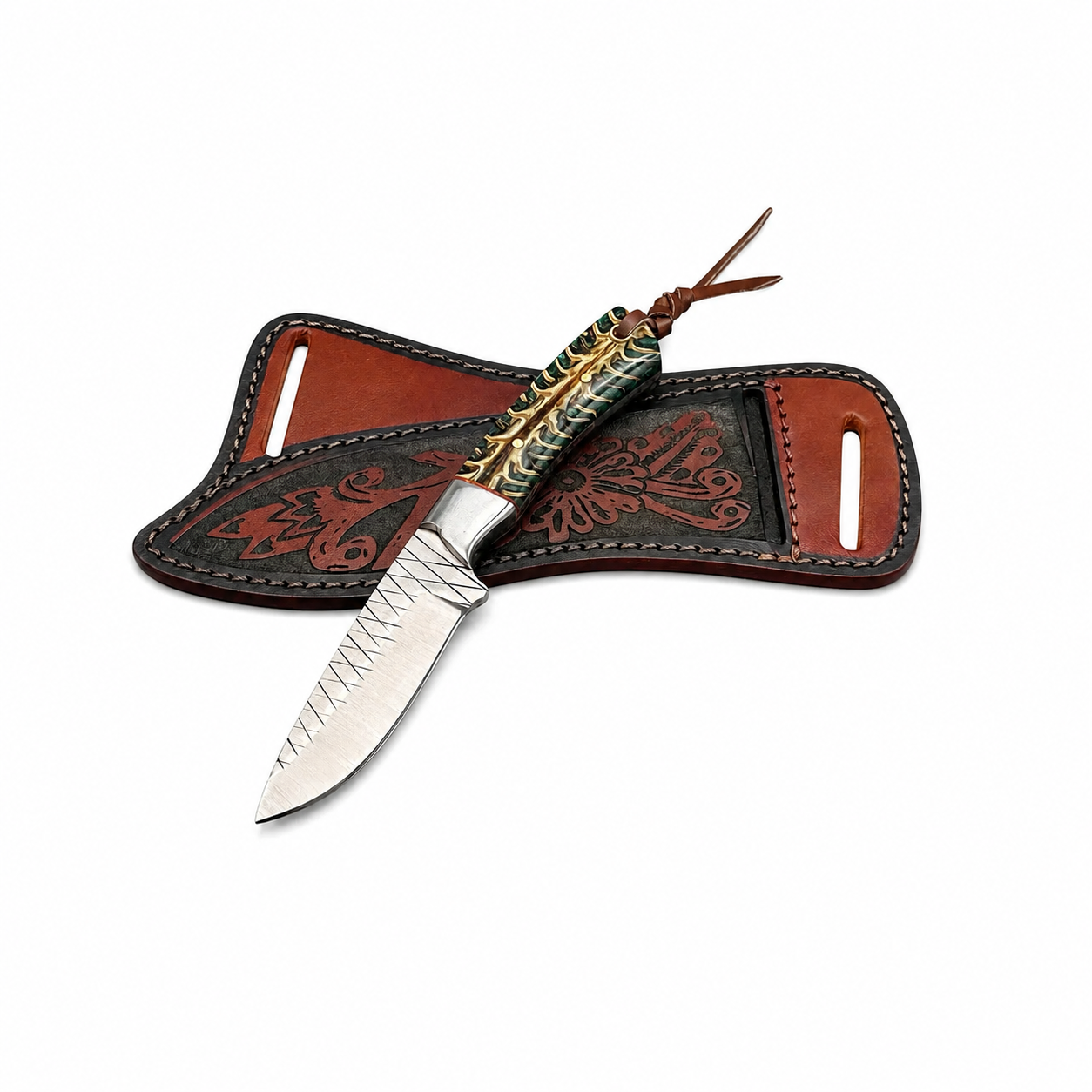
The first image shows the complete knife diagonally positioned across the decorative sheath.
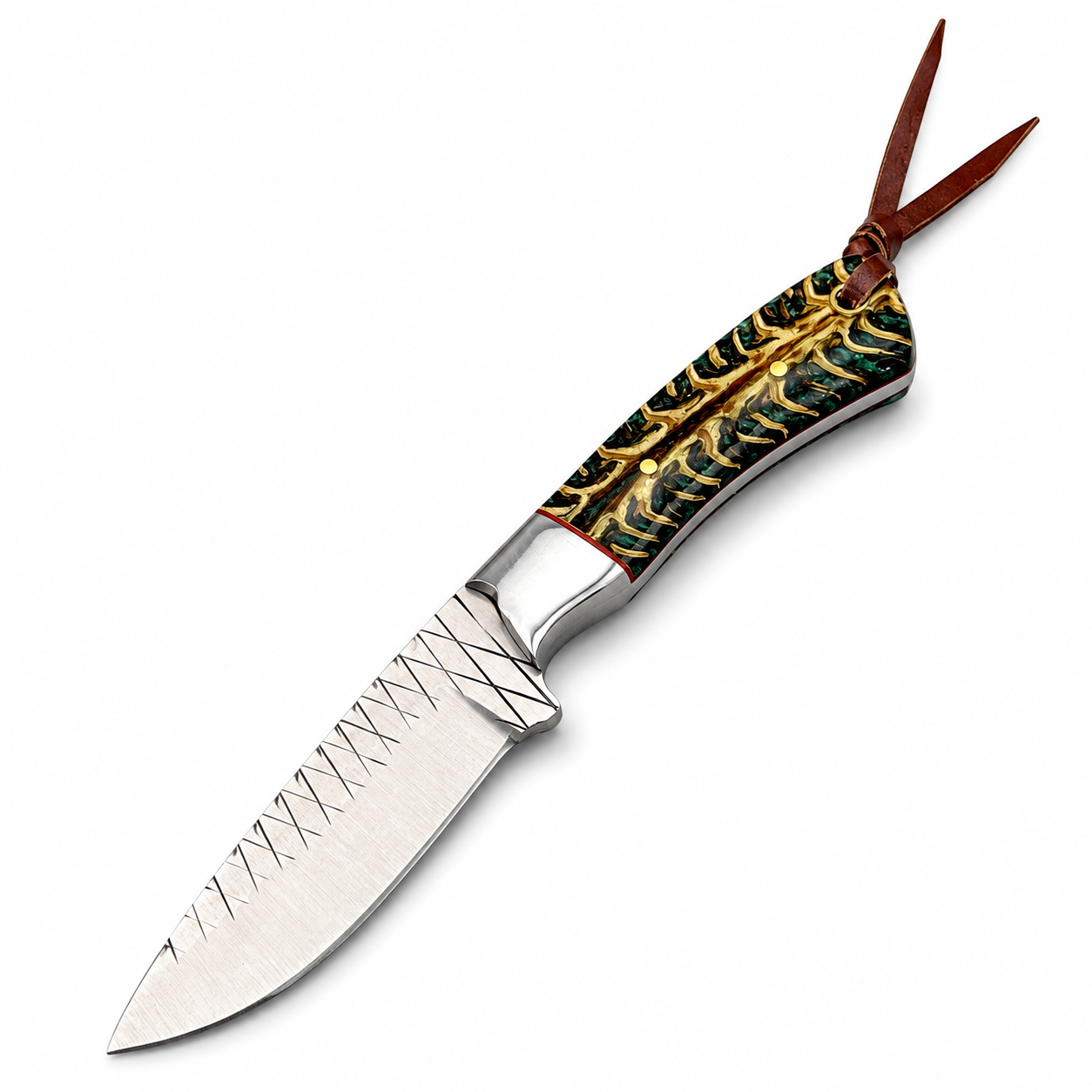
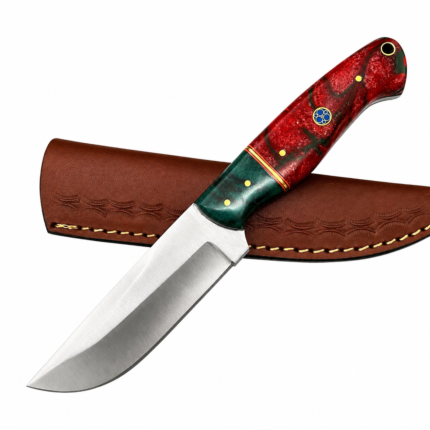
Another image highlights the blade and colorful handle against a clean white background.
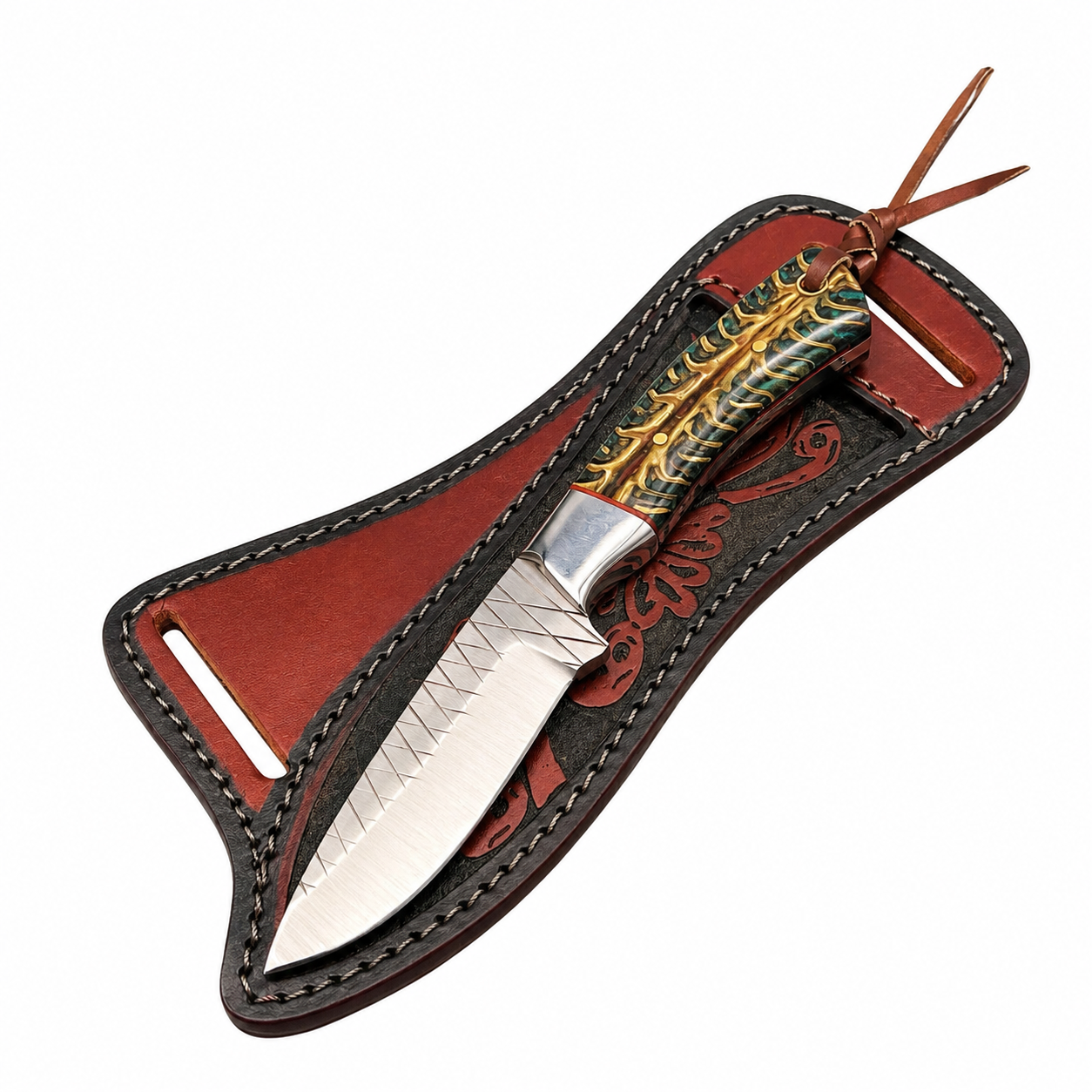
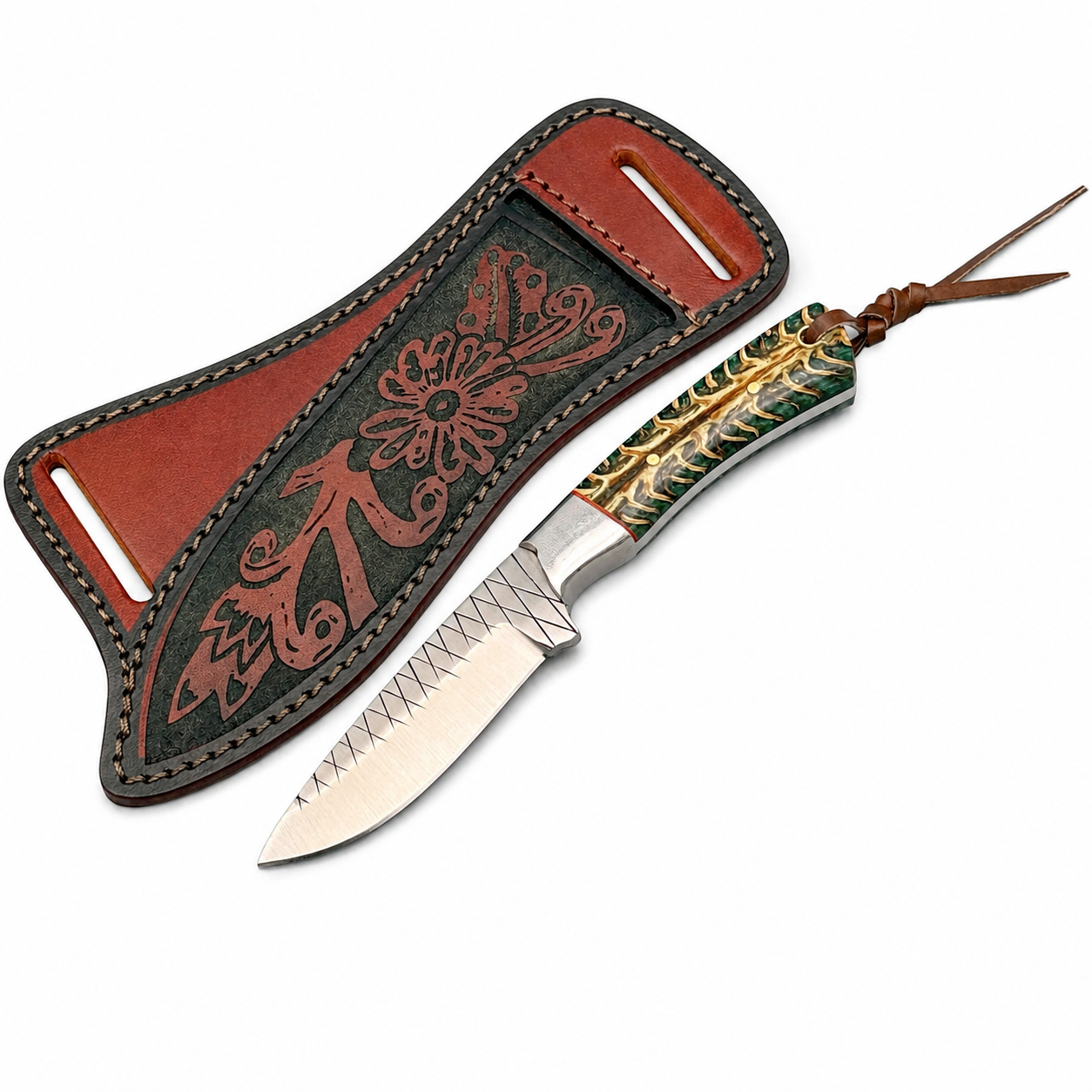
Additional views display the sheath’s floral pattern, stitching, and belt slots.
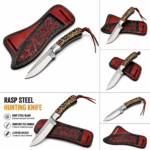
The final collage provides a broader overview of the product and its design characteristics.
Together, these images help buyers understand the external appearance of the complete knife set.
For WooCommerce, the clearest photograph showing the full knife and sheath should be used as the featured image.
The remaining photographs can be added to the product gallery.
Descriptive filenames and image alt text support accessibility and help organize product media.
Image descriptions should reflect what is actually visible rather than repeat unrelated search keywords.
20. Care and Maintenance of the Steel Blade
Proper maintenance helps preserve the appearance of the blade.
After suitable use, the steel should be cleaned according to the manufacturer’s instructions.
Moisture, dirt, and residue should be removed before storage.
The blade should then be dried completely.
Certain steel grades may develop corrosion when exposed to moisture for extended periods.
A compatible protective oil may be recommended depending on the exact blade material.
Harsh chemicals and abrasive cleaners should be avoided unless approved for the steel finish.
The cutting edge should be inspected periodically for signs of damage.
Sharpening should be performed using equipment suitable for the blade’s verified steel grade and edge geometry.
The decorative rasp-style markings should not be modified during routine maintenance.
Appropriate care can help preserve the blade’s visual finish over time.
21. Maintaining the Decorative Handle
The handle should be cleaned carefully to preserve its distinctive appearance.
A soft cloth can remove ordinary dust and surface residue.
The product showcase identifies stabilized wood as the handle material.
Care requirements may vary depending on the wood species, stabilization process, and surface coating.
Strong solvents or abrasive cleaning products should be avoided without manufacturer approval.
The metallic pins and bolster should be inspected for visible damage or loosening.
The leather lanyard should also be checked for wear.
Any structural defects should be assessed before using the knife.
Keeping the handle clean and dry can help maintain its decorative finish.
22. Leather Sheath Care and Storage
The decorative sheath should be maintained separately from the steel blade.
Its stitched edges, floral surface pattern, and elongated slots should be inspected periodically.
Loose dust can generally be removed with a soft, dry cloth.
If the sheath is confirmed to be genuine leather, an appropriate leather-care product may be suitable.
The exact treatment should follow the supplier’s material recommendations.
Abrasive scrubbing may affect the decorative tooling.
The knife should be clean and dry before being inserted into the sheath.
For extended storage, follow manufacturer guidance regarding moisture and contact between leather and steel.
A sheath with damaged seams or poor retention should not be relied upon for protected storage.
23. Buyer Considerations and Product Specifications
The supplied photographs establish the knife’s visible design features.
These include the satin silver blade, rasp-inspired markings, decorated handle, metallic bolster, leather lanyard, and ornate sheath.
However, several technical details remain unconfirmed.
Customers should request the overall length, blade length, blade thickness, steel grade, hardness, tang construction, handle dimensions, and weight.
The exact stabilized wood type and leather composition should also be confirmed.
Accurate specifications allow buyers to compare knives more effectively.
Wholesale customers may also require information about packaging, inspection standards, and shipping requirements.
Providing reliable specifications supports customer confidence and reduces misunderstandings.
24. Responsible Handling and Secure Storage
Any fixed blade knife should be handled responsibly.
Users should keep their hands away from the cutting edge and maintain control during appropriate cutting activities.
The knife should only be used for tasks consistent with manufacturer recommendations.
Before use, inspect the blade, handle, bolster, and relevant fittings.
A properly fitting sheath should protect the blade when the knife is not being used.
The knife must be stored securely away from children and unauthorized persons.
Owners should follow all applicable laws concerning knife possession, transportation, and use.
Decorative appearance does not reduce the importance of responsible handling.
Frequently Asked Questions
What is a Rasp Steel Hunting Knife?
A Rasp Steel Hunting Knife is a hunting-style fixed blade knife featuring rasp-style markings on its steel blade. This model also includes a decorative green and gold handle and a matching leather sheath.
Does the knife include a leather sheath?
Yes. The supplied product images show a reddish-brown and black decorative sheath with floral tooling, contrasting stitching, and two elongated openings.
Is the handle made from stabilized wood?
The supplied product showcase identifies stabilized wood as the handle material. Its exact composition and stabilization process should be confirmed with the manufacturer.
Is this a folding knife?
No. This model uses a fixed blade configuration.
Does the handle have a lanyard?
Yes. A brown leather-style cord is visible at the rear of the handle.
What makes the blade distinctive?
The blade features a satin silver finish with repeated angular rasp-style markings near its upper section.
Is the sheath suitable for belt attachment?
The sheath includes two elongated openings resembling belt slots. Exact compatibility and carrying arrangements require supplier verification.
Is the knife suitable for outdoor activities?
It belongs to the hunting-style outdoor knife category. Suitability for specific activities depends on verified construction, dimensions, steel composition, and manufacturer guidance.
How should the blade be maintained?
Clean and dry the steel after appropriate use and follow manufacturer-approved maintenance instructions for the verified steel grade.
What product information should be confirmed?
Buyers should confirm blade dimensions, steel composition, hardness, overall weight, tang design, handle material, sheath composition, and intended applications.
Final Product Overview
The Rasp Steel Hunting Knife combines a clean satin silver blade with distinctive diagonal detailing, a richly patterned green and gold handle, and an ornate leather sheath.
Its traditional fixed blade profile provides a recognizable hunting-style silhouette, while the polished metal bolster and decorative pins complement the grip.
The brown leather lanyard adds another traditional detail.
The reddish-brown and black sheath completes the set with floral tooling, contrasting stitching, and two elongated belt-style slots.
For collectors, specialist retailers, and enthusiasts interested in traditional outdoor knife designs, this model offers an attractive combination of decorative craftsmanship-inspired elements and classic fixed blade styling.
With appropriate maintenance, responsible handling, and secure storage, it can remain an appealing addition to a specialty knife collection.






Reviews
There are no reviews yet.