




Wood-Grain Handle Gut Hook Knife – Design and Metalwork Reference
Introduction
The Wood-Grain Handle Gut Hook Knife combines a dark metallic blade with a warm brown handle and several contrasting decorative details. Its design is distinguished by a curved blade profile, a small hook-shaped cutout near the tip, a black front handle section, and a vivid red accent band.
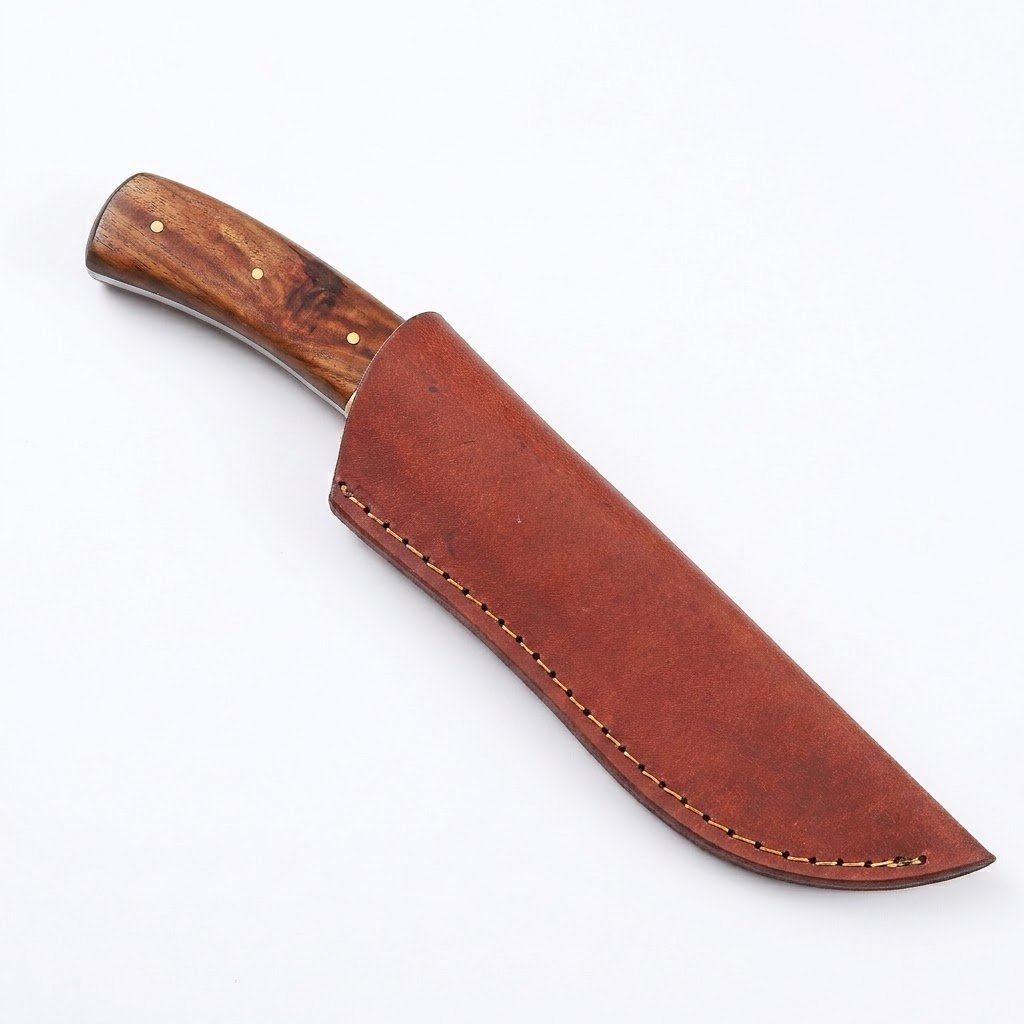
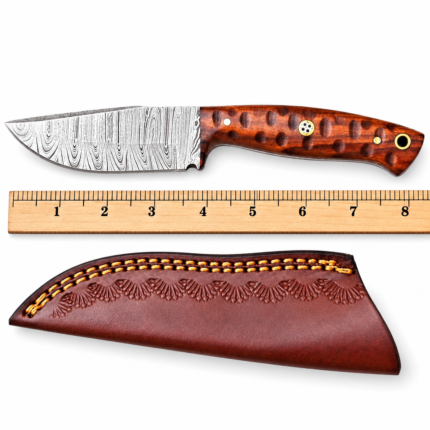
The accompanying images present the knife from several perspectives. These include a fully sheathed view, complete side views, a close-up of the handle, and a presentation with the reddish-brown sheath positioned beneath the knife.
Together, the photographs document the object’s external form, surface appearance, color arrangement, and visible components.
The information below describes these observable characteristics without assuming specifications that cannot be verified from images.
1. Overall Fixed-Blade Configuration
The object has a fixed-blade design, meaning the blade remains extended rather than folding into the handle.
Its silhouette consists of an elongated blade with a gently curved lower edge and an upward-sloping pointed tip.
The handle curves slightly and becomes wider near its rounded end.
A narrow transition connects the blade to the black front section of the handle.
These features establish the object’s overall external form.
Although the photographs show the visible blade and handle arrangement, they do not reveal the full internal construction.
2. Distinctive Gut Hook Blade Profile
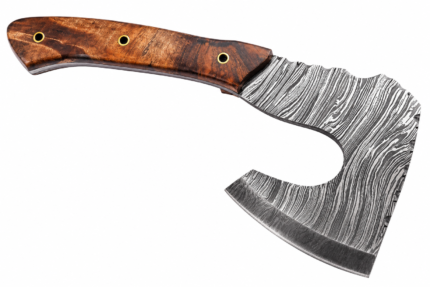
The blade includes a small hook-shaped cutout near its pointed end.
This visible detail identifies the object as a gut-hook-style knife.
The cutout interrupts the blade outline and forms a recognizable curved recess.
The feature is especially apparent in the complete side-view images.
Its precise dimensions cannot be determined because the photographs do not provide a calibrated scale.
The images also do not establish technical performance characteristics.
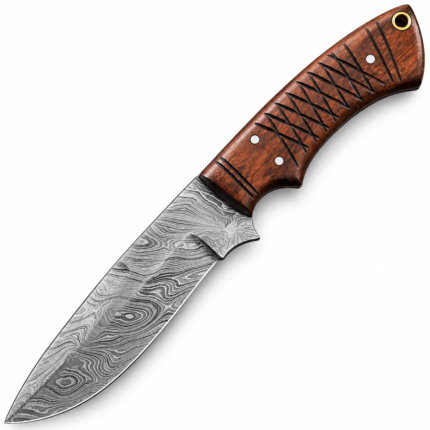
3. Dark Gray Metallic Blade
The blade has a predominantly dark gray metallic appearance.
Its surface is comparatively subdued rather than mirror-polished.
Lighter markings run across a substantial portion of the blade face.
These markings create a repeating, wave-like visual effect.
The contrast between darker and lighter regions becomes more noticeable near the upper section of the blade.
The exact metal alloy and manufacturing treatment cannot be established from the photographs.
4. Decorative Blade Markings
The blade surface displays several elongated, curved markings.
They follow a broadly repeated arrangement along part of the blade.
The shapes resemble shallow waves or scalloped decorative bands.
Their appearance contributes to the object’s recognizable visual character.
It is not possible to confirm whether the markings result from forging, grinding, etching, or another finishing process.
A technical reference would need manufacturer documentation to identify the method.
5. Pointed Blade Silhouette
The blade narrows gradually toward its tip.
The upper edge slopes gently, while the lower edge follows a longer curve.
The two outlines meet at a defined point.
The combination produces an elongated appearance.
A transition in the metal surface is also visible near the handle.
These features can be described from the photographs without assigning unverified dimensions or mechanical properties.
6. Brown Wood-Grain Handle
The handle’s largest visible section has a warm brown finish.
Its surface displays irregular darker streaks and grain-like markings.
Some areas are reddish-brown, while others have golden or medium-brown tones.
The pattern resembles natural polished wood.
However, appearance alone does not verify the actual wood species or confirm that the material is natural wood.
The appropriate factual description is a brown wood-grain handle.
7. Handle Surface Variations
The wood-grain-like markings vary along the handle.
Some sections contain relatively straight, elongated streaks.
Other areas display irregular patches and darker knots or swirls.
These patterns contribute to the object’s natural-looking appearance.
The colors also change subtly depending on the photographed angle.
Such differences may result from the surface texture, lighting, or image processing.
8. Three Gold-Colored Handle Pins
Three small circular gold-colored details appear along the brown handle.
They are positioned at intervals from the red accent band toward the rounded end.
Their bright metallic coloration contrasts with the darker wood-grain surface.
The repeated circular shapes introduce a geometric element to the handle design.
They resemble fastening pins, although their composition and internal structure cannot be established from the images.
9. Black Front Handle Section
Near the blade, the handle transitions into a glossy black section.
This region forms a distinct visual separation between the dark gray blade and the brown handle.
The black material has a comparatively smooth appearance.
Its profile follows the curved outline of the handle.
Two small gold-colored circular details are visible in this section.
The photographs do not establish whether the material is wood, resin, polymer, or another substance.
10. Red Decorative Accent Band
A bright red band separates the black front section from the brown handle.
Its surface displays subtle variations in tone.
The red material appears glossy in the close-up image.
This accent creates a strong color contrast between the adjacent components.
It is an important identifying feature because it introduces a vivid color into an otherwise dark and earth-toned design.
11. Pale Spacer Lines
Thin pale-colored lines border the red decorative band.
They visually separate the red section from the black and brown handle components.
The spacers have a cream or ivory-like appearance.
Their precise material is not identifiable from the photographs.
The combination of red and pale bands creates a layered decorative transition.
12. Curved Handle Outline
The handle has a gently curved silhouette.
Its front region narrows near the blade transition.
The middle section follows a smooth outward curve.
Toward the rear, the handle widens slightly and finishes with a rounded end.
The grain-like surface markings follow the handle’s general length.
This shape is clearly visible in the complete photographs.
13. Contrasting Handle Materials
The handle appears to contain several visually distinct sections.
The front region is glossy black.
The central accent is bright red.
Thin pale bands separate these sections.
The rear section has a warm brown wood-grain finish.
Small gold-colored circular details appear across the black and brown areas.
These contrasts contribute to the overall decorative composition.
The images do not confirm the actual number or composition of individual manufactured components.
14. Reddish-Brown Sheath
The accompanying photographs show a reddish-brown sheath.
Its appearance resembles finished leather.
The surface has subtle variations in color and texture.
A curved lower outline follows the shape of the enclosed blade.
The sheath’s visible exterior is relatively simple, without extensive decorative embossing.
The exact material remains unverified.
15. Contrasting Sheath Stitching
A line of yellowish-brown stitching follows the sheath’s lower perimeter.
Individual stitches are visible against the darker surface.
The stitching continues around the curved end.
This border creates a visual distinction between the sheath’s body and edge.
Its design contributes to the sheath’s traditional-looking appearance.
16. Sheathed Presentation
The first photograph shows the blade enclosed inside the sheath.
Only the brown handle is visible above the opening.
This view documents the shape and color of the sheath alongside the handle.
The sheath extends diagonally across the white background.
The arrangement also emphasizes the contrast between the warm brown handle and the reddish-brown covering.
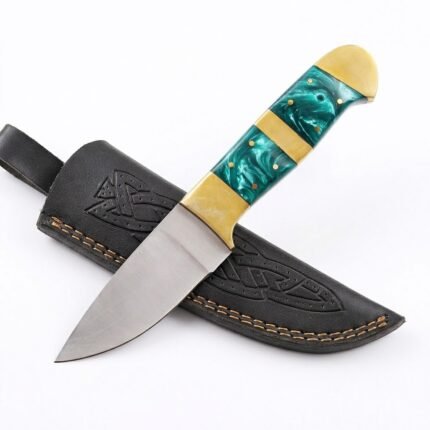
17. Complete Knife with Sheath
The second and third photographs show the knife positioned diagonally over its sheath.
The blade extends toward the lower left.
The handle points toward the upper right.
This arrangement provides a clear view of both components.
It highlights the dark blade, black handle section, red accent band, and brown wood-grain surface.
The reddish-brown sheath creates a contrasting backdrop.
18. Close-Up Handle Photograph
The fourth image concentrates on the handle.
The brown wood-grain pattern is clearly visible.
Three gold-colored circular details appear along its length.
The red accent band and thin pale spacers can be examined closely.
The black front section contains two additional circular details.
The close-up documents the decorative components more clearly than the full-length images.
19. Alternative Full-Length View
The fifth photograph shows the complete knife against a plain white background.
The blade extends toward the upper right.
The handle curves toward the lower left.
This perspective makes the full silhouette easy to examine.
The gut hook cutout is visible near the blade tip.
The gray blade markings and decorative handle sections remain prominent.
20. Color Composition
The object’s appearance combines several colors.
Dark gray dominates the blade.
Black forms the front handle section.
Red introduces a bright accent.
Pale cream-colored lines border the red section.
Warm brown covers the rear handle.
Small gold-colored circular details introduce metallic highlights.
The sheath adds a deeper reddish-brown tone.
Together, these colors create a coordinated visual design.
21. Metal Surface Finishing
The blade has a dark, satin-like appearance.
Its lighter wave-shaped markings create contrast across the surface.
Different metal-finishing processes can produce variations in color and texture.
However, the photographs do not establish which treatment was used.
The blade should therefore be described according to its visible appearance rather than an assumed manufacturing process.
22. Decorative Wood-Grain Aesthetics
Wood-grain patterns have long been used as decorative elements in manufactured objects.
Natural wood and several composite materials can display irregular grain-like markings.
The brown handle shown here resembles this decorative tradition.
Its warm tones contrast with the cooler metallic blade.
The visible pattern also differs from the uniform appearance of the black front section.
This combination provides visual variation within the handle.
23. Fixed-Blade Construction Terminology
The knife can be visually classified as a fixed-blade design.
However, the photographs do not establish its internal handle construction.
It would therefore be inaccurate to specify a full-tang, partial-tang, or other internal configuration.
Likewise, the fastening method cannot be confirmed solely from the visible circular pins.
Technical construction claims should be supported by manufacturer information.
24. Material Specifications Requiring Verification
The following details cannot be reliably established from the supplied photographs:
- Manufacturer and model designation
- Exact blade metal alloy
- Blade finishing method
- Handle material and wood species
- Red and black component materials
- Pin composition
- Overall dimensions
- Blade dimensions
- Product weight
- Sheath material
- Production location
These specifications should remain unconfirmed until reliable documentation is available.
25. Importance of Accurate Descriptions
A useful reference description distinguishes visible features from assumed technical details.
For this object, “dark gray blade” accurately describes its main metallic surface.
“Gut hook cutout” identifies the distinctive blade feature.
“Brown wood-grain handle” describes its visible surface.
“Black front section with red accent band” identifies the handle’s decorative arrangement.
“Reddish-brown stitched sheath” describes the accompanying accessory.
These terms communicate meaningful information without making unsupported claims.
26. Decorative Design Influences
The object combines several design approaches.
Its elongated blade provides a recognizable fixed-blade silhouette.
The brown handle introduces a natural-looking surface pattern.
The black front section adds a solid contrasting color.
The red band introduces a bright accent.
The sheath contributes a traditional-looking accessory.
These elements illustrate how different surface finishes and colors can be combined within a single manufactured object.
27. Photographic Documentation
The collection includes five views.
The sheathed photograph documents the accessory and visible handle.
The two knife-and-sheath arrangements show the overall silhouette.
The close-up provides details of the handle’s decorative components.
The isolated full-length image makes the blade outline easier to distinguish.
Together, they provide a useful visual reference.
Conclusion
The Wood-Grain Handle Gut Hook Knife is characterized by its elongated dark gray blade, hook-shaped cutout, wave-like surface markings, and contrasting brown-and-black handle.
The bright red accent band and pale spacers create a distinctive separation between the handle sections.
Small gold-colored circular details provide additional ornamentation.
The reddish-brown stitched sheath completes the photographed arrangement.
The supplied images document the object’s external appearance, while its exact materials, dimensions, manufacturing processes, and technical specifications remain unverified.





Reviews
There are no reviews yet.