





Double Bit Viking Axe with Rustic Steel Head and Wrapped Handle
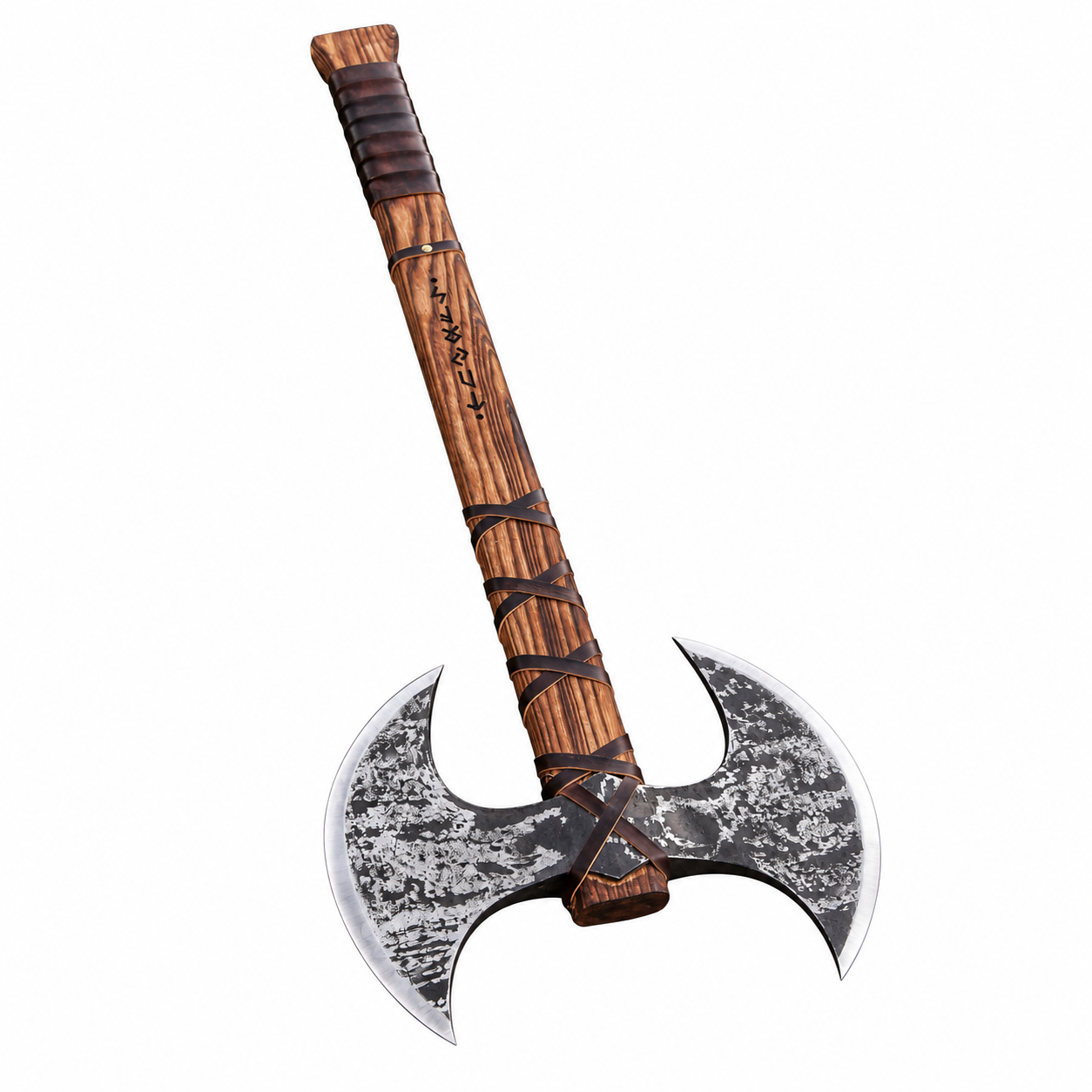
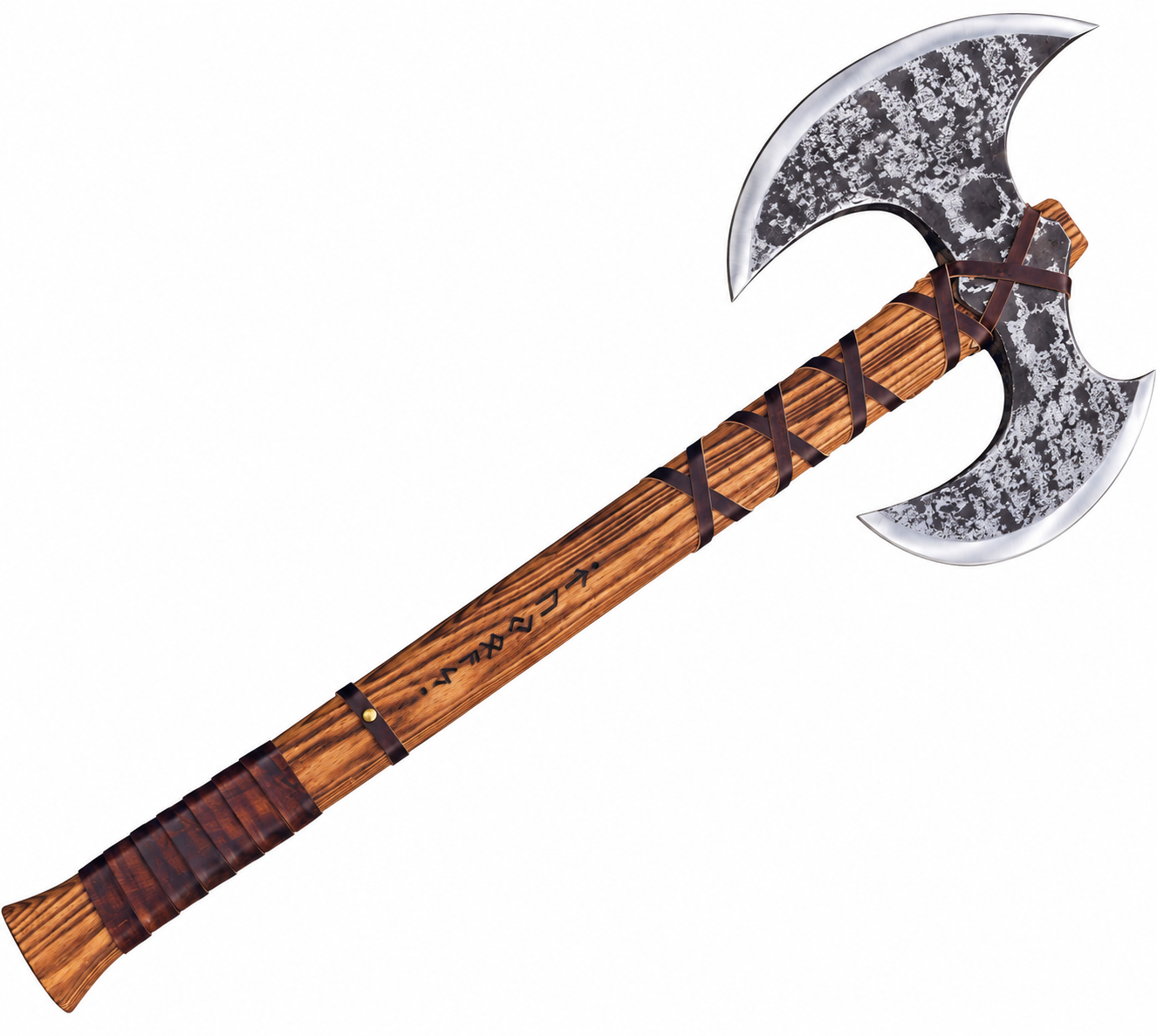
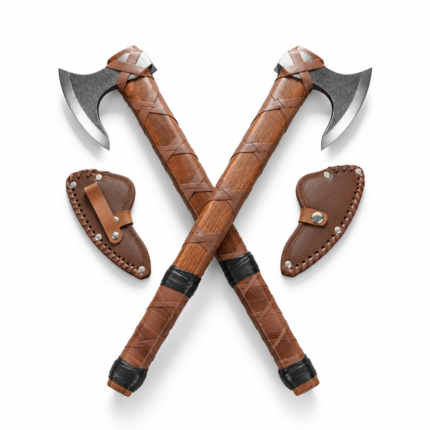
The Double Bit Viking Axe features a bold double-bladed head, a long wood-look handle, and decorative wrapping inspired by traditional Norse-style designs. With two sweeping crescent-shaped blades and a distinctive dark-and-silver metal finish, this axe offers an eye-catching appearance for enthusiasts of Viking-inspired equipment, historical-themed collectibles, and ornamental axes.
Its symmetrical-looking double-head arrangement is the most prominent design feature. Each side curves outward into a broad, pointed crescent shape, giving the axe a dramatic silhouette. The dark textured blade faces contrast with the bright, polished-looking outer edges.
The handle provides a warmer visual balance through its rich brown coloring and visible wood-grain pattern. Dark bands wrap around the shaft, creating a traditional, rustic appearance.
Together, the double-bladed head, wrapped handle, and decorative markings give this axe a character that stands apart from conventional single-bit axes.
Distinctive Double-Bit Axe Head
A double-bit axe is identified by the presence of cutting edges on opposite sides of the axe head.
This design features two crescent-shaped blades extending from a central mounting area. The upper blade curves toward an upward-pointing tip, while the opposite blade sweeps downward into a similarly prominent shape.
The result is an unusual, dramatic profile that is immediately recognizable.
Unlike a standard single-bit axe, which has one cutting edge and a poll at the opposite end, a double-bit design has two exposed blade edges.
In this product, those edges follow broad curves rather than a straight chopping profile.
The shape resembles decorative Viking-inspired double-headed axes commonly associated with fantasy artwork, historical reenactment displays, and Norse-themed collections.
The product’s actual suitability for chopping or other physical applications depends on the steel grade, head construction, handle attachment, balance, and edge preparation. Those specifications are not established by the photograph.
For this reason, the axe should be described primarily by its visible construction and appearance until further manufacturer details become available.
Dark Rustic Blade Finish
The axe head displays a textured gray-and-black surface.
Irregular patches of dark gray, charcoal, and silvery metal extend across both blade faces, creating an intentionally weathered appearance.
The finish resembles the surface treatments commonly seen on rustic or forged-look axes.
Rather than having a completely polished head, this design combines textured interior surfaces with brighter outer edges.
That contrast enhances the shape of each blade.
The silver-colored cutting edges follow the entire outer curve, while the darker inner portions emphasize the decorative finish.
This treatment gives the axe an aged, rugged appearance without requiring the blade to be genuinely antique.
The surface may resemble hammered or forged steel, but its actual manufacturing process cannot be verified visually.
It would be inaccurate to claim that the head is hand-forged, heat-treated, high-carbon steel, or Damascus steel without supplier confirmation.
The visible feature that can be stated confidently is its textured, rustic steel-like appearance.
Crescent-Shaped Double Blades
The curved cutting-edge profiles are important elements of the axe’s visual identity.
Both blades widen away from the central attachment area before narrowing into pointed ends.
This produces a broad, sweeping shape that differs considerably from the flatter cutting edges found on many conventional utility axes.
The crescent design gives the axe a striking appearance when displayed horizontally, vertically, or at an angle.
The smooth silver-colored outer borders also create visual definition against the textured blade faces.
From a collector’s perspective, the curved blades are among the most distinctive features.
They contribute to the product’s Viking-inspired aesthetic, making the axe relevant for buyers interested in Norse-themed decorative equipment.
However, the photograph does not establish the blade’s actual sharpness, thickness, or edge durability.
Those properties need to be verified separately.
Long Brown Wood-Look Handle
The axe features an extended handle with a warm brown finish and visible dark grain patterns.
The shaft has a relatively straight central section with gentle changes in thickness near the head and lower end.
Its natural-looking color creates a traditional appearance that complements the dark axe head.
The handle’s length also creates a dramatic overall silhouette.
Compared with compact hatchets, long-handled axes have a noticeably different appearance and presentation.
This design uses that extended shaft to emphasize the decorative double-headed construction.
The handle resembles finished wood, with dark brown linear markings running along its surface.
However, the photograph cannot establish the exact wood species or whether the handle is made from natural hardwood, laminated wood, or a wood-look composite.
Until the material is verified, the most accurate description is a brown wood-grain or wood-look handle.
Its visible finish is smooth in the exposed sections, with contrasting darker wrapping in selected areas.
Decorative Crisscross Handle Wrapping
A distinctive feature of the axe is the dark brown wrapping near the head.
Several narrow bands cross diagonally over the upper portion of the shaft, creating an X-shaped arrangement.
The wrapping extends downward from the mounting area and covers part of the exposed brown handle.
Its overlapping layout gives the axe a traditional, rugged appearance.
The color is noticeably darker than the underlying shaft, creating a clear contrast.
The decorative bands also echo the leather-wrapped designs commonly seen in Viking-inspired accessories and fantasy-themed axes.
Although the wrapping looks leather-like, the actual material cannot be determined from the image alone.
It may be leather, synthetic leather, or another flexible decorative material.
The construction method and fastening details are also unknown.
The bands should therefore be described as dark leather-look wrapping unless the supplier confirms genuine leather.
Beyond their visual contribution, such wraps are sometimes used to modify grip texture. However, this particular wrapping’s durability or grip performance cannot be confirmed without physical inspection.
Wrapped Lower Grip Section
Near the bottom of the handle, a wider section features closely arranged dark brown bands.
This lower wrapping differs from the upper crisscross pattern.
It follows a more continuous arrangement around the handle and appears thicker and more closely spaced.
The wrapping creates a visually distinct grip area.
Its darker color helps separate the lower handle from the exposed wood-look section above it.
This combination of wrapped and unwrapped surfaces creates a traditional aesthetic without excessive decoration.
The lower end of the shaft also appears slightly widened compared with the adjacent grip section.
That shape gives the handle a defined finishing point.
The exact thickness, texture, and dimensions of this section require supplier verification.
Although the wrapping may provide a tactile gripping surface, no particular ergonomic or slip-resistant performance should be claimed from the image alone.
Norse-Inspired Decorative Markings
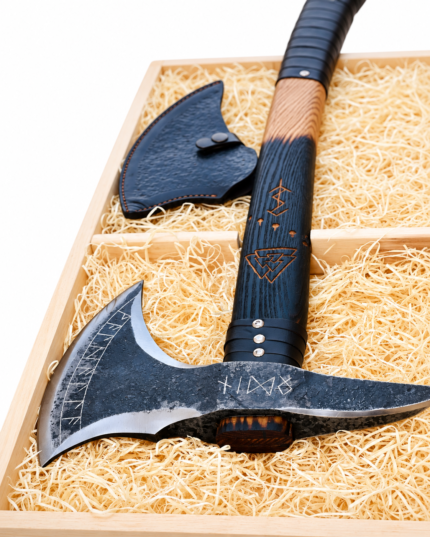
The exposed central portion of the handle includes a series of dark angular symbols.
These markings resemble stylized runes, contributing to the Viking-inspired appearance.
Their placement along the handle creates a decorative focal point between the two wrapped sections.
The markings contrast with the brown wood-grain background and appear relatively dark.
They provide an additional design element without dominating the overall appearance.
Rune-like decorations are frequently associated with Norse-inspired artwork and collectible items.
In this case, the exact characters, their meaning, and whether they represent a recognized historical inscription are not verified.
They are best described as rune-style markings rather than authentic Viking inscriptions.
This distinction is important for accurate product representation.
The axe’s overall styling is inspired by popular interpretations of Viking equipment, but that does not establish historical accuracy.
For enthusiasts of Norse-inspired decorative designs, the markings are an attractive addition to the axe’s appearance.
Rustic Styling with Metallic Contrast
The combination of the dark blade faces and bright silver-colored edges is particularly noticeable.
The axe head has a weathered-looking interior, while the edges appear smooth and reflective.
The handle introduces warm brown tones that contrast with the cooler metal finish.
Dark wrapping continues that contrast by adding a second brown shade.
Small metallic-colored details are also visible on the handle, including a round fitting on a narrow band.
The overall color palette remains relatively restrained.
Brown, charcoal gray, black, and silver work together to create a cohesive Viking-style appearance.
This makes the axe visually suited to collections that emphasize traditional, medieval, or fantasy-inspired aesthetics.
Its appearance does not depend on bright colors or complex engraved decorations.
Instead, the double-headed profile and textured metal finish provide most of the visual impact.
A Viking-Inspired Collectible Design
The axe is especially relevant to people who appreciate Viking-themed decorative objects.
Its double-bit head, long handle, crossed wrapping, and rune-like markings combine several familiar elements of Norse-inspired design.
These features can make the product attractive as a specialty display piece in an appropriate private collection.
It can also be considered by enthusiasts who collect axes with unusual blade shapes or decorative handles.
The design is visually different from standard camping hatchets, felling axes, and compact outdoor cutting tools.
While those products commonly prioritize particular working applications, this axe’s visible distinguishing features are primarily its double-bladed shape and decorative styling.
This does not necessarily mean that the product is decorative-only.
The actual functional classification requires confirmation from the manufacturer.
Until the blade’s technical specifications, structural integrity, and intended use are verified, customers should not assume that it is suitable for chopping wood, physical demonstrations, or reenactment activities.
Comparing Double-Bit and Single-Bit Axes
A single-bit axe has one cutting edge, with the opposite side typically serving as the back of the head.
A double-bit axe features cutting edges on both sides.
That basic structural difference is visible in the uploaded image.
Double-bit designs can be found among both functional axes and decorative reproductions.
Traditional working double-bit axes often use blade geometries and head constructions intended for particular cutting tasks.
Decorative Viking-inspired versions may prioritize unusual shapes and visual detailing.
This product has pronounced crescent-shaped blades and a heavily stylized presentation.
Its appearance should therefore not be treated as evidence of performance equal to a conventional forestry axe.
A buyer comparing axe models should consider several specifications beyond the number of blades.
These include head weight, overall length, material grade, blade geometry, handle construction, and the connection between the head and shaft.
Actual intended use also matters.
Some products are manufactured for display, while others are intended for specified cutting applications.
The manufacturer’s classification should establish which applies to this model.
Handle and Head Construction Considerations
The visible relationship between the head and handle is an important design feature.
The handle extends into the central region between the two curved blades.
Decorative wrapping is positioned around the upper shaft close to the head.
The photograph does not reveal the internal mounting structure.
It is therefore not possible to verify whether the head uses a traditional eye-and-wedge construction, a concealed mechanical attachment, or another assembly method.
Likewise, the image does not establish the head’s weight or the strength of the handle-to-head connection.
For customers seeking an axe for physical use, these details are particularly important.
The connection must be appropriate for the intended application, and the product should be inspected according to the manufacturer’s instructions.
A decorative appearance should not be mistaken for proof of structural strength.
For collector-oriented buyers, the visible finish and overall design may be the more relevant considerations.
Display and Collection Appeal
The product’s long, diagonal silhouette makes it visually prominent.
Its two crescent-shaped blades create a broad head, while the extended handle provides a contrasting narrow section.
The wrapping and dark decorative markings add detail to the shaft without overwhelming its wood-grain appearance.
This type of design may appeal to collectors who prefer visually distinctive historical-inspired accessories.
The rustic metal finish creates an aged appearance, while the polished-looking edges add definition.
For display purposes, the double-headed form is recognizable from several viewing angles.
The combination of silver, black, and brown also fits naturally within collections emphasizing traditional or medieval-inspired aesthetics.
However, the overall dimensions need to be verified before selecting a display stand, mount, or storage arrangement.
The blade tips and both cutting edges should be treated as potentially sharp.
Secure positioning and restricted access are important considerations, particularly where children or visitors may be present.
Care and Maintenance
Correct maintenance depends on the materials used in the head, handle, and wrapping.
Because those materials are not fully verified, the supplier’s care instructions should take priority.
For metal axe heads, keeping surfaces clean and dry is generally important.
Moisture can affect some metal finishes and may contribute to corrosion depending on the steel composition and any protective coating.
After handling, inspect the axe for visible dirt, moisture, or residue.
If cleaning is necessary, use methods appropriate to the confirmed surface finish.
Avoid aggressive abrasives that could unnecessarily scratch the patterned metal.
The wood-look handle should also be maintained according to its actual material.
Natural wood, sealed wood, synthetic composites, and decorative coatings may require different cleaning approaches.
The wrapping should not be soaked or exposed to harsh chemicals unless specifically permitted by the manufacturer.
Store the axe in a dry, secure location.
Protect both exposed blade edges from accidental contact.
A suitable protective cover may be appropriate, but no sheath or blade guard is shown in the photograph.
Such accessories should not be advertised as included without verification.
Important Product Specifications
Customers reviewing this axe should have access to verified technical details before purchasing.
Overall length is especially relevant because the handle extends substantially beyond the axe head.
The width of the head should also be specified.
Head weight and total product weight help clarify its size and handling characteristics.
The steel grade and manufacturing method are important if the product is intended for functional use.
The exact handle material, wrapping material, and assembly method should be confirmed separately.
The image does not provide reliable measurements, so exact dimensions must not be estimated from the photograph.
Similarly, manufacturer claims concerning hardness, heat treatment, forging, or blade strength should be supported by product documentation.
For a decorative product, the supplier should confirm whether the edges are sharpened and whether the axe is intended exclusively for display.
These details help customers understand precisely what they are purchasing.
A Distinctive Addition to a Viking-Inspired Collection
This Double Bit Viking Axe combines an unusual two-blade silhouette with rustic metal finishing and decorative handle details.
The sweeping crescent shapes give the head a dramatic appearance.
The brown wood-grain shaft adds traditional warmth, while the crisscross wrapping and rune-style markings emphasize its Norse-inspired character.
Bright silver-colored blade edges contrast with the textured dark metal surfaces, completing the design.
The result is a visually distinctive axe for customers interested in Viking-inspired craftsmanship, decorative cutlery, and themed collections.
Its functional capabilities remain dependent on confirmed manufacturing specifications.
Explore this double-bit Viking-style axe if you appreciate bold decorative blade shapes, traditional wood-look finishes, and rustic Norse-inspired details.





Reviews
There are no reviews yet.