




4 Piece Twisted Handle Camping Cutlery Set
The 4 Piece Twisted Handle Camping Cutlery Set combines traditional-inspired metal utensils with a distinctive spiral-handle design and an orange-brown storage pouch. Featuring a knife, three-pronged fork, spoon, and slim pointed utensil, this coordinated set offers an attractive presentation for customers interested in rustic dining accessories, outdoor dining equipment, and medieval-style tableware.
Unlike conventional flatware with straight, polished handles, each utensil features a series of twists that create a rope-like metal profile. This unusual construction gives the set a recognizable appearance and makes it an interesting option for themed dining collections.
Twisted Handle Camping Cutlery Set – Design & Features
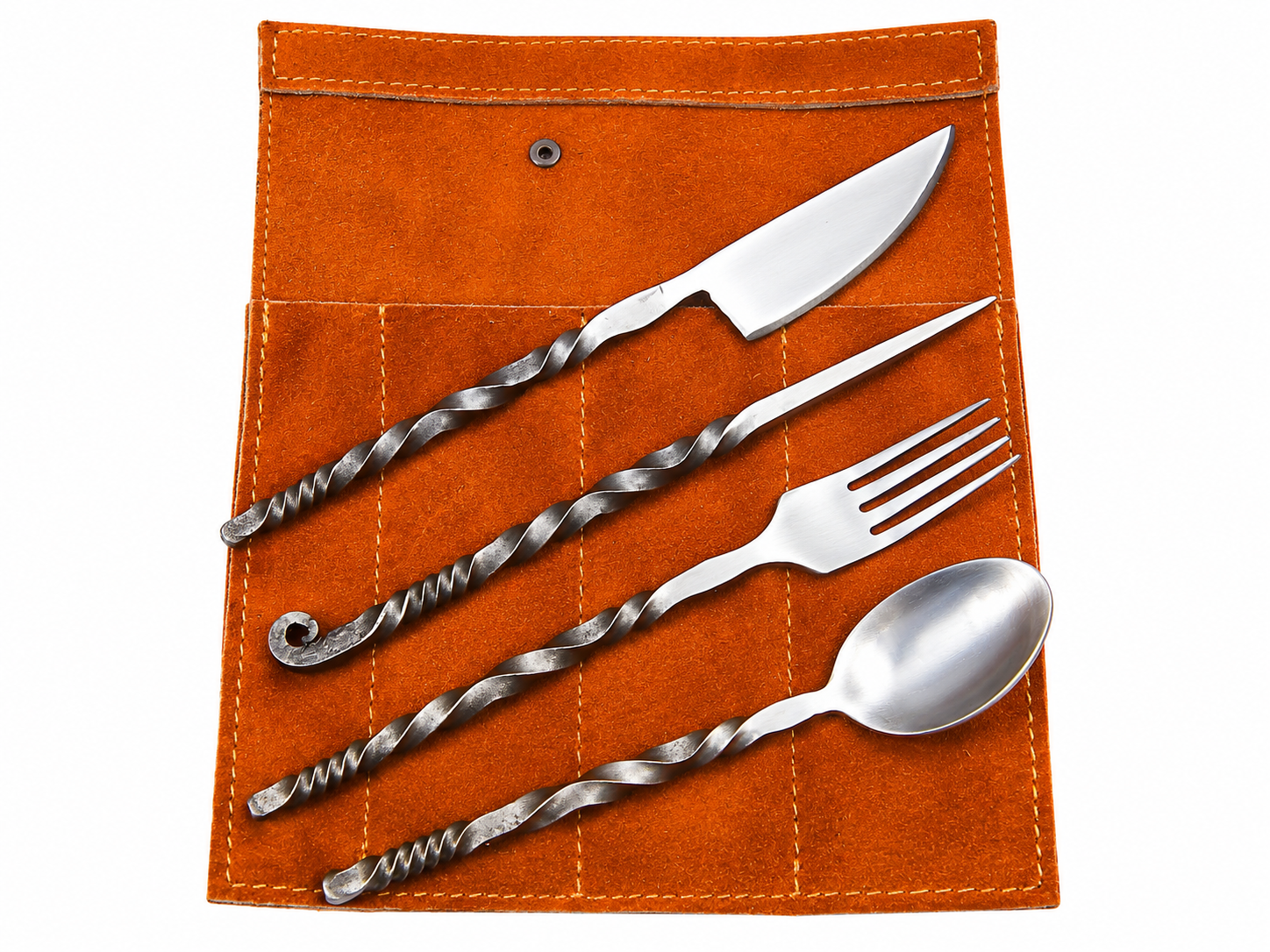
The photograph shows four different utensils arranged on a soft-looking pouch with visible stitching and individual storage sections. The warm orange-brown background highlights the bright metallic finish of the utensils.
The combination of twisted handles, silver-colored metal, and the rustic pouch creates a strong visual identity.
This design is especially relevant to buyers searching for Viking-inspired cutlery, medieval-style dining accessories, and compact utensil collections with a traditional appearance.
Distinctive Spiral Twisted Handle Design
The most noticeable feature of this cutlery set is its twisted metal handle design.
Each utensil has an elongated handle with a visible spiral pattern running along much of its length. The twists create alternating highlights and shadows across the metal surface.
This gives the handles a textured appearance that differs from standard kitchen flatware.
The twisting is visible on the knife, fork, spoon, and narrow pointed utensil, allowing all four pieces to share a consistent design.
The handles taper toward their ends, with slightly different finishing details.
One utensil has a curled end, while others terminate in simpler flattened shapes.
These small variations give each piece its own appearance without changing the coordinated style of the collection.
The visible finish is silver and dark gray, with brighter areas reflecting the lighting.
Although the handle design resembles traditional forged metalwork, the image alone cannot confirm whether the pieces were individually hand-forged.
The set should therefore be described as having a twisted-handle design until the manufacturing process is verified.
Four Distinctive Utensils
The image shows four separate pieces rather than four identical tools.
Each utensil has a different working end, making the set visually recognizable as a dining-related collection.
The upper utensil has a broad, pointed blade resembling a small dining or food-preparation knife.
Its blade has a bright metallic surface with a curved cutting edge and pointed tip.
The handle connects to the blade through an irregular, sculpted transition.
The second utensil has a long, narrow pointed end.
Its slender profile resembles a food pick or skewer, although its exact intended purpose should be confirmed with the manufacturer.
The third utensil is a fork with three long, narrow prongs.
Its working end is wider than the pointed utensil and has a conventional fork-like shape.
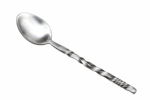
The fourth utensil is a spoon with an oval bowl.
The spoon has a smooth-looking, reflective interior and a twisted handle similar to the other pieces.
Together, these four components create a visually coordinated collection.
Because the narrow pointed utensil is not clearly identified by the image alone, it should not be assigned a specific specialized purpose without supplier confirmation.
Medieval-Inspired Dining Style
The design of this set is closely associated with rustic and medieval-inspired tableware.
Traditional-themed dining accessories often feature dark metal finishes, twisted handles, and simple utensil profiles.
This product follows a similar visual direction.
The distinctive metal twisting creates a historical-looking appearance, while the pouch contributes to the traditional presentation.
For customers interested in medieval-style table settings, the set offers a coordinated selection of utensils.
It may also appeal to buyers who enjoy Viking-inspired accessories or historical-themed decorative collections.
However, the product should not be described as a historically accurate reproduction without supporting documentation.
The design is inspired by traditional aesthetics, but the photograph does not establish a particular historical period, geographical origin, or reproduction standard.
Describing it as medieval-inspired is both accurate and useful for customers.
Silver-Colored Metal Construction
All four utensils have a metallic appearance.
The working ends show relatively smooth silver surfaces, while the twisted handles contain darker areas between the raised metal sections.
The different textures create an attractive contrast.
The knife has a broader polished-looking blade, the fork has slender reflective prongs, and the spoon has a rounded metallic bowl.
The pointed utensil has a similarly bright, narrow tip.
These visible characteristics suggest metal construction, but the photograph does not establish the exact alloy.
Stainless steel, carbon steel, and other metal compositions may have similar appearances.
Each material has different properties and care requirements.
For this reason, it would be inappropriate to claim that the product is rustproof, dishwasher-safe, food-grade stainless steel, or manufactured from a specific carbon steel without manufacturer confirmation.
Those details should be provided in the final product specifications after verification.
The accurate visual description is silver-colored metal utensils with twisted handles.
Orange-Brown Roll Pouch
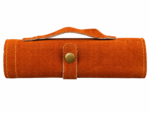
Another prominent feature is the orange-brown pouch displayed behind the utensils.
The pouch has a warm rust-orange color and a soft, slightly textured appearance.
Visible stitched lines run along its outer edges and across the body.
The photograph shows multiple divided storage sections suitable for holding individual utensils.
A folded upper section is also visible, together with a small metallic opening or fitting.
These details suggest a roll-style storage design.
Such pouches are commonly used to organize portable utensils or protect individual items during storage.
The pictured pouch offers a matching rustic presentation for the cutlery.
Its color contrasts clearly with the silver metal components.
The orange-brown material resembles suede or leather, but its composition cannot be determined with confidence from the image.
It may be genuine leather, suede, synthetic leather, or another textured material.
The material, closure method, and exact dimensions should be confirmed before publication.
The photograph also does not prove whether the pouch is included with every supplier configuration.
For a final retail listing, the contents of the package must be established.
A Coordinated Set for Rustic Table Settings
One of the advantages of a matching utensil collection is the consistent appearance it creates.
The four pieces in this image share the same twisted handle style.
Although their working ends vary, the matching metal finish ties the collection together.
This makes the set suitable for customers seeking coordinated decorative tableware.
Rustic dining environments often feature natural materials, darker metallic finishes, and simple traditional accessories.
The pictured set fits that aesthetic.
It may complement wooden serving boards, natural table linens, and traditional-inspired table decorations.
For medieval-themed gatherings, the twisted metal appearance offers a distinctive alternative to ordinary modern cutlery.
The set can also be presented as a gift-oriented dining accessory when its materials, packaging, and intended applications are confirmed.
Rather than relying on exaggerated claims about craftsmanship, its visual features provide a straightforward reason for customer interest.
Outdoor Dining and Camping Appeal
The roll-pouch presentation makes this product relevant to customers interested in portable dining accessories.
Outdoor dining sets often include a small selection of utensils that can be kept together during storage.
The pictured four-piece arrangement follows that general concept.
A knife, fork, spoon, and pointed utensil cover several familiar utensil shapes.
The accompanying pouch provides a visually organized way to keep the pieces together.
For camping-related product pages, however, it is important to verify the practical specifications.
The image does not establish the utensils’ weights, dimensions, corrosion resistance, or suitability for prolonged exposure to outdoor conditions.
It also does not confirm whether the set meets food-contact requirements.
These are important considerations for customers intending to use the utensils during camping or outdoor meals.
Once the supplier confirms the relevant specifications, the product can be marketed more specifically for portable outdoor dining.
Until then, the most accurate approach is to emphasize its camping-inspired presentation and visible construction details.
An Alternative to Conventional Cutlery
Most everyday flatware sets use smooth handles with a fairly uniform shape.
The twisted-handle design shown here offers a different appearance.
The spiral metal sections give each utensil a more textured profile.
This creates visual interest across the entire set.
Customers shopping for unusual tableware may appreciate the combination of rustic styling and recognizable utensil shapes.
The design is particularly relevant to themed product collections.
Instead of presenting the utensils as ordinary restaurant silverware, the listing can emphasize the medieval-inspired appearance.
The orange pouch also contributes to this distinction.
It gives the set a more traditional presentation than a standard cardboard cutlery box.
The result is a coordinated product with several recognizable design features.
Knife Design and Appearance
The knife is positioned near the top of the photograph.
It features a broad, pointed blade with a curved cutting edge.
The blade has a clean, bright metallic appearance.
The handle is long and visibly twisted, creating a pronounced spiral effect.
Its overall shape differs from a conventional blunt-ended table knife.
The pointed tip and broad blade may be associated with food preparation or serving, but the exact intended use has not been verified.
The cutting-edge geometry and sharpness cannot be assessed reliably from the image.
Before advertising the knife for food preparation, the supplier should confirm its intended application, material, and edge specifications.
The design may also interest customers who collect unusual traditional-style dining accessories.
Three-Pronged Fork Design
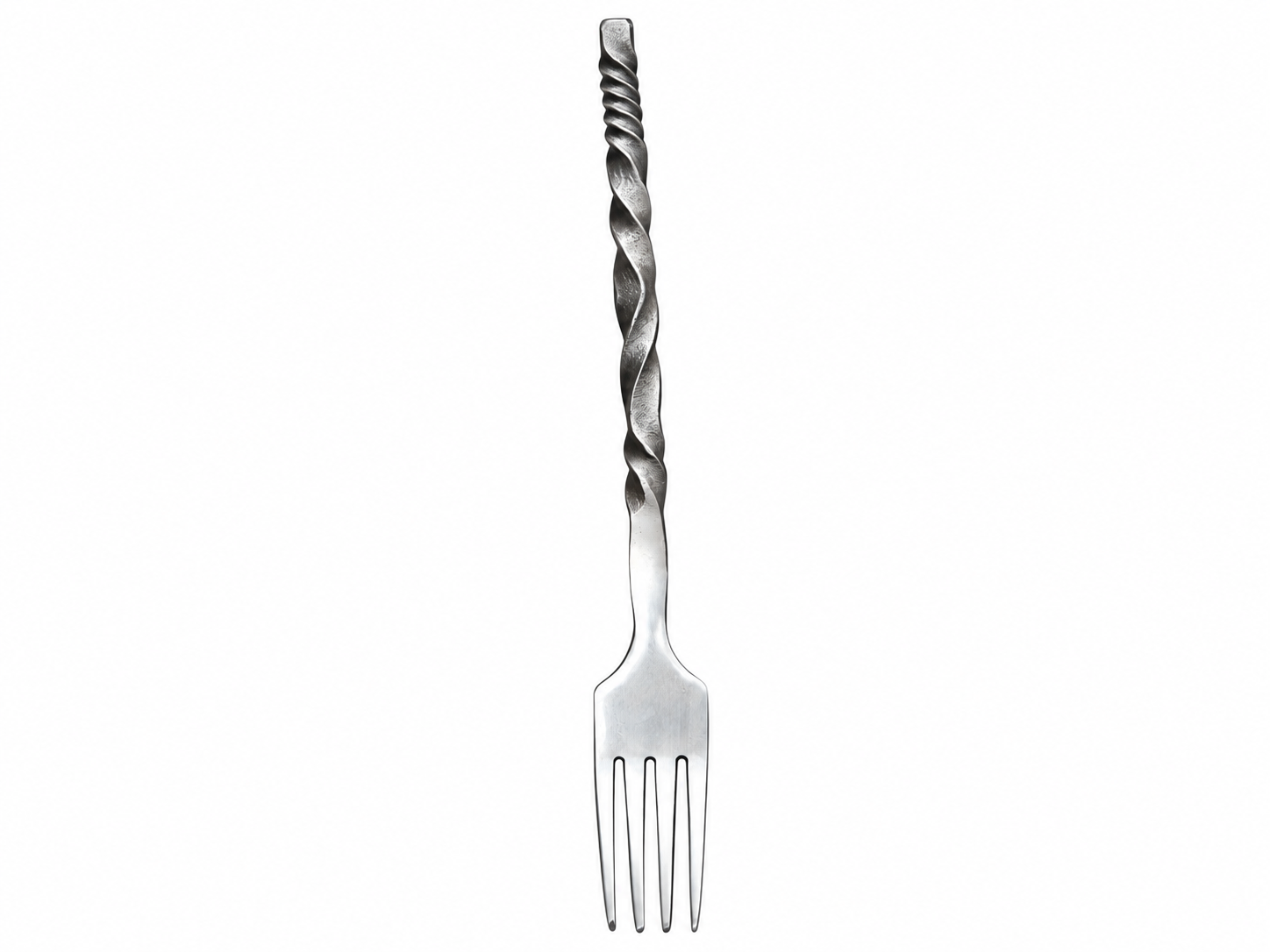
The fork has three visible prongs extending from a relatively broad central section.
Its prongs are long, narrow, and slightly tapered.
The reflective surface creates a clean contrast against the orange pouch.
The handle features the same spiral pattern found on the other utensils.
Unlike conventional four-prong dining forks, this design uses three prongs.
That distinction makes it important for accurate product identification.
The photograph does not establish whether the fork is intended for everyday dining, serving, or a particular type of food.
The product listing should therefore identify it simply as a three-pronged fork.
More specific claims can be added when verified.
Spoon Design and Appearance
The spoon has an oval-shaped bowl with a polished-looking interior.
Its bowl is relatively broad compared with the narrow twisted handle.
The handle transitions into the spoon through a smoothly curved neck.
The silver-colored finish reflects the surrounding light, making the shape clearly visible.
The spoon’s design complements the knife and fork while retaining its own practical form.
The exact bowl capacity and overall dimensions are unknown.
Consequently, the listing should avoid describing it as a teaspoon, dessert spoon, soup spoon, or tablespoon unless measurements confirm that classification.
For general product identification, the term spoon is sufficient.
Slim Pointed Utensil
The fourth component is a slender pointed metal utensil.
It has a narrow working end and a twisted handle.
The tip tapers to a fine point, giving it a different profile from the knife and fork.
Its handle terminates in a decorative curled shape.
This element adds variety to the set.
It may resemble a food pick or skewer, but the photograph does not provide enough information to determine its intended function conclusively.
The final product description should use a neutral term until the supplier identifies it.
This avoids presenting a specialized feature that may not match the actual product.
Storage and General Care
The correct care method for the set depends on the metal composition and pouch material.
As a general precaution, metal utensils should be cleaned and dried according to the manufacturer’s recommendations.
Avoid leaving unverified metal alloys exposed to moisture for extended periods.
If the utensils are intended for food contact, the supplier should provide suitable material and safety information.
The pouch should be cleaned according to its actual construction material.
A leather pouch may require different care from a synthetic fabric or imitation suede pouch.
The pieces should be dry before being returned to storage.
Handle the knife and pointed utensil carefully to avoid accidental contact with their tips or edges.
Do not assume that the utensils are dishwasher-safe or suitable for direct heat exposure without confirmation.
Manufacturer guidance should determine the proper maintenance procedure.
Important Specifications to Confirm
For an accurate online product listing, customers should be able to review essential specifications.
These include the complete contents of the set, overall utensil lengths, knife blade length, fork dimensions, and spoon bowl size.
The manufacturer should also identify the metal alloy and its suitability for food contact.
The pouch material and dimensions are similarly important.
Packaging information should specify whether the four utensils and pouch are sold together.
If the supplier offers customization, the available options should be documented.
Potential customization details may include logo placement, packaging changes, or alternative finishes, but none should be advertised as available until verified.
Accurate specifications help customers understand what they are purchasing and reduce uncertainty during ordering.
A Distinctive Traditional-Style Cutlery Collection
The 4 Piece Twisted Handle Camping Cutlery Set is visually defined by its spiral metal handles, four different utensil profiles, and orange-brown stitched roll pouch.
Its medieval-inspired styling makes it relevant to rustic tableware collections and customers interested in unusual dining accessories.
The set’s appearance is consistent across the knife, fork, spoon, and pointed utensil, creating a coordinated design.
For buyers interested in traditional-looking cutlery, this product offers a distinctive alternative to conventional smooth-handled flatware.
Review the verified materials, sizes, and included components to determine whether this twisted-handle cutlery set is the right choice for your collection or dining needs.
Reviews
There are no reviews yet.