







Feather-pattern knife blank for a custom handle project
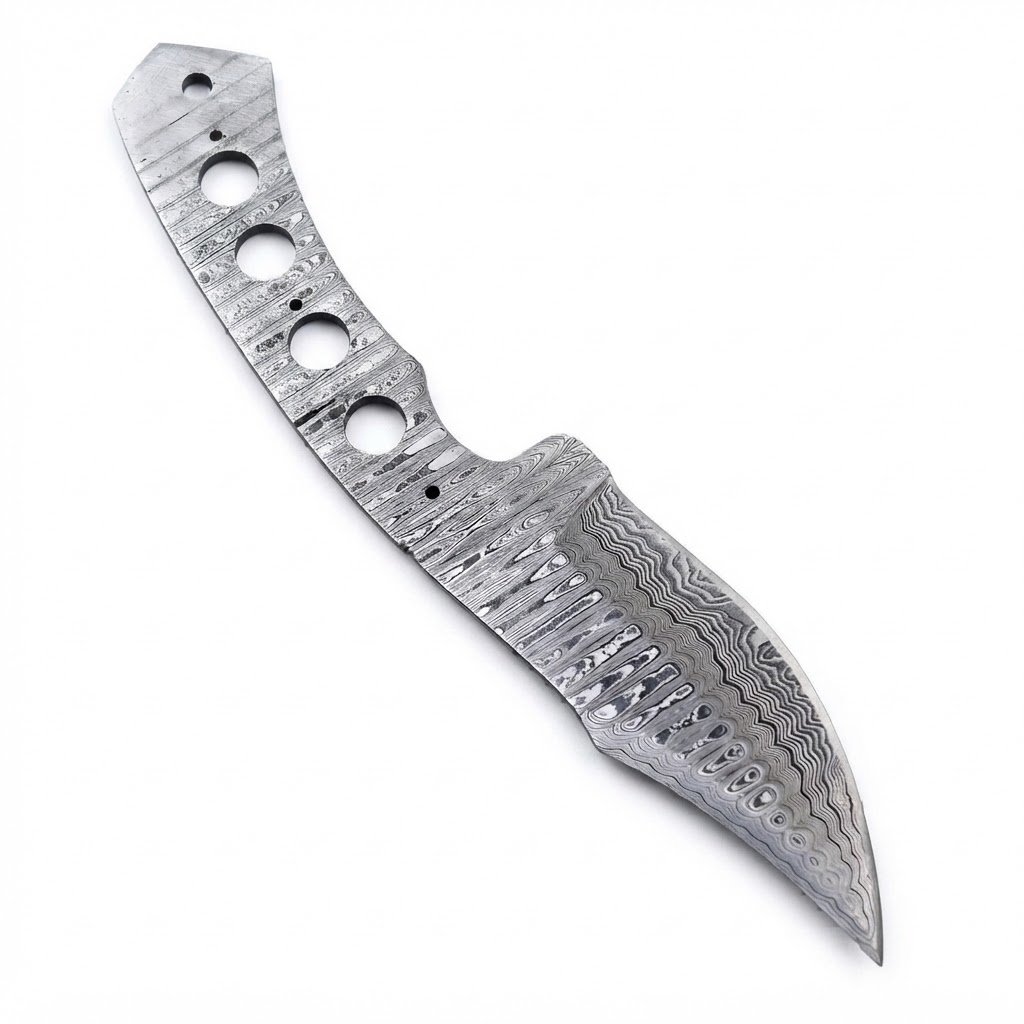
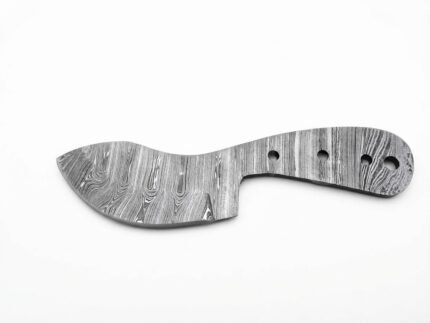
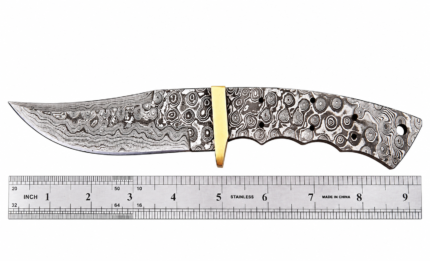
This feather-pattern knife blank provides a distinctive starting point for a custom knife-making project. The pictured piece combines a broad, pointed blade with an exposed handle tang, four large circular tang cutouts, and several smaller holes. Its silver-gray surface carries contrasting lines and elongated markings that create a feather-like appearance across the blade and handle section.
Unlike a completed knife, this blank has no fitted handle scales. The entire outline is visible, from the rounded and angled rear of the tang to the curved blade tip. That makes the photograph useful for assessing the overall shape before choosing a handle design.
The appeal is both practical and visual. A pre-shaped blank gives a maker an existing outline around which to plan the rest of a project, while the patterned surface offers a clear decorative direction. The final handle, hardware, and finishing choices will determine how the completed piece looks and feels.
The photograph confirms the visible profile and hole arrangement. Steel composition, heat treatment, hardness, dimensions, and sharpening status remain unverified and should be confirmed before selecting the blank for a particular build.
A blade blank rather than a finished knife
This product belongs in knife-making supplies because the handle section is exposed and no grip material has been installed. It is best described as a blade blank for further assembly and finishing, rather than a ready-to-use outdoor knife.
That distinction helps customers understand what they are choosing. A finished knife normally has an assembled handle and a clearly stated specification for its intended use. Here, the maker still has decisions to make about the handle, attachment hardware, and any remaining finishing work.
The supplied shape may be useful to someone who wants to focus on handle design instead of beginning with an unshaped piece of material. However, the amount of work remaining cannot be established from the image. A patterned surface does not prove that the blank is fully hardened, ground to final dimensions, or sharpened.
For a suitable project, the starting point is therefore the visible design combined with a confirmed technical specification. Once both are available, the maker can judge whether the blank fits their experience, equipment, and intended result.
Feather-like pattern across the visible face
The surface pattern is the blank’s most recognizable feature. Narrow dark and light lines run through wider elongated shapes, creating a layered-looking effect. Across the blade, some markings resemble the branching structure of a feather, while others form closely spaced waves and small oval shapes.
The design is not uniform across the whole piece. Near the cutting-edge area, the lines become tighter and more curved. Elsewhere, longer markings stretch across the face and continue toward the tang. This variation gives the blank a more detailed appearance than a plain satin or polished surface.
“Feather-pattern” describes that visible effect. It does not confirm a particular forging method or steel combination. Although the finish resembles patterned Damascus steel, genuine pattern-welded construction cannot be established from a photograph alone.
For customers choosing a blank partly for its appearance, the pattern provides a strong visual foundation. It can remain the main decorative feature of the finished knife or be paired with a handle that introduces another color or texture.
Broad blade with a pointed outline
The blade is broad near its base and narrows toward a pointed tip. One side follows a curved cutting-edge outline, while the opposite side slopes toward the point. The overall silhouette has a drop-point-style appearance.
There is no visible serrated section or gut hook. Instead, the blade presents a continuous edge profile, with a curved transition toward the tip. This gives the blank a different appearance from a straight-edged utility blade, a clipped-point design, or a hooked skinning profile.
The photograph also shows a clear change in shape where the blade meets the tang. The blade widens beyond the handle section, creating a defined front shoulder rather than continuing at the same width throughout.
These details are useful when choosing the look of a project, but they do not establish cutting performance. Blade thickness, cross-section, edge geometry, and material treatment all affect practical use. Those specifications should be checked separately before the finished knife is assigned a particular working role.
Exposed full-tang profile
The handle section forms a broad continuation behind the blade. Its full-width outline is visible because there are no handle scales covering it. This is a full-tang-style blank, with the handle area shaped as part of the same visible piece as the blade.
For a maker, an exposed tang provides a clear reference for planning the shape of the grip. The handle material can be selected and fitted around the existing outline, subject to the blank’s actual dimensions and the chosen construction method.
The photograph shows that the tang is not a simple straight rectangle. It curves along its length and changes width as it approaches the blade. The rear has an angled, rounded outline, while the front transitions into a more pronounced contour.
Those features will influence the appearance of the finished handle. They do not, by themselves, confirm strength, balance, or comfort. The thickness of the blank, its condition, and the completed assembly all matter when evaluating the finished product.
Four large circular tang cutouts
Four large circular openings run along the handle section. They are spaced between the rear of the tang and the transition toward the blade, making the blank easy to distinguish from designs with a solid handle area.
These openings remove material from the tang. However, the image does not provide enough information to quantify any weight reduction or determine the balance of the finished knife. Handle materials and hardware would also affect the final weight distribution.
The cutouts are separate from the smaller holes visible along the tang. Their larger diameter makes that distinction clear, even though their exact measurements are unknown.
For a custom handle project, the opening layout is worth reviewing before selecting components. The finished handle needs to work with the existing tang geometry rather than assuming that every blank uses the same arrangement.
A dimensioned drawing would help clarify the size and spacing of all four cutouts. That would allow the maker to compare this blank with their planned handle layout before purchasing additional materials.
Smaller holes along the handle section
In addition to the four large openings, the image shows three smaller holes distributed along the tang and another opening near the rear. This arrangement is consistent with a blank prepared for a handle assembly, although the intended role of each hole has not been documented.
The smaller holes may be intended for handle attachment, while the rear opening may accommodate another fitting. Their precise functions, diameters, and suitable hardware sizes should be confirmed rather than assumed.
This is particularly important when ordering pins, tubes, or other components. A hole that looks suitable in a photograph may differ from the diameter required by a particular fastening system.
The visible arrangement nevertheless provides useful planning information. It shows that the tang already has several openings and gives an initial sense of where they sit relative to the handle outline.
No pins, fasteners, tubes, or handle scales are pictured. Those items should be treated as separate requirements unless the seller confirms that they are included with the order.
Shaped transition between blade and handle
A curved recess appears where the handle section meets the blade. Beside it, the blade profile rises into a rounded shoulder before continuing toward the tip. This gives the blank a clearly defined transition between its two main sections.
For the finished design, that area can influence where the front of the handle ends and how the grip relates visually to the blade. It deserves attention during handle planning because it is more shaped than the straighter rear portions of the tang.
The image does not establish the dimensions of the recess or whether it is intended as a specific finger-placement feature. It would therefore be inaccurate to promise an ergonomic grip or a particular level of hand protection.
What can be seen is the outline: a curved junction that separates the narrow handle section from the broader blade. Makers who prefer this type of transition can use it as a visual criterion when comparing different blanks.
Choosing a handle to complement the pattern
Because no handle is fitted, the blank leaves the finished appearance open to the maker’s choice. A restrained handle could keep attention on the blade pattern, while a more colorful handle could create contrast with the silver-gray surface.
Those are design possibilities rather than included product options. No particular wood, synthetic material, liner, or decorative fitting has been verified as part of the offer.
The visible tang shape provides the starting boundary for that decision. Before selecting handle material, the maker needs the actual tang length, width, thickness, and hole spacing. These measurements determine whether the chosen components can accommodate the existing profile.
The relationship between handle and blade is also worth considering visually. The blade already has a detailed surface, so the handle can either echo that detail or provide a simpler background.
This blank may therefore appeal to makers who want some control over the final appearance while beginning with a pre-established blade shape and visible surface pattern.
Planning the finished proportions
The photograph shows the relationship between the blade and tang, but it does not provide a dependable scale reference. Overall length, blade length, handle length, and stock thickness cannot be calculated accurately from the image.
Those dimensions are essential when planning the finished proportions. A handle that looks long enough in a photograph may feel different at its actual size, and the same blade outline can produce very different results at different scales.
Weight is another unknown. The tang cutouts are visible, but they do not establish whether the completed knife will feel light, heavy, blade-forward, or handle-forward.
For a maker comparing blanks, a simple dimensioned drawing would answer more than a broad size label such as “small” or “large.” It would also help determine the amount of handle material needed and the space required for the completed project.
This listing therefore describes the shape without assigning an unverified size category. The actual measurements should guide purchasing and assembly decisions.
A starting point for individual projects
This blank may suit a maker who wants to build a distinctive fixed-blade knife around a patterned surface and an already shaped tang. Its most relevant audience is customers shopping for components, rather than buyers seeking a finished tool.
An individual project offers room to make choices about handle appearance, fittings, and presentation. The blank supplies the visible blade profile; the maker supplies the remaining design decisions and any work needed to complete the assembly.
That does not automatically make it a beginner-ready kit. No instructions, hardware package, or list of required tools is shown. The level of experience needed depends on the blank’s actual condition and the work remaining.
A customer with an established process can compare those requirements with their own equipment. Someone approaching a first project would benefit from clear supplier information about what has already been completed and what still needs to be done.
Useful details for workshop purchasing
For a workshop buying more than one blank, consistency matters alongside appearance. Dimensions, hole positions, thickness, surface condition, and heat-treatment status would all need to be checked across the supplied pieces.
The single photograph does not establish batch consistency. It also does not show whether the photographed pattern is representative of every item or specific to one sample.
If several blanks are being considered for a coordinated project, the seller should clarify what variation to expect. Surface patterns can be an important part of the finished design, so photographs of the actual supplied pieces may be useful where available.
Quantity pricing and minimum orders also belong to the specific supplier offer. They cannot be inferred from the image or borrowed from a different blank with a similar outline.
For this reason, the product’s visible design and the supplier’s commercial terms are kept separate. One helps assess appearance; the other determines whether an order fits the workshop’s requirements.
Material and heat-treatment information
The blank has a metallic silver-gray appearance, but the steel grade and composition are not confirmed. The surface pattern alone does not identify the alloys used or prove a particular layer count.
Heat-treatment status is equally important. A blank can be sold at different stages of production, and the photograph does not indicate whether this one is hardened, tempered, annealed, or awaiting further processing.
These are not minor details for a maker. They determine what work remains and whether the blank is compatible with the intended finishing process. A product described only as “Damascus” would still need more specific information to answer those questions.
Before beginning a build, obtain the material designation and a clear statement of the supplied condition. If a hardness figure is provided, it should refer to this product rather than a general claim about other items in the supplier’s range.
Until those details are confirmed, the accurate description remains a patterned knife blank with a visible full-tang profile.
Edge and surface condition
The blank has a defined blade outline, but the image does not establish whether the edge is sharpened. A narrow-looking edge in a photograph is not enough to confirm that it is finished or ready for use.
The exact grind is also unclear from this single face-on view. A side view and thickness measurements would help distinguish the blade’s cross-section and the amount of work remaining.
The visible surface contains both patterned areas and lighter sections, particularly toward the rear of the tang. These can be described as part of the photographed appearance, but their cause should not be guessed.
For a buyer, the useful question is the supplied finishing stage. The seller should clarify whether the blank requires additional surface preparation, edge work, or other processing before handle installation and final completion.
That information helps prevent a mismatch between expectations and the actual component. A pre-shaped blank can still require substantial work, depending on its condition.
What is shown with the product
The photograph contains one blade blank on a white background. No handle scales, pins, adhesive, sheath, storage pouch, or presentation packaging are displayed.
The listing should therefore be understood as describing the pictured blank. Any additional components need confirmation in the seller’s package-content statement.
Only one profile and one surface appearance are shown. Alternative sizes, other blade shapes, different patterns, or custom hole layouts have not been verified for this exact product.
The image also shows only one face. It does not establish the appearance of the reverse side, the thickness of the spine, or the condition of the perimeter.
For customers who want to evaluate those details before purchase, additional photographs would be useful. A reverse view, spine view, and dimensioned image would complement the current photograph without requiring assumptions.
Care and storage information
Care requirements depend on the confirmed steel and surface treatment. Since those specifications are unavailable, no particular oil, cleaner, polish, or corrosion-resistance claim is included here.
The maker’s instructions should explain how the blank should be stored before assembly and how the patterned finish should be maintained. Those instructions should be appropriate to the actual material.
The same applies to any finishing work. A process suitable for one steel or surface treatment may not be appropriate for another. The visible pattern does not provide enough information to select a method.
For customers planning a project over time, knowing the storage requirements is useful before the blank arrives. It helps them prepare suitable conditions and avoid choosing maintenance products based only on appearance.
Bring your handle design to the project
This feather-pattern knife blank combines a broad pointed blade, a curved tang, four large circular cutouts, and a series of smaller holes. Its exposed profile makes the layout easy to assess, while the flowing surface markings give the project a distinct visual starting point.
The opportunity lies in completing the design around that foundation. Handle selection and finishing choices can give the assembled piece its own character, provided they are based on the blank’s confirmed dimensions and supplied condition.
Review the photographs, confirm the technical specifications and included components, and choose this blank if its patterned finish and full-tang profile suit your next custom handle project.







Reviews
There are no reviews yet.