







Dark Finish Fixed Blade Knife with Brown Wooden Handle
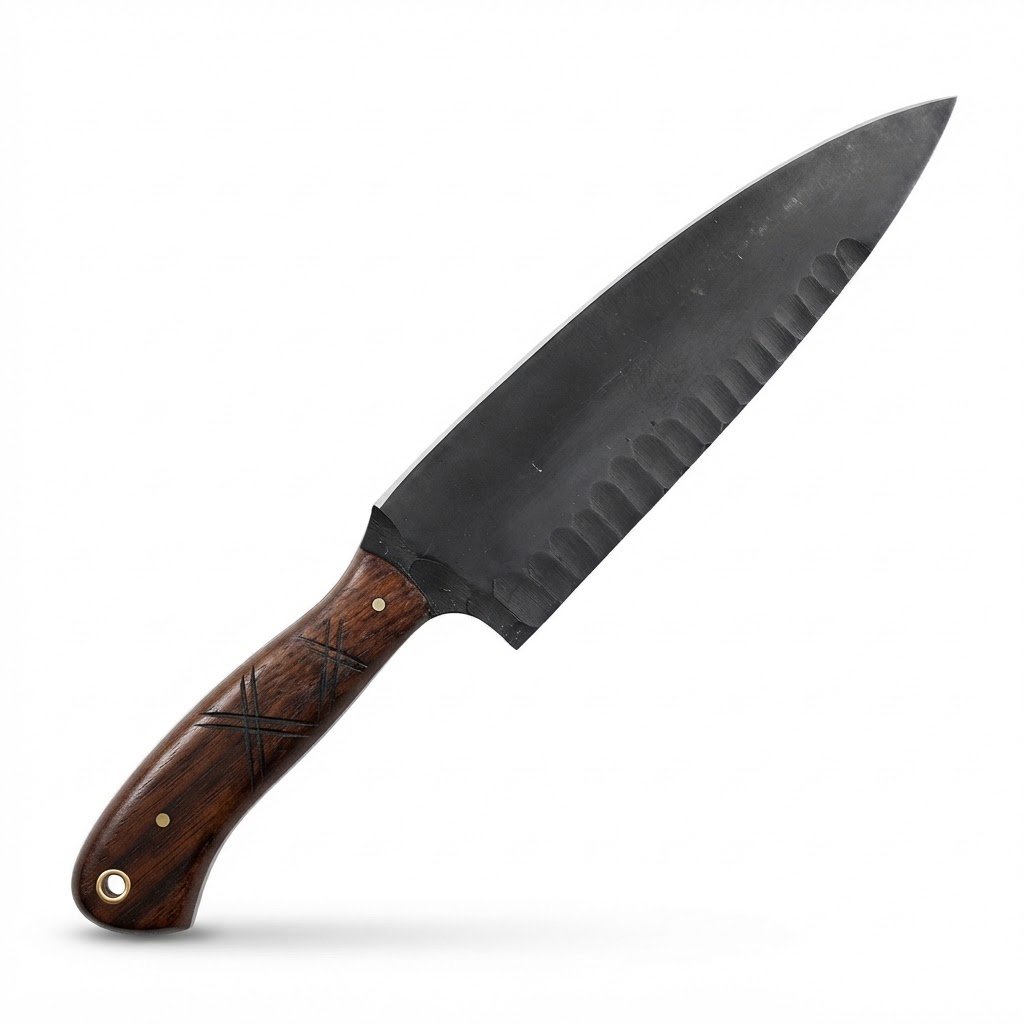
The Dark Finish Fixed Blade Knife combines a traditional outdoor-knife silhouette with understated decorative details. Its broad, pointed blade features a dark gray surface, a lighter cutting edge and a series of irregular markings near the spine. A brown wood-grain handle with dark cross-line accents complements the metallic blade, while a tan stitched sheath completes the presentation.
Designed in the recognizable style of a fixed-blade outdoor utility knife, this piece stands apart from standard polished knives through its contrasting finishes and traditional appearance. The gently contoured handle, visible metallic pins and pointed blade create a balanced visual composition suited to collectors and buyers interested in classic knife designs.
The knife is photographed with a tan protective sheath featuring decorative impressions, stitching along the edges, a fastening strap and an extended belt-loop section.
Together, these details create an appealing combination of functional-inspired form and traditional styling.
Distinctive Dark Blade Finish
One of the most noticeable characteristics of this knife is its dark gray blade finish.
Unlike bright, fully polished blades, the visible blade surface has a muted appearance with subtle changes in tone. These variations give the metal a textured look.
A lighter cutting edge follows the lower curved profile, creating a noticeable contrast with the darker blade face.
The blade also displays a series of irregular, overlapping marks near its upper section. These markings resemble the visual effects sometimes associated with forging or hammer finishing.
However, they do not independently establish the manufacturing technique.
For accurate product information, the blade should be described as having a dark finish with visible textured detailing.
The exact finishing process, whether blackened, oxidized, chemically treated or mechanically produced, requires supplier confirmation.
The understated metallic appearance gives the knife a traditional character without depending on elaborate surface artwork.
Broad Pointed Blade Profile
The Dark Finish Fixed Blade Knife features a broad blade that gradually narrows toward a defined point.
Its cutting edge follows a gentle outward curve before rising toward the tip.
This profile resembles the general-purpose blade shapes commonly seen in outdoor utility and hunting-style knives.
The blade is relatively wide near the handle, with a smooth transition toward the narrower forward section.
A slightly angular shoulder is visible at the junction between the blade and handle.
The shape gives the knife a recognizable fixed-blade profile.
Unlike folding knives, a fixed-blade knife does not use a folding blade mechanism. Its blade remains in an extended position.
This design category is familiar to outdoor enthusiasts, knife collectors and buyers interested in traditional cutting tools.
The actual performance of this particular blade depends on its steel grade, thickness, edge geometry and heat treatment.
These technical characteristics cannot be confirmed from a product photograph.
Traditional Brown Wooden Handle Appearance
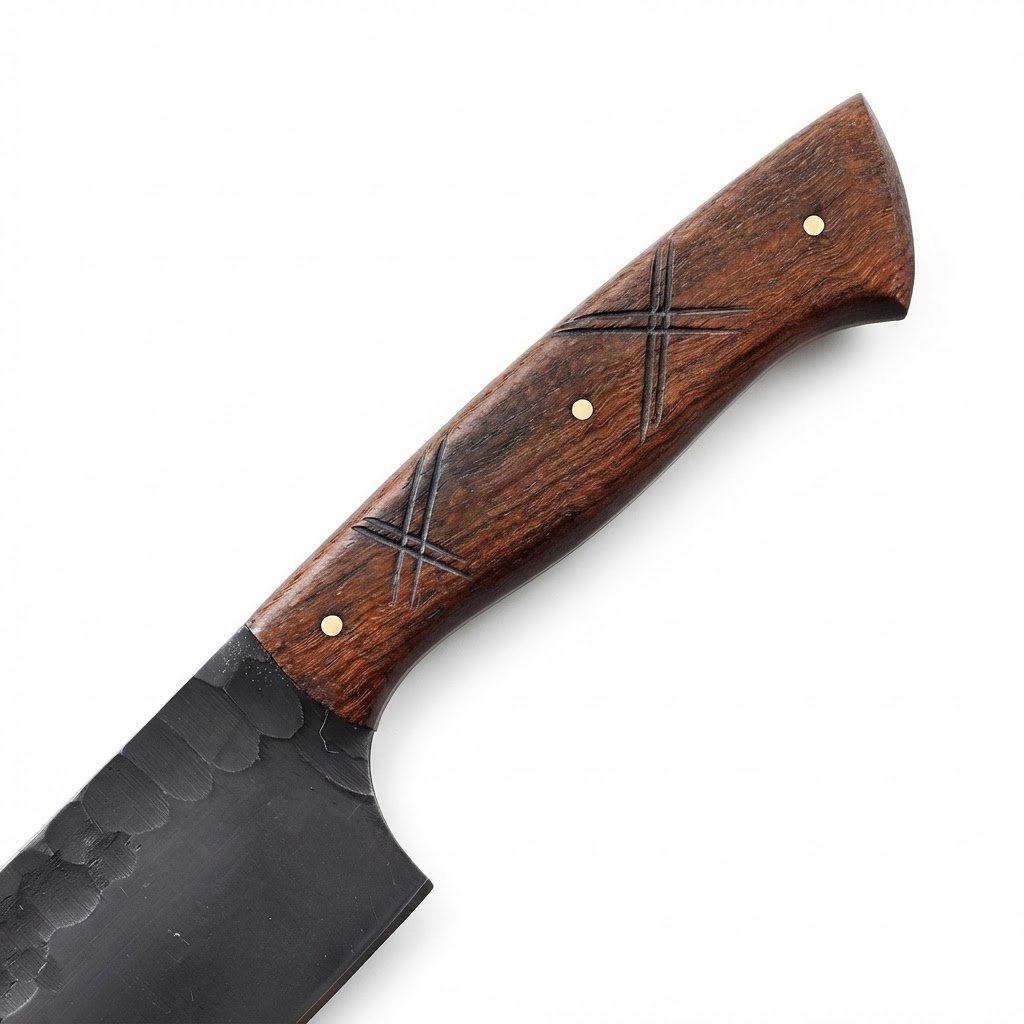
The handle features a rich brown wood-grain appearance with darker streaks across the surface.
Its warm finish creates a strong visual contrast with the dark gray blade.
The handle has an elongated profile with gentle contours along the lower edge.
Its upper surface transitions toward a slightly wider, raised end.
The visible shape suggests that the handle has been designed around the natural placement of a hand, although comfort and ergonomic performance require physical evaluation.
Three small, gold-colored circular pins are visible along the handle.
These metallic accents provide subtle contrast against the darker brown surface.
Decorative cross-line markings are also visible near the center of the handle.
They add visual character while maintaining the traditional appearance.
The image suggests a wood-grain material, but the exact wood species and whether it is natural, stabilized or composite wood should be confirmed before publication.
Decorative Cross-Line Handle Details
A distinguishing feature of this particular knife is the subtle decoration on its handle.
Two groups of dark diagonal lines cross the brown surface, creating an understated carved-looking pattern.
The lines are positioned along the central area rather than extending across the entire handle.
This gives the handle a distinctive appearance without overwhelming its natural-looking grain.
The visible gold-colored pins contribute additional detail.
Together, the metallic accents and darker markings produce a design that feels more individual than a plain wooden handle.
The decoration also helps distinguish this product from similar fixed-blade knives in an online catalog.
Customers comparing different knife models can easily identify this version by its brown grain, cross-line accents and dark blade.
The exact method used to create the markings is not established by the photograph.
Classic Outdoor Knife Styling
Traditional outdoor knives are often characterized by fixed blades, recognizable handle profiles and protective sheaths.
This model follows that visual language.
Its broad blade, pointed tip and contoured wooden-looking handle give it a familiar outdoor utility-knife appearance.
The tan sheath further reinforces the traditional style.
The design may appeal to customers who prefer classic tools rather than highly modern or aggressively styled products.
The combination of brown, tan and dark gray creates a restrained appearance.
It also makes the knife visually suitable for inclusion in collections of traditional-inspired cutlery.
Although the design resembles outdoor working knives, intended usage and cutting performance should be verified with the supplier.
The product should not be marketed as suitable for demanding survival, hunting or professional applications solely on the basis of its appearance.
Tan Protective Sheath
The uploaded image includes a tan, leather-looking protective sheath positioned beneath the knife.
Its shape follows the blade’s broad outline.
A stitched seam runs along the outer edges, while decorative impressions create an additional border across the front.
The sheath has a warm orange-tan appearance that complements the brown handle.
An extended loop is visible above the sheath body.
This appears to be intended for belt attachment.
A short retaining strap with a dark circular snap fastener is also visible.
These details resemble common features of traditional knife sheaths.
The sheath provides an attractive presentation alongside the knife.
However, its exact material, thickness, retention strength and compatibility with particular belt sizes have not been verified.
Genuine leather should only be specified once the supplier has confirmed the material.
Likewise, the inclusion of the sheath in the final selling package should be verified before the product is published.
Contrast Between Blade and Handle
The combination of a dark metallic blade and warm wooden-looking handle is central to this knife’s appeal.
The blade has a subdued gray finish.
The handle introduces natural-looking brown tones with darker accents.
Small metallic pins add a brighter visual detail.
The tan sheath creates a third complementary surface.
Together, these materials and colors produce a cohesive, traditional-inspired appearance.
The contrast between the dark blade face and lighter cutting edge is especially noticeable.
It helps define the blade’s shape clearly in product photographs.
The handle’s decorative markings are subtle enough to complement the overall style.
This makes the knife visually distinct without relying on branding or prominent logos.
Fixed-Blade Construction
The knife is identifiable as a fixed-blade model because its blade is shown extending directly from the handle without a folding mechanism.
Fixed-blade designs are a longstanding category of cutting tools.
They are commonly found in outdoor, craft and utility-knife collections.
This product has a visible transition between the blade and handle, with no opening hinge or folding lock shown.
However, the internal construction is not visible.
The image cannot establish whether the knife uses a full tang, partial tang or another handle attachment method.
These details are important when assessing the intended application and structural characteristics of a knife.
Buyers should review manufacturer specifications before choosing the knife for any particular cutting task.
Verified details about the tang, blade thickness and handle fastening system should be added to the listing when available.
Suitable for Traditional Knife Collections
The Dark Finish Fixed Blade Knife is an interesting option for adults who appreciate traditional knife designs.
Its combination of familiar form and subtle decoration makes it visually recognizable.
A collector may be particularly interested in the contrast between the dark blade and the lighter cutting edge.
The brown wood-grain handle gives the product a classic appearance.
The visible metallic pins and cross-line details introduce additional character.
The tan sheath contributes to its presentation.
These features make the knife appropriate for consideration as part of a collection of fixed-blade cutlery.
Collectors who prioritize particular materials, manufacturing techniques or places of origin should request documentary confirmation.
The photograph establishes the knife’s visible design but does not prove handmade construction, a specific steel composition or a particular production origin.
Understanding the Blade Material
The blade’s metallic appearance suggests a steel cutting component.
However, no precise material identification is possible from the photograph.
Different steels can exhibit similar visual finishes while having different characteristics.
Factors such as carbon content, alloy composition, heat treatment and surface finishing affect their maintenance requirements.
A darkened appearance should not automatically be interpreted as evidence of corrosion resistance.
Likewise, visible texture does not establish hardness or edge retention.
Before describing the knife as high-carbon steel, stainless steel, forged steel or another material, the seller should obtain the manufacturer’s specification.
Information about blade hardness and thickness would also be valuable.
Customers can make better comparisons when technical specifications are presented clearly and accurately.
Handle Material and Construction
The handle’s brown surface resembles polished wood with visible grain.
The decorative lines and metallic pins create a traditional finish.
Although its appearance is distinctive, the material should not be identified more specifically without verification.
Different wood species and engineered materials can have similar colors and grain patterns.
Some handles may feature natural wood, while others use laminated, stabilized or synthetic materials.
The manufacturer should confirm the exact composition.
Handle attachment is another important detail.
The small circular pins visible on the surface may be associated with fastening, decoration or both.
Their appearance alone does not establish the method of construction.
For a complete product specification, buyers should be informed about handle materials, overall length, handle length and care requirements.
Display and Storage Considerations
This knife’s color scheme and traditional appearance may appeal to enthusiasts who organize collections by blade type, finish or handle style.
The dark blade contrasts well with the tan sheath and brown handle.
The product can be photographed from several angles to show these details more clearly.
A side view can highlight the blade’s broad profile.
A close-up of the handle can show its grain-like markings and metal pins.
A separate photograph of the sheath can help buyers understand its shape and visible fastening details.
For physical display, the knife should be positioned in a secure manner with the cutting edge protected and inaccessible to children.
Displaying or storing it responsibly helps preserve its appearance while reducing accidental contact with the blade.
General Care and Maintenance
Care instructions should ultimately follow the manufacturer’s recommendations for the actual steel and handle materials.
As a general precaution, keep the blade clean and dry.
After handling, gently wipe the metallic surface with a soft cloth.
Avoid prolonged exposure to moisture.
Moisture can affect some steel finishes, particularly when the corrosion resistance of the material is unknown.
Do not use abrasive cleaning products on decorative surfaces unless approved by the manufacturer.
The wooden-looking handle should be kept away from excessive moisture and heat.
Avoid soaking the handle or leaving the knife submerged in water.
If the handle is genuine wood, the appropriate maintenance treatment depends on the particular species and finish.
The sheath should also be kept clean and dry.
Do not store a moisture-sensitive blade inside a damp sheath for long periods.
Regular inspection can help identify loose fittings, surface wear or corrosion before further handling.
Responsible Handling
A fixed-blade knife must always be handled carefully.
Keep fingers and other body parts away from the cutting edge.
Use suitable blade protection whenever the knife is not in active use.
The sheath should fit securely before being relied on for storage or transport.
Do not assume the visible retaining strap guarantees secure retention without checking the actual product.
Keep the knife out of children’s reach.
Any intended work should remain within the manufacturer’s verified specifications and recommendations.
Knives may also be subject to local laws regarding possession, transportation and use.
Customers should check the requirements that apply in their jurisdiction.
Important Product Specifications
Several details should be verified before the final e-commerce listing is published.
These include the total knife length, blade length, blade thickness, blade width and product weight.
The steel grade and hardness should also be confirmed.
For the handle, the manufacturer should identify the exact material, construction and finish.
The sheath composition and package contents should be documented.
If the supplier offers personalization or custom manufacturing, those services should be described separately with their actual terms.
A comprehensive product page should distinguish confirmed technical specifications from visible design features.
This improves accuracy and helps buyers understand the product.
A Distinctive Traditional Knife Design
The Dark Finish Fixed Blade Knife brings together a broad pointed blade, dark metallic surface, warm brown handle and tan stitched sheath.
Its decorative cross-line handle markings and small metallic accents provide identifiable finishing details.
The lighter edge contrasts with the dark blade face, while the wood-grain handle adds a traditional appearance.
The combination makes this model an attractive option for adult collectors who value familiar fixed-blade forms with subtle decorative details.
Explore the Dark Finish Fixed Blade Knife for its classic silhouette, contrasting finishes and distinctive wooden-handle styling.







Reviews
There are no reviews yet.