





Damascus Pattern Belt Knife with Two-Tone Handle and Brown Leather Sheath
Classic Styling in a Compact Fixed-Blade Design
The Damascus Pattern Belt Knife combines a distinctive patterned blade, contrasting handle sections, and a richly textured brown sheath. Its compact hunting-inspired profile and carefully coordinated colors make it an appealing addition to collections of traditional fixed-blade cutlery.
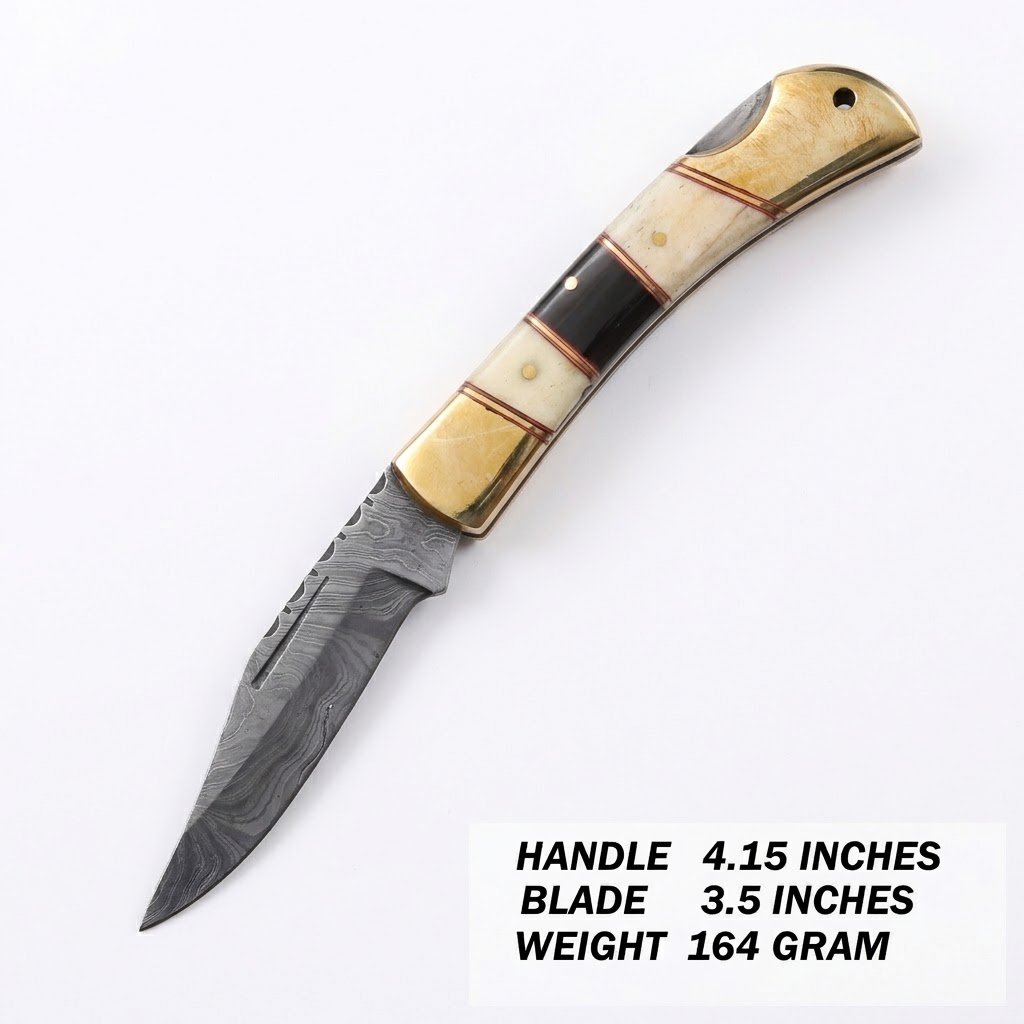
The knife features a pointed blade with flowing silver-gray markings that resemble the layered patterns commonly associated with Damascus steel. These irregular lines extend across the visible blade, creating an attractive contrast between darker and lighter metallic areas.
The handle introduces a different set of visual details. Pale cream-colored sections surround a darker central insert, while narrow reddish-brown spacer bands define the individual components. Gold-colored fittings at the front and rear complete the traditional-inspired arrangement.
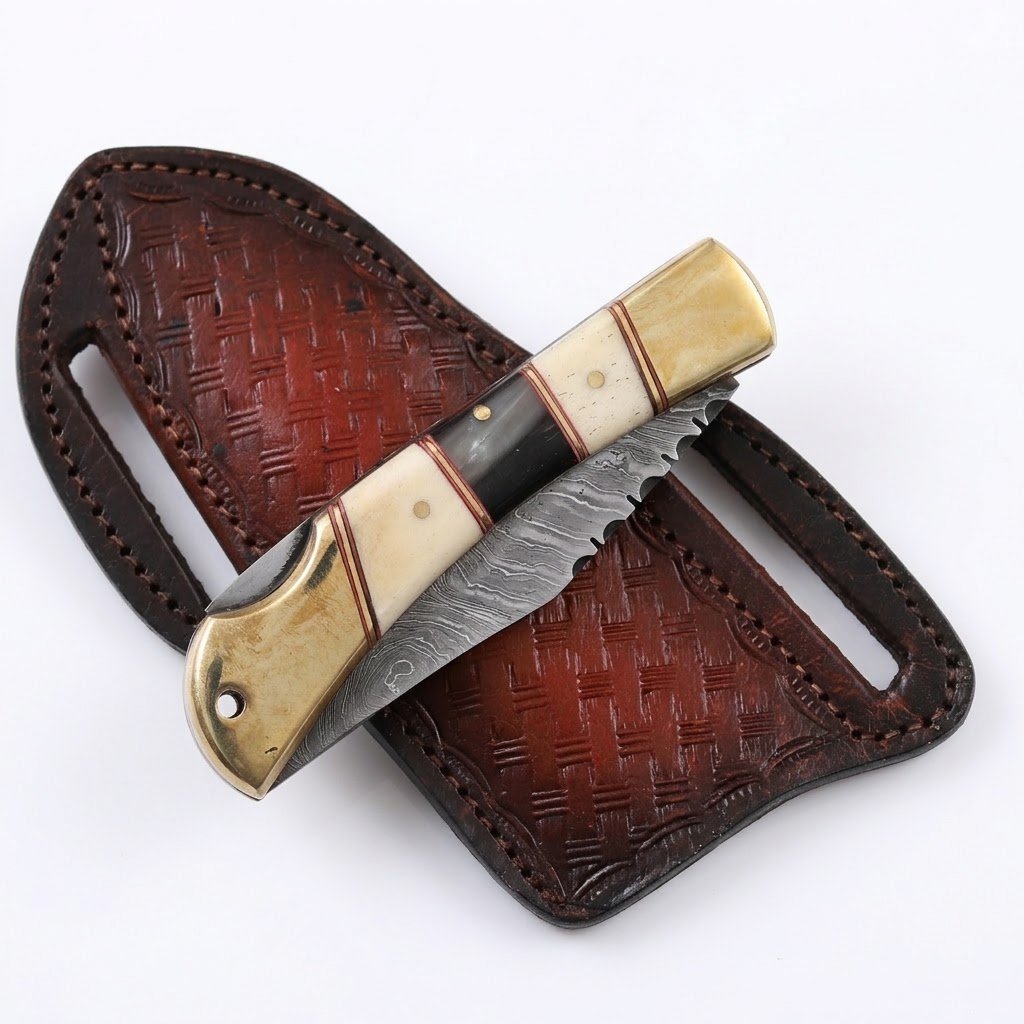
A brown sheath accompanies the knife in the photograph. Its surface displays an embossed basket-weave pattern, dark stitching, and elongated openings on either side.
Together, these details give the Damascus Pattern Belt Knife a recognizable appearance that differs from ordinary single-color fixed-blade knives.
The knife may interest adult collectors, enthusiasts of decorative outdoor cutlery, and buyers who appreciate traditional handle styling. Its exact functional applications should be determined from verified manufacturer specifications.
Slender Pointed Blade Profile
The blade features a narrow, elongated shape with a pointed tip and a gently curved cutting edge.
Its lower edge sweeps toward the tip, while the upper outline follows a gradual taper. The blade appears proportionally slimmer than the broad blades used on many butcher-style or heavy chopping knives.
Near the handle, a defined shoulder creates a visible transition between the cutting section and the grip.
This general blade shape is associated with certain hunting-style, utility, and traditional fixed-blade knife designs.
The Damascus Pattern Belt Knife has a compact appearance that makes it visually distinct from large Bowie knives and broad-bladed cleavers.
The exact blade length, thickness, edge geometry, and cutting capacity are not identifiable from the photograph.
These characteristics matter because similarly shaped knives can differ significantly in their intended applications.
Customers interested in practical use should verify whether the supplied model is designed for general-purpose cutting, light field utility, or decorative display.
The photograph establishes the blade’s appearance but does not demonstrate performance.
Flowing Damascus-Style Blade Pattern
The blade displays a combination of silver-gray and charcoal-colored lines.
These markings follow irregular, flowing paths across the metal surface.
Some sections contain tightly arranged waves, while others display broader layered formations.
The resulting appearance resembles the decorative patterns commonly found on Damascus steel knives.
Unlike a plain satin-finished blade, the patterned surface adds considerable visual detail without requiring a large blade profile.
The swirling lines are especially noticeable along the central and lower areas.
This appearance complements the more restrained colors of the handle.
For collectors who appreciate patterned metalwork, the Damascus Pattern Belt Knife offers an interesting combination of traditional shape and ornamental surface detail.
However, the photograph does not prove that the blade has been manufactured using multiple forged steel layers.
The pattern could be produced through pattern welding, surface etching, or another manufacturing process.
The actual steel grade, layer count, heat treatment, and hardness should be confirmed directly with the manufacturer.
Those characteristics should not be assumed from the visual pattern alone.
Cream and Black Segmented Handle
The handle is another defining characteristic of the knife.
Its design combines pale cream-colored sections with a contrasting dark central component.
The front portion sits behind a gold-colored bolster, creating a gradual transition between the blade and the grip.
A darker central section adds visual depth and divides the lighter handle areas.
Narrow reddish-brown spacer lines separate the components, emphasizing the segmented construction.
The handle also has a gently curved profile, becoming slightly broader toward its rear.
The Damascus Pattern Belt Knife uses this combination of contrasting colors and metallic fittings to create a classic decorative appearance.
The cream-colored portions resemble bone or polished natural material, while the darker section resembles horn or dark composite.
However, the photograph cannot establish their actual composition.
For accurate merchandising, these sections should be described by their visible appearance unless the supplier confirms genuine bone, horn, stabilized wood, resin, or another specific material.
Gold-Colored Bolster and Rear Fitting
A prominent gold-tone bolster is visible where the blade joins the handle.
Its smooth metallic appearance contrasts with the flowing pattern of the blade and the pale grip section immediately behind it.
At the opposite end, another gold-colored component forms the rear fitting.
These details help create a consistent color scheme across the knife.
The gold tones also complement the warm brown sheath and the narrow reddish-brown spacer lines.
Although these fittings resemble brass, the photograph does not establish their exact composition.
They may be made from brass, another metal, or a coated material.
For the Damascus Pattern Belt Knife, it is therefore more accurate to use the description gold-colored fittings until technical specifications are available.
The photograph does not confirm whether the fittings are decorative, structural, or both.
Their visible presence contributes to the knife’s appearance without establishing particular strength or durability claims.
Traditional Handle Shape and Small Rear Opening
The grip has an elongated shape with a gentle curve along its length.
Its rear end is rounded and includes a small circular opening.
This hole could serve a lanyard-related purpose, although the manufacturer should confirm its intended use.
The curved handle visually balances the pointed blade.
Its proportions also distinguish the knife from products with straight cylindrical handles or large finger grooves.
For some buyers, the traditional-looking grip will be an important part of the design.
However, actual handling comfort cannot be determined from a photograph.
Grip suitability depends on the product’s dimensions, material texture, weight, and the user’s hand size.
Customers who plan to use the Damascus Pattern Belt Knife regularly should review the actual measurements and handle construction before purchase.
Brown Basket-Weave-Patterned Sheath
A brown sheath is prominently displayed behind the knife.
Its surface features a geometric basket-weave pattern resembling interlaced strips.
The embossed design creates repeated rectangular and diagonal details across the central area.
Darker edging surrounds the sheath, while visible stitching follows portions of its outline.
The mixture of dark brown and reddish-brown tones complements the cream, black, and gold colors of the knife.
This sheath is an important distinguishing feature because it provides a visually coordinated accessory in the photograph.
The Damascus Pattern Belt Knife is shown together with the sheath, but the seller should confirm that the sheath is actually included in the supplied package.
Its appearance resembles leather, although the exact material cannot be verified from the image.
Until confirmed, leather-look sheath or brown basket-weave-patterned sheath are suitable descriptions.
Elongated Belt Openings
The sheath includes two visible elongated openings positioned near opposite sides.
These openings resemble belt slots commonly found on traditional knife sheaths.
Their placement and shape are consistent with a design intended to accommodate a belt or strap.
However, the photograph cannot establish compatible belt width, attachment strength, orientation during wear, or retention performance.
The actual sheath dimensions should be checked before describing it as suitable for a particular carrying arrangement.
For buyers comparing traditional fixed-blade knives, the sheath design may be an appealing visual feature.
Its embossed surface and visible slots give the accessory a distinctive appearance.
The Damascus Pattern Belt Knife is especially relevant to customers interested in knives presented with traditional-looking sheaths.
Any practical carrying arrangement should comply with local laws and the manufacturer’s instructions.
A Traditional Alternative to Modern Knife Designs
Many contemporary outdoor knives use black synthetic handles, angular blade profiles, and minimalist fittings.
This knife takes a different approach.
Its slender patterned blade recalls traditional decorative metalwork.
The segmented handle introduces cream and black tones rather than a single uniform color.
Metallic separators and end fittings provide additional ornamental detail.
The brown sheath reinforces the classic aesthetic.
Together, these features give the Damascus Pattern Belt Knife an appearance suited to collections of traditional and custom-inspired cutlery.
The product does not rely on elaborate tactical styling or a particularly large blade.
Instead, it emphasizes the relationship between the patterned metal, contrasting grip materials, and textured sheath.
These details make the model easy to distinguish from the green-handled and turquoise-handled fixed-blade knives in a broader product collection.
Fixed-Blade Construction and Product Classification
The knife shown has a blade that remains extended from its handle.
No folding hinge or opening mechanism is visible.
It is therefore appropriately classified as a fixed-blade knife.
The pointed blade and traditional handle also give it a hunting-style appearance.
The included-looking sheath makes the belt-knife classification relevant, although the seller should confirm the actual accessory package.
The Damascus Pattern Belt Knife should not be advertised as a particular historical model without manufacturer documentation.
Likewise, its construction should not automatically be described as full tang.
Tang design cannot be determined from the visible side of the assembled knife.
The manufacturer’s specifications are required to establish the internal construction, attachment method, and intended operating limits.
Decorative Appeal for Adult Collectors
Collectors of fixed-blade knives often appreciate differences in blade geometry, handle design, and accompanying accessories.
This model offers visual interest across all three areas.
The blade displays flowing patterned lines.
The handle uses alternating light and dark sections.
The sheath features an embossed geometric texture.
These elements create a coordinated product presentation.
The Damascus Pattern Belt Knife may appeal to adult collectors who prefer classic styling over modern tactical aesthetics.
Its relatively narrow blade and curved handle give it a distinctive silhouette when placed alongside broader hunting and utility knives.
The sheath also creates opportunities for secure, protected presentation when its actual fit and construction have been verified.
Any claim about handmade production, historical authenticity, rarity, or collectible value should be supported by appropriate documentation.
Potential Uses and Suitability
Fixed-blade knives with this general profile are available for a range of outdoor and utility purposes.
Some are designed for practical cutting, while others are intended mainly for display.
The appearance of this knife alone does not establish which applications the supplied model supports.
For practical use, buyers should confirm the steel grade, blade thickness, edge sharpness, tang construction, and handle attachment.
The sheath should also be evaluated for proper fit and blade protection.
If the manufacturer verifies suitable construction, the knife may be considered for the specific tasks identified in its product instructions.
The Damascus Pattern Belt Knife should not be assumed capable of heavy chopping, prying, or impact-intensive work.
Its patterned blade and decorative handle are visual features rather than evidence of particular performance capabilities.
Customers should choose working knives according to confirmed technical specifications instead of appearance alone.
A Distinctive Gift for Adult Knife Enthusiasts
The combination of a patterned blade and contrasting handle can make this model interesting to adult gift buyers.
The cream and black grip provides a traditional appearance.
Gold-colored fittings add warmth, while the textured brown sheath gives the product a coordinated presentation.
For someone interested in collecting decorative knives, these details may offer an appealing alternative to plain fixed-blade models.
The Damascus Pattern Belt Knife can also interest enthusiasts of traditional knife designs and ornamental metalwork.
However, suitability as a gift depends on the recipient’s preferences, local laws, and arrangements for safe storage.
The knife should never be treated as a toy or intended for children.
Any gift packaging, display box, or additional accessory must be confirmed by the supplier before being advertised.
Identifying Features Visible in the Product Image
The uploaded photograph provides a useful reference for the model’s appearance.
Knife type: Compact fixed-blade hunting-style knife.
Blade shape: Slender, pointed blade with a gently curved lower edge.
Blade finish: Silver and dark-gray flowing Damascus-style patterns.
Handle design: Segmented cream-colored and black grip with reddish-brown spacer lines.
Metallic details: Gold-tone front bolster and rear fitting.
Rear handle feature: Small circular opening near the end.
Sheath appearance: Dark reddish-brown basket-weave-textured sheath with stitched edges.
Sheath openings: Two elongated belt-slot-style openings.
Overall aesthetic: Traditional decorative fixed-blade knife with a matching-looking brown sheath.
Technical Information to Confirm Before Ordering
Several important specifications remain unknown.
The overall knife length and actual blade length should be obtained from the supplier.
Blade thickness and product weight are also important for determining suitability.
The manufacturer should identify the steel alloy and clarify whether the Damascus-style appearance comes from pattern-welded metal or a decorative finish.
The handle materials should be verified separately.
The cream-colored sections may resemble bone, while the black component may resemble horn, but those appearances do not establish genuine natural materials.
The gold-colored fittings also require material confirmation.
Sheath composition, retention, included status, and compatible belt width should be established before publishing detailed accessory claims.
For wholesale orders, buyers should request the available variations, packaging details, sample requirements, and minimum order quantities.
These checks help ensure that the photographed model matches the actual supplied product.
Cleaning and Maintenance
Proper care depends on the verified blade and handle materials.
After handling or use, keep the knife free from moisture and surface contamination.
If the blade is made from corrosion-sensitive steel, a manufacturer-approved protective treatment may be appropriate.
Avoid aggressive abrasive cleaners that could alter the patterned finish.
Do not assume that the knife is dishwasher-safe.
The contrasting handle sections may respond differently to moisture or cleaning chemicals depending on their composition.
For routine decorative maintenance, use a soft cloth and follow the manufacturer’s cleaning recommendations.
The sheath should also be kept dry and clean.
If it is genuine leather, use care products appropriate to the actual leather finish.
If it is synthetic, follow the supplier’s material-specific instructions instead.
The Damascus Pattern Belt Knife should be stored in a dry, secure location away from children and unauthorized handling.
Responsible Storage and Handling
Always treat the knife as potentially sharp.
Avoid touching the cutting edge and inspect the product for loose fittings or damage before practical use.
If the sheath is included, confirm that the knife fits securely before relying on it for storage.
Do not assume that the visible belt openings are compatible with all belt sizes.
Store the knife where accidental contact cannot occur.
For long-term preservation, follow the manufacturer’s recommendations regarding blade protection and sheath storage.
Comply with applicable local laws regarding possession, transport, and carrying of fixed-blade knives.
Proper handling and storage are important whether the knife is intended for display or practical use.
Why Choose This Damascus Pattern Belt Knife?
The appeal of this product lies in its combination of traditional styling and distinctive visual details.
The slender pointed blade features flowing metallic patterns that contrast with the smooth-looking handle sections.
Cream and black colors give the grip a recognizable segmented appearance.
Gold-tone fittings introduce warm accents.
The brown basket-weave sheath completes the presentation with textured detailing and traditional-inspired styling.
For adult collectors and customers exploring decorative fixed-blade cutlery, the Damascus Pattern Belt Knife offers an unusual alternative to standard single-color knives.
Its visual design can be appreciated independently of any unverified performance claims.
Explore the Damascus Pattern Belt Knife and review the manufacturer’s confirmed specifications to determine whether it suits your collection or intended use.






Reviews
There are no reviews yet.