





Damascus Pattern Hunting Knife Making Kit – Create Your Own Wooden Handle Knife
The Damascus Pattern Hunting Knife Making Kit combines a patterned fixed-blade knife blank with separate handle components and a protective sheath. Designed for knife-making projects, this kit offers an attractive starting point for hobbyists, custom knife makers, and outdoor knife enthusiasts who enjoy working with traditional-style blade designs.
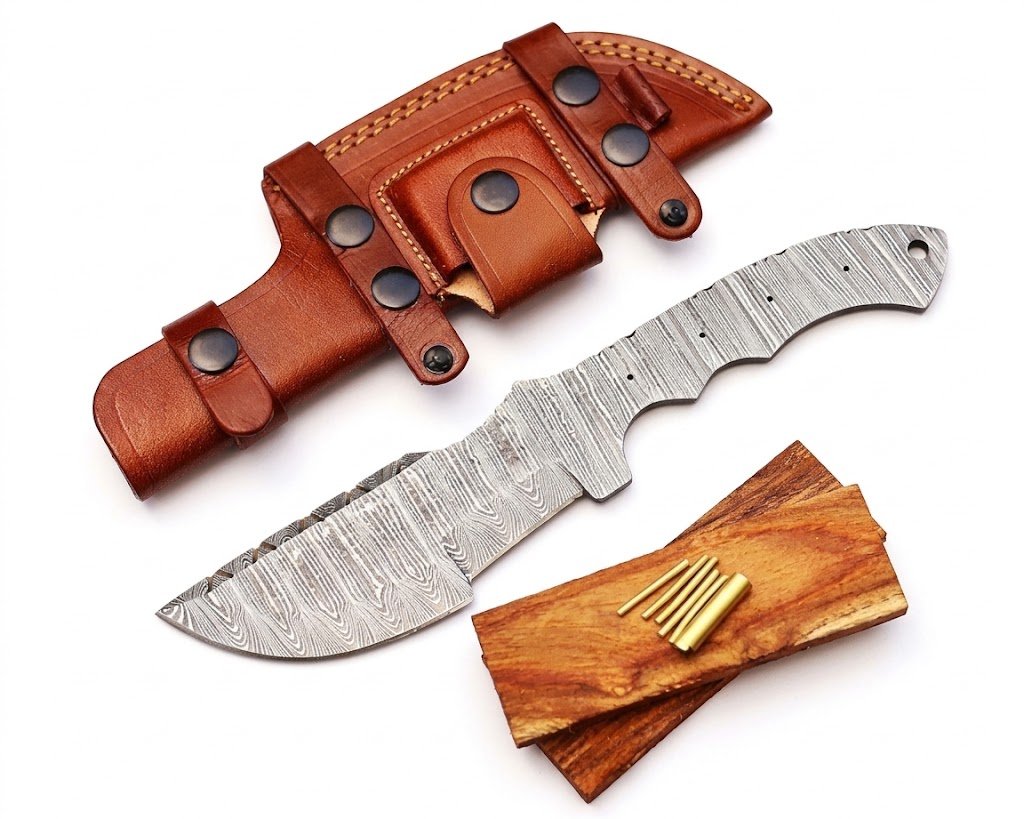
Unlike a completed hunting knife, the product is pictured with the handle components separate from the blade. This allows customers to see the knife blank’s shape, the visible handle mounting holes, the wood-grain scales, and the metal pins used in the assembly process.
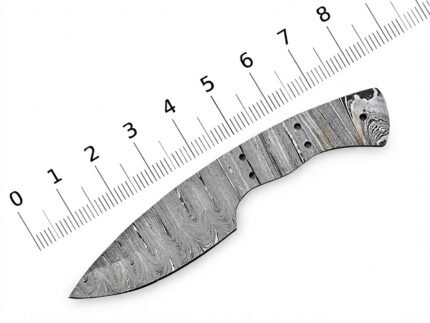
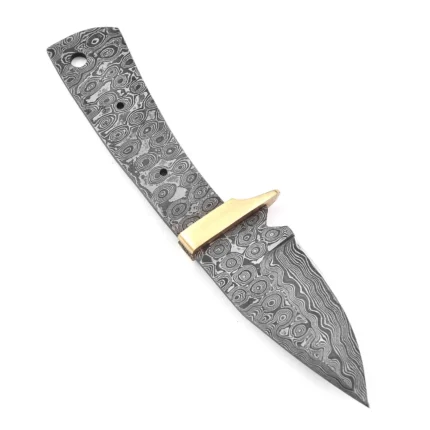
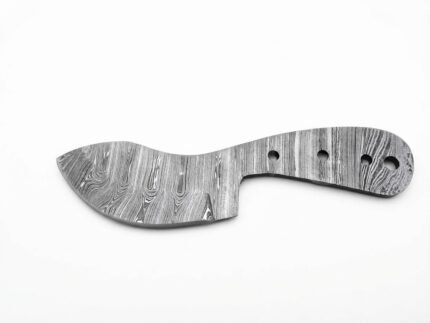
The blade features distinctive silver-gray flowing patterns that resemble layered Damascus steel. Its broad, curved profile gives it the appearance of a hunting or skinning-style fixed blade, while the exposed tang includes finger contours and multiple drilled holes.
Two brown wood-grain pieces are shown beside the blade, along with several gold-colored metal rods. These components appear intended for creating a fitted handle.
The image also shows a reddish-brown stitched sheath with multiple fastening straps, providing a traditional-looking accessory for the finished knife.
For customers interested in knife-making supplies, this kit brings together several visible components commonly associated with DIY fixed-blade knife projects.
Distinctive Damascus-Style Blade Pattern
The blade’s most noticeable feature is its intricate patterned surface.
Across the visible blade, flowing silver and gray lines form a series of layered, wave-like patterns. These markings are especially prominent near the cutting edge, where curved lines repeat along the broad blade face.
The design resembles the patterned appearance commonly associated with Damascus steel.
Traditional and modern Damascus-style blades are popular among collectors because their surfaces display distinctive patterns.
However, a patterned appearance does not establish how the steel was manufactured.
Some blades feature genuine pattern-welded construction, while others use decorative surface treatments that create a similar visual result.
The uploaded image does not establish the steel composition, layer count, forging method, hardness, or heat-treatment process.
Until these details are supplied by the manufacturer, the most accurate designation is a Damascus-pattern knife blank.
This distinction helps customers understand the product without making unsupported claims about blade performance.
Broad Hunting-Style Blade Profile
The knife blank has a broad cutting section with a gently curved lower edge and pointed tip.
Its shape resembles hunting and skinning-style fixed blades.
The edge curves upward toward the tip, producing a sweeping profile.
The upper blade surface is wider near the middle and transitions gradually toward the front.
A row of pronounced textured notches is visible along part of the upper spine close to the blade’s rear section.
These notches create a distinctive design detail.
Depending on their shape and location, similar spine textures may serve decorative or grip-related purposes.
However, their exact intended function on this model is not verified.
The blade shape makes this product relevant to customers interested in traditional outdoor knife designs.
Actual performance for hunting, skinning, or utility applications depends on verified blade geometry, material quality, hardness, and the final assembly.
Exposed Full-Length Tang Design
The blade blank includes a metal tang extending behind the cutting section.
This portion is intended to receive the handle scales.
The visible tang follows a curved profile with several finger-shaped indentations.
Multiple circular holes are positioned along its length.
These openings appear suitable for accommodating handle pins or other fastening components.
The tang and blade are presented as a continuous metal piece, giving the blank the appearance of a full-tang construction.
However, thickness, structural integrity, and exact dimensions require manufacturer confirmation.
The tang’s contoured shape is an important feature for customers selecting a knife-making project.
Because the handle is not yet assembled, the metal profile remains visible and makes it easier to understand the intended placement of the handle components.
The final fit and finish will depend on the handle materials, fasteners, and quality of the completed work.
Separate Wooden Handle Scales
The photograph shows two brown, wood-grain handle pieces.
These appear intended to form the handle once attached to the exposed metal tang.
The visible wood grain includes warm brown and reddish-brown tones.
Dark natural-looking lines extend across the surfaces, creating an attractive traditional appearance.
The handle pieces have an unfinished or partially prepared appearance.
Their shape suggests that additional fitting and finishing may be required.
The exact wood species is not established by the photograph.
For this reason, the handle components should be described as wood-grain scales unless the manufacturer confirms that they are natural hardwood.
Customers who prefer a traditional wooden-handle appearance may appreciate the contrast between these warm brown materials and the silver-gray patterned blade.
Gold-Colored Handle Pins
Several small gold-colored rods are displayed on top of the handle material.
These appear to be handle pins supplied for the assembly project.
Pins are commonly used in fixed-blade knife construction to help secure handle scales to the tang.
The visible drilled holes along the tang suggest positions for fastening components.
However, the precise dimensions and composition of the rods are not confirmed.
Their gold-colored finish resembles brass, but the actual metal should be verified before the product is advertised as including brass pins.
Pin length and diameter should also be checked against the knife blank’s handle holes.
These measurements are particularly important for customers purchasing knife-making components.
The photograph confirms the presence of multiple metal rods but does not provide a sufficiently reliable basis for listing their exact quantity or dimensions.
Reddish-Brown Leather-Style Sheath
The kit is pictured with a reddish-brown sheath designed to hold a fixed-blade knife.
The sheath has a curved outline that generally follows the shape of the blade.
Decorative stitching runs along its edges.
Several fastening straps are visible across the sheath, each featuring dark circular snap fasteners.
The sheath also includes a smaller attached pouch or raised section with its own snap-fastened closure.
This detail gives the accessory a distinctive, traditional outdoor appearance.
The visible material resembles leather, although its precise composition and grade cannot be verified from the image.
The sheath is one of the main visual elements distinguishing this kit from knife blanks sold without accessories.
Before using the sheath with the assembled knife, customers should confirm that the completed handle and blade fit correctly.
The presence of fastening straps does not independently establish retention strength or suitability for carrying the knife.
Designed for Custom Knife-Making Projects
This product is particularly relevant to customers interested in assembling and finishing custom fixed-blade knives.
The components shown in the photograph create an opportunity to work with a traditional-looking knife blank and contrasting handle materials.
The patterned blade acts as the primary visual feature.
The brown handle scales introduce a warmer finish.
The gold-colored pins complement the design, while the sheath provides an accessory that visually matches the outdoor style of the kit.
Customers should understand that this is an unfinished knife project.
The image does not establish whether adhesive, finishing supplies, instructions, protective equipment, or assembly tools are included.
The project may require additional materials and specialist tools that must be obtained separately.
Knife assembly should be undertaken only by individuals with suitable experience, equipment, and safety precautions.
An Interesting Choice for Knife Collectors
Knife collectors often appreciate blades that feature unusual patterns, traditional handle materials, and distinctive shapes.
This kit brings several of those characteristics together in an unassembled form.
The Damascus-style blade pattern gives the metal surface a layered appearance.
The broad blade silhouette is reminiscent of classic hunting knives.
The handle components have a warm brown appearance that contrasts with the blade.
The matching leather-style sheath further contributes to the traditional presentation.
Collectors interested in craftsmanship may find the unassembled format appealing because it displays the main structural elements separately.
The product can also be considered by customers exploring knife-making as a hobby, provided they have appropriate knowledge and equipment.
Traditional Appearance with Customization Potential
An unfinished knife kit provides a different experience from purchasing a completed knife.
Instead of receiving a knife with its handle already fitted, the customer receives components that appear intended for assembly.
This allows the handle material to be shaped and finished as part of the project.
The visible handle scales offer a traditional wood-grain appearance.
The metal pins provide decorative fastening details.
The broad blade pattern completes the overall aesthetic.
However, customization options beyond the pictured components have not been confirmed.
The availability of alternative handle colors, blade sizes, steel patterns, or packaging options must be checked with the supplier.
It would be inaccurate to promise personalized engraving, custom logos, or made-to-order specifications without manufacturer approval.
Blade Material and Performance Considerations
A key consideration when purchasing any knife blank is the material used to manufacture the blade.
The photographed blade has a Damascus-style pattern, but visual appearance alone does not identify the steel.
Important technical specifications include the steel composition, heat treatment, blade hardness, thickness, and edge condition.
These characteristics determine whether the blade is suitable for a particular intended application.
For example, a decorative patterned blade may have a different material specification from a working blade designed for frequent outdoor cutting.
Likewise, the presence of a shaped cutting edge does not establish whether the blank has been sharpened or is ready for use.
Customers should request accurate information from the manufacturer before relying on the knife for practical tasks.
The finished knife’s performance will also depend on the quality of the completed handle assembly.
Handle Material and Finishing Considerations
The brown wood-grain handle scales contribute much of the kit’s traditional appearance.
They are shown as separate pieces and may require fitting before the knife is complete.
The final surface finish will depend on the material and the preparation process.
Customers should check whether the supplied scales are already drilled or require additional work.
They should also verify whether the pins are compatible with the tang holes.
The image does not establish the handle scales’ thickness, exact shape, or moisture treatment.
Natural wood, stabilized wood, and composite materials can have different care and finishing requirements.
Accurate material identification is therefore important for preparing a reliable product specification.
Understanding the Included Components
The photograph presents the kit as a collection of separate knife-making parts.
The central component is the Damascus-pattern knife blank, which includes the blade and exposed tang.
Beside it are two pieces of brown handle material.
Several short gold-colored metal rods are placed across the handle pieces.
A reddish-brown sheath with multiple snap-fastened straps is positioned above the blade.
These visible parts establish the general nature of the kit.
However, buyers should confirm the actual package contents with the supplier.
Some similar products may include additional adhesive, tools, or handle materials, while others may contain only the components shown.
A complete inventory should therefore be confirmed before publishing a final commercial listing.
Suitable Customers and Applications
The kit may appeal to knife-making hobbyists, blade collectors, and customers interested in unfinished fixed-blade products.
Its patterned blade and traditional appearance make it relevant to specialty knife collections.
The exposed tang and separate handle components also make the product suitable for consideration as a knife-making project.
However, whether the completed knife can be used for hunting, skinning, camping, or other practical work depends on verified technical specifications and the quality of assembly.
Customers should not assume that the blade is ready for immediate use.
The actual intended application should be confirmed with the manufacturer.
Maintenance and Storage
The blade blank should be kept clean and dry before and after assembly.
Avoid prolonged exposure to moisture.
If the metal is susceptible to corrosion, follow the manufacturer’s recommended protective treatment.
The patterned surface should be cleaned gently to avoid damaging its appearance.
Handle components should be stored in a dry location and protected from unnecessary exposure to water or extreme temperatures.
The appropriate care method will depend on the confirmed handle material.
The sheath should also be kept clean and dry.
Long-term storage of a blade inside a moisture-retaining sheath may not be suitable for every steel type.
The manufacturer should provide storage recommendations based on the actual materials used.
Important Product Specifications
| Feature | Description |
|---|---|
| Product type | Unassembled knife-making kit |
| Blade style | Hunting/skinning-style fixed blade |
| Blade pattern | Damascus-style layered pattern |
| Blade color | Silver and gray |
| Tang | Exposed, contoured, pre-drilled |
| Handle components | Two brown wood-grain scales |
| Fasteners | Multiple gold-colored metal pins |
| Sheath | Reddish-brown leather-style sheath |
| Sheath details | Stitching, straps, snap fasteners |
| Steel composition | Not verified |
| Handle wood species | Not verified |
| Blade hardness | Not verified |
| Blade length | Not verified |
| Overall length | Not verified |
| Customization | Not verified |
| Manufacturer | Not verified |
Why Consider This Knife Making Kit?
The most appealing aspect of this kit is the combination of its patterned blade blank and separate handle components.
The visible tang and drilled holes show the unfinished construction clearly.
The wood-grain scales provide a traditional appearance, while the gold-colored pins introduce contrasting details.
The sheath adds a matching accessory to the presentation.
The broad blade shape makes the design recognizable within hunting-style knife collections.
For customers who appreciate knife-making projects, these components offer an interesting starting point.
Before purchase, customers should confirm the steel specification, included parts, dimensions, and assembly requirements.
Final Thoughts
The Damascus Pattern Hunting Knife Making Kit offers a visually distinctive combination of a broad patterned blade blank, brown handle scales, metal pins, and a traditional-style sheath.
Its unassembled format makes it relevant to experienced knife-making hobbyists and collectors interested in traditional fixed-blade designs.
Explore this knife-making kit and review the confirmed component specifications to determine whether it is suitable for your next collection or knife-making project.







Reviews
There are no reviews yet.