




Blue Handle Patterned Chef Knife – Distinctive Kitchen Cutting Design
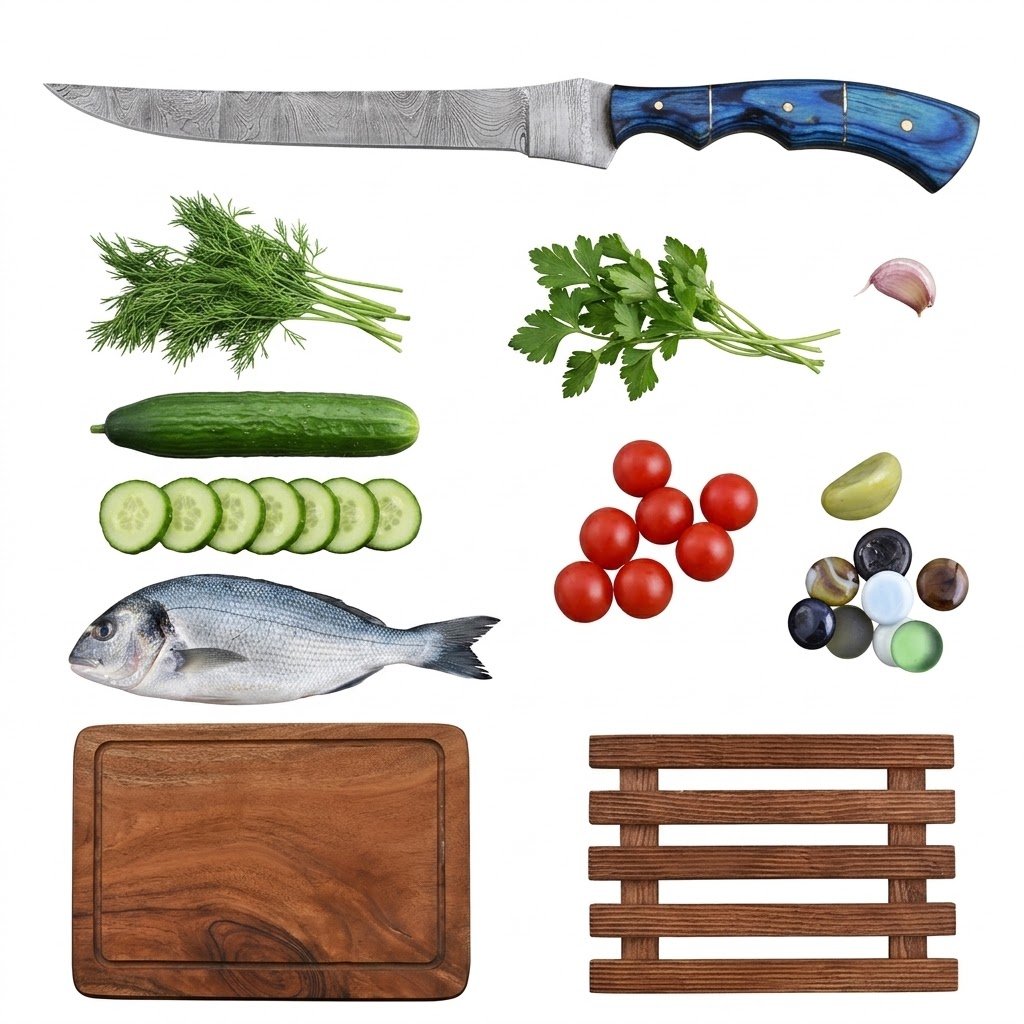
The Blue Handle Patterned Chef Knife combines a long, pointed cutting blade with an eye-catching blue contoured handle and a distinctive swirling metal pattern. Created in the familiar shape of a chef-style kitchen knife, this design appeals to customers looking for a cutting tool with a more decorative appearance than ordinary plain-finish kitchen knives.
The blade features a detailed silver and dark-gray pattern resembling the flowing lines commonly associated with Damascus-style steel. The handle introduces a striking combination of ocean blue, turquoise, navy, and darker layered tones.
Its gently curved profile and defined finger grooves complement the long blade, creating a recognizable kitchen knife design with distinctive visual character.
Suitable for consideration by home cooks, culinary enthusiasts, specialty cutlery collectors, and kitchenware retailers, this knife combines a familiar chef-style silhouette with decorative blade and handle details.
Distinctive Patterned Blade Design
One of the most noticeable elements of this knife is its decorative patterned blade.
The metal surface displays closely arranged, flowing lines in varying shades of silver and dark gray. These markings create irregular waves and rounded formations across the blade, giving it a layered visual appearance.
Rather than featuring a completely smooth and uniform finish, the blade presents a more detailed design.
Patterned blades have become popular among buyers who appreciate kitchen tools that look different from standard stainless steel knives.
The contrasting markings can make a chef knife attractive both as a practical kitchen accessory and as part of a specialty cutlery collection.
Although the markings resemble Damascus steel patterns, their presence does not establish the actual steel composition.
The knife should therefore be described as having a Damascus-style patterned appearance unless the supplier confirms genuine layered Damascus steel.
This distinction is important because decorative etching, printed patterns, and metallurgical layering are different manufacturing processes.
Long Chef-Style Blade Profile
The Blue Handle Patterned Chef Knife has an elongated blade that tapers toward a pointed tip.
Its outline resembles traditional chef knives used for preparing a variety of ingredients.
The lower cutting edge appears relatively straight through much of its length, while the forward section curves gently toward the tip.
This type of geometry is commonly associated with general food preparation.
Chef knives are frequently selected for slicing vegetables, cutting fruit, preparing herbs, and portioning suitable food ingredients.
The exact cutting performance of this model, however, depends on verified blade geometry, edge condition, steel properties, and manufacturing quality.
The image does not establish the knife’s exact length, weight, thickness, sharpening angle, or hardness.
These specifications should be confirmed before marketing it for professional culinary applications.
Eye-Catching Blue Handle
The most distinctive visual feature of this knife is its blue handle.
Instead of a conventional black or brown handle, this model features multiple shades of blue with flowing grain-like patterns.
Light turquoise sections blend with deeper navy and dark blue tones, producing an appearance similar to dyed or layered wood.
The result is a strong contrast between the colorful handle and the silver-colored patterned blade.
This design can appeal to customers who prefer kitchen accessories with a modern, expressive appearance.
The visible color combination also makes the knife easy to distinguish from other products in a kitchen knife collection.
Although the surface resembles dyed wood or a laminated composite, its exact composition cannot be confirmed from the image.
The material may need to be identified through supplier specifications before making claims about water resistance, durability, or natural wood construction.
Contoured Finger-Groove Handle
The handle includes several clearly defined curved recesses along its lower edge.
These recesses give it a sculpted, finger-groove appearance.
The handle also curves slightly upward toward its outer end, producing an ergonomic-looking profile.
Its shape suggests a design intended to accommodate the hand, although comfortable grip and suitability for different users cannot be guaranteed from appearance alone.
Grip preference varies according to hand size, cutting technique, and personal comfort.
A buyer should consider the handle’s actual dimensions, surface texture, and weight before selecting it for extended kitchen work.
The visible finger grooves nevertheless provide a distinctive styling element that separates this model from straight-handled chef knives.
Decorative Handle Pins and Separators
Small circular metallic-colored pins are visible along the handle.
Thin metallic-colored dividing lines also appear across several sections of the blue material.
These details break up the handle visually and emphasize its layered appearance.
The individual blue sections transition between lighter and darker tones, while the pins create small contrasting points.
Together, these features produce a more elaborate appearance than an entirely plain handle.
The image shows these details clearly, but it does not confirm their underlying construction method.
The pins may be structural fasteners or decorative elements, while the separators may be metal or another contrasting material.
Their exact composition and purpose require supplier confirmation.
Silver and Blue Color Combination
The Blue Handle Patterned Chef Knife uses a visually balanced combination of cool metallic and blue tones.
The blade has an intricate silver-gray appearance, with darker lines that emphasize its patterned finish.
The handle introduces more saturated colors, including turquoise, medium blue, navy, and almost black sections.
These colors complement the steel’s lighter appearance.
This combination offers an alternative to conventional natural wood handles and all-black kitchen knives.
It can be particularly appealing to customers who coordinate their kitchen tools or enjoy collecting knives with unusual handle designs.
The color pattern is a notable identifying feature of the uploaded product.
Actual color shades may vary slightly between photographs, lighting environments, and individual production pieces.
Customers should review current supplier photographs when exact color matching is important.
Traditional Chef Knife Silhouette
Despite its decorative appearance, the knife retains a familiar chef-style outline.
A long cutting blade extends from the handle and narrows toward its pointed end.
The transition between the blade and handle is relatively simple, without an oversized guard or complex external fitting.
This gives the product a clean silhouette.
Chef-style knives are commonly associated with general ingredient preparation rather than a single specialized cutting task.
Their versatility is one reason this design remains popular in residential kitchens, restaurants, and culinary settings.
Nevertheless, specific applications should depend on the knife’s confirmed edge characteristics and steel specifications.
The image supports identifying the product as a chef-style knife but does not verify professional-grade performance.
Kitchen Preparation Applications
A knife with this general blade shape may be considered for common kitchen preparation tasks, subject to its confirmed specifications.
Typical applications for chef-style knives include slicing suitable vegetables, preparing fruit, portioning boneless ingredients, and cutting herbs.
The longer blade profile is visually similar to knives used for preparing larger ingredients on a cutting board.
The pointed tip is characteristic of many general-purpose kitchen knives.
Actual effectiveness depends on sharpness, edge geometry, balance, and user technique.
Customers should avoid assuming that the knife is appropriate for cutting bones, frozen foods, or unusually hard materials without the manufacturer’s explicit approval.
Using a knife outside its intended applications can damage the edge or create safety risks.
For routine kitchen work, appropriate cutting surfaces and correct handling practices are important.
A Distinctive Choice for Home Kitchens
Many customers look for kitchen knives that combine practical familiarity with attractive presentation.
The Blue Handle Patterned Chef Knife offers an unusual visual approach to a recognizable kitchen tool.
Its blade retains a classic pointed chef-style shape while the blue patterned handle makes the design stand out.
This may appeal to home cooks who appreciate tools that have a little more personality.
The layered blue appearance also pairs naturally with modern kitchen accessories and specialty culinary equipment.
For customers comparing different kitchen knife designs, its combination of patterned steel appearance and finger-groove handle is an important distinguishing feature.
The final purchase decision should also consider verified dimensions, materials, and maintenance requirements.
Appeal for Culinary Enthusiasts
Culinary enthusiasts often compare kitchen knives based on several factors.
These include blade length, handle design, balance, steel composition, appearance, and ease of maintenance.
This product provides a visually distinctive option for customers who prioritize patterned blade designs and colorful handles.
The swirling markings create a decorative surface, while the layered blue grip provides contrast.
The knife may also interest collectors who enjoy displaying different knife patterns, handle colors, and blade silhouettes.
However, appearance should not replace verified technical information.
Customers seeking a knife for professional or frequent kitchen use should confirm its hardness, steel grade, edge retention characteristics, and suitability for food contact.
Fixed Blade Construction
The uploaded image shows a fixed-blade kitchen knife rather than a folding knife.
Its blade extends permanently from the handle in a conventional kitchen knife arrangement.
This differs from pocket knives that rely on folding joints and locking mechanisms.
Fixed-blade construction is standard across many kitchen knife categories.
The absence of a folding mechanism creates the familiar one-piece external configuration seen in chef knives.
However, the picture does not reveal the internal tang construction.
Whether the knife uses a full tang, partial tang, or another attachment system remains unverified.
Similarly, the exact method used to join the blue handle components to the blade is not visible.
These details should be obtained from the manufacturer when buyers require technical construction information.
Suitable for Specialty Kitchenware Collections
The Blue Handle Patterned Chef Knife can fit naturally into product assortments focused on decorative kitchen cutlery.
Retailers may position it alongside patterned chef knives, colorful-handle kitchen knives, and other specialty culinary accessories.
Its visual characteristics make it distinguishable in product photographs and catalog displays.
The combination of a pointed silver-gray blade and vibrant blue handle gives customers a clear way to recognize the design.
For knife collectors, the product also offers an interesting contrast between decorative steel-style markings and modern handle coloration.
Buyers should still review available technical information before selecting it for frequent cutting work.
Blade Pattern and Material Considerations
The blade surface is covered by a detailed pattern of flowing lines.
These markings resemble the irregular layered formations often associated with Damascus-style knife designs.
However, similar appearances can be created using different materials and surface treatments.
A product may feature genuine layered steel, an etched decorative pattern, or another finish that produces a comparable appearance.
The photograph does not provide enough information to determine which method was used here.
For this reason, terms such as “genuine Damascus steel,” “67-layer steel,” or “VG10 core” should not be added without supplier documentation.
A verified steel specification would help customers understand the knife’s maintenance requirements and intended performance characteristics.
It would also allow more accurate comparison with other kitchen knives.
Handle Material and Maintenance Considerations
The handle appears to feature layered blue coloring with visible grain-like lines.
Its exact material is currently unknown.
Depending on the manufacturing process, similar handle appearances may be produced using dyed wood, stabilized wood, composite laminates, or synthetic materials.
Each option has different maintenance requirements.
Natural wood generally requires attention to moisture exposure.
Some composites may have different cleaning and care recommendations.
Customers should therefore follow the manufacturer’s instructions once the handle composition is confirmed.
Avoid describing the handle as waterproof or heat-resistant without verified evidence.
The same applies to claims of antibacterial properties or suitability for dishwasher cleaning.
General Cleaning and Care
Proper cleaning and storage are important for maintaining kitchen knives.
After use, wash the knife carefully using a method appropriate to its confirmed steel and handle materials.
Dry it thoroughly before storage.
Avoid leaving a knife immersed in water for extended periods.
Do not use abrasive cleaning materials on decorative blade finishes unless approved by the manufacturer.
A suitable knife block, protective blade guard, or secure storage system may help prevent accidental contact with the cutting edge.
Use a stable cutting board and keep fingers away from the cutting path during food preparation.
The correct sharpening method depends on the blade’s steel, geometry, and manufacturer recommendations.
Do not assume the knife is dishwasher-safe.
Hand washing is generally a prudent precaution for knives with decorative finishes or potentially moisture-sensitive handles.
Product Features at a Glance
- Product Type: Chef-style kitchen knife
- Blade Configuration: Fixed blade
- Blade Shape: Long pointed chef-style profile
- Blade Appearance: Silver-gray swirling pattern
- Handle Color: Blue, turquoise, and navy
- Handle Shape: Contoured with finger grooves
- Handle Details: Visible metallic-colored pins and narrow separators
- Overall Style: Decorative modern kitchen cutlery
- Steel Composition: Not confirmed
- Handle Material: Not confirmed
- Blade Length: Not confirmed
- Overall Length: Not confirmed
- Hardness: Not confirmed
- Included Accessories: Not confirmed
Important Information Before Ordering
Customers considering this product should verify the complete technical specifications.
The most important details include blade length, total length, blade thickness, weight, steel grade, and handle material.
For customers interested in frequent kitchen use, hardness and edge geometry are also relevant.
Supplier confirmation is required before claiming that the product is manufactured using a specific number of Damascus layers.
Likewise, the blue handle should not be identified as genuine stabilized wood, pakkawood, resin, or G10 without supporting information.
These details help customers compare products accurately and avoid confusion between visually similar knives.
Why Choose This Design?
The main appeal of this chef knife is its combination of decorative blade patterning and a distinctive blue handle.
The silver-gray blade markings introduce texture and contrast.
The contoured handle provides a more sculpted appearance than a straight conventional grip.
The layered blue tones create an attractive visual connection between different handle sections.
Together, these details give the knife a recognizable style suitable for specialty cutlery collections and kitchen knife product ranges.
For buyers who prefer kitchen knives with unusual colors and decorative finishes, this design offers a clear alternative to traditional plain-blade models.
Final Thoughts
The Blue Handle Patterned Chef Knife brings together a long chef-style blade, detailed swirling metal appearance, and an eye-catching blue finger-groove handle.
Its distinguishing features make it an interesting addition to a specialty kitchen knife collection.
Explore this design if you appreciate patterned blades and colorful handles, and confirm the actual steel, dimensions, and handle specifications before purchasing.









Reviews
There are no reviews yet.