

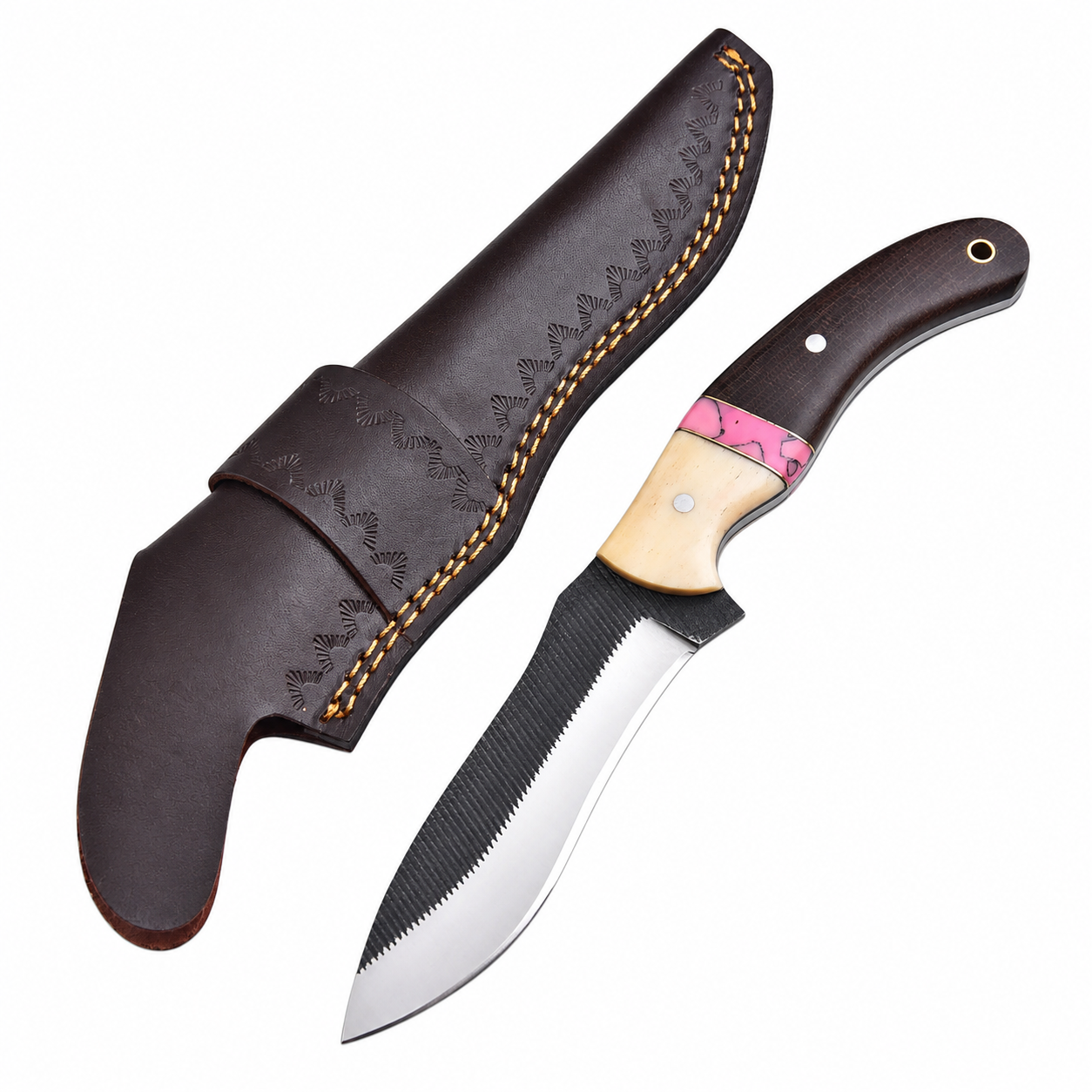
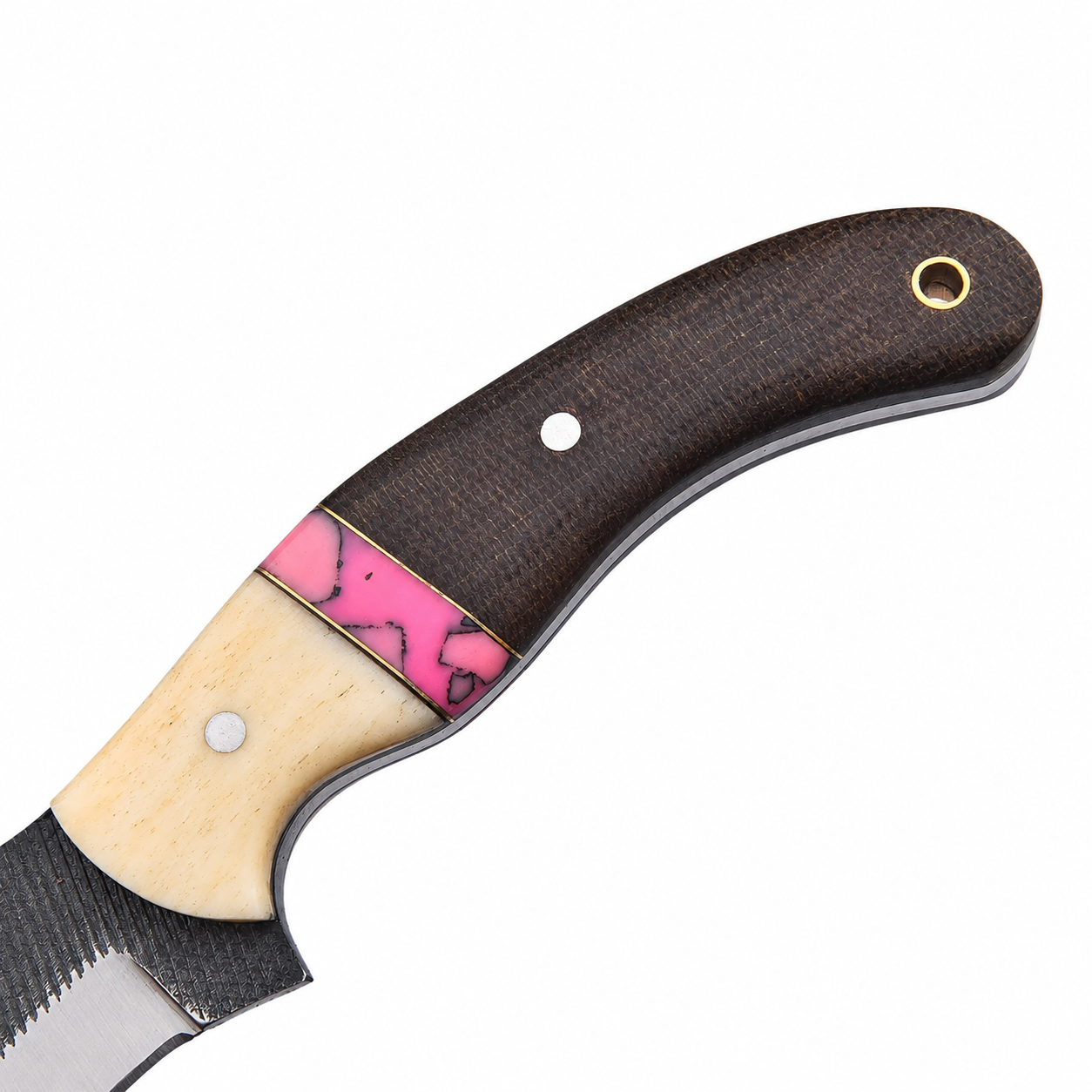
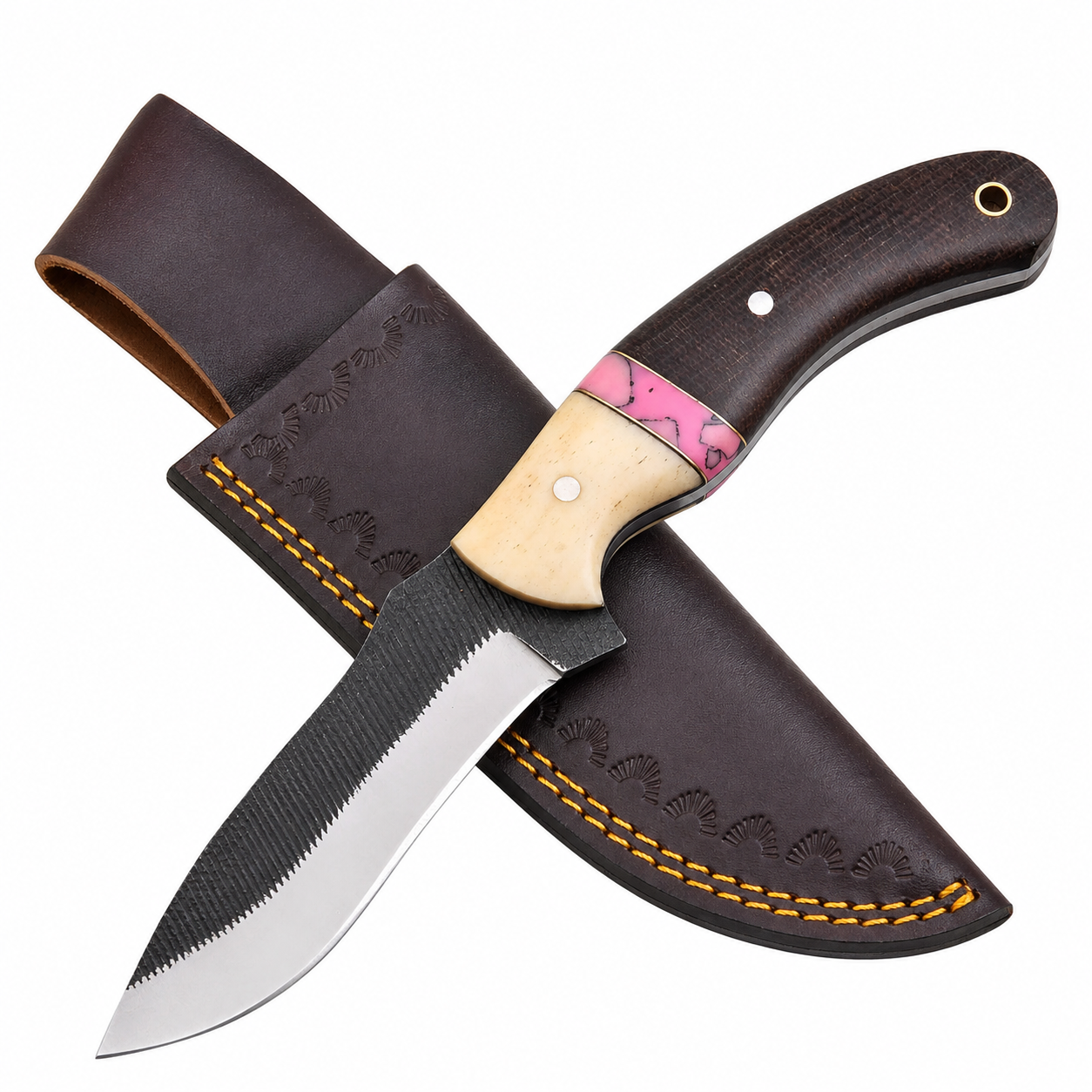
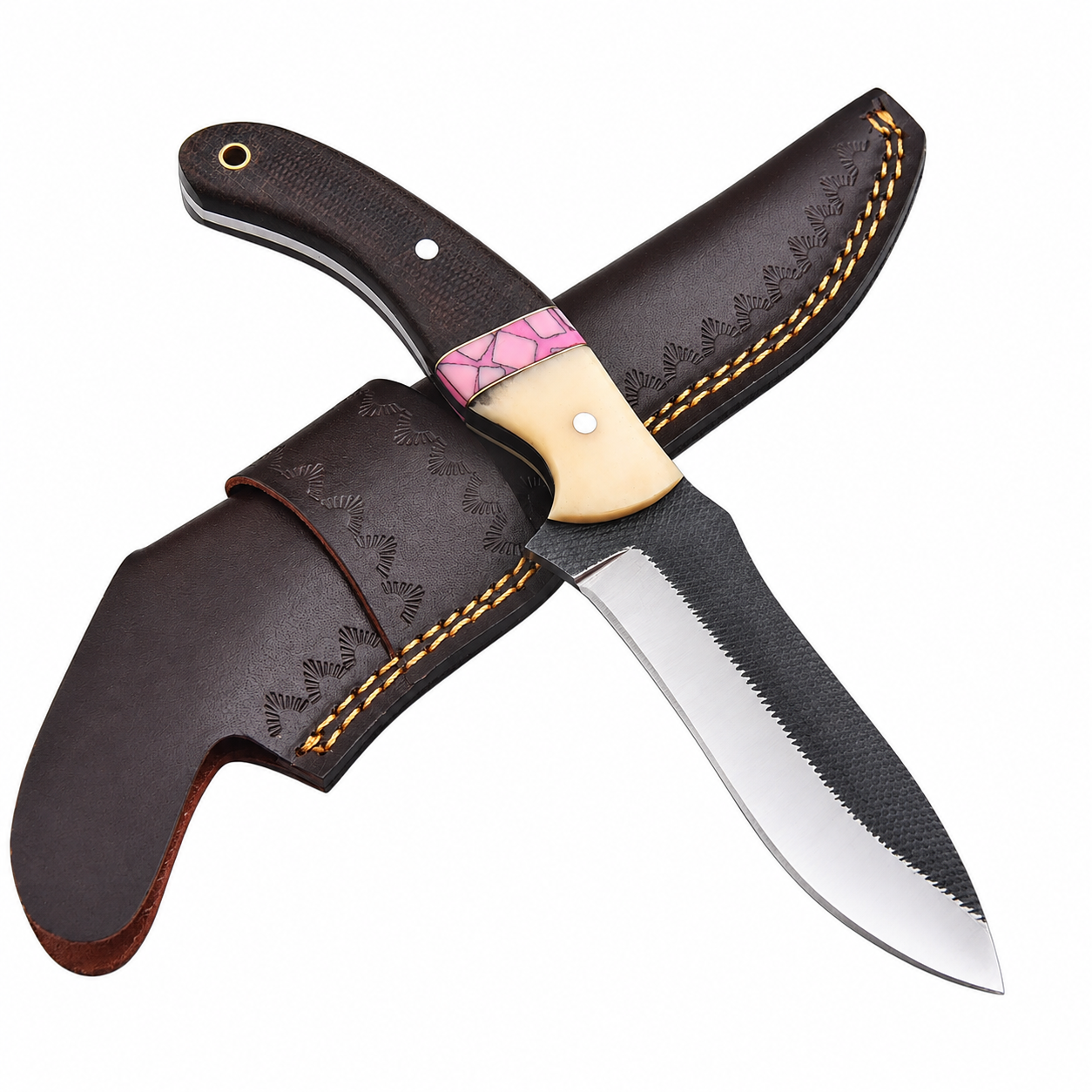
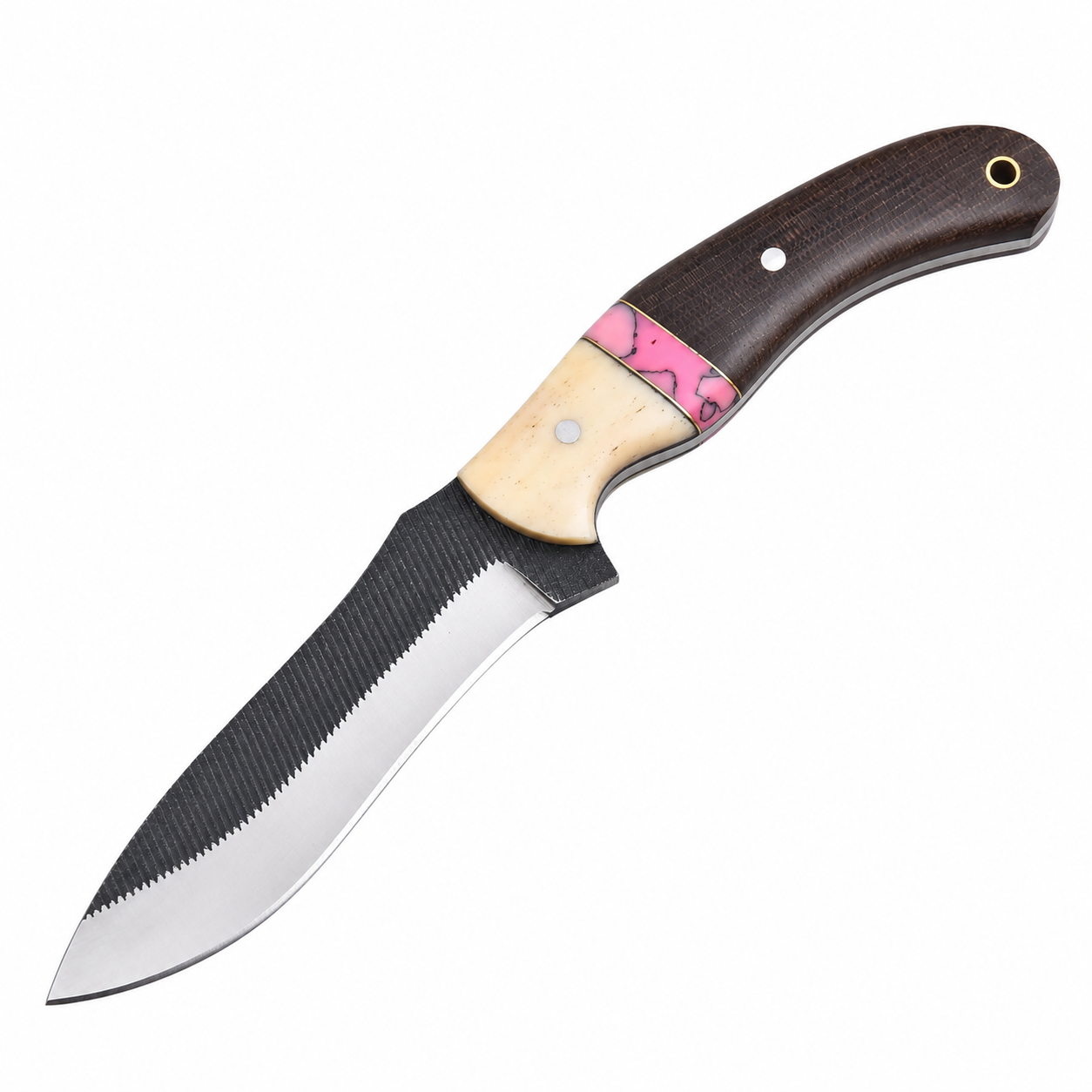
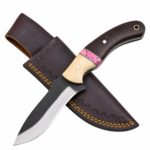
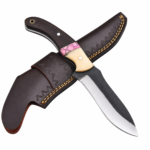
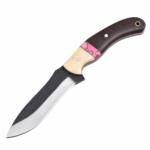
The first detail you notice on this pink accent fixed blade knife is a narrow band of rose pink between a cream-colored front section and a dark brown grip. Look closer and you can see fine black lines running through the pink, slim gold-tone borders on either side, and a small silver-tone pin set into each of the two larger handle sections. The color occupies only a small part of the handle, but it gives the whole knife its identity.
The blade has an equally distinctive finish. A dark panel of closely spaced diagonal ridges follows its upper face. Below it, a broad silver-colored bevel sweeps forward into a pointed tip. The regular lines of the dark panel end at slightly different positions, giving the boundary a fine toothed appearance. That texture sits on the face of the blade; the cutting edge itself follows a continuous curve with no visible serrations.
This is a fixed blade knife for buyers who appreciate the details of a finished piece: where two colors meet, how a handle curves into the blade, and how a small fitting can pick up a color elsewhere in the design. Its outdoor-knife silhouette is familiar. The combination of a pink marbled accent, a cream front, and a file-like blade surface makes this particular version easy to pick out.
A pink accent with room to see the pattern
The pink band crosses the handle just behind the cream section. It is wide enough to show an irregular network of dark lines, yet narrow enough to leave most of the grip dark brown. The pattern is especially clear at the lower edge of the band, where a dark line bends back across the pink. This gives the accent more character than a single straight stripe of color.
Thin gold-tone lines frame the band against the adjoining sections. On the cream side, the border is subtle. On the brown side, it stands out more clearly and gives the pink a crisp edge. A similar warm metallic color appears around the opening at the rear of the handle. Those small details connect the front and back without adding another large block of color.
If you like pink accessories but prefer a more restrained knife, this is the detail to look at first. From a distance the handle reads mainly as brown and cream. At closer range the veining and narrow borders become easier to see. The appeal is in that change of scale: a simple outline across a display, with more to look at when the piece is seen up close.
“Marbled” describes the pattern. It does not identify the accent as natural stone, dyed turquoise, or resin. If you collect knives for a particular inlay material, ask for the material specification for this exact handle.
Cream at the front, dark brown through the grip
The cream-colored section sits immediately behind the blade. Its surface shows subtle flecks and warm variations in tone, particularly toward the lower edge. A single round silver-tone pin breaks up the pale face. Because there is no large guard between the handle and blade, the light cream area sits directly against the darkest part of the blade, making the transition easy to see.
The dark brown section occupies most of the handle length. It has a fine, faintly crosshatched surface pattern visible in the light, and a second silver-tone pin sits within it. The color is deep enough to look almost black in shadow, but the warmer brown shows across the wider face and toward the rounded end. Buyers comparing photographs should look at that broad area to get the clearest impression of the color.
Together, the two sections give the handle quite different views from front to back. The cream draws attention toward the blade; the long dark section keeps the rear visually simple. If you already own knives with plain wood-look handles, this one offers a different arrangement while staying within the same family of warm, understated colors.
The photograph supports the colors, pattern, and placement of the pins. It does not establish the underlying handle materials. In particular, the cream section should not be purchased on the assumption that it is bone, or the brown section on the assumption that it is a specific wood species.
A blade with dark ridges and a bright bevel
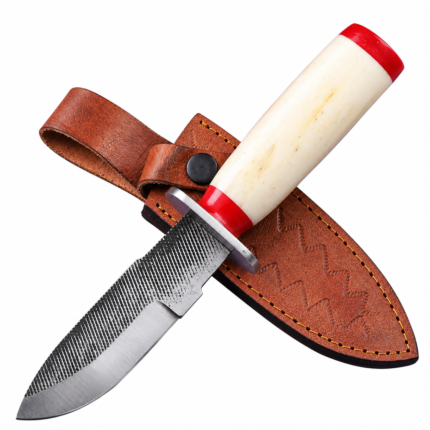
The upper blade face has the appearance of a file or rasp. Seen near the handle, the ridges are particularly easy to distinguish: each dark diagonal line runs down toward the bright bevel, creating a row of small points along the transition. The dark area narrows toward the front as the silver portion curves up toward the tip.
This gives the blade two distinct surfaces to look at. The silver bevel is the quieter one, with a comparatively even appearance and a long uninterrupted sweep. The upper face carries almost all the texture. Buyers who like rustic blade finishes may appreciate this arrangement because the textured area is prominent without covering the entire blade.
The term rasp-style refers specifically to those visible ridges. It does not mean the knife was made from a reclaimed farrier’s rasp. It also does not mean the upper face is intended to work as a file. If the origin of the steel is part of what you value in a knife, that detail needs a maker’s specification. For this piece, the visible feature is the contrast between the ridged dark face and the bright ground area below it.
Another useful distinction is the location of the pattern. On some knives, decorative lines run across the whole face, including the area near the edge. Here, the pattern stops where the bright bevel begins. If you are choosing between a swirled blade design and a knife with more definite surface texture, that dividing line is the easiest way to tell the styles apart.
A curved edge and a clearly defined point
The edge starts near the cream handle section and follows a gentle curve before rising toward the point. The broadest-looking part of the silver bevel sits through the forward curve. At the rear, the bright surface stops short of a small dark projection beneath the front of the handle. These changes in profile give the blade a defined heel, belly, and tip when viewed from the side.
There is no visible gut hook, toothed section on the cutting edge, or separate crossguard extending across the handle. For a collector comparing profiles, the result is a relatively simple silhouette paired with a much more detailed surface. The outline remains easy to follow even where the blade texture is most pronounced.
The photograph is useful for judging that outline, but it cannot tell you how thick the blade is. A narrow blade seen from the side may have very different proportions when viewed along the spine. If you are choosing this knife primarily for practical use, blade length, spine thickness, steel grade, and the maker’s intended application will be more useful than the side profile alone.
A defined front recess and rounded handle end
The underside of the cream section curves inward just behind the blade. This is the most pronounced recess on the handle. Farther back, the brown grip follows a longer, gentler curve before reaching the rounded rear. There is no row of deep individual finger grooves, so the side outline remains fairly open through the main grip area.
That difference matters if you have a preference about handle shapes. Some buyers like several defined finger positions. Others prefer one clear front recess and a less interrupted grip behind it. This knife has the latter appearance. A front view can show where the recess sits, although actual comfort depends on handle length, thickness, and the size of your hand.
At the rear is a round opening lined with a gold-tone rim. It is more conspicuous than the two pale pins because its center is dark and open. No cord is fitted in the photograph. If you plan to use a lanyard, confirm the opening diameter before choosing one; the apparent width in a close-up product image is not a reliable measurement.
A narrow silver-colored line is also visible along part of the handle perimeter. It outlines the curved underside particularly well near the rear. The photograph does not establish enough about the internal construction to specify the tang type.
The dark brown sheath in the photograph
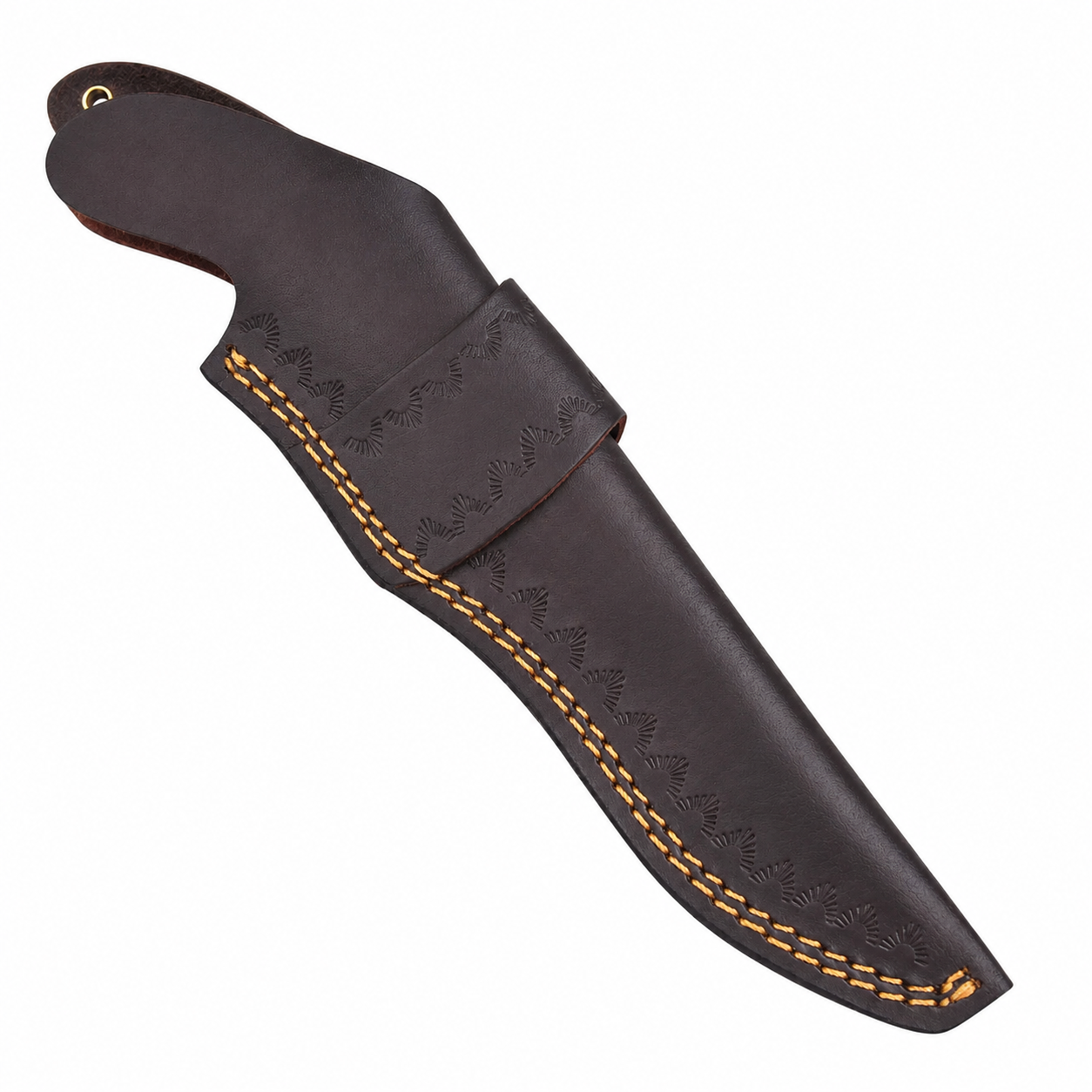
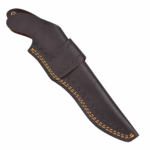
The pictured sheath is worth a closer look in its own right. It has a dark brown, leather-like surface, with two closely spaced lines of golden-colored stitching following the curved outer edge. Just inside the stitching is a row of small fan-shaped impressions. The same motif appears across a broad band near the opening.
Several design choices tie the sheath visually to the knife. The brown echoes the rear of the handle, the golden stitching picks up the warm-colored accent borders, and the repeated impressions give the sheath a textured area of its own. The sheath has no pink panel, so the brightest color in the photograph remains on the knife.
The photograph shows the two items lying separately, which gives a clear view of both the blade and the sheath decoration. It does not confirm that the sheath is included in the sale. Its material, attachment arrangement, and fit are also unverified. If you are buying specifically for the combination shown, confirm that the order includes the dark brown sheath with the golden stitching and fan-pattern detail. A generic description such as “brown sheath” does not identify that particular design.
Choosing this knife for a collection
For a collection arranged by blade finish, this piece offers a clear example of a two-tone, rasp-style appearance. The silver bevel makes the dark diagonal ridges easy to study, and the pointed profile gives the texture a different setting than it would have on a broad, square-ended blade. The pattern is easiest to see on the section nearest the handle, before the dark area tapers toward the point.
For a collection arranged by handle design, the strongest feature is the relationship between the three colored sections. This is neither an all-pink handle nor a brown handle with a small colored pin. The pink crosses the full visible width of the grip, dividing a short cream front from a much longer dark rear. If you collect segmented handles, that placement is more informative than the color name alone.
It may also suit an adult gift recipient whose taste you know well. Someone who likes traditional brown sheaths and darker blade finishes may appreciate the small departure introduced by the pink. Someone who specifically collects natural stone inlays or knives forged from repurposed tools will want confirmation of those materials first. The same photograph can appeal to both buyers, but for different reasons.
Details to check for your intended use
If the design is what brought you to this knife, the photograph answers many of the visual questions. You can see the distribution of color, the pin placement, the blade pattern, and the shape of the edge. If you have a specific use or storage arrangement in mind, a few measurements will make the decision easier.
For fit in the hand, look for the usable grip length from just behind the front recess to the rounded end. Overall knife length alone does not tell you how much room the handle provides. Grip thickness is useful as well, particularly if you already own a knife whose proportions suit you and want a meaningful comparison.
For a display case, use the overall length and maximum width of the unsheathed knife. If you would like to display the knife beside the pictured sheath, allow space for both. The sheath has a broad extension at its opening; its outline takes up more room than the narrow pointed end might suggest.
For an existing sheath, check the blade width and thickness as well as its length. The small projection at the heel and the curve at the front of the handle can affect where the knife sits. Two knives with similar side profiles are not necessarily interchangeable in the same sheath.
For functional use, obtain the blade specification and the maker’s recommended applications. The bright bevel does not establish sharpness or edge retention, and a dark upper face does not guarantee corrosion resistance. No material-specific maintenance routine has been verified for this knife. Ask for care instructions that cover both the blade finish and the decorative handle sections.
What distinguishes this version
If you are choosing between several similar knives, start with the narrow pink band. Check that it has dark veining, warm-colored borders, cream toward the blade, and dark brown toward the rear. Then look at the blade itself: the diagonal texture is dark, the lower bevel is bright, and the plain edge rises into a point. Together, those details identify this version more reliably than broad terms such as “outdoor knife” or “rasp knife.”
The pleasure of this design is in the smaller decisions: a pale pin against the dark grip, a gold-colored rim around the rear opening, the uneven end of each ridge above the silver bevel, and that single line of pink where the two handle colors meet. If those are the details you look for in a fixed blade, explore this pink-accented design for your collection.




Reviews
There are no reviews yet.