




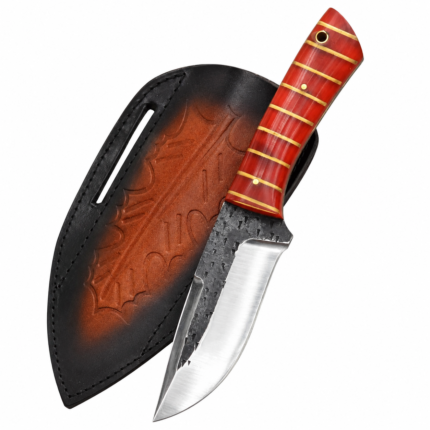
A tracker knife with two distinct blade sections
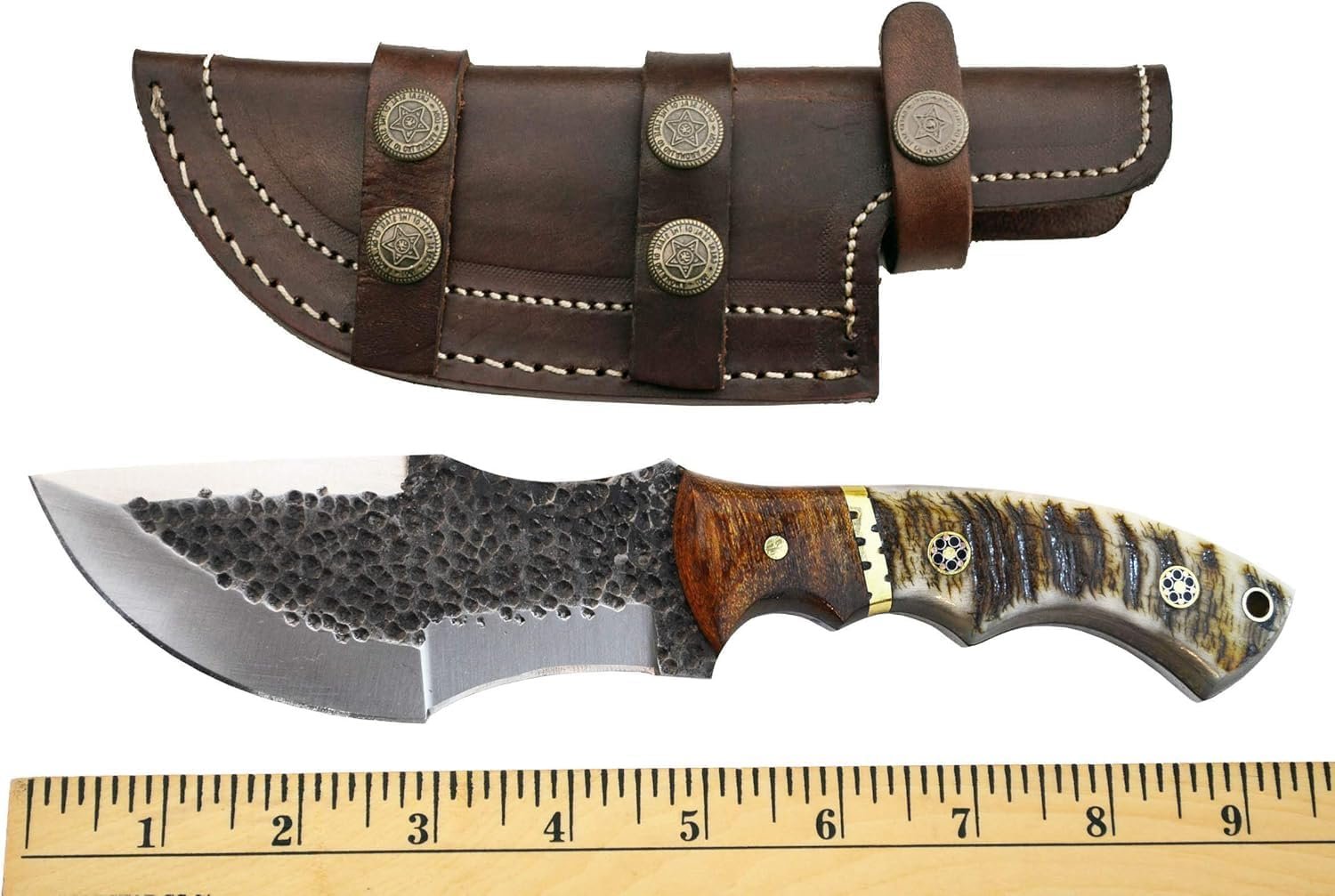
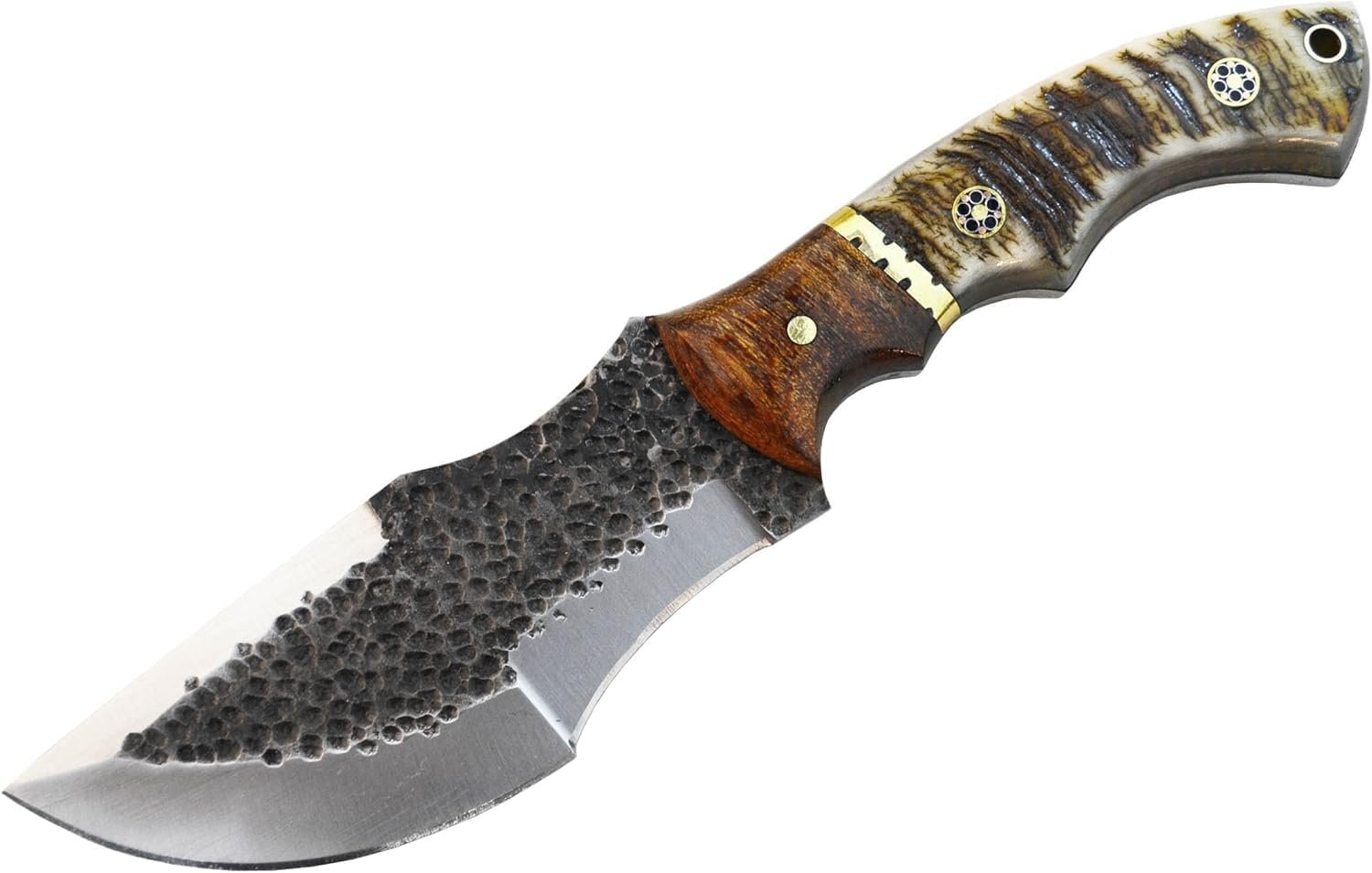
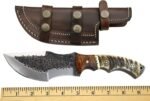
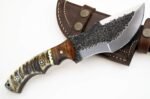
This stag-style tracker knife is recognizable by the step halfway along its lower edge. The section nearest the handle is relatively straight. At the step, the blade drops into a deeper belly that sweeps upward toward the tip. Above it, a dark, dimpled blade face contrasts with fine silver-gray waves along the bevel. The handle combines a reddish-brown front section with a ridged cream-and-brown rear grip, separated by a narrow gold-tone band.
For a collector, the appeal lies in how those details work together. From a distance, the stepped silhouette is the feature that stands out. Up close, you can follow the waves around the belly, see where the textured face meets the bevel, and pick out the individual dark circles inside the two decorative handle pins. It is a fixed blade with an outdoor-knife profile and enough detail to reward a closer look.
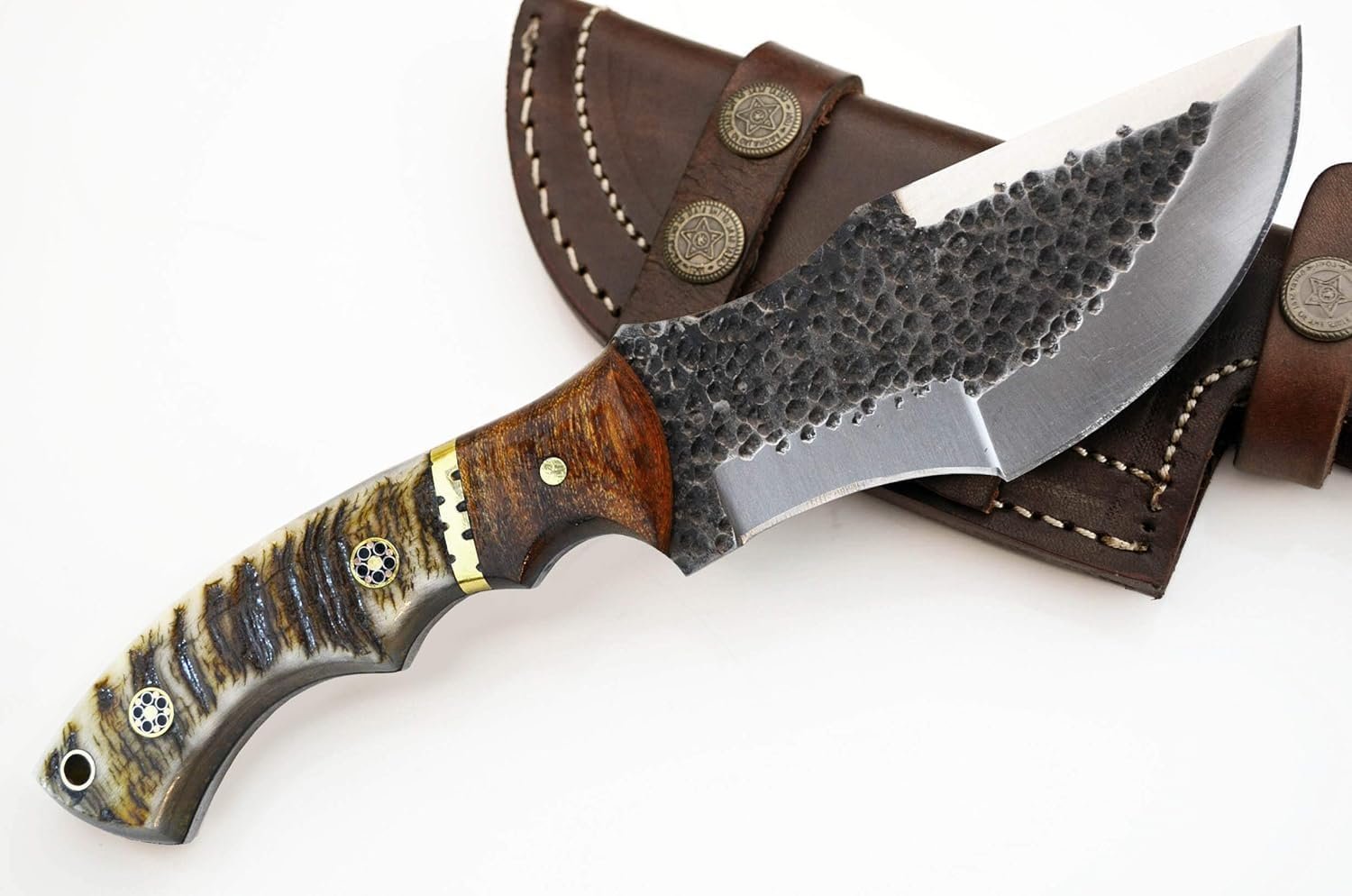
The knife is pictured across a dark brown stitched sheath with decorated gold-tone snaps. The photograph shows the sheath clearly enough to identify its design, but does not establish that it is included with the knife. If you are choosing this particular combination, confirm the package contents before ordering.
What makes the blade a tracker style
Look first at the edge immediately in front of the grip. It runs forward in a shallow curve before ending at a distinct shoulder. Beyond that point, the front of the blade is visibly deeper. This change is part of the blade outline itself, not simply a change in color on a conventionally shaped blade. It is the clearest reason to describe the knife as tracker-style.
The two sections also give the lower face different proportions. Near the handle, the patterned bevel forms a comparatively narrow band. Across the front, there is more room for the pattern to spread, and the lines bend upward as they approach the point. If you prefer knives with a full belly but find an uninterrupted curved edge visually plain, this design offers both the broad forward curve and a clearly defined rear section.
The step is also worth considering if you are buying a working knife. A blade with one continuous edge and a tracker profile with two sections do not present the same geometry to a surface. Overall blade length alone tells you little about the length available in each section. If that distinction matters for your planned use, ask for the length of the rear edge and the curved front section separately.
A dark textured face above a wave-patterned bevel
The upper part of the blade has a charcoal-gray surface marked by small, irregular depressions. Light catches the edges of these marks, creating a mottled appearance across the area nearest the spine. The texture continues forward but does not cover the whole blade. Below it, closely spaced light and dark lines extend across the bevel in a visibly different finish.
The transition between the two areas is particularly striking near the middle. The upper texture ends unevenly, while the lower pattern follows the more orderly geometry of the ground face. Near the tip, the silver-gray lines turn sharply upward. Near the handle, they form flatter, tighter waves. The blade has more visual variety than an all-black finish, while keeping its colors within a restrained gray palette.
The lower pattern has a Damascus-style appearance. That describes what you can see; it does not confirm pattern-welded Damascus steel, a layer count, or a particular alloy. Likewise, the dimpled surface does not establish that the blade was hand-hammered. If the pattern itself is what you like, the image shows it well. If you collect knives for their metallurgy or forging method, request documentation for this exact knife.
The notched spine
A row of prominent notches runs along part of the spine toward the front of the blade. Each notch has an angular profile, with a short raised section before the next cutout. Their spacing is broad enough to see in the overall product view. They are separate from both the stepped lower edge and the small depressions in the blade face.
This helps distinguish the knife from other tracker designs. Some have a smooth back; others have finer, closely spaced ridges that are visible mainly near the handle. Here, the notches form a conspicuous part of the forward outline. If you are comparing similar product photographs, their position is a better identifying detail than a generic description such as “textured blade.”
The image does not establish that the notches are sharpened saw teeth or that the spine is intended for sawing. For display, their contribution is clear: they give the top of the blade an angular outline against the smooth sweep of the belly below. For practical use, their purpose should be confirmed by the maker.
A two-part handle in warm, natural tones
The section nearest the blade is reddish brown, with fine, darker marks resembling wood grain. A single round gold-tone pin sits within it. Its underside curves inward just behind the blade, creating the most pronounced front recess in the handle. The warmer color sets this part apart from both the nearly black blade texture and the paler grip behind it.
The rear section has a different character. Cream and tan areas frame dark brown ridges that run lengthwise across the handle. Toward the lower edge, the surface looks smoother and lighter; toward the top, the darker markings are more prominent. That contrast gives the grip its stag-like appearance. It is a useful choice for someone who likes the look of antler but wants the front of the handle to have a simpler, warmer finish.
Between the sections is a slim gold-colored band with dark, evenly spaced marks along its face. It is wide enough to separate the patterns without taking attention away from either one. The gold color appears again at the front pin and around the rear opening, so the handle has a few related accents rather than one large area of bright metal.
The photograph does not verify natural stag antler, a particular wood species, or solid brass. The distinction matters if you are buying for material provenance. A collector seeking genuine antler may need a supplier specification; a buyer selecting by color and pattern can judge the cream ridges, reddish-brown grain, and gold-tone spacer directly from the image.
Mosaic-style pins and the rear opening
Two circular fittings sit in the stag-style section. Each has a pale outer ring surrounding a cluster of smaller dark circles. Their mosaic-like pattern is visible against both the darker ridges and the cream portions of the grip. They are more decorative than the plain pin near the blade, but small enough to leave most of the handle pattern exposed.
The difference between the fittings is useful when identifying this version. The reddish-brown front carries one plain gold-tone pin; the cream-and-brown rear carries two mosaic-style pins. Near the butt is a separate gold-rimmed opening with a dark center. No cord is fitted through it in the photograph.
If you intend to add a lanyard, obtain the internal diameter of that rear opening before choosing a cord. Its position can be seen clearly, but its size cannot be calculated from the photograph. The pins, by themselves, do not establish how the handle is assembled or how far the tang extends inside it.
A contoured grip with a defined front recess
The handle does not follow a straight line from the blade to the butt. Its underside curves inward beneath the reddish-brown front section, changes direction at the decorative band, and follows a longer contour beneath the rear grip. The end of the handle broadens again, with a visible gray outline around part of its perimeter.
For someone choosing between this knife and a straight-handled model, the distinction is worth noticing. This grip provides a more defined outline near the front, while most of the rear section remains uninterrupted by deep individual finger grooves. If you prefer a handle that indicates where the front of your hand will sit, the side view gives you a useful starting point for comparison.
Comfort, however, depends on more than that side profile. Two handles with a similar outline may feel quite different if one is thicker, more rounded, or shorter through the usable grip. The most useful comparison is with a fixed blade you already find comfortable. Measure that handle from the front recess to the butt, then compare its length and thickness with the specifications for this knife.
The brown sheath pictured with the knife
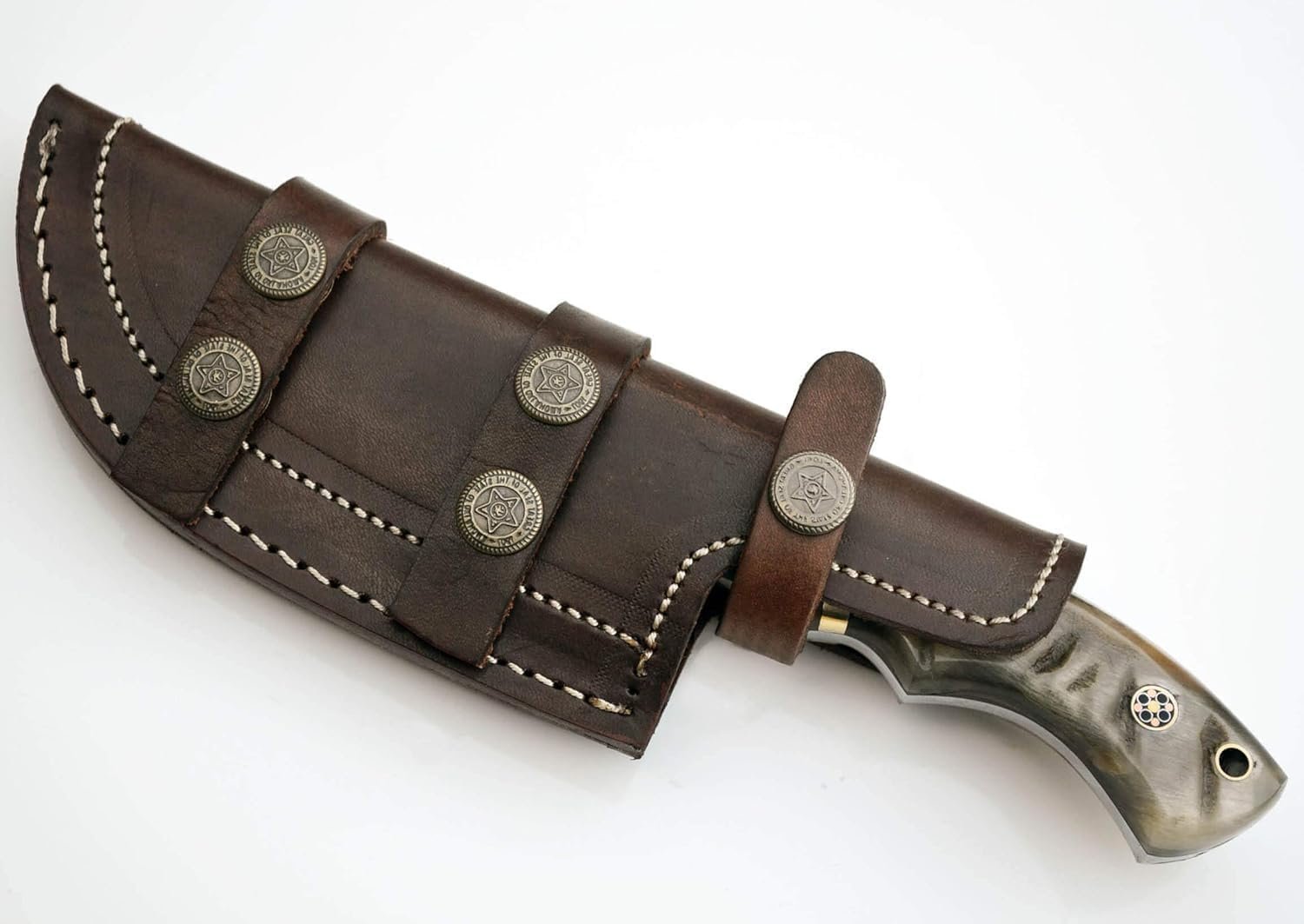
The sheath has a dark brown, leather-like exterior with pale stitching that follows the perimeter. Its broad body narrows toward a rounded point. Two strap sections cross the visible side, and the round gold-tone snaps carry a star-like motif. These details are easy to distinguish from the knife’s own hardware: the mosaic-style fittings belong to the grip, while the larger stamped circles belong to the sheath.
The color pairing is part of the presentation. The brown sheath echoes the front of the handle, and the warm snap color picks up the narrow gold-tone spacer. The knife is laid across the sheath rather than seated inside it, leaving both the stepped blade and the stitching in view. For a collector choosing a knife and sheath as a visual pair, that combination is more specific than simply asking for “a brown sheath.”
If the sheath is an important part of your purchase, confirm that the selected offer includes the dark brown stitched version with the decorated snaps. Its material, belt attachment, carry orientation, and fit are not established by this view. A photograph of the reverse would show the attachment arrangement; a photograph with the blade seated would show how much of the grip remains exposed.
Choosing the knife for a collection
This design makes sense in a collection organized by blade profile. A conventional drop-point or clip-point knife draws the eye toward the tip. Here, the eye stops first at the step in the edge, then follows the deeper front section forward. Alongside knives of similar color, that outline gives this piece a distinct place without relying on a visible logo or a named model.
It also offers a different way to collect by finish. The upper blade face is irregular and dark, while the bevel shows continuous silver-gray waves. If most of your knives have a smooth, evenly finished face, the contrast is easy to appreciate. The handle follows a similar idea: the front has a comparatively even grain-like surface, and the rear has a more rugged stag-style texture.
For a display, consider what you want to see most often. Placing the knife side-on shows the step, the belly, and the two decorative pins. Displaying the sheath separately also makes the stitching and snap details visible. A fitted display case needs room for the widest part of the blade as well as the full length of the knife; a long, narrow recess intended for a slimmer fixed blade may not suit this profile.
Choosing it as a gift
A knife makes a more considered gift when the choice reflects something specific about the recipient. This model is a candidate for an adult collector who likes tracker profiles, patterned blades, or traditional-looking handles. The details are distinctive enough that you can explain why you chose it: the broad front belly, the change in texture across the blade, or the small mosaic circles set into the ridged grip.
For someone who collects by appearance, those are meaningful features in their own right. For someone who collects by material, the buying decision is different. Genuine pattern-welded steel, documented antler, and a named maker are each separate criteria. None should be inferred from a photograph, even when a supplier offers a similar knife using those descriptions.
For a gift intended for actual outdoor use, prioritize the recipient’s preferences for size, weight, grip, and sheath arrangement. A person who favors a simple continuous edge may prefer another profile; someone specifically interested in a stepped tracker blade may see that same feature as the main attraction. The best reason to choose this knife is that its design suits the person receiving it.
Fit, dimensions, and intended use
If you are considering this tracker for a field kit, ask for more than its overall length. Blade length, maximum blade width, spine thickness, usable grip length, and weight answer different questions. The maximum width is especially relevant here because the front belly is visibly deeper than the rear section. Two knives of equal length can take up quite different amounts of space in a sheath or storage case.
The same principle applies to sheath compatibility. A sheath made for a narrower blade of the same length may not accommodate the forward belly. The notched spine and the projection near the heel also change the outline the sheath must accept. If you plan to use an existing sheath, compare its internal profile with the knife rather than relying on a nominal blade length alone.
For working use, confirm the steel grade, heat treatment, and maker’s intended applications. Those details matter more than the name “tracker” when deciding whether a particular knife suits your plans. The photograph does not establish edge retention, corrosion resistance, impact tolerance, or the sharpness of either lower blade section. It also provides no scale from which to derive dimensions.
The actual materials should guide maintenance. No product-specific care instructions are verified for the blade finish, the two handle sections, or the pictured sheath. Until their composition is known, avoid assuming that one oil, polish, or abrasive is appropriate for every surface. If keeping the contrasting finishes intact matters to you, ask for the maker’s care guidance for each material.
The details that distinguish this tracker
When comparing alternatives, start with the combination that most clearly identifies this knife: a dark dimpled blade face above a wavy stepped bevel, and a cream-and-brown stag-style grip with two mosaic pins. Check the reddish-brown front section, marked gold-tone spacer, and gold-rimmed rear opening next. A knife that shares only the stepped profile can look quite different in the hand or on display.
The appeal of this stag-style tracker knife is that its most interesting features are visible at different scales. The blade shape reads from across a display; the patterned bevel and decorated pins reward a closer view. If those are the details you want in a fixed blade, explore this design and confirm the dimensions, materials, and sheath contents that matter to your purchase.








Reviews
There are no reviews yet.