



Gut Hook Damascus Pattern Hunting Knife with Antler-Style Handle and Eagle Design
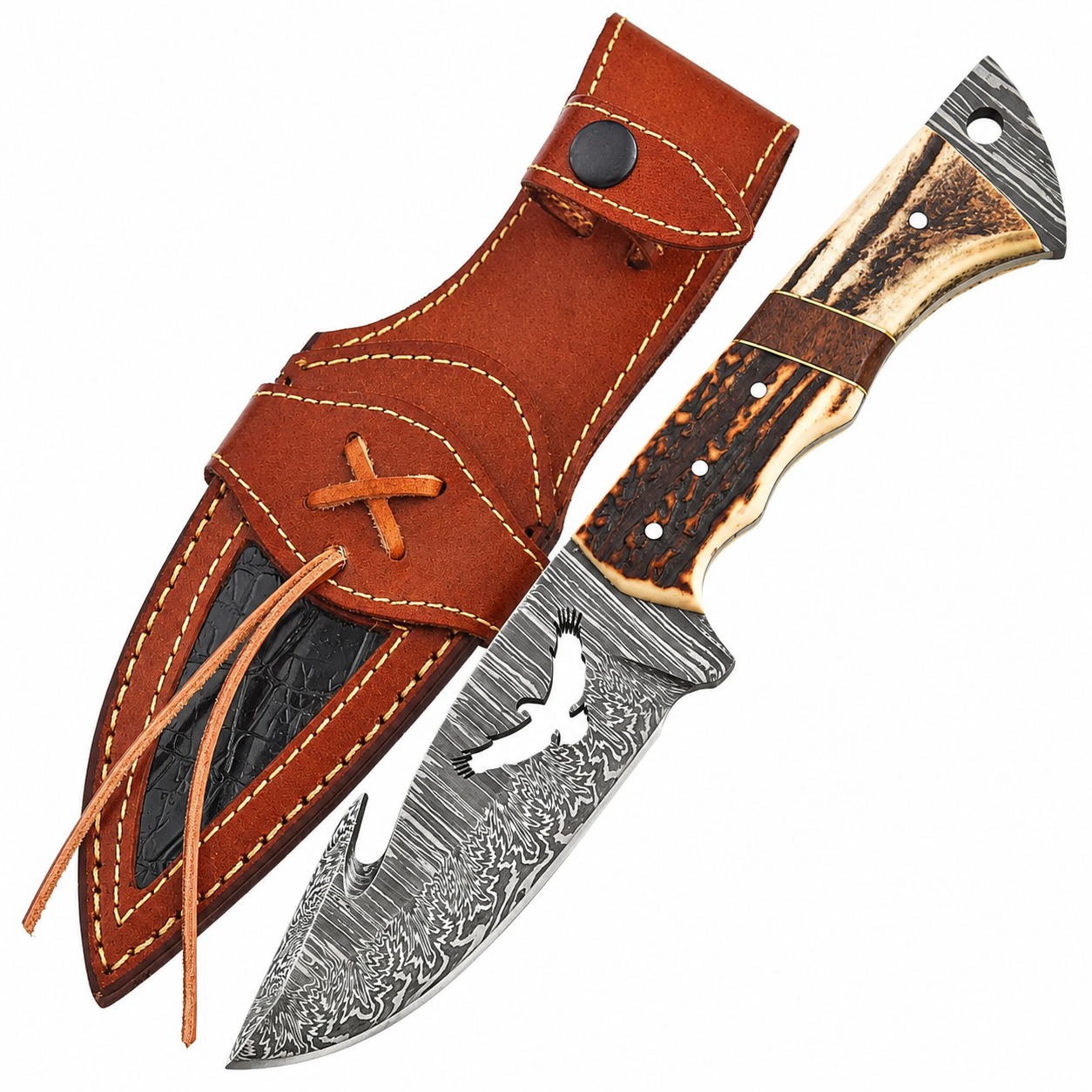
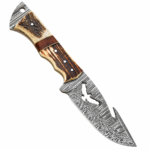
The Gut Hook Damascus Pattern Hunting Knife combines distinctive outdoor-inspired styling, a curved blade profile, an integrated gut-hook feature, and an eye-catching antler-style handle. Its layered-looking blade pattern, contrasting handle sections, decorative eagle motif, and matching brown sheath give the knife a traditional hunting aesthetic with several distinctive design details.
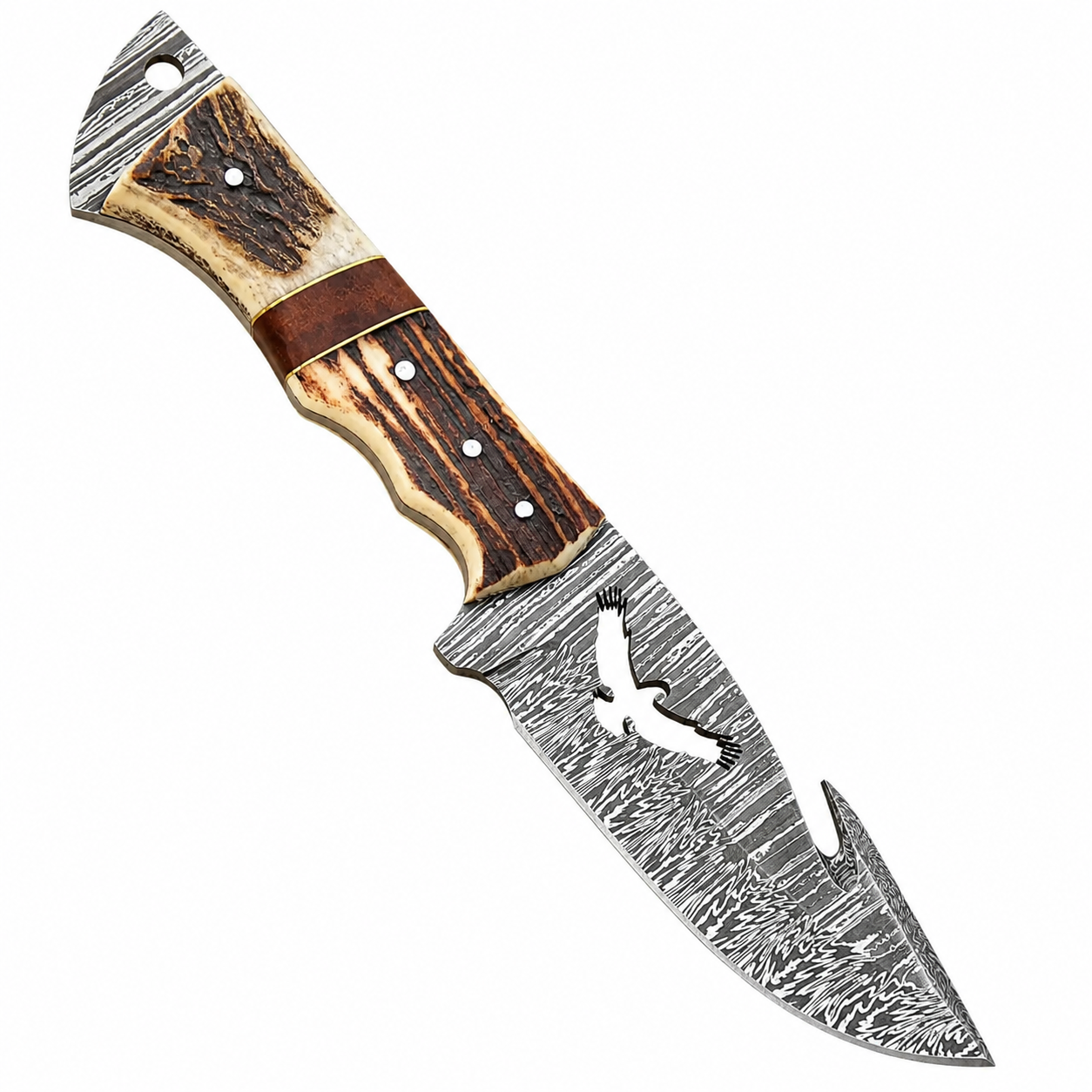
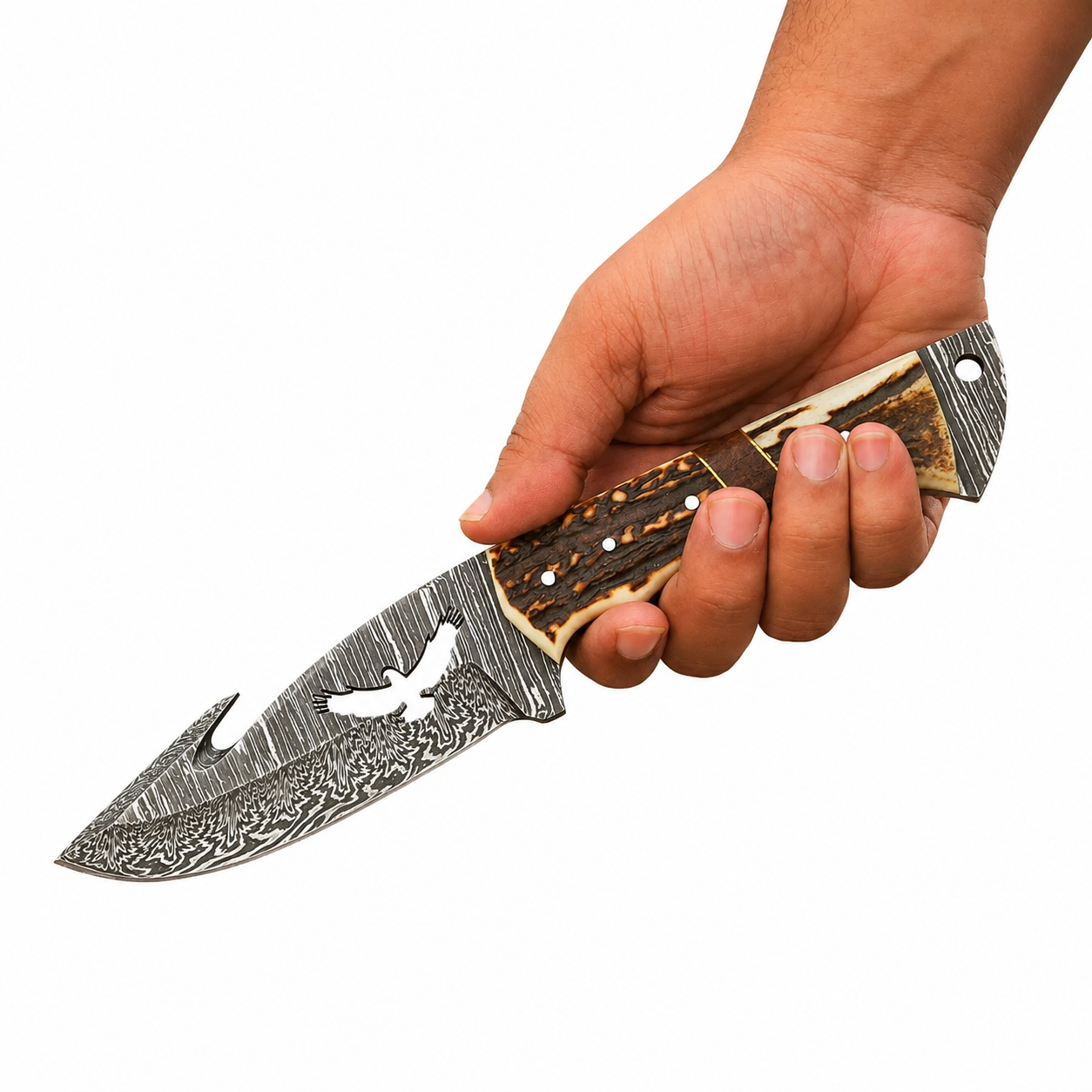
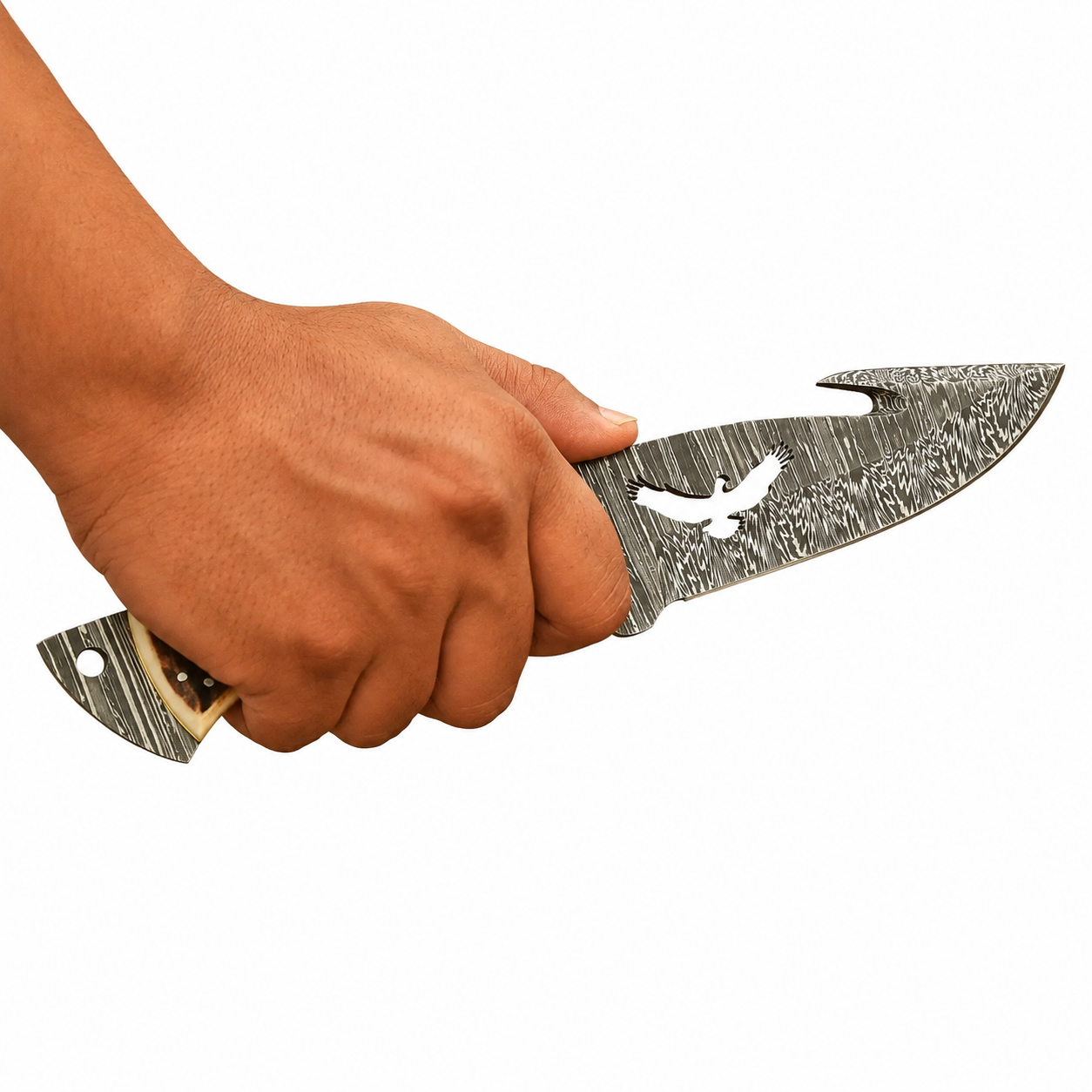
Designed in the style of a fixed-blade hunting and skinning knife, this model features a broad blade that curves gently toward a pointed tip. A small upward-facing hook is positioned along the blade’s upper edge near the tip, creating the characteristic gut-hook profile associated with certain hunting knives.
The blade displays intricate silver and charcoal-colored lines that resemble the flowing patterns found in Damascus steel. These lines vary across the blade surface, creating a textured-looking appearance with alternating waves, narrow bands, and irregular formations.
A contrasting white eagle silhouette is visible near the blade’s upper section. This decorative design adds another recognizable element to the product’s appearance, complementing the traditional outdoor theme.
The handle brings together cream-colored, dark brown, and black antler-like textures, separated by narrow gold-colored lines. Its contoured profile includes subtle finger positioning and a wider rear section with a circular lanyard opening.
A reddish-brown sheath with contrasting stitching, dark snap fasteners, a textured black panel, and leather-like ties is also visible beside the knife.
Together, these features create an attractive fixed-blade knife design for outdoor knife enthusiasts, hunters seeking an appropriately specified field knife, and collectors who appreciate detailed traditional cutlery.
Distinctive Damascus-Style Blade Pattern
One of the most striking details of this hunting knife is its patterned blade.
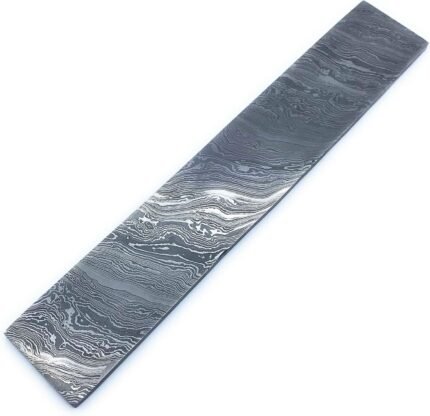
The surface features a mixture of dark gray, charcoal, and bright silver-colored lines. Some areas display narrow parallel bands, while others contain more irregular, flowing shapes.
The effect resembles traditional Damascus steel patterns, which are commonly associated with layered and pattern-welded blade materials.
The patterned appearance makes the knife visually different from plain polished blades or uniformly black-coated outdoor knives.
The contrast between the darker blade face and its lighter decorative lines is particularly noticeable against the white background in the product photograph.
Near the handle, the pattern appears relatively linear, with narrow silver lines passing across a darker surface. Toward the middle and tip, the design becomes more irregular and pronounced.
This variation adds visual depth to the blade.
However, the image does not establish whether the pattern was created through pattern welding, surface etching, printing, or another finishing technique.
Authentic Damascus construction must be confirmed through the manufacturer or verified material specifications.
Until that information is available, the term Damascus-pattern blade accurately describes the visible design without making an unsupported metallurgical claim.
Curved Blade with a Gut Hook
The most recognizable functional design element is the small hook-shaped feature along the blade’s upper edge.
This feature resembles the gut hook found on certain hunting and game-processing knives.
Gut-hook knife designs are commonly associated with field dressing and other specialized hunting-related cutting applications.
The photographed model has a clearly defined upward-facing hook positioned near the forward section of the blade.
Its curved profile differs from that of a conventional straight-backed hunting knife.
The hook also creates a distinctive outline when viewed from the side.
The main blade has a wider body and a continuous curved cutting edge that narrows toward the point.
The combination of the broad blade and hook-shaped feature identifies the product as a gut-hook hunting-style knife rather than an ordinary utility knife.
Actual suitability for hunting applications depends on blade dimensions, sharpness, edge geometry, steel composition, and construction quality.
Those technical specifications have not been established from the image.
The hook should not be assumed to have a particular cutting capability or factory sharpness without manufacturer confirmation.
Broad Hunting Blade Profile
The blade has a substantial-looking body, especially near the handle.
Its cutting edge follows a smooth curve toward a pointed tip.
This shape produces a broad surface in the center of the blade while maintaining a narrower forward section.
Broad, curved blade profiles are common among hunting and skinning-style knives.
The main edge has no visible serrations.
Instead, it appears to form one continuous cutting line from the lower base toward the tip.
The steel-colored bevel is distinguishable from the patterned blade surface.
This difference in appearance helps define the cutting profile.
The blade’s overall shape is suitable for describing the knife as hunting-style cutlery, although performance characteristics require separate verification.
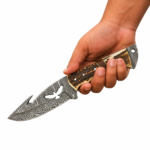
There is no scale or measurement reference in the photograph.
Consequently, the blade length, cutting-edge length, thickness, and overall weight cannot be determined reliably.
These details should be added to the finished product specification table only after confirmation from the manufacturer.
Decorative White Eagle Design
A distinctive white eagle-shaped graphic appears on the blade.
The design depicts a bird with extended wings, creating an immediately recognizable silhouette.
Its white coloring contrasts sharply with the surrounding dark patterned metal.
The eagle motif contributes to the knife’s visual identity and reinforces its traditional outdoor theme.
Decorative animal and bird designs are commonly found on collectible hunting-style knives.
They may appeal to buyers interested in outdoor heritage themes, wildlife imagery, or distinctive blade decoration.
In this case, the bird motif is positioned close to the upper section of the blade.
Its simplified shape makes it stand out without covering the entire patterned surface.
The photograph does not reveal whether the graphic is engraved, etched, painted, printed, or applied using another method.
Therefore, the listing describes it as a decorative eagle design rather than claiming a particular engraving process.
Customers interested in the durability of this decorative detail should request confirmation of the finishing technique.
Antler-Style Handle Design
The handle is another prominent feature of the knife.
It combines cream-colored sections with darker brown, black, and amber-like textured areas.
The upper portion has a pale cream background with irregular dark markings resembling natural antler.
The central section contains rich brown and black textures with a rough, organic-looking pattern.
A slightly raised cream-colored contour runs along the lower edge of the main grip.
These features create the appearance of a handle made with antler-inspired or horn-inspired materials.
The visual effect is traditional and contrasts with the more elaborate blade pattern.
Natural stag antler is a recognized handle material in traditional knife manufacturing.
However, the photograph alone does not confirm that this product contains genuine stag antler.
Other materials can be shaped, colored, or textured to create a similar appearance.
The exact handle composition should be confirmed by the supplier before describing it as natural stag, deer antler, bone, or horn.
For SEO and customer accuracy, antler-style handle is the appropriate description based on the available evidence.
Multi-Section Handle Construction
The handle appears to consist of several visually distinct sections.
Near the blade, the grip begins with a darker textured area containing cream and brown accents.
Toward the middle, a separate dark-brown section is visible.
Thin gold-colored lines divide the different sections.
The rear section returns to a pale cream-and-brown textured appearance.
These transitions give the handle a layered decorative character.
The individual sections may be separate pieces or a single component designed to resemble multiple materials.
The photograph does not establish the actual manufacturing method.
The narrow gold-colored bands could be metallic spacers or decorative finishing elements.
Their exact composition is unknown.
The handle also features several small, round, silver-colored fittings.
These fittings resemble pins commonly seen in knife-handle construction.
Although visible pins can contribute to the appearance of a traditional fixed-blade handle, the photograph does not confirm how they connect to the internal tang.
The knife should not be advertised as full tang, hidden tang, or through tang until the manufacturer provides that information.
Contoured Grip Profile
The grip is shaped with several gentle curves.
Its upper section is relatively smooth, while the lower edge includes a series of subtle finger-positioning contours.
These contours visually define different sections of the handle.
The central area narrows slightly compared with the wider rear.
Near the end, the handle broadens into a more pronounced pommel section.
This creates the familiar shape of a traditional outdoor knife grip.
The combination of curves and varied surface textures may be attractive to customers who prefer handles with a more sculpted appearance.
However, grip comfort cannot be established from an image.
Comfort depends on handle dimensions, grip circumference, balance, weight, surface finish, and individual hand size.
The manufacturer should provide the overall handle length and, ideally, additional photographs showing its thickness.
These specifications would help customers evaluate whether the handle suits their requirements.
The visible design is best described as contoured and antler-inspired rather than claiming verified ergonomic performance.
Decorative Handle Pins and Spacers
Several small circular pins are visible in the handle.
These light-colored fittings contrast against the dark brown and black grip sections.
They also coordinate with the narrow gold-colored separator lines.
The visual combination gives the knife a detailed, traditional appearance.
Decorative pins and spacer materials are commonly used to create contrast in custom-style knives.
Their appearance can help distinguish one model from another, even when the blade profile is similar.
On this knife, the fittings are distributed along the handle rather than clustered in one area.
Their positioning creates a consistent visual pattern.
The small gold-colored dividers between the handle sections add another decorative detail.
They separate the lighter antler-style areas from the darker central portion.
The exact pin material and spacer composition remain unverified.
Customers should not assume brass, stainless steel, copper, or other specific metals based only on color.
Those details can be added after the manufacturer confirms the materials.
Distinctive Rear Pommel
At the end of the handle, a dark patterned pommel is visible.
It features narrow gray and black lines resembling the blade’s Damascus-style surface.
This creates a coordinated appearance between the blade and handle.
The pommel has a slightly flared shape and a rounded upper profile.
A circular opening is positioned near its outer end.
The opening appears to have a light-colored interior and may serve as a lanyard attachment point.
This detail is common on certain outdoor knives.
It can provide a location for attaching a compatible cord, although no lanyard is included in the visible image.
The opening’s diameter and construction are unknown.
The photograph also does not establish whether the pommel is made from the same metal as the blade or uses a separate decorative material.
It is therefore described as a patterned, metallic-looking pommel.
Fixed-Blade Hunting Knife Style
The Gut Hook Damascus Pattern Hunting Knife uses a non-folding blade configuration.
The blade extends directly from the handle without a visible pivot or folding mechanism.
This identifies it as a fixed-blade knife.
Fixed-blade knives are available in many categories, including hunting, camping, field utility, bushcraft, and collectible cutlery.
Their construction and intended capabilities vary substantially.
Some fixed blades are designed for light cutting, while others are manufactured for more demanding outdoor applications.
The image alone does not establish which performance category applies to this particular product.
It also does not confirm the internal blade tang or the connection between the blade and handle.
For this reason, buyers should examine verified technical specifications rather than relying solely on the knife’s appearance.
The fixed-blade profile and gut-hook feature make it appropriate to categorize the model under hunting and skinning-style knives.
Traditional Hunting Aesthetic
The visual character of this knife is influenced by several traditional design elements.
Its curved blade, antler-style handle, metallic-looking fittings, and brown sheath create an appearance associated with classic outdoor cutlery.
At the same time, the eagle motif and intricate layered blade pattern give it a more decorative personality.
The handle’s natural-looking color variation is especially important to the overall design.
Cream, brown, black, and amber-like shades appear across the grip.
These colors contrast with the cooler silver and gray tones of the blade.
Thin gold-colored separators add smaller highlights.
The reddish-brown sheath completes the warm color palette.
Together, the components create a visually coordinated product.
For collectors, this combination may be as important as the knife’s shape.
The knife can be appreciated for its design without assuming that it possesses rare materials or specialized manufacturing characteristics.
Matching Reddish-Brown Sheath
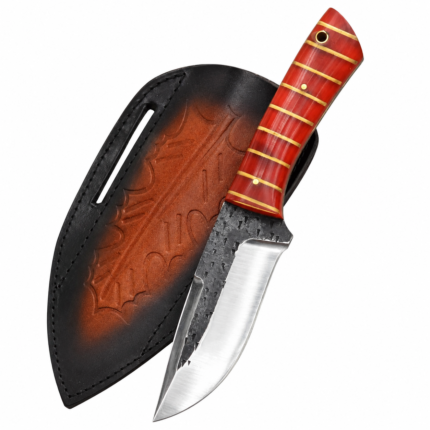
A large reddish-brown sheath is shown beside the knife.
Its surface has a smooth, leather-like appearance with decorative stitching.
The sheath follows the broad profile of a hunting knife and narrows gradually toward its pointed end.
The photographed sheath has several visible attachment and closure features.
At the upper portion, a strap with a dark circular snap button is visible.
A second strap-like section appears toward the lower portion.
This lower section includes a decorative crossed tie made from narrow brown material.
The stitching follows the outer edges and several internal contours.
Its lighter golden-brown color contrasts with the reddish-brown surface.
The sheath has a detailed appearance that complements the knife’s traditional styling.
Although it resembles leather, its exact composition cannot be determined from the photograph.
It should be listed as a leather-look sheath until genuine leather has been confirmed by the manufacturer.
The actual package contents should also be verified to establish whether the sheath is included with every knife.
Decorative Sheath Details
The sheath includes several features beyond a basic blade cover.
A dark textured panel is visible near its lower section.
This black insert has an embossed or reptile-like appearance.
It contrasts with the smoother reddish-brown material surrounding it.
The sheath also features a stitched flap with a crossed lace design.
Two thin brown ties extend outward from this area.
These decorative components make the sheath visually distinctive.
The upper snap-button flap provides another recognizable detail.
The photograph does not show the reverse side of the sheath.
Consequently, it is not possible to confirm the position or construction of a belt loop, attachment system, or backing reinforcement.
The visible straps should also not be assumed to provide specific retention performance.
Customers who intend to carry the knife should confirm the sheath’s actual fastening arrangement and fit.
The sheath should securely cover the edge and point when the knife is not in use.
Knife and Sheath Color Combination
The color palette is one of the strongest elements of this product’s appearance.
The blade features shades of silver, gray, charcoal, and black.
The eagle graphic introduces a bright white accent.
The handle combines cream, brown, black, and small gold-colored details.
The pommel repeats the patterned metal appearance.
The sheath uses reddish-brown tones with tan stitching and black decorative components.
These colors work together to create a traditional outdoor style.
Unlike knives with brightly colored synthetic handles, this model has a natural-looking aesthetic.
Its handle coloration resembles organic materials associated with traditional hunting equipment.
The patterned blade adds visual texture without requiring large amounts of brightly colored decoration.
The result is a recognizable fixed-blade design with a coordinated sheath.
Hunting and Field-Use Considerations
The knife’s design places it within the hunting and outdoor cutlery category.
Gut-hook blade profiles are commonly associated with certain field-dressing applications.
However, buyers should distinguish between a knife’s intended appearance and its verified performance.
The actual ability of this product to perform specialized tasks depends on several technical factors.
These include blade steel, hardness, thickness, edge geometry, handle security, and sharpening quality.
The photograph does not provide this information.
Therefore, the knife should not be marketed as professionally tested or suitable for particular demanding applications without supporting evidence.
Customers considering the knife for hunting-related tasks should request complete specifications from the supplier.
They should also review any relevant local laws and safe handling requirements.
For general collecting or display purposes, customers may place greater emphasis on the decorative blade pattern, eagle design, and handle appearance.
These visible characteristics can be evaluated directly from the photographs.
A Distinctive Choice for Collectors
Knife collecting includes a wide range of interests.
Some collectors focus on blade patterns.
Others prefer traditional handle designs, unusual blade profiles, or decorative metalwork.
This model combines several of these features.
The Damascus-style blade pattern gives the knife a layered-looking surface.
The eagle silhouette adds a wildlife-inspired decorative element.
The antler-style handle creates a traditional appearance.
The patterned pommel and gold-colored separators provide additional finishing details.
The gut-hook feature makes the blade profile distinctive.
The brown sheath contributes to the presentation.
These elements may appeal to collectors who enjoy hunting-themed fixed-blade knives.
However, collectible value cannot be established from appearance alone.
Factors such as verified material composition, workmanship, maker identification, production quantity, condition, and market demand affect collectible value.
The image does not prove that the knife is handmade, limited edition, antique, or rare.
Such descriptions should be used only when supported by reliable documentation.
Blade Material and Steel Verification
One of the most important technical details for any knife is the blade material.
The photographed blade has a highly visible Damascus-style pattern.
However, visual patterning does not prove the underlying steel composition.
Pattern-welded Damascus steel is typically produced using multiple layers of metal that are combined and processed to create visible patterns.
Other techniques can also produce a similar appearance.
The exact manufacturing method for this knife has not been confirmed.
Similarly, the blade’s hardness and heat treatment cannot be determined visually.
The manufacturer should provide the steel grade, hardness range, blade thickness, and relevant construction details.
These specifications help buyers understand maintenance requirements and compare similar knives.
Without this information, claims concerning exceptional edge retention, corrosion resistance, or toughness would be unsupported.
For an accurate website listing, the verified blade material should be added as a separate specification rather than inferred from the patterned finish.
Handle Material Verification
The handle resembles natural antler, particularly in the cream-colored and dark textured areas.
Its surface contains irregular markings and color variations that resemble organic material.
However, several materials can imitate this appearance.
Manufacturers may use natural stag antler, bone, horn, stabilized wood, resin-based composites, or other decorative materials.
Each material has different care requirements and physical characteristics.
Because the actual composition has not been established, buyers should not assume that the handle contains genuine deer antler.
The supplier should identify the handle material clearly.
If the material is natural antler, the product listing can be updated accordingly.
If it is a synthetic material or composite, that composition should also be stated accurately.
This distinction is important for customer expectations, product valuation, and certain international import requirements.
Maintaining the Patterned Blade
Proper care helps preserve the condition and appearance of a knife.
After appropriate use, remove visible residue and moisture from the blade.
Dry the surface thoroughly before storage.
The best cleaning products depend on the steel composition and blade finish.
Because neither has been verified for this model, harsh chemicals and abrasive cleaning methods should be avoided.
A soft cleaning cloth is generally preferable for routine surface cleaning.
If the blade is confirmed to be carbon steel or pattern-welded Damascus, follow the manufacturer’s specific corrosion-prevention recommendations.
Do not assume that a patterned surface is naturally rustproof.
Avoid prolonged exposure to moisture.
Inspect the blade periodically for visible corrosion, scratches, or surface changes.
The decorative eagle motif should also be treated carefully.
Its finishing technique is unknown, so abrasive cleaning could damage its appearance.
Caring for the Antler-Style Handle
Handle care depends on material composition.
Natural antler and synthetic imitation materials may require different cleaning methods.
Until the material is confirmed, avoid soaking the handle or exposing it to strong cleaning chemicals.
A soft cloth can be used to remove light surface dirt.
Dry the handle after cleaning.
Do not apply oils, waxes, or conditioning treatments intended for natural materials unless the supplier confirms compatibility.
Inspect the visible handle pins and spacers for looseness or damage.
If any component becomes unstable, the knife should not be used until it has been examined.
Avoid unnecessary exposure to excessive heat and prolonged direct sunlight.
These precautions can help preserve the handle’s visible finish.
Caring for the Brown Sheath
The sheath should also receive appropriate attention.
Keep it clean and dry.
Avoid storing it in damp conditions.
Inspect the stitching, straps, and snap-button closures periodically.
If the sheath is confirmed to be genuine leather, suitable leather-care products may be appropriate.
If it is synthetic, use cleaning methods recommended for that material.
Do not assume that all leather conditioners are suitable for every leather-like surface.
The decorative brown ties should be checked for visible wear.
The sheath must cover the blade adequately and fit securely.
If it becomes damaged or loose, use another appropriate protective storage solution.
For extended storage, follow the manufacturer’s recommendations about keeping a metal blade inside or outside its sheath.
Safe Handling and Storage
A fixed-blade knife should always be handled carefully.
Its cutting edge and pointed tip can cause injury.
Keep fingers away from the edge during handling, cleaning, and inspection.
Never test sharpness directly against the skin.
Store the knife securely when not in use.
The blade should be covered by a suitable sheath or protective case.
Keep the product away from children and unauthorized users.
Before any practical application, inspect the blade, handle, and fittings for visible damage.
Do not use the knife if the blade is loose or the handle is unstable.
A decorative appearance does not guarantee suitability for demanding cutting tasks.
Check the manufacturer’s recommendations before use.
Local regulations may restrict carrying, transporting, importing, or selling certain types of knives.
Buyers should review the requirements that apply in their jurisdiction.
Important Product Specifications
The following characteristics are visible in the supplied image.
Product Type: Fixed-blade hunting-style knife
Blade Design: Broad curved blade with a gut-hook feature
Blade Appearance: Silver and charcoal Damascus-style pattern
Blade Decoration: Contrasting white eagle silhouette
Handle Design: Contoured, antler-style multi-section handle
Handle Colors: Cream, brown, black, and amber tones
Handle Fittings: Small metallic-looking pins and gold-colored separators
Pommel: Patterned metallic-looking end section
Lanyard Opening: Circular opening near the handle end
Sheath Appearance: Reddish-brown leather-like surface
Sheath Details: Contrasting stitching, dark snap fasteners, decorative brown ties, and textured black panel
General Style: Traditional outdoor hunting and collectible cutlery
The following details require manufacturer confirmation:
Blade steel composition, genuine Damascus construction, hardness, blade length, overall length, blade thickness, weight, exact handle material, tang construction, sheath composition, manufacturing origin, sharpening method, and warranty.
Choosing the Right Hunting Knife
Selecting a hunting knife involves more than identifying an attractive design.
Customers should consider the specific application for which the knife is intended.
A collectible knife may be selected primarily for appearance.
A working outdoor knife requires greater attention to construction details and practical specifications.
Blade length influences the size and handling characteristics of the tool.
Blade thickness affects its profile and weight.
Steel composition determines many of its maintenance requirements.
Handle material and contour influence how it feels in the hand.
Sheath design is important for storage and transport.
A gut-hook feature may also be relevant for buyers seeking a particular blade configuration.
The correct choice depends on verified performance characteristics rather than appearance alone.
Customers should compare the manufacturer’s specifications with their own requirements.
Why This Knife Design Stands Out
Several details make this model visually distinctive.
The Damascus-style blade pattern has considerable contrast.
The white eagle decoration introduces a recognizable wildlife motif.
The curved blade and gut-hook feature create an unusual outline compared with standard straight-backed knives.
The handle combines multiple natural-looking colors and textures.
Small gold-colored separators provide decorative contrast between sections.
The patterned pommel visually connects the handle to the blade.
The reddish-brown sheath includes carefully arranged decorative elements.
Together, these features create a cohesive hunting-inspired product.
Its appearance may suit customers who appreciate traditional knife styling with more elaborate decorative accents.
The design offers a combination of blade patterning, wildlife imagery, and an antler-style grip in one product.
Final Overview
The Gut Hook Damascus Pattern Hunting Knife features a broad curved blade, distinctive gut-hook profile, flowing silver-and-charcoal blade pattern, contrasting eagle motif, and multi-section antler-style handle.
Its gold-colored separators, metallic-looking pommel, circular lanyard opening, and detailed reddish-brown sheath complete the design.
The knife’s appearance is well suited to outdoor cutlery enthusiasts and collectors who appreciate traditional hunting-inspired styling.
Before purchasing for practical use, review the manufacturer’s confirmed material and performance specifications.
Explore this distinctive gut-hook fixed-blade design and discover its combination of patterned metalwork, antler-inspired styling, and traditional outdoor character.




Reviews
There are no reviews yet.