


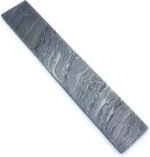

A rectangular knife billet with a flowing gray pattern
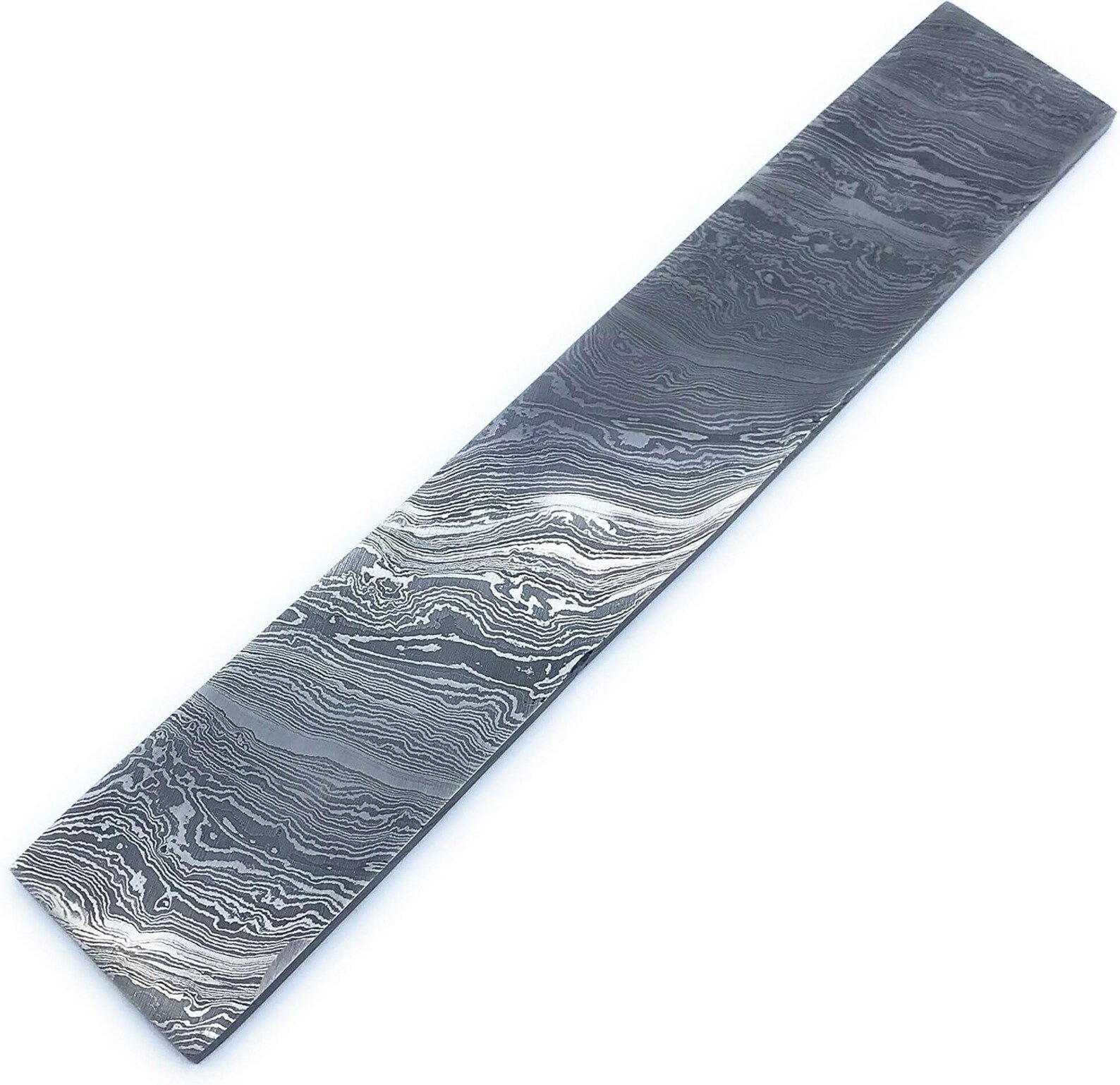
This Damascus-style knife billet is a long, rectangular piece of flat stock with fine silver-gray lines flowing across a charcoal-colored face. Its two long sides are straight, its ends are squared, and there is no pre-cut blade outline, handle section, bevel, or sharpened edge. It is pictured as a single bar for makers to evaluate as project stock, rather than as a blade ready to fit with a handle.
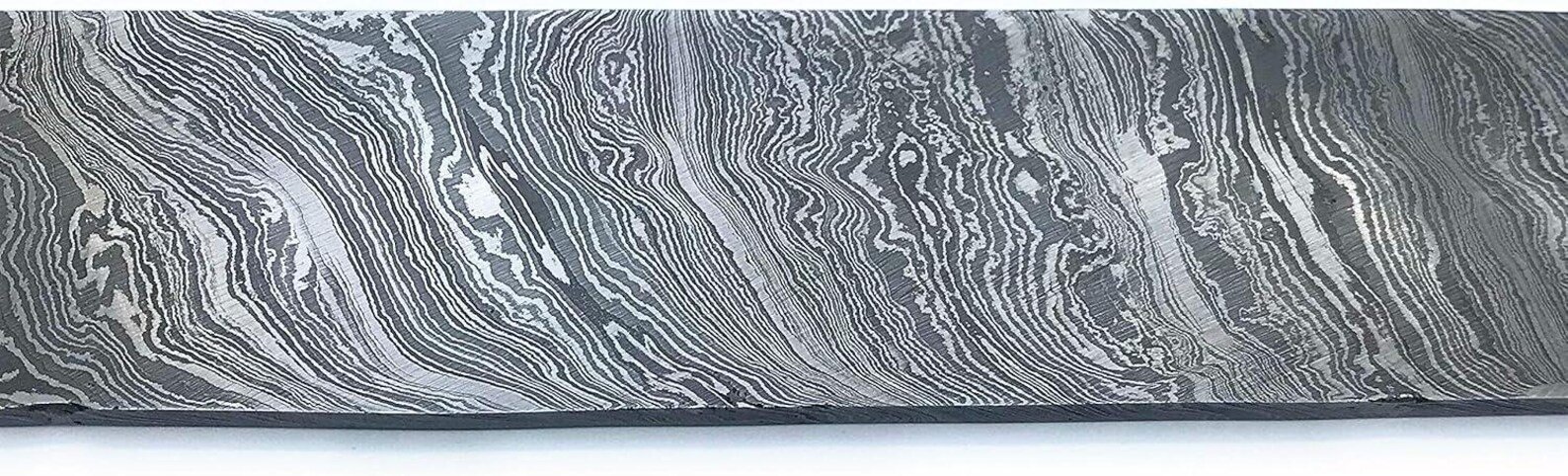
The pattern is what sets this billet apart. Some lines run close together like the contours on a map. Others open into wider bands that bend around dark islands or double back into small loops. Near the lower portion of the photograph, a bright band sweeps across the bar. Toward the opposite end, the lines are subtler and closer in tone to the dark background. A design placed over one area would capture a noticeably different part of the pattern from a design placed over another.
The rectangular format leaves that choice open. A maker can consider where a curve, tip, bolster face, or decorative panel would sit in relation to the waves before settling on a layout. The photograph is a useful guide to appearance; the actual dimensions, alloy, and supplied condition are the details to confirm before committing the bar to a functional project.
What is shown, and what “Damascus-style” means
The product image shows one dark gray bar lying diagonally on a white background. Most of what you see is the broad face. A narrow side is visible along the lower-right edge, showing that the piece has thickness, but there is no scale from which to measure it. The reverse face and a clear end-on view are not shown.
The term Damascus-style describes the visible waves. It does not establish how the bar was made, which metals it contains, how many layers it has, or whether the pattern continues through its thickness. A photograph of the face cannot answer those questions. If your interest is primarily the gray-on-charcoal design, the photograph gives you something concrete to judge. If your project calls for documented pattern-welded steel, obtain that specification for the actual billet.
This distinction matters especially when planning to remove material. The area visible on the face today may not look the same after shaping or finishing. Even if a supplier confirms that a billet is pattern-welded, the design exposed on a different plane can differ from the one on the original face. A buyer who wants to preserve one particular sweep of lines should discuss the planned use with the supplier rather than expect the product photograph to predict the finished result.
Reading the pattern from one end to the other
At the lower-left end of the image, tightly spaced lines curve around irregular dark patches. They spread and converge, with no obvious repeated interval. Moving toward the middle, the contrast grows stronger: pale bands stand out against a darker field, and several bend across much of the visible width. This is the most prominent part of the design if you are looking for an area that will read clearly in a smaller piece.
Farther along the face are broader patches where the gray tones sit closer together. The lines are still visible, but they have a quieter appearance than the bright central waves. Near the upper-right end, several narrow bands run beside one another, interrupted by small curves and changes of direction. There is no single emblem or repeating geometric motif that has to be centered in the finished design.
That variation gives you a useful choice. A design that uses a long stretch of the bar can show the change from fine contours to broader waves. A smaller component may show only a few lines and one distinct bend. Neither is necessarily the better use of the pattern. The right choice depends on whether you want the finished piece to show the overall movement across the bar or one well-chosen detail.
Lighting also plays a part. The lower area is brighter in the photograph and the upper area is darker; that does not prove that the two ends have different finishes. If a particular degree of contrast matters to you, a photograph of the available piece under even lighting is a better buying reference than treating the brightest highlight as its normal color.
Billet stock rather than a pre-shaped blank
A pre-shaped knife blank already determines much of the design. Its tip, blade belly, heel, and handle outline have been cut, and it may have holes positioned for fittings. This billet presents a rectangle instead. There is no hole pattern to match, no existing edge to follow, and no fixed point at which the blade must begin. That freedom is useful for a maker who has an original outline in mind.
It also means that this is a different purchase from a nearly finished blade. Someone looking for a project centered on choosing and attaching handle scales would usually be better served by a profiled blank with confirmed dimensions and a known supplied condition. Someone who wants to choose the profile and its position within a patterned face has a stronger reason to consider a billet.
The rectangular shape is particularly helpful at the planning stage. With a full-size outline on paper, you can evaluate how the broadest part of your design sits across the stock and whether the preferred section of pattern will remain inside the outline. What you cannot determine from this photograph is how many finished pieces the bar will yield. That depends on its measured size, the shape of each piece, and the allowance your project needs.
Choosing where the pattern will appear
Consider a design with a broad area at one end and a narrow area at the other. If you position the broader area over the sweeping silver band, more of that curve will remain visible. Move the same outline toward the quieter end and its character changes: the finished face may feature finer lines with less dramatic contrast. The outline has not changed, but the part of the billet that becomes the focus has.
For a smaller decorative component, it can help to think in terms of a window. Cut a window the shape of the planned face in a piece of paper, then move it over a correctly scaled image of the available stock. This lets you compare compositions without being distracted by the pattern outside the finished boundary. Use a photograph with a ruler or a supplier drawing for scale; the uploaded image alone is not a dimensional template.
Orientation is another design choice. A band that seems to run gently across the finished face in one layout may enter through a corner in another. On a long, narrow component, closely spaced lines can remain visible almost from end to end. On a short, broad component, a single loop may become the dominant feature. If the pattern is central to your purchase, make that choice before deciding where the outline goes.
There is a trade-off between keeping a favorite area and using the available stock efficiently. Placing a small part in the middle of the brightest wave may leave offcuts that are less useful for the rest of the project. Moving it nearer an end may preserve a longer uninterrupted section for another design. Dimensions and a photograph of the actual piece make that a deliberate choice rather than a guess.
Length, width, and thickness each answer a different question
Length tells you whether the complete project outline fits from end to end. For a knife design, that means accounting for the blade and any handle section that will be part of the same piece. Comparing only the intended cutting-edge length with the overall stock length can leave a project short before any allowance for finishing is considered.
Width determines whether the broadest part fits between the long sides. A design with a deep belly, a broad heel, or a handle that flares at the rear may need more width than its narrowest section suggests. Lay out the widest points together. A bar may be long enough for the project while still being too narrow where the outline turns or widens.
Thickness is the measurement this image communicates least well. The exposed side looks narrow relative to the broad face, but perspective is not a substitute for a measurement. Thickness affects project suitability, how much material can be removed, and what remains afterward. If your plan requires a precise finished thickness, ask for the actual stock thickness and any stated variation along the piece.
Finally, distinguish nominal dimensions from usable dimensions. If a finished project needs nearly the entire width, a small deviation along one edge may matter. A buyer with a generous allowance has more flexibility. Requesting measurements at more than one point is especially useful when the fit is close. No numerical dimensions have been verified for the pictured billet.
Project ideas suited to this format
For a custom knife design, the appeal is the freedom to place the blade and handle outline within the same rectangle. The waves give the maker something to plan around before settling on the final shape. Whether the bar is suitable for a working blade depends on its verified alloy, condition, dimensions, and the project requirements. The pattern alone is not a cutting-performance specification.
For decorative fittings or inlays, a smaller section can be selected for its particular arrangement of lines. A detail that might be missed on the full bar can become the central feature of a compact panel. Here, the important questions are how much of the face will remain visible, how deeply the part must be shaped, and whether the pattern will remain after that work.
For a material display or workshop sample, the intact bar has an advantage of its own: it shows several changes in the pattern on one continuous face. The brighter waves, darker fields, and fine nested lines can be seen together. A buyer choosing it mainly as a visual sample should confirm whether the photographed bar is the exact piece supplied or a representative example of the design.
For a coordinated group of pieces, stock from one bar may give the group a related appearance, but it will not make the pieces identical. Each one occupies a different position in the pattern. That can be desirable when the aim is a family of related details rather than repeated copies. If you need symmetrical or closely matched faces, ask to see the proposed layout and both sides of the stock before buying.
Comparing this wave pattern with other billets
Start with the visible character rather than the supplier’s pattern name. This bar has irregular, flowing lines with occasional loops and broad changes in spacing. It does not show a clearly repeating ladder motif, a row of evenly spaced circular marks, or a feather pattern with a distinct central axis. Sellers may use terms such as “wave,” “random,” or “natural” differently, so a current photograph is more useful than the name alone.
Contrast is worth comparing separately from shape. A billet can have similar waves but much less separation between its light and dark areas. Another can have stronger contrast but a more regular pattern. If your finished part will have a small exposed face, the contrast within that particular area matters more than how dramatic the whole bar looks in a product photograph.
Also compare like with like. A broad rectangular billet, a narrow strip intended for fittings, and a profiled blade blank can all be advertised using similar Damascus-related terms. They are not interchangeable purchases. Check the outline, the dimensions, and the sales unit before using one listing as a price comparison for another. A photograph showing several bars does not necessarily mean the price covers a set; likewise, the single bar pictured here does not establish the seller’s package quantity.
The supplied condition matters as much as the pattern
For a working project, the first material question is the composition. Request the maker’s declared alloy or alloy combination for the available stock. Do not substitute the specification of another billet with a similar face. Two pieces can look much alike in a photograph while differing in how they can be worked or finished.
The next question is the condition in which the bar is sold. A buyer expecting annealed stock needs a different product description from someone seeking material already hardened and tempered. If a hardness value is supplied, establish whether it describes the bar as delivered or a result the supplier expects after further treatment. The two statements are not equivalent.
Finish is a separate issue. The visible face has a contrasting pattern, but there is no verified information about how that contrast was produced, whether both sides are finished, or what the side faces look like. If your piece will expose the reverse or an edge, ask for those views. The front photograph can help you choose a pattern; it cannot describe a surface it does not show.
No product-specific maintenance or processing instructions accompany the image. In particular, there is no basis for claiming that the bar is stainless, rust-resistant, ready to harden, or ready for immediate use as an edge tool. Obtain handling, storage, and finishing guidance for the confirmed material rather than choosing a treatment on the strength of the visible pattern.
Buying one billet or planning a small batch
For a one-off project, the most useful question is whether the exact bar in the image is the one available. If it is, you can plan around the broad pale curve in the lower half and the subtler lines farther along. If it is a sample photograph, choose based on the general pattern family and ask for a current image before committing to a particular arrangement.
For a small batch, size consistency can matter more than exact visual matching. Several bars may all fit a broad description yet leave different amounts of usable stock. Ask for the length, width, thickness, and quantity of the proposed batch, and whether the stated tolerances fit your design. If every piece has to fit the same template, an assortment of attractive patterns does not make up for a bar that is too narrow.
Price comparisons become more meaningful once the stock size is known. A lower price per bar is not necessarily a lower price for the usable material your project requires. Compare equal dimensions, the same supplied condition, the same quantity tier, and the same delivery basis. For an appearance-led project, also consider how much of each bar has the pattern you want to retain.
This billet is best chosen for what the photograph actually offers: a long rectangular face, squared ends, and irregular silver-gray waves that give a maker several possible layouts. If those lines suit your design, compare your full-size outline with the confirmed stock dimensions and choose the section of pattern you most want the finished piece to show.




Reviews
There are no reviews yet.