



Blue Marbled Fixed Blade Knife: Color in the Grip, Ripples in the Blade
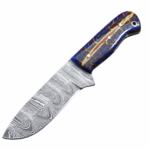
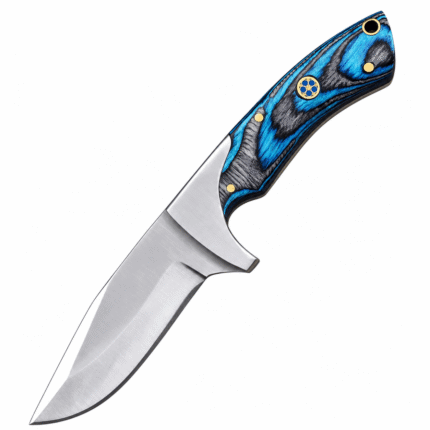
A cream-colored streak runs almost the full length of this blue marbled fixed blade knife’s handle. Along either side of it, cobalt blue gives way to chestnut brown, dark branching marks, and fine amber-colored lines. Three pale circular pins follow the length of the grip. At the rounded rear, a larger silver-tone ring frames an open hole.
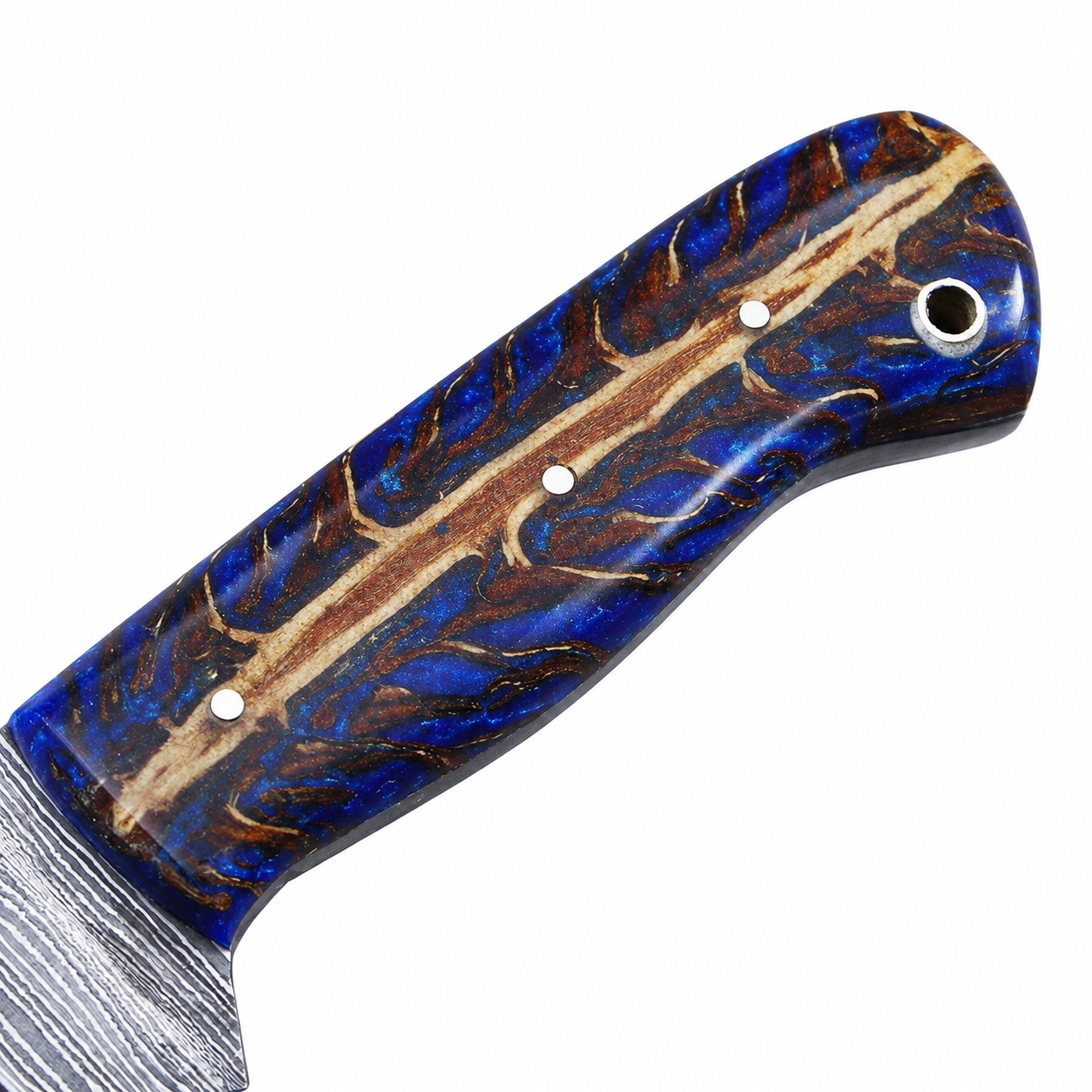
The blade has a different kind of pattern. Closely spaced silver and charcoal lines bend into nested curves across its broad face. They are especially distinct near the cutting edge, where the curves resemble a sequence of ripples. The main edge follows a continuous arc toward the point, with no visible serrations or gut hook. The photograph shows one fixed blade knife on a white background; no sheath or other accessory is pictured.
This design is a good choice for someone who wants a colorful handle without losing sight of the blade itself. The grip draws attention first, but the broad blade gives the gray pattern enough room to stand on its own. Its strongest selling points are the shape, color, and detail you can actually see.
A blue handle with a cream center stripe
The handle is more distinctive than the phrase “blue handle” suggests. Near the blade, the blue is deep and inky. Through the middle, it brightens around irregular patches of brown. Toward the rear, warm brown markings fan outward against the blue. Separating those areas is a long, uneven cream stripe with a narrower brown line running through part of it.
That stripe gives the eye a path from the blade to the butt. It also makes this version easy to identify among other blue knives. A solid blue grip, a blue-and-black striped grip, and this branching cream-and-brown design may all appear under the same color filter, but they look quite different in person or on display.
The face has a noticeable shine. A curved highlight follows the lower portion of the handle near the rear, showing how the surface rounds away from the camera. That tells you something about its appearance, but not what it is made from. Here, marbled describes the arrangement of colors. It does not imply marble, resin, stabilized wood, pine cone, or any other particular material.
If the exact pattern is what attracts you, check whether the seller is offering the piece pictured or an example from a series. For a buyer who wants this particular cream stripe, a photograph of the available knife is more useful than a general promise of a blue handle.
The silver-gray ripple pattern
At the heel, where the blade meets the handle, close parallel lines run across the face. Farther forward, those lines bend into repeated U-shaped curves. Each curve sits inside a wider one, with thin pale lines separating broader gray bands. The pattern changes again near the point, where the lines angle into the narrowing blade.
The contrast is easy to appreciate because the face is broad and there is no large logo, colored coating, or engraved illustration competing with it on the visible side. The linework is the decoration. It has a finer scale than the markings on the handle: the grip uses broad areas of blue and brown, while the blade uses many narrow bands of gray. The two patterns work together without trying to match.
The image supports calling this a Damascus-style pattern, but it does not establish pattern-welded Damascus steel. Steel grade, layer count, heat treatment, and the method used to create the surface design are unverified. If your interest is visual, you can judge the ripple pattern directly. If you collect knives for their metallurgy, ask for the specification for this exact piece before making that part of your purchase decision.
A broad blade with a continuous curved edge
The blade starts with a broad shoulder at the handle and carries considerable width through its middle. Toward the front, the lower edge curves upward to meet the descending spine. The result is a defined point with a rounded belly behind it. That silhouette places the knife naturally among hunting-style fixed blades rather than among folding pocket knives or narrow fillet knives.
For buyers comparing shapes, the important feature is the uninterrupted lower edge. There is no hooked recess near the tip, no saw-tooth section along the belly, and no abrupt step dividing the edge into two separate profiles. If you prefer a simple outline with the detail concentrated on the blade face, this knife offers that combination.
The broad face also changes how the pattern reads. A slimmer blade might show only fragments of each ripple; here, several complete curves are visible across the lower half. For a display piece, that difference can matter more than a nominal style name. For practical outdoor use, blade length, thickness, steel specification, and the maker’s intended applications still need to be confirmed. A side view alone cannot establish cutting performance.
The transition from blade to grip
Where the blade meets the blue handle, the heel extends slightly below the front of the grip. The edge then curves inward briefly before continuing into the wider belly. There is no large separate crossguard or brightly colored bolster. Instead, the patterned blade meets the blue face of the handle across a short, clean boundary.
This is one of the quieter details of the design. The knife already has strong color and linework, so a simple transition helps preserve the outline. Viewed side-on, you can follow the spine from the blade into the back of the handle and see where the lower edge gives way to the shallow grip contour.
For someone accustomed to knives with a pronounced front finger groove, this handle looks different. It has a relatively open underside through the middle and widens toward the back. Whether that shape suits your hand depends on the grip’s length, thickness, and cross-section. If fit is important, compare those measurements with a fixed blade you already find comfortable.
Three pins and a silver-rimmed rear opening
The three small pins are solid, pale circles set into the patterned handle. One sits toward the front, another near the middle, and one farther back. Their simple finish provides a useful contrast: against the irregular color patches, each pin is a small, clearly defined point. The rear opening is larger and hollow, so it is easy to distinguish from the pins even in the overall photograph.
The position of the opening leaves most of the handle face available for the blue-and-brown pattern. No cord is fitted in the photograph. If you intend to add a lanyard, ask for the opening’s internal diameter before buying one. Its visible presence is a useful feature, but the photograph has no scale from which to determine cord compatibility.
A dark border is visible along part of the handle’s underside and rear. It helps define the edge of the blue surface, especially around the flared butt. It does not, by itself, establish full-tang construction. A photograph of the spine and butt, or a maker’s construction specification, would be needed to describe the internal arrangement accurately.
Choosing this design for a collection
If your collection is arranged by handle color, this knife earns its place through more than blue alone. The pale streak makes it recognizable from a distance. Up close, the branching brown shapes give different parts of the grip their own character. The area next to the blade is darker, while the rear has a brighter mix of blue, brown, and cream around the metal-rimmed opening.
If your collection is arranged by blade pattern, look instead at the lower half of the blade. The ripples are more structured there than the free-form markings on the handle. The broad profile lets you see the change from close lines near the heel to larger nested curves across the belly. A side-on display shows both features without needing to turn the knife or rely on an inscription.
The design may also appeal to an adult gift recipient who likes colorful fixed blades. A useful distinction is whether the recipient values appearance or a particular material. Someone drawn to blue marbling can judge that feature from the image. Someone specifically seeking a pine-cone handle, a particular steel, or a documented forging process would need confirmation before this could be recommended on those grounds.
Fit, storage, and accessories
No ruler appears in the photograph. The proportions are visible, but overall length, blade length, maximum width, thickness, and weight are not. If you plan to place the knife in an existing display case, measure the available space against the actual overall length and maximum blade width. A long compartment may still be too narrow for the belly.
For an existing sheath, compare the full outline rather than the blade length alone. The broad heel, the curve near the front of the grip, and the wider portion of the blade all affect compatibility. A sheath that accepts a slim straight blade of equal length is not necessarily suitable for this profile. No sheath is shown, and none should be assumed to be included.
For a working knife, the most useful details to obtain are the actual blade alloy, supplied edge condition, stock thickness, and intended use. Verified care advice also depends on the blade and handle materials. There is no basis here for promising rust resistance, prescribing a polishing product, or assigning a sharpening angle. Those details should come from the maker rather than from a similar-looking supplier knife.
The blue grip and ripple-pattern blade are what distinguish this piece, and those features do not require an exaggerated performance claim. If you like a broad plain-edge profile with a colorful handle, explore this knife for the cream stripe, three pale pins, and sweeping gray blade pattern that make it recognizable.






Reviews
There are no reviews yet.