






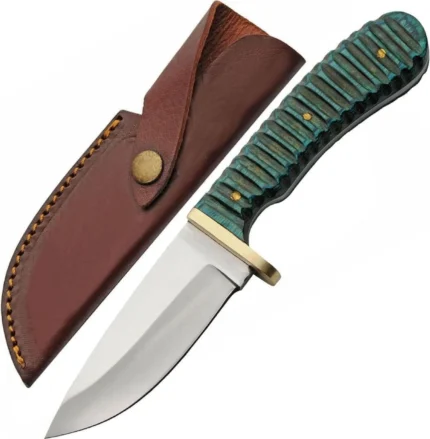
Damascus Pattern Bowie Knife with Wooden Handle and Decorative Guard
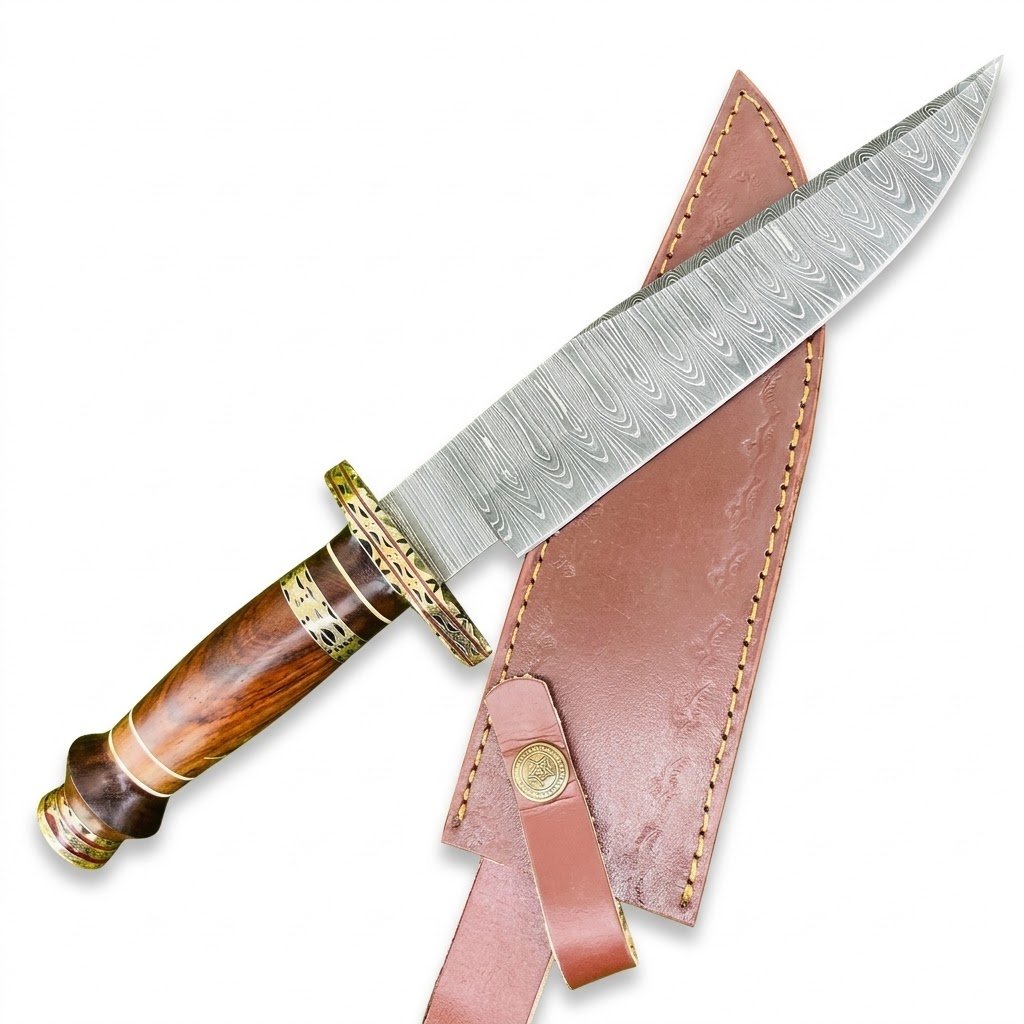
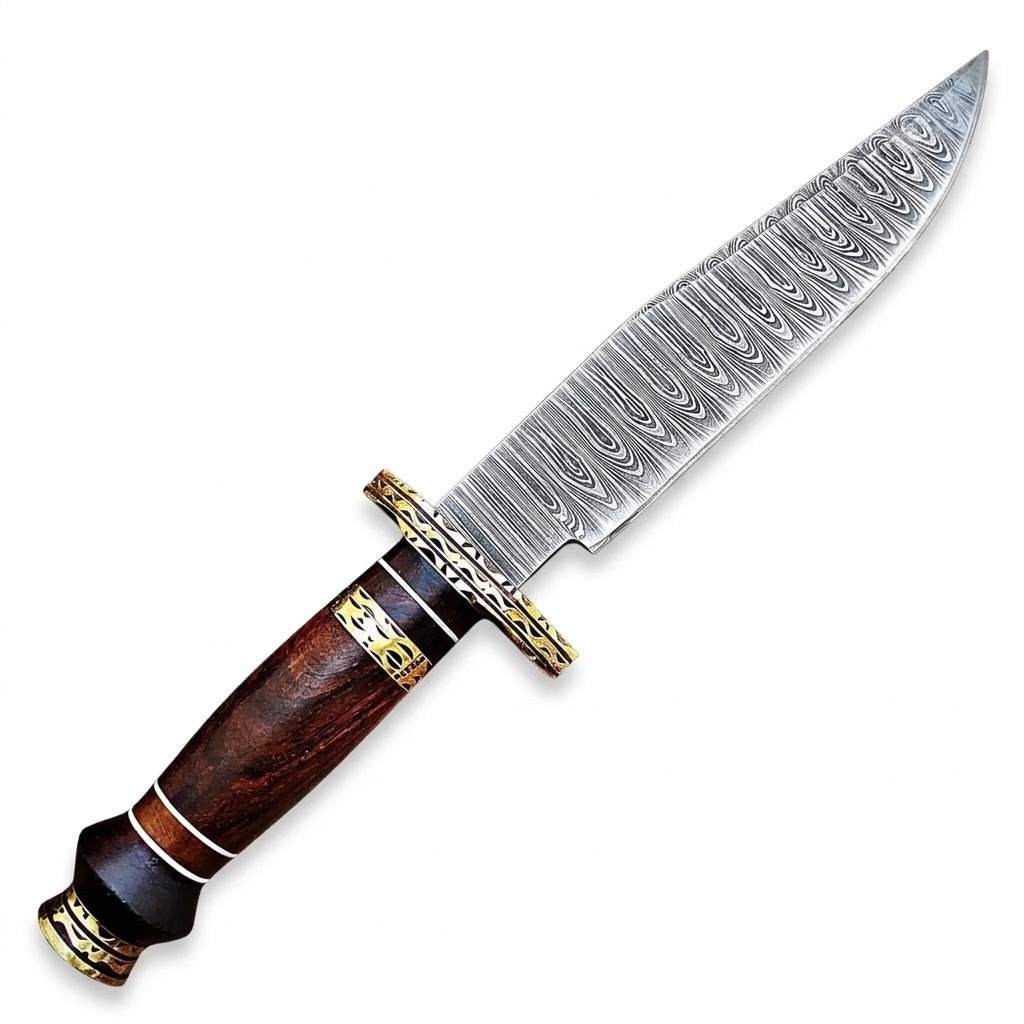
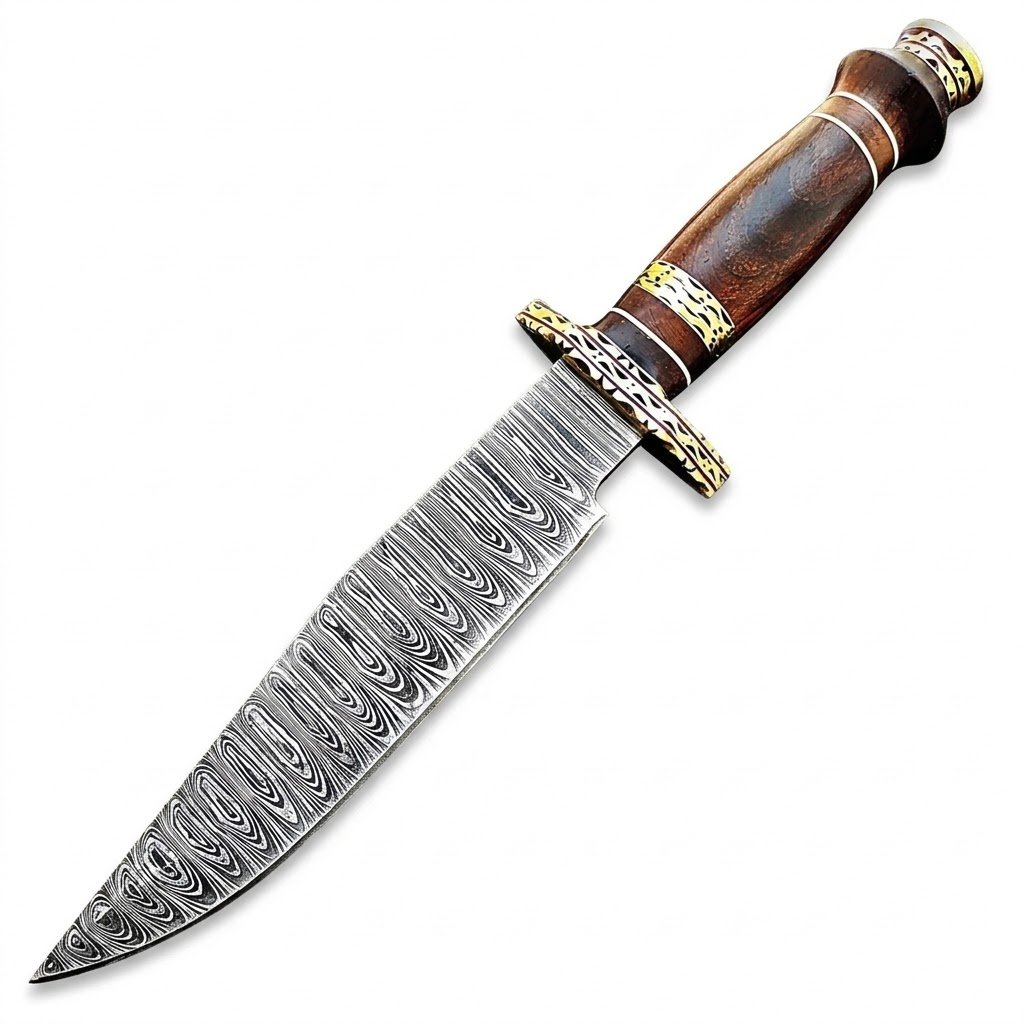
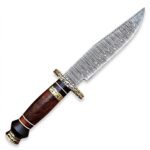
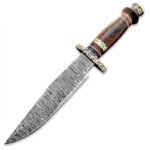
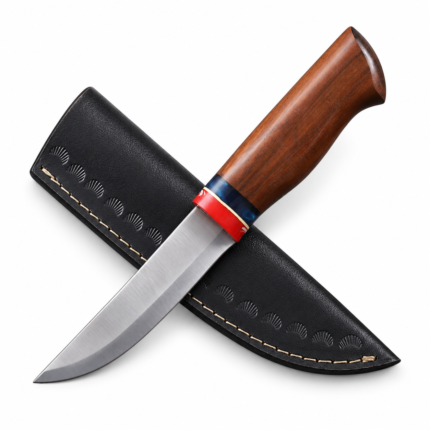
The Damascus Pattern Bowie Knife combines a long, gracefully shaped blade, an attractive wood-grain handle, decorative metal fittings, and a coordinating brown sheath. Inspired by the classic Bowie knife silhouette, this fixed-blade design has a broad cutting section, a gently rising pointed tip, and a distinctive silver-and-gray pattern across the blade.
Its appearance brings together traditional hunting knife styling and ornamental detailing. The richly colored handle provides a warm contrast to the patterned blade, while the gold-toned guard, handle spacers, and pommel accents create a coordinated finish.
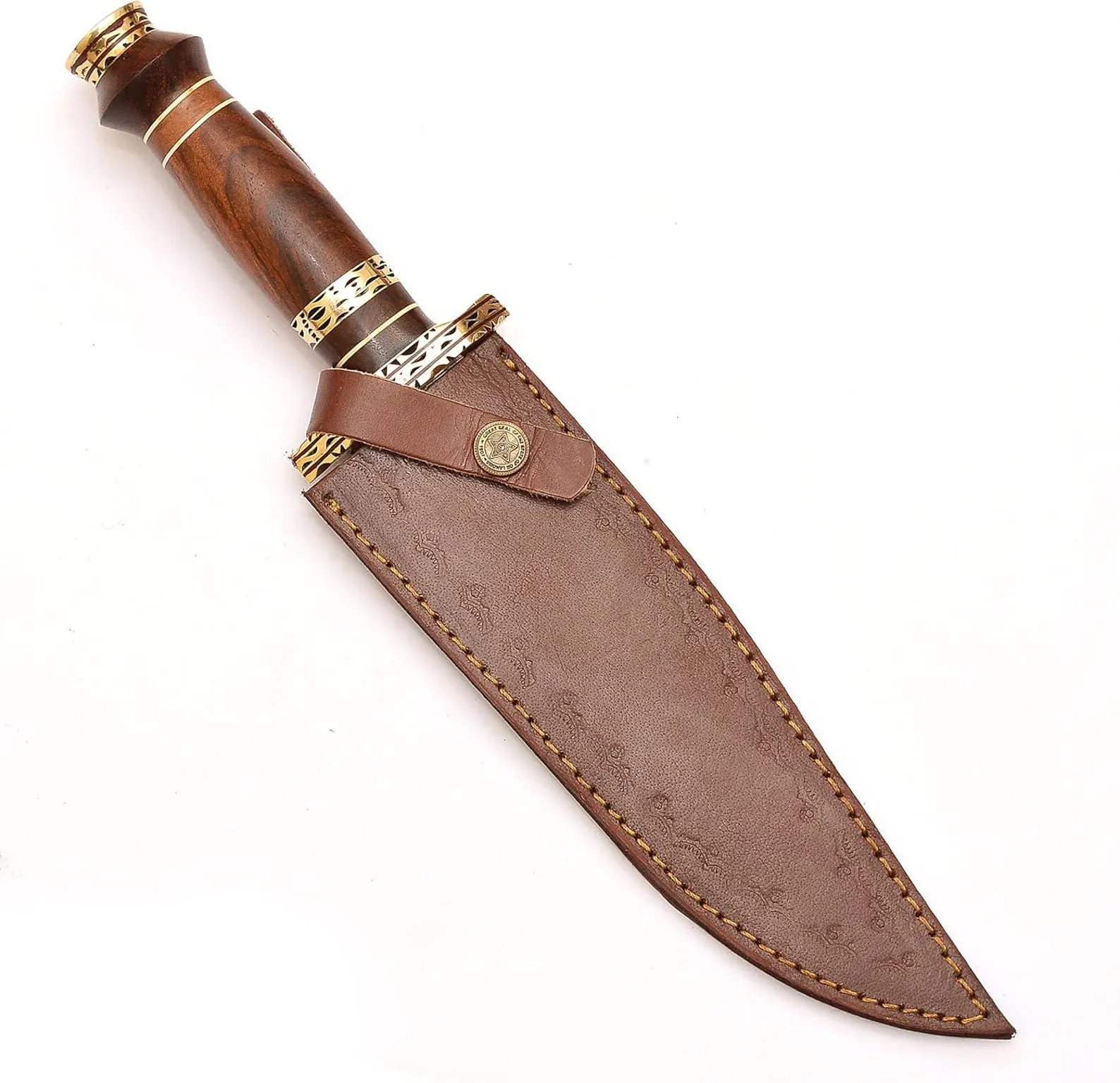
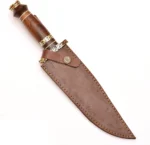
The knife is photographed alongside a brown leather-looking sheath featuring visible stitching and a retaining strap with a decorative metal fastener. The combination creates a complete and visually distinctive knife-and-sheath presentation.
This Bowie-style knife is especially suited to customers who appreciate traditional fixed-blade designs, patterned steel appearances, detailed handles, and collectible outdoor cutlery.
The visible craftsmanship-inspired details make the design stand out, although the precise manufacturing method and materials must be confirmed with the supplier before technical performance claims can be made.
Classic Bowie Knife Design
A Bowie knife is recognized by its substantial fixed-blade construction and prominent cutting profile. While Bowie knives come in many shapes and sizes, they are often associated with broad blades, pointed tips, and handles separated from the blade by a guard.
This knife follows that design tradition.
Its blade is relatively long compared with the handle, with a straight-looking upper section that gradually approaches a raised point. The cutting edge curves toward the tip, producing an elegant and balanced visual profile.
The knife has a pronounced guard between the handle and blade, reinforcing its classic Bowie-style appearance.
Compared with smaller utility knives, the design has a more traditional hunting knife silhouette.
The blade, handle, and sheath are all presented with decorative elements rather than a completely plain finish.
For buyers exploring classic Bowie knife designs, these details help distinguish the product from simple, modern fixed-blade models.
The knife can be described as Bowie-style based on its appearance, but its exact intended applications should be confirmed through manufacturer information.
Damascus-Style Patterned Blade
One of the most recognizable features of this knife is its patterned blade.
Across the silver-colored surface, numerous wavy lines form an intricate flowing design.
These lines run along much of the blade and become particularly noticeable near the pointed tip.
The pattern resembles the layered visual effect associated with Damascus steel.
Rather than appearing as a uniform polished surface, the blade displays alternating light and dark lines that create movement and depth.
The result is an attractive finish that appeals to customers who prefer visually distinctive knives.
Damascus-patterned blades are commonly appreciated for their characteristic appearance.
Some products are made from pattern-welded steels, while others may use different techniques to produce similar-looking surfaces.
The uploaded photograph cannot establish which manufacturing method was used for this particular knife.
Therefore, its blade is accurately described as having a Damascus-style pattern.
Claims about hand forging, steel layering, alloy composition, and heat treatment should be added only after obtaining verified supplier specifications.
Long Blade with Pointed Profile
The blade has an elongated shape with a narrow, pointed tip.
Its upper edge follows a relatively smooth line toward the front, while the cutting edge rises gradually to meet the tip.
This creates a distinctive Bowie-style profile.
The visible blade proportions provide a substantial appearance without revealing its exact dimensions.
Its overall length cannot be measured accurately from the photograph because no ruler or reliable size reference is provided.
Similarly, the blade thickness and weight cannot be established.
These measurements are important to buyers comparing different hunting and outdoor knife designs.
A longer blade does not automatically indicate a particular cutting capability or structural strength.
Those characteristics depend on the blade material, heat treatment, geometry, construction, and testing.
For accurate product information, the manufacturer should provide the blade length, maximum width, thickness, and weight.
Until that information is available, descriptions should focus on the visible shape and finish.
Attractive Silver and Gray Finish
The blade combines a metallic silver appearance with fine gray pattern lines.
This produces a bright surface with a detailed decorative effect.
The darker lines create contrast against the lighter metal and emphasize the blade’s overall shape.
Near the tip, the pattern appears to follow the direction of the blade, giving the surface a flowing appearance.
The edge is visibly defined by a bright narrow line.
The photograph shows the blade in a clean product presentation, but it does not prove its sharpness or edge retention.
The blade’s surface may have been polished or finished using one of several processes.
Its precise treatment is not identifiable from the image.
For buyers who appreciate decorative metalwork, the patterned appearance is a significant feature of the knife’s design.
The combination of silver and gray also complements the warmer brown and gold-toned handle components.
Decorative Crossguard
The knife has a metal-looking guard positioned between the blade and handle.
The guard extends outward on both sides, creating a recognizable crossguard shape.
It features gold-toned detailing and a decorative pattern.
The guard provides a visual transition between the patterned blade and the polished-looking handle.
Its metallic appearance coordinates with other fittings on the knife.
The gold-colored finish stands out against the darker handle spacers.
Crossguards are traditional components of many Bowie-style knives.
They are often included as part of the handle and blade assembly.
However, the image alone does not establish the guard’s metal composition or mechanical strength.
It should not be described as solid brass unless the material is verified.
For this product, the accurate wording is decorative gold-toned crossguard.
Its ornamental design is particularly relevant to customers interested in traditional knives with detailed metal fittings.
Polished Wood-Grain Handle
The handle is one of the most attractive elements of the knife.
It features a smooth-looking, rich brown surface with visible wood-grain patterns.
The color varies from warm medium brown to darker brown tones.
These natural-looking variations give the handle a traditional appearance.
The handle has a rounded profile and appears slightly contoured.
Its shape creates a visual balance with the long blade.
Near the guard, decorative spacers separate the main handle section from the metal fittings.
The rear portion ends in a dark, rounded pommel with gold-colored accents.
Although the handle resembles polished wood, the exact species and construction cannot be determined from the image.
It may be natural hardwood, stabilized wood, laminated wood, or another wood-grain-style material.
A final product specification should identify the material based on the supplier’s documentation.
Until then, the visible characteristics can be described as a polished-looking brown wood-grain handle.
Traditional Brown Handle Color
The handle’s warm brown color complements the knife’s classic design.
Compared with brightly colored synthetic handles, this appearance creates a more traditional aesthetic.
The wood-grain pattern introduces visual variation without making the design overly complicated.
Darker areas appear toward the handle’s ends, while the central section displays warmer brown tones.
These details give the handle an attractive, natural-looking finish.
The gold-toned spacers add contrast.
Together, the brown and gold colors create a coordinated appearance suitable for a traditional Bowie-style knife.
For collectors, handle color and material appearance can be important factors when selecting a knife.
Some prefer dark wood, while others prefer lighter natural grain.
This model offers a rich brown finish that works well with the patterned blade.
The visible surface also makes the handle suitable for close-up product photography.
Decorative Handle Spacers
Several contrasting bands are visible near the handle’s connection to the guard.
These create a layered decorative effect.
A dark spacer section sits alongside narrow gold-colored bands.
The combination adds detail without overwhelming the handle’s wood-grain appearance.
The spacers visually separate the handle from the guard.
They also complement the gold-colored metal accents at the rear of the handle.
Their exact materials cannot be confirmed.
They may be metal, composite, resin, or another decorative component.
For accurate product information, they should be described as contrasting decorative handle spacers.
The design is especially appealing when viewed from the side because the layered sections are clearly visible.
These elements help establish the knife’s traditional, ornamented styling.
Decorative Pommel Finish
The rear of the handle has a rounded pommel.
It includes dark brown tones with a gold-colored end fitting.
The pommel appears slightly wider than the central handle section.
This contributes to the knife’s distinctive outline.
Its decorative bands correspond with the fittings near the guard.
Together, they create a coordinated appearance from one end of the handle to the other.
The photograph does not establish whether the pommel is solid metal, hollow, threaded, or attached using another method.
It also does not reveal the internal tang construction.
For this reason, claims about structural reinforcement, weight distribution, or full-tang construction require verification.
The pommel can accurately be described by its visible appearance and decorative finish.
Fixed-Blade Construction
The knife is shown with a fixed blade rather than a folding mechanism.
Fixed-blade knives have a blade that remains extended during normal use.
They are available in many designs, including hunting knives, utility knives, collectible knives, and traditional Bowie-style models.
The pictured knife has a clearly defined handle and blade assembly.
There is no visible folding joint.
The crossguard separates the two main sections.
However, the internal attachment between the blade and handle cannot be determined.
Some knives use hidden tangs, while others have full or partial tang construction.
These designs differ in their internal structure.
Because the image does not reveal the tang, its configuration should not be assumed.
Customers seeking specific construction characteristics should request the manufacturer’s technical details.
Traditional Hunting Knife Inspiration
The knife’s overall appearance reflects traditional hunting and outdoor knife styling.
The long blade, prominent guard, wood-grain handle, and protective sheath are recognizable elements within this category.
These features give the knife a classic appearance.
Its silver-and-gray patterned blade adds a decorative element.
The brown handle introduces warmth and visual contrast.
The coordinating sheath completes the traditional presentation.
Hunting knife enthusiasts may appreciate these design characteristics.
Collectors may also be interested in the combination of a Bowie-style blade and ornamental fittings.
Although the visual style is associated with hunting knives, the exact functional capabilities of this model remain unverified.
Blade hardness, edge geometry, construction, and material quality influence performance.
The manufacturer should confirm these details before the knife is marketed for demanding field applications.
Brown Sheath with Stitched Edges
A fitted brown sheath is displayed beside the knife.
Its long, tapered shape follows the general outline of the blade.
The surface has a leather-like appearance with subtle decorative markings.
Visible stitching runs along the sheath’s outer edge.
The stitching is lighter than the brown material, creating a noticeable outline.
The sheath also includes a retaining strap with a circular decorative fastener.
The overall appearance complements the knife’s traditional handle.
The sheath is an important part of the product presentation because it allows customers to see a matching accessory alongside the knife.
However, the precise sheath material cannot be identified visually.
Although it resembles leather, it should not be advertised as genuine leather without supplier confirmation.
Its construction, thickness, and retention characteristics should also be verified before specific performance claims are made.
Sheath Retaining Strap
The sheath includes a long brown retaining strap.
A circular gold-colored fastener is visible on the strap.
This decorative feature coordinates with the guard and handle fittings.
The strap appears to form part of the sheath’s closure or attachment system.
Its exact configuration cannot be determined from the photograph.
The visible hardware resembles a snap-style fitting.
However, its operation and retention strength are not established.
The product listing can describe the sheath as having a retaining strap with decorative metal-looking hardware.
Customers should confirm that the sheath fits the knife properly before use.
A suitable sheath should cover the cutting edge and help reduce accidental contact during storage.
Actual fit and retention should be inspected rather than assumed from a photograph.
Coordinated Knife and Sheath Design
The knife and sheath use complementary colors.
The blade provides a bright silver finish.
The patterned lines introduce gray tones.
The handle features rich brown wood-grain coloring.
Gold-colored fittings add decorative contrast.
The sheath has a warm tan-brown finish with visible stitching.
These elements create a cohesive visual presentation.
The overall design is more traditional than many modern outdoor knives with plain black handles and coated blades.
For customers who appreciate classical cutlery styling, this combination may be particularly attractive.
The coordinated presentation also makes it easier to display the knife alongside its sheath.
The product image clearly shows both components.
Collectible Knife Appeal
Knife collectors often consider several visual characteristics when evaluating different models.
Blade shape, handle styling, decorative fittings, surface patterns, and accompanying accessories can all influence personal preference.
This Bowie-style knife has several noteworthy design features.
The blade is long and pointed.
Its silver-and-gray surface contains numerous flowing lines.
The handle has a distinctive brown wood-grain appearance.
The crossguard includes decorative gold-colored detailing.
The pommel carries matching accents.
The brown sheath completes the presentation.
Together, these features create a recognizable traditional design.
Collectors who appreciate patterned blades may be drawn to the unusual surface appearance.
Those who prefer classic handles may appreciate the warm brown finish.
The knife is suitable for consideration as a collectible design, subject to legal ownership and safe storage requirements.
An Attractive Gift for Knife Enthusiasts
For an adult recipient who legally collects knives, a decorative Bowie-style knife may be considered as a gift.
Its presentation combines traditional styling with ornamental details.
The patterned blade creates visual interest.
The wood-grain handle adds a classic appearance.
The decorative guard provides contrast.
The brown sheath helps complete the set.
These characteristics may appeal to people who enjoy collecting traditional outdoor knives.
Before purchasing it as a gift, buyers should confirm the recipient’s interests and the applicable legal restrictions.
The manufacturer should also provide accurate product specifications.
Gift packaging is not visible in the photograph and should not be advertised unless confirmed.
Comparing Bowie and Skinning Knife Designs
Bowie knives and skinning knives often have different blade profiles.
Traditional Bowie-style knives commonly feature substantial blades and prominent points.
Skinning knives often place greater emphasis on a curved cutting belly.
The pictured knife is best categorized as a Bowie-style fixed blade because of its long, narrow profile and pronounced guard.
Its cutting edge rises gently toward the tip, but it does not have the extremely broad curved shape seen in some dedicated skinner designs.
This distinction is useful for accurate product categorization.
Customers searching for Bowie knives are more likely to find the photographed design relevant than customers searching for compact skinning knives.
Correct categorization also supports clearer navigation within an online store.
Understanding the Damascus Appearance
Damascus is a term frequently associated with visually patterned steel blades.
In modern knife manufacturing, the term may refer to pattern-welded materials or other specific steel constructions.
However, products with similar appearances are not necessarily made using the same techniques.
The photographed blade shows a pronounced wavy pattern.
This appearance is visually consistent with Damascus-style knife designs.
The photograph does not identify the steel alloys or manufacturing process.
It cannot establish the number of layers.
It also cannot verify whether the lines extend through the material or exist only at the surface.
These distinctions are important for accurate product descriptions.
For this reason, the term Damascus-pattern is appropriate until the supplier confirms genuine pattern-welded construction.
If verified documents establish the steel composition and forging process, the listing can be updated accordingly.
Blade Material and Hardness
Blade steel is an important technical specification for knife buyers.
Different grades have different characteristics.
Their corrosion resistance, edge behavior, and maintenance requirements may vary.
Heat treatment can also influence performance.
The uploaded image does not identify the steel grade.
No hardness testing information is provided.
Therefore, the listing should not claim that the blade is D2, 1095, 15N20, 440C, or another specific steel.
Similarly, an HRC rating should not be published without supporting documentation.
Customers intending to use the knife regularly should review the verified steel specification.
The supplier should also confirm whether the blade requires special corrosion protection.
Accurate technical information is more useful than unsupported claims about exceptional hardness or durability.
Blade Length and Dimensions
The knife appears relatively large because of its Bowie-style proportions.
However, the image does not provide an accurate scale.
Overall length cannot be calculated reliably.
Blade length, handle length, thickness, and weight are also unknown.
These measurements should be obtained directly from the supplier or by measuring the physical product.
Exact dimensions are important for online customers.
They help buyers understand the size of the item before purchasing.
If the product is available in different sizes, each variant should have its own measurements.
The published dimensions should correspond to the item actually being shipped.
Avoid adding estimated measurements based only on the photograph.
Handle Material and Maintenance
The handle resembles polished brown wood.
Natural wood, stabilized wood, and wood-grain composites can look similar in photographs.
Their care requirements may differ.
The manufacturer should confirm the material before detailed maintenance advice is published.
In the meantime, gentle cleaning with a soft cloth is a cautious approach.
Avoid prolonged exposure to water.
Do not use harsh chemical cleaners on the decorative spacers or metal fittings.
Aggressive abrasives may affect polished finishes.
If the handle is natural wood, the supplier may recommend suitable conditioning.
If it is a synthetic composite, different cleaning instructions may apply.
The most appropriate maintenance method depends on the actual product materials.
Caring for the Patterned Blade
A patterned blade requires appropriate care to preserve its appearance.
After handling, fingerprints can be removed with a clean, soft cloth.
The blade should be kept dry.
Avoid leaving moisture on the metallic surface.
Do not use abrasive cleaning pads that might alter the decorative pattern.
If the manufacturer recommends a protective treatment, use a product compatible with the confirmed steel type.
Corrosion resistance varies by alloy and surface treatment.
A patterned appearance alone does not establish resistance to rust.
For prolonged storage, follow the manufacturer’s instructions.
The sheath should also be clean and dry before the knife is inserted.
Sheath Care and Maintenance
The brown sheath should be protected from unnecessary moisture and abrasion.
A soft cloth can remove loose surface dust.
If the sheath is confirmed to be genuine leather, use maintenance products recommended for the particular leather finish.
If it is synthetic, follow the relevant cleaning instructions instead.
Do not assume that every leather-looking sheath requires conditioner.
Inspect the stitching periodically.
Check the retaining strap and metal-looking fastener for visible damage.
Avoid storing a damp blade inside the sheath.
The sheath should fit the knife securely and cover the cutting edge properly.
Safe Storage and Handling
A fixed-blade knife should be handled with care.
Keep the cutting edge covered when the knife is not being inspected or used.
Store the knife in a secure location away from children and unauthorized users.
A fitted sheath may help protect against accidental edge contact during appropriate storage.
However, the sheath’s fit and retention should be checked before relying on it.
Avoid leaving the exposed knife loose among other equipment.
Follow applicable laws concerning knife ownership, transportation, and carrying.
Safe handling remains essential regardless of the knife’s decorative appearance.
Product Photography and Presentation
The uploaded photograph presents the knife diagonally against a white background.
This composition provides a clear view of the blade, handle, guard, and sheath.
The silver-and-gray blade pattern is highly visible.
The brown handle adds warm color.
The decorative guard creates contrast between the blade and handle.
The sheath is displayed beside the knife, allowing customers to see the coordinating accessory.
For a more complete product page, additional authentic photographs would be useful.
A close-up could show the guard and handle fittings.
A separate blade photograph could display the pattern more clearly.
A side profile could help buyers understand the overall shape.
A photograph with a ruler would provide useful size information.
Images showing the opposite side could also help customers inspect the design.
All photographs should accurately represent the actual product being sold.
Recommended Product Specifications
Product Type: Fixed Blade Knife
Design Category: Bowie Knife
Blade Profile: Long pointed Bowie-style blade
Blade Appearance: Silver-and-gray Damascus-style pattern
Handle Appearance: Brown polished wood-grain finish
Handle Shape: Rounded and slightly contoured
Guard: Decorative gold-toned crossguard
Handle Spacers: Contrasting dark and gold-colored bands
Pommel: Rounded with gold-colored detailing
Sheath: Brown leather-looking blade cover
Sheath Features: Visible stitching, retaining strap, and decorative circular fastener
Visible Package Contents: One knife and one sheath
Blade Steel: Not verified
Damascus Construction: Not verified
Blade Hardness: Not verified
Blade Length: Not verified
Overall Length: Not verified
Blade Thickness: Not verified
Handle Material: Not verified
Guard Material: Not verified
Sheath Material: Not verified
Tang Construction: Not verified
Weight: Not verified
Country of Manufacture: Not verified
Customization Availability: Not verified
Why Choose This Bowie-Style Knife?
The Damascus Pattern Bowie Knife offers a combination of traditional styling and decorative finishes.
Its long blade creates a recognizable silhouette.
The wavy silver-and-gray surface introduces a distinctive visual effect.
The warm brown handle provides a classic appearance.
The gold-toned guard and matching fittings create ornamental contrast.
A coordinating brown sheath completes the design.
These details distinguish the knife from plain fixed-blade models.
For collectors and enthusiasts interested in traditional outdoor cutlery, the overall presentation is a notable feature.
Customers intending to use the knife for practical applications should also examine the verified material and performance specifications.
The knife’s appearance is clear from the photograph, but its technical capabilities require confirmation.
Final Overview
The Damascus Pattern Bowie Knife is a distinctive fixed-blade design featuring an elongated pointed blade, a flowing silver-and-gray pattern, a brown wood-grain handle, decorative gold-toned fittings, and a coordinating brown sheath.
Its traditional Bowie-style silhouette makes it an attractive option for customers interested in patterned knives and classic hunting knife designs.
The decorative crossguard and detailed handle provide character, while the stitched sheath complements the overall presentation.
Explore this Bowie-style knife and review the confirmed blade materials, dimensions, and construction specifications before choosing it for your collection or intended use.





Reviews
There are no reviews yet.