









Compact Damascus Skinning Knife with Dark Textured Handle
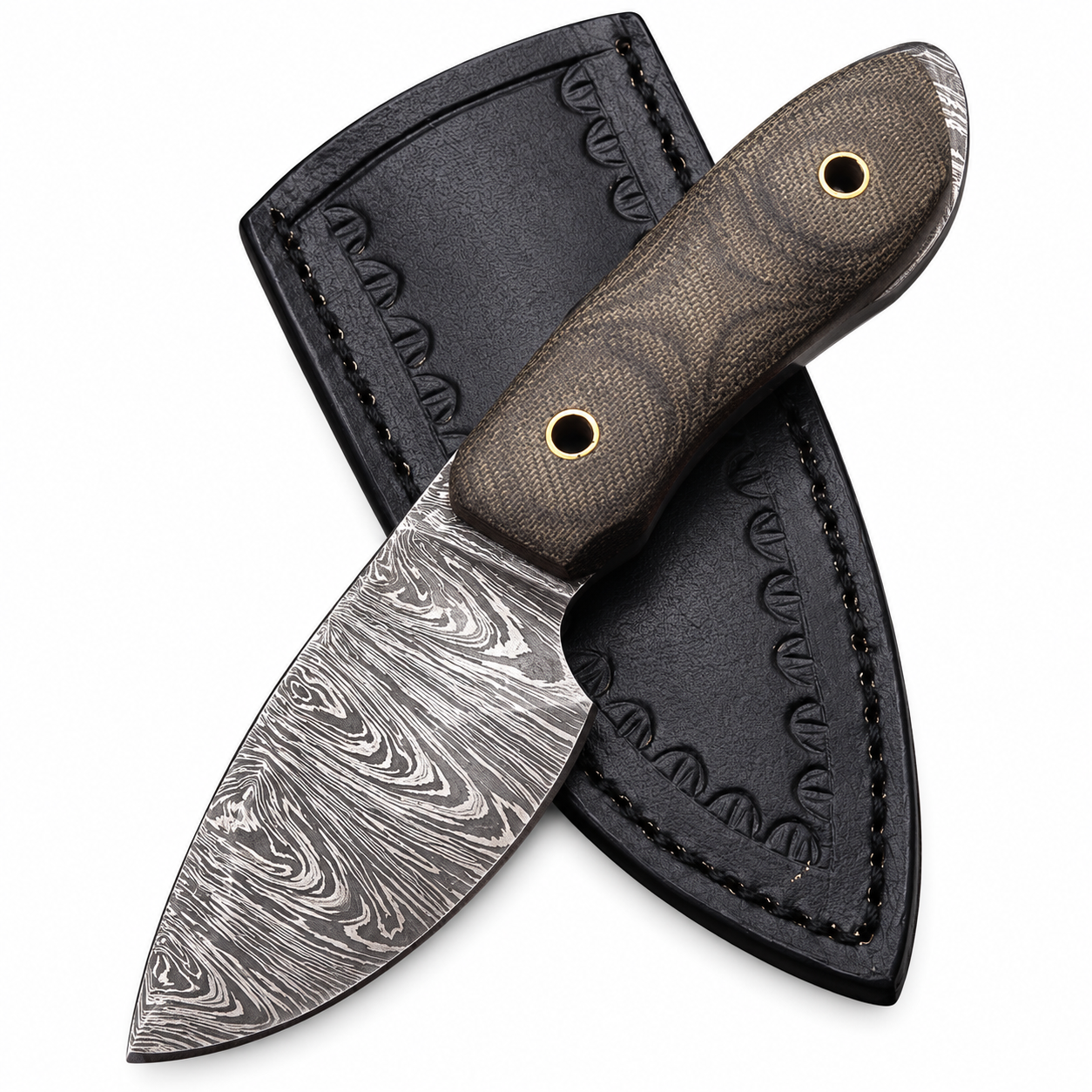
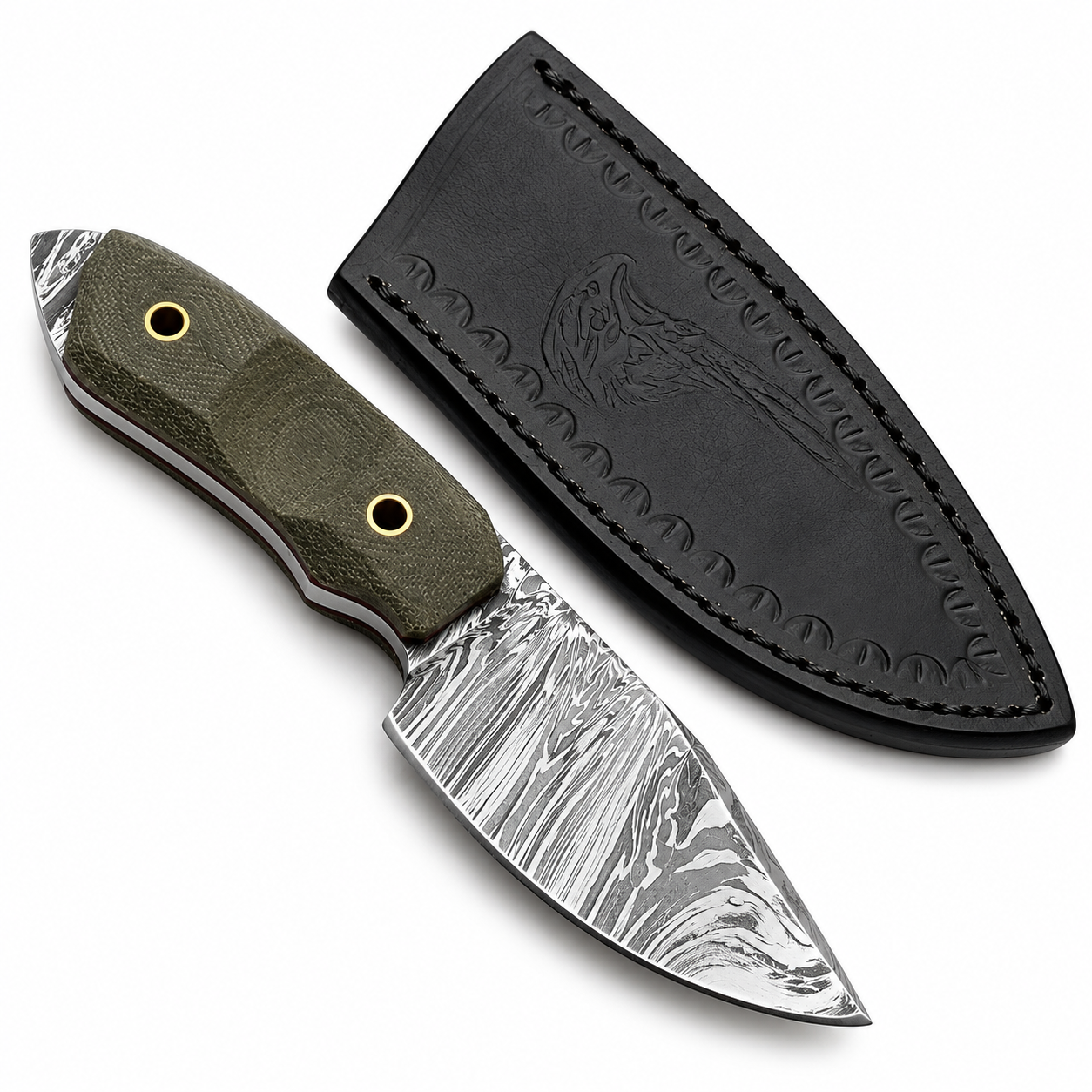
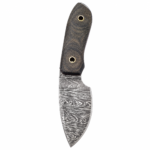
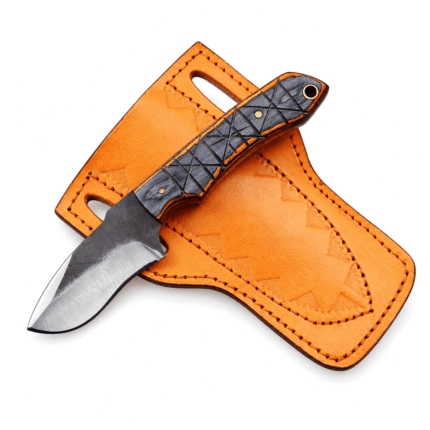
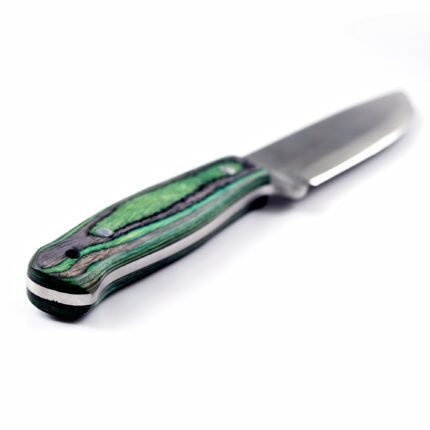
Compact Damascus Skinning Knife is a distinctive fixed-blade knife featuring a short, curved blade, intricate Damascus-style metal patterns, and a dark textured handle with two decorative gold-tone-lined openings. Its compact profile combines traditional outdoor-knife styling with a blade shape commonly associated with skinning and general utility knives.
Unlike larger hunting knives with elongated blades, this design emphasizes a smaller, broader cutting profile. The blade widens near its base and gradually curves toward a pointed tip, creating a recognizable shape.
The silver-gray blade features flowing patterns that resemble layered metal. These markings contrast with the darker handle, which displays subtle brown and charcoal-colored grain-like lines.
The result is a visually distinctive knife that may appeal to hunting-knife collectors, outdoor equipment enthusiasts, and customers who appreciate compact fixed-blade designs.
Compact Damascus Skinning Knife Design and Appearance
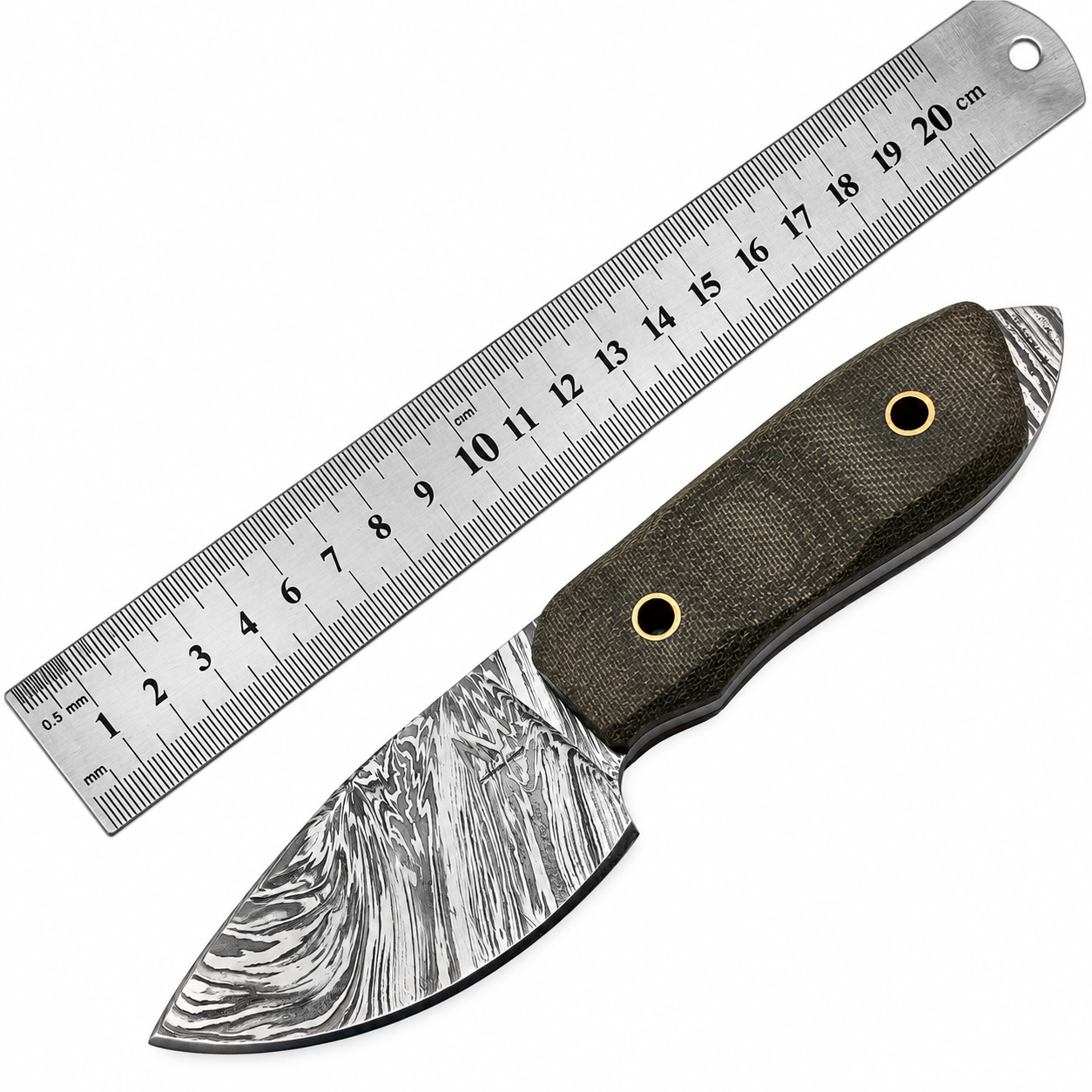
One of the most noticeable features of this knife is its compact overall silhouette.
The handle appears longer than the blade, giving the product a distinctive proportion compared with conventional hunting knives.
Its blade has a broad section near the handle and a curved cutting edge that narrows toward the tip.
This shape resembles the short skinning-style blades commonly found in outdoor knife collections.
The knife also features a small curved transition where the handle meets the blade.
The blade’s patterned surface provides contrast, while the dark handle maintains a relatively understated appearance.
Two circular fittings with gold-tone borders add small decorative details.
Together, these characteristics create a design that looks traditional without relying on unnecessary ornamentation.
For customers who prefer smaller fixed-blade knife styles, this compact shape is an important visual feature.
Beautiful Damascus-Style Blade Pattern
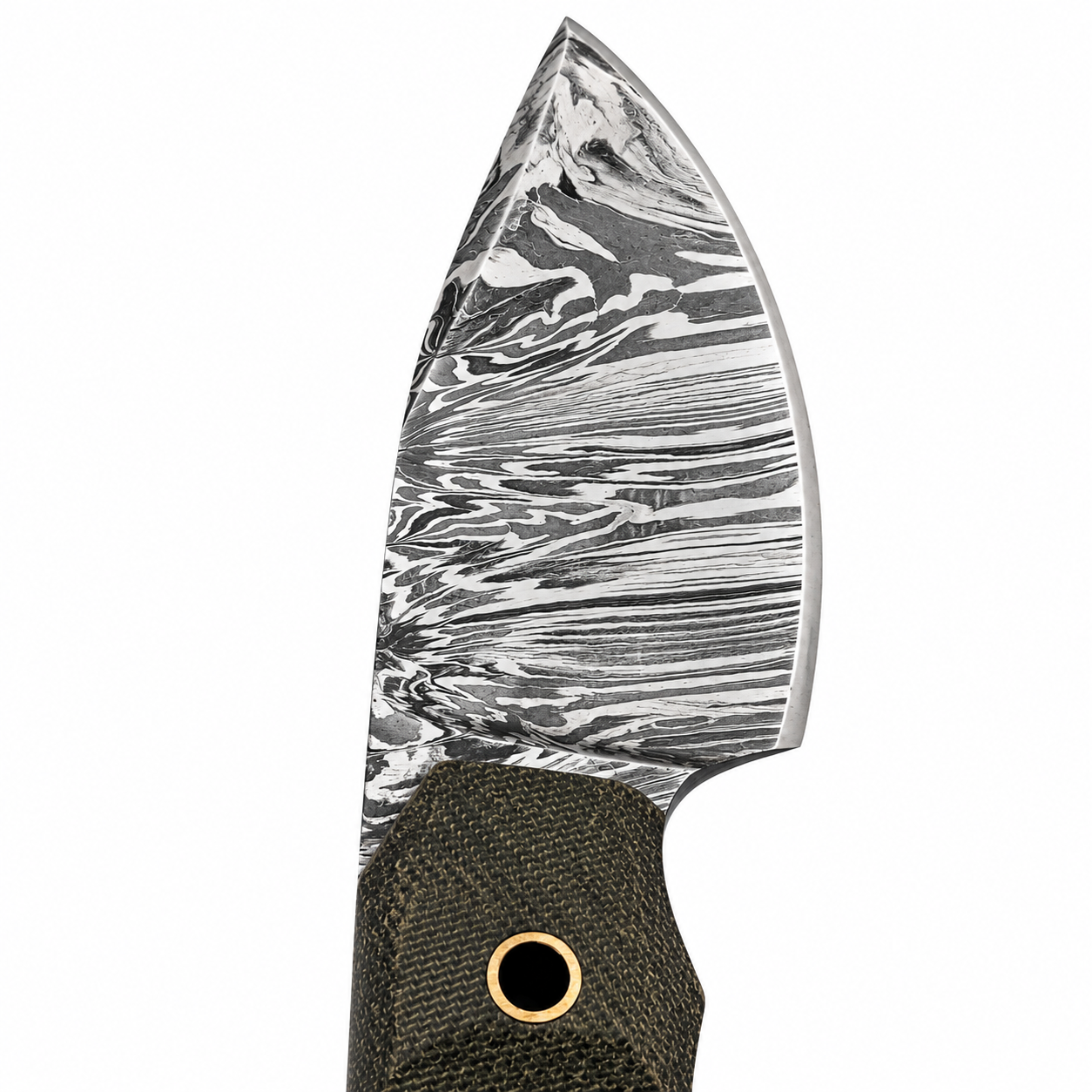
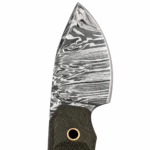
The blade displays a detailed combination of silver and darker gray lines.
These markings flow across the metal surface in irregular wave-like formations.
Some areas have closely arranged parallel lines, while others contain wider swirling patterns.
The variation creates the distinctive layered appearance commonly associated with Damascus steel.
Patterned blades are popular among collectors because their surfaces offer more visual detail than ordinary plain-finish metal.
Traditionally, pattern-welded Damascus steel is created by combining different steel alloys through specialized manufacturing processes.
The resulting layers can produce visible patterns after appropriate finishing.
However, similar appearances may also be created through other manufacturing methods.
The photograph confirms the presence of a Damascus-style pattern but does not establish the exact steel composition or production process.
Customers seeking a particular steel grade or genuine pattern-welded construction should request manufacturer documentation before purchasing.
The blade’s visible pattern remains one of its most attractive design characteristics.
Short Curved Blade Profile
This knife features a relatively short blade with a broad, curved cutting section.
The cutting edge gradually sweeps toward the tip, creating a rounded-belly shape.
This silhouette is commonly found among hunting and skinning-style knives.
It differs from long, narrow fillet knives and large Bowie-style blades.
The broad section near the handle gives the blade a distinctive appearance, while the pointed end completes its compact outline.
Knives with curved cutting edges are associated with a variety of outdoor cutting applications.
However, the performance of a particular knife depends on its actual blade geometry, sharpness, steel composition, and construction.
These properties cannot be reliably assessed from a product photograph.
For customers interested in a traditional skinning-knife profile, the visible blade shape is a useful starting point when comparing designs.
Compact Damascus Skinning Knife with Dark Textured Handle
The handle provides a strong visual contrast to the patterned blade.
Its surface appears predominantly dark charcoal and black, with subtle brown or bronze-colored grain-like markings.
These lines create a layered appearance that resembles certain textured wood or composite materials.
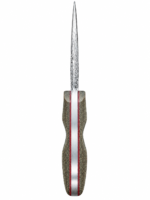
The handle has a gently curved outline, with a wider rounded section near the rear.
It narrows slightly through the middle before joining the blade.
This creates a recognizable fixed-blade knife silhouette.
The darker color also helps draw attention to the silver-gray blade pattern.
Although the handle resembles a textured composite or dark wood-grain material, the exact composition is unverified.
It should not be described as confirmed Micarta, G10, hardwood, or another specific material without supplier information.
Customers who prefer particular grip materials should check the manufacturer’s specifications.
Two Decorative Gold-Tone Handle Openings
Two circular openings are visible along the handle.
Each has a contrasting gold-tone border surrounding a darker central area.
One is positioned toward the rear of the handle, while the other sits closer to the blade.
These features give the knife a distinctive appearance compared with ordinary solid-pin handle designs.
The circular borders complement the warmer tones visible in the dark grip.
Their placement also adds a balanced decorative effect.
However, the exact purpose and construction of these openings are not confirmed.
They should not automatically be described as lanyard holes, hollow rivets, or structural fasteners unless the manufacturer verifies their function.
From a visual perspective, they are important distinguishing features of the handle.
Traditional Fixed-Blade Configuration
The photographed knife features a fixed-blade design.
Unlike folding pocket knives, its blade does not pivot into the handle.
This configuration creates a recognizable silhouette without a visible folding mechanism.
Fixed-blade knives are commonly found in hunting, camping, and outdoor utility equipment categories.
They are also popular among collectors interested in traditional knife designs.
The compact blade and longer handle give this model a slightly different appearance from larger fixed-blade hunting knives.
However, the photograph does not confirm the knife’s internal tang construction.
It is not possible to establish whether the blade extends through the full length of the handle.
This information is important for buyers evaluating construction quality and intended practical applications.
Customers should confirm tang construction through reliable manufacturer specifications.
A Compact Style for Outdoor Knife Enthusiasts
Outdoor knife designs vary considerably in size and shape.
Some feature long blades intended for specific applications, while others use shorter profiles.
This model belongs visually to the compact fixed-blade category.
Its short, curved blade resembles designs commonly associated with skinning and general outdoor utility knives.
The relatively broad blade face also provides enough surface area for its decorative metal pattern to be clearly visible.
For collectors, the compact proportions can offer variety alongside larger hunting knives.
The dark handle and metallic fittings further distinguish the knife.
Actual suitability for outdoor tasks depends on verified construction details.
Buyers planning practical use should confirm the steel grade, blade length, thickness, edge geometry, and manufacturer’s intended application.
An Attractive Addition to a Knife Collection
Knife collecting often involves appreciating variations in blade shape, decorative finishes, and handle design.
This knife combines several interesting visual features.
Its short, curved blade gives it a recognizable skinning-style appearance.
The Damascus-style metal pattern adds intricate detail.
The dark textured handle introduces contrast.
The two gold-tone circular fittings provide small decorative highlights.
Together, these elements create a compact fixed-blade knife with an individual appearance.
It may appeal to collectors who already own larger Bowie knives, hunting knives, or curved outdoor designs.
The smaller blade profile also makes it visually distinct from the longer patterned hunting knives often found in collections.
For customers interested in traditional knife craftsmanship and decorative metal patterns, this model is worth considering.
Why the Dark Handle Stands Out
Dark knife handles remain popular because of their understated appearance.
They contrast naturally with polished or patterned metal blades.
On this knife, the handle is not simply flat black.
Its surface contains subtle variations in tone and textured markings that resemble layered grain.
These details create visual depth.
The gold-tone openings add another element of contrast.
The combination of dark charcoal, muted brown, silver-gray metal, and warm metallic accents gives the knife a coordinated appearance.
For customers who prefer a more restrained color palette than brightly colored outdoor knives, this design provides an alternative.
Its handle pattern also complements the intricate markings across the blade.
A Distinctive Gift for Knife Collectors
A compact decorative knife can be an interesting gift for someone who appreciates traditional fixed-blade designs.
This model features several details that separate it from plain utility knives.
The patterned blade attracts attention immediately.
The dark textured handle creates contrast.
The two gold-tone fittings add decorative character.
These features may appeal to collectors interested in smaller hunting and outdoor knife profiles.
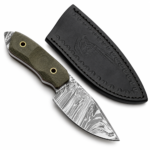
Before purchasing as a gift, customers should confirm whether the product includes a protective sheath, storage case, or presentation packaging.
No sheath or box is visible in the supplied image.
Buyers should also consider applicable local laws and the recipient’s circumstances before purchasing or gifting any fixed-blade knife.
Key Features of the Compact Damascus Skinning Knife
The uploaded image shows several recognizable characteristics.
Compact fixed-blade design: A short blade combined with a longer contoured handle.
Damascus-style blade pattern: Intricate silver-gray lines create a layered-looking metallic surface.
Curved cutting profile: A broad blade with a sweeping cutting edge and pointed tip.
Dark textured handle: Charcoal and brown grain-like markings create visual depth.
Two gold-tone circular openings: Decorative fittings distinguish the handle from more conventional designs.
Contoured grip: The handle has a gently curved shape with a rounded rear section.
Traditional hunting-knife styling: The overall silhouette resembles compact skinning and utility knives.
These characteristics are based on the supplied photograph. Exact technical details require manufacturer confirmation.
Compact Damascus Skinning Knife Specifications
Product Type: Compact Fixed-Blade Knife
Knife Style: Skinning / Outdoor Utility Knife
Blade Profile: Short, Broad, Curved Cutting Blade
Blade Appearance: Silver-Gray Damascus-Style Pattern
Handle Color: Dark Charcoal with Brown Grain-Like Markings
Handle Shape: Gently Contoured with Rounded Rear
Visible Handle Details: Two Gold-Tone-Lined Circular Openings
Primary Category: Hunting Knives
Suggested Subcategory: Skinning Knives
The manufacturer should confirm missing technical specifications before they are presented as verified product attributes.
Understanding Damascus-Patterned Blades
Damascus-style blades are known for their attractive surface patterns.
The contrasting lines can resemble flowing water, layered stone, or natural grain.
On this knife, the pattern extends across the visible blade surface.
The combination of dark and light lines gives the metal a detailed appearance.
However, a decorative pattern does not automatically establish a particular steel composition.
It also does not guarantee superior hardness, corrosion resistance, or edge retention.
Those characteristics depend on the actual steel alloy, manufacturing process, heat treatment, and edge geometry.
Customers who prioritize technical performance should request reliable manufacturer information.
For collectors, the patterned appearance may be one of the most appealing characteristics.
Knife Care and Maintenance
Proper cleaning and maintenance help preserve the appearance of a fixed-blade knife.
After appropriate use, remove dirt and moisture using a method suitable for the confirmed steel type.
Dry the blade thoroughly before storing it.
Avoid leaving moisture around the handle-to-blade junction.
Some carbon-steel blades may require additional protective oil to reduce corrosion.
Whether this applies to this knife depends on its actual steel composition.
The handle should be cleaned according to its verified material.
Avoid aggressive chemicals or abrasive treatments unless the manufacturer confirms that they are suitable.
A soft cloth is generally useful for routine exterior cleaning.
The circular handle fittings should also be kept clean and dry.
Store the knife in a secure location with suitable blade protection.
Safe Handling and Storage
This knife has a pointed blade and should be treated as a potentially sharp tool.
Keep hands away from the cutting edge during inspection and cleaning.
Use a properly fitted protective sheath or secure storage case when appropriate.
No sheath is visible in the supplied photograph, so its inclusion should be confirmed separately.
Store the knife away from children and unauthorized users.
Avoid using it for applications beyond the manufacturer’s verified intended purpose.
Follow applicable local laws concerning knife ownership, possession, transportation, and use.
What to Confirm Before Purchasing
Before purchasing a compact fixed-blade knife, buyers should check the product’s confirmed specifications.
Important details include the steel grade, blade thickness, overall length, and product weight.
The handle material and tang construction may also influence purchasing decisions.
Buyers should determine whether a protective sheath is supplied.
For collectors, decorative characteristics such as the patterned blade and textured handle may be the primary considerations.
For practical applications, construction details are especially important.
Reviewing reliable manufacturer information helps ensure that the selected knife matches the buyer’s expectations.
Why Choose This Compact Damascus Skinning Knife?
This knife combines an attractive patterned blade with a distinctive compact silhouette.
The short curved cutting profile gives it a recognizable skinning-style appearance.
The dark textured handle creates contrast without relying on bright colors.
Two gold-tone circular fittings add subtle decorative detail.
Together, these elements produce a fixed-blade design that differs from larger traditional hunting knives.
For collectors and outdoor knife enthusiasts who appreciate smaller patterned blades, this model offers an interesting combination of shape and appearance.
Explore the Compact Damascus Skinning Knife
The Compact Damascus Skinning Knife with Dark Textured Handle features a short, curved patterned blade, a gently contoured dark grip, and distinctive gold-tone circular fittings.
Its compact profile makes it visually different from larger Bowie and hunting knives.
Whether you are exploring traditional skinning-knife designs or adding another decorative fixed-blade model to your collection, this knife is worth considering.
Review the confirmed specifications, materials, and available accessories before purchasing to determine whether it meets your requirements.





Reviews
There are no reviews yet.