







Curved Blade Hunting Knife – The Art of Traditional Craftsmanship and Unique Design
A hunting knife can be prized for several features – such as the geometry of the blade, the overall profile, the intricacies of the decorative craftsmanship, the harmony between the handle and the cutting edge. Some knives emphasize a minimalist approach, whereas others try to draw attention to their unique shape and multiple details.
The curved blade hunting knife with decorative wooden handle falls under the latter category.
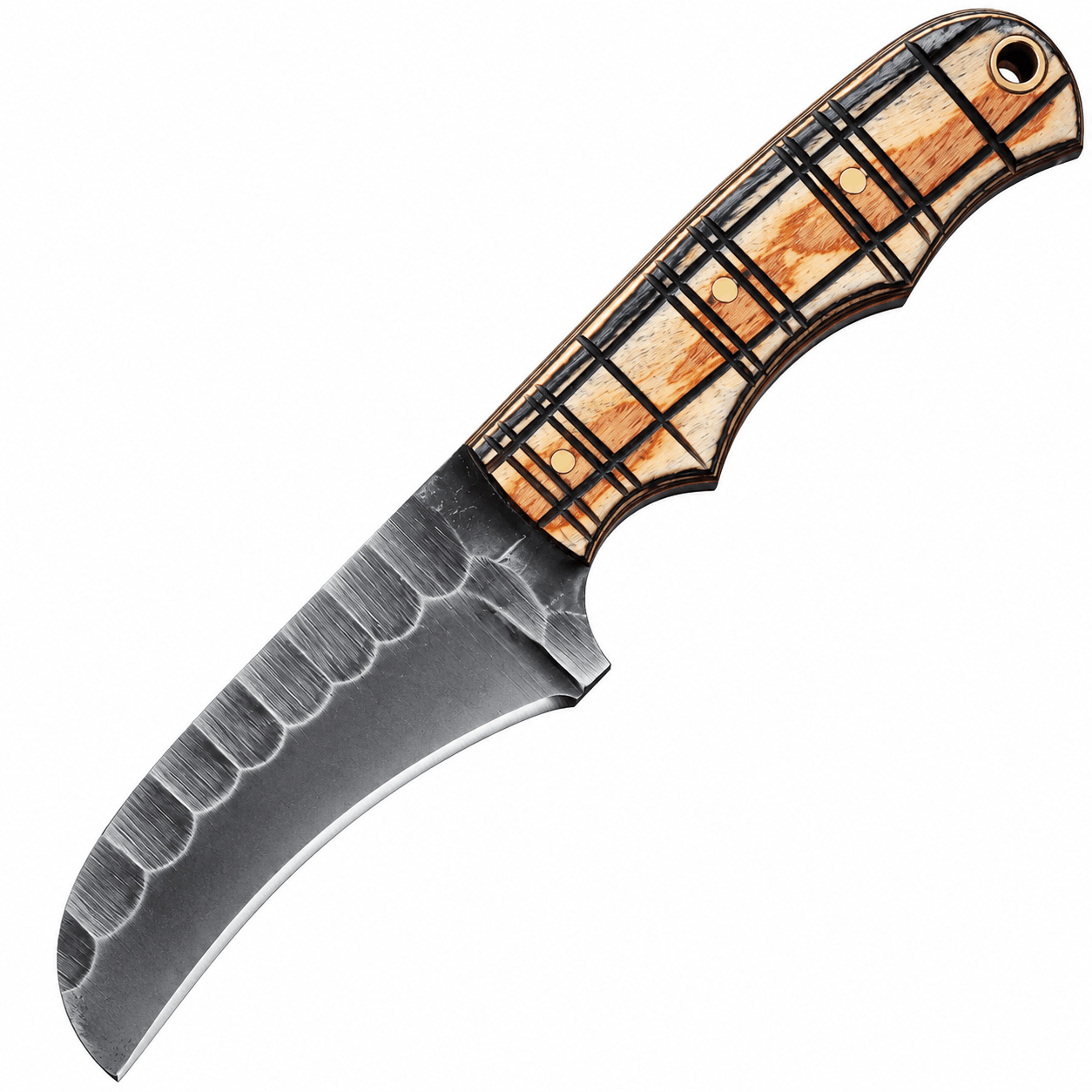
This distinctive fixed blade knife features a deeply curved steel blade and a detailed cream-and-brown handle. The product’s visuals combine the traditional features of an outdoor knife with added decorative elements that endow it with a unique appearance.
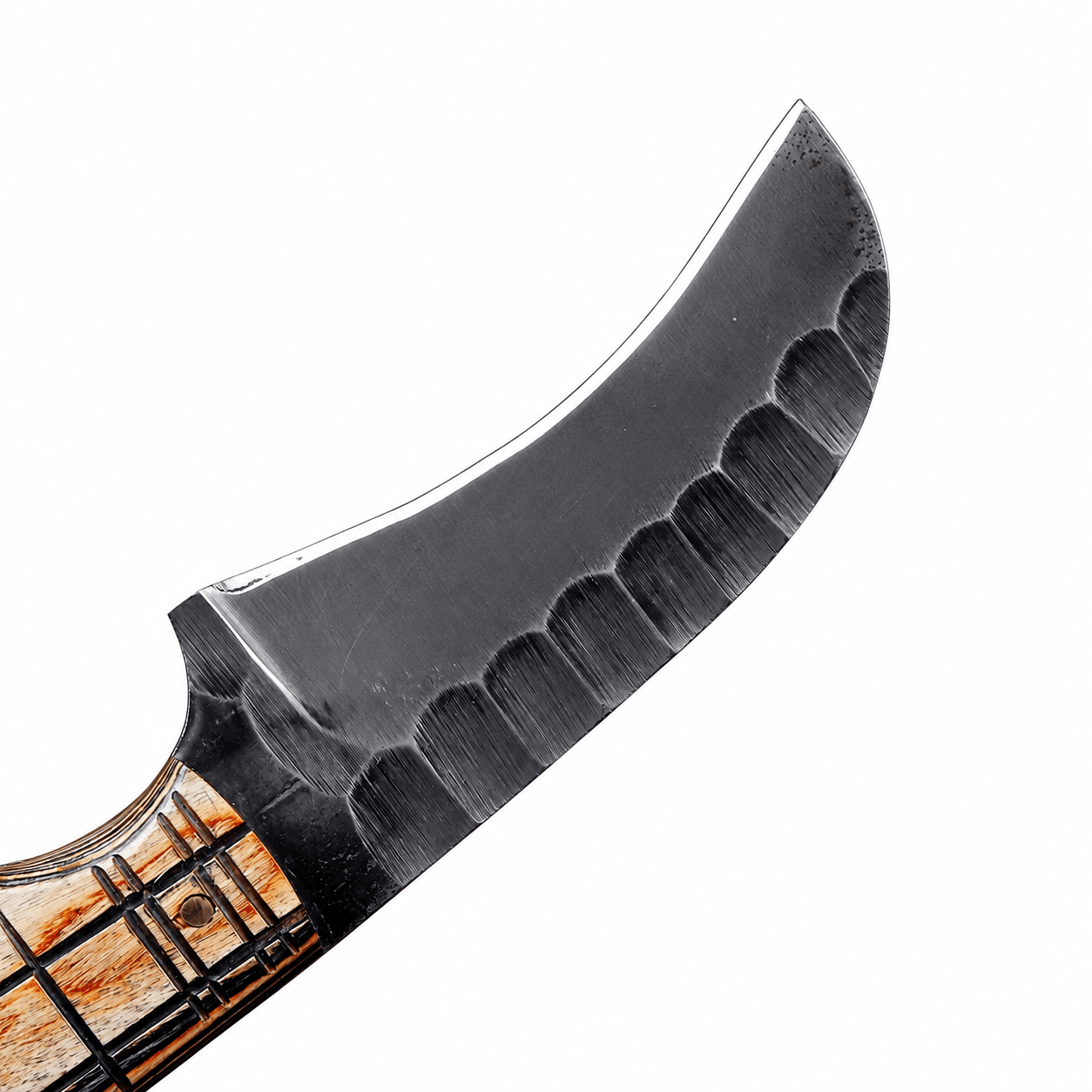
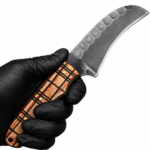
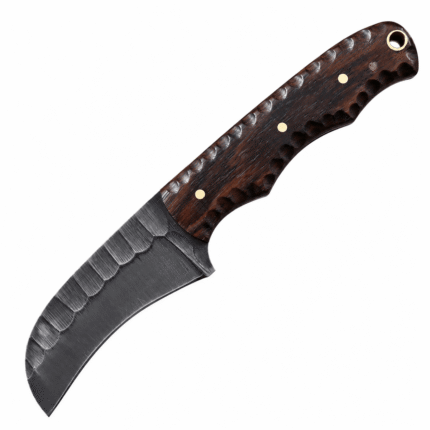
The blade takes a deep curve and extends outwards from the handle to take the tip. The dark grey blade has a brushed metallic appearance and a repeated pattern of brighter grinding marks.
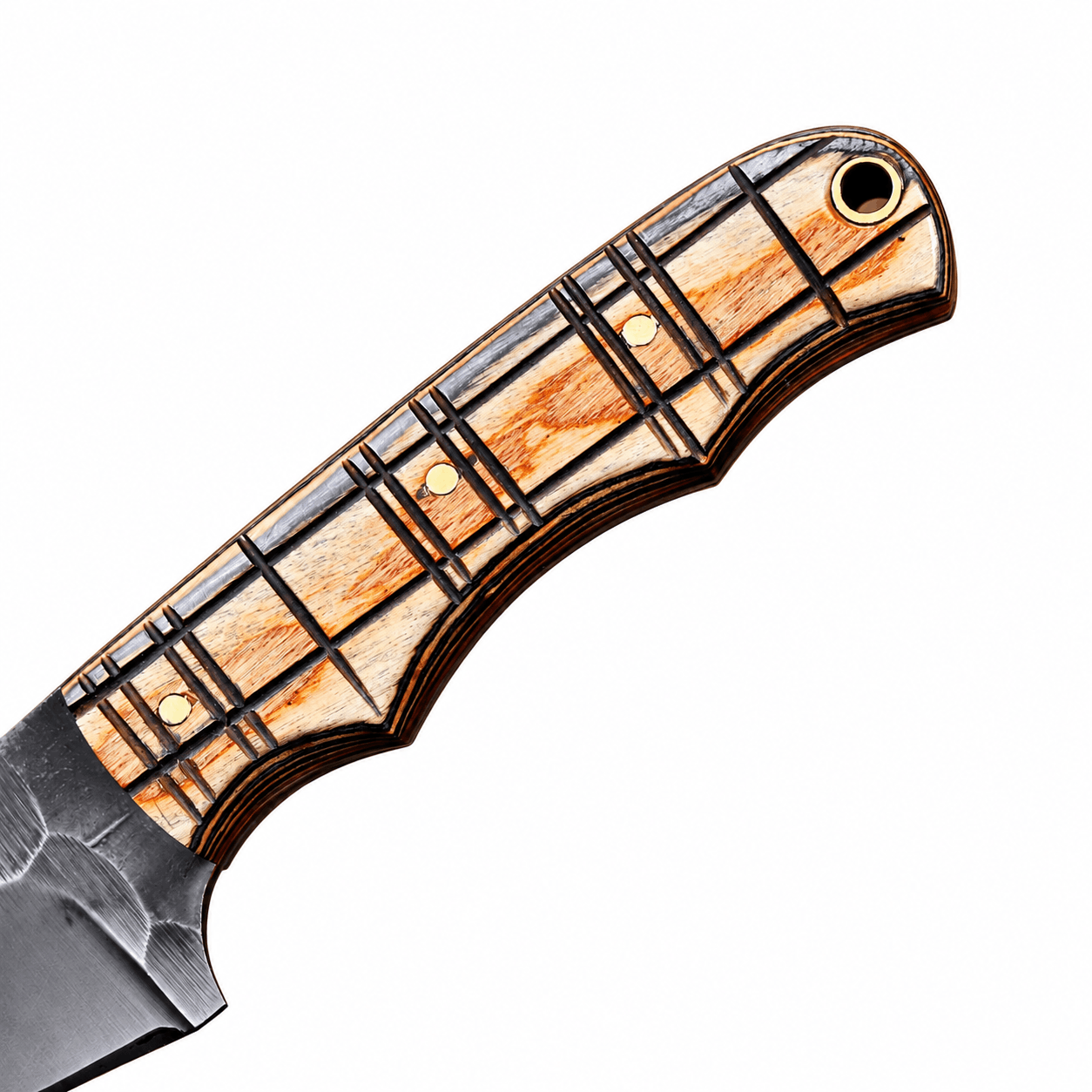
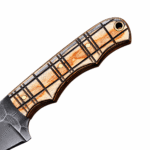
Meanwhile, the handle has warm orange-brown grain effects and a combination of pale cream areas and dark geometric lines. Three brass-colored pins provide traditional metallic accents, while a large circular lanyard hole completes the design.
This combination makes for a unique fixed blade knife that could appeal to collectors of unique decorative outdoor products and those looking for an unusual curved blade hunting knife.
Unique Approach to the Design of a Hunting Knife
Traditional outdoor knives could be found in a variety of shapes and sizes.
Some feature straight cutting edges, whereas others use gently curved drop point designs. A number of manufacturers also incorporate highly curved blades into their products.
The knife depicted above makes use of a uniquely deep sweeping blade.
It takes a distinctive shape that is vastly removed from the image of an average hunting knife.
The blade’s overall impression also provides a visual connection to a number of curved cutting-edge tools.
The handle provides a visual contrast to the deeply curved blade, featuring a combination of warm colors and intricate detailing.
It makes use of contrasting light and dark areas to create a sense of depth.
The overall impression of this knife is one of a carefully balanced blend of the traditional features of the well-known outdoor knife combined with unique decorative additions.
It must also be noted that a knife’s visual appeal should not be confused with its actual performance characteristics.
Its overall capabilities will be defined by the steel type and treatment, construction, size, and the intended use.
Deeply Curved Steel Blade Profile
The most distinctive feature of this curved blade hunting knife is the deeply curved blade.
The blade takes a large arc outwards before tapering to a point.
It provides a striking visual contrast to the relatively long handle portion.
The exaggerated curve of the blade
Unlike many blades that take a gentle curve only along the belly portion, this knife makes use of a substantially deeper arc.
It should also be noted that this type of geometry will affect the angle along the length of the cutting edge.
Its application in terms of specific tasks will depend on the manufacturer’s recommendations.
The width of the blade surface
The blade takes a relatively wide metallic surface.
It provides a good area for the inclusion of the repeated pattern of bright grinding marks, which provide a distinctive appearance to the knife.
Its visual weight is also substantial in comparison to the handle portion.
Defined blade tip
The blade narrows to a clearly defined point.
The unique shape of the blade contributes to the distinctive appearance of the knife.
It should also be noted that users should take the geometry and position of the blade tip into account when considering the potential methods of use.
Traditional inspiration
Deeply curved blades could be found in a number of traditional cutting tools.
The specific category that this product falls under should be defined by the manufacturer’s specifications.
In terms of search engine optimization and the general organization of the marketplace, it could be described as a curved hunting-style or specialty fixed blade knife.
Dark Forged-Style Blade Finish
The blade of this curved hunting knife takes a dark charcoal-gray metallic appearance.
It should also be noted that it is not a uniformly polished surface.
Subtle variations in the surface texture and color depth create a textured appearance.
It adds to the impression of a traditional craftsmanship-inspired design.
The blade has fine directional lines on some surfaces, giving it the appearance of a brushed or ground steel surface.
It creates subtle highlights along the dark blade surface.
Scalloped decorative grind marks
A series of curved, brighter markings appear along part of the blade.
Their shape resembles a number of scalloped decorative finishing marks.
They add to the overall visual appeal and highlight the distinct geometry of the blade.
It should also be noted that they cannot be considered serrations or a specific type of metallurgical treatment, unless specified by the manufacturer.
Dark steel character
The dark appearance of the blade provides a good contrast to the light wooden-style handle.
It also gives the knife a distinct traditional outdoor appearance.
The specifics of the blade coating and the steel type should be confirmed by the manufacturer.
Decorative Cream and Brown Handle
The handle is also a distinctive feature of the knife.
It has a striking combination of cream, tan, orange-brown, and black tones.
The light areas have markings that resemble wood grain, whereas the dark sections create a bold decorative framework.
The warm brown grain patterns
The orange-brown streaks extend along some areas of the handle.
They create a natural appearance.
Their warm tone also provides a good contrast to the dark blade.
Cream-colored handle sections
The pale cream and beige areas occupy much of the visible handle surface.
They accentuate the dark sections, creating a bold appearance that combines well with the steel blade.
Dark decorative borders
The black lines follow some sections along the outline of the handle.
They create a clear border around some of the handle’s sections, defining them.
Material identification
It should also be noted that the appearance of the handle is only indicative of the material.
The actual composition cannot be confirmed solely on the photograph.
It could be made from natural wood or stabilized or laminated material.
The specific requirements and characteristics of this material should be confirmed by the manufacturer prior to publishing any information.
Intricate Geometric Handle Inlays
One of the most distinctive aspects of this knife is the combination of intricate dark markings that extend along the handle.
The lines take a number of directions, intersecting at some points and outlining a number of geometric shapes.
Some follow a diagonal direction, whereas others are placed at different angles.
The intersecting black lines
The black lines create a sense of contrast to the pale central area of the handle.
Their intricate nature is especially evident along the middle and upper sections of the handle.
Balanced decorative composition
The overall pattern takes an intricate yet balanced approach to the design of the handle.
It spans a number of sections along the blade rather than following a single area.
It should also be noted that the repetitive use of lines in a similar fashion creates a connection between different parts of the handle.
Collectible appeal
Collectors often appreciate the intricate nature of unusual patterns.
The unique approach to the detailing of this knife could make it a distinctive addition to a collector‘s display.
It should also be noted that this approach to the handle’s design provides a greater visual appeal than many simpler single-color wooden handles.
Ergonomically Contoured Handle Appearance
The handle takes a gently curved appearance.
It also tapers at certain points to create a contoured grip profile.
The rounded upper end and the shaped junction with the blade contribute to the overall impression.
Natural-looking grip curve
The handle extends along a smoothly curved surface.
It provides the knife with a gently flowing appearance.
Its overall shape also follows the directional flow of the deeply curved blade.
Rounded handle end
The upper end of the handle is rounded and features the lanyard hole.
It completes the formation of a smoothly curved upper profile.
Shaped lower grip area
The lower portion of the handle also takes a slightly recessed shape.
It creates a more defined appearance of the lower grip area.
Grip considerations
It should also be noted that the grip qualities of the handle will depend on the size and shape, the material and its tactile impression, as well as the user’s individual hand size and shape.
The image above also serves as a good reference to the general shape of the handle.
However, it cannot be relied upon to provide information on the general ergonomics of the product.
This information should be supplied by the manufacturer.
Three Brass-Colored Handle Pins
The blade has three circular metallic pins along the grip area.
Their warm golden tone blends well with the orange-brown handle sections.
The pins are placed at different intervals along the blade.
This creates a traditional appearance to the design of the knife.
The use of metallic details is common to many knife-making traditions.
The role of the pins
It should also be noted that metal pins are often used in the construction of fixed blade knives to provide a secure connection between different sections of the handle.
The actual construction details of this model should be confirmed by the manufacturer.
The pins should also be referred to as brass-colored, unless the composition has been specified.
Their understated appearance provides a good balance to the more elaborate black geometric lines along the handle.
Metal-Lined Lanyard Hole
A large circular hole is located near the end of the handle.
Its perimeter is formed by a metallic ring with a warm golden finish.
It is a traditional detail for many outdoor knives and can be used to secure a lanyard for additional safety and organizational purposes.
Organizational considerations
A compatible lanyard may help keep the tool secured and organized.
It should also be noted that it should not be relied upon to provide a safe carry solution.
The lanyard should only be used as a secondary measure of security.
Consistent decorative theme
The appearance of the metallic ring matches the general tone of the pins.
This contributes to the general traditional appearance of the knife.
Fixed Blade Construction
This product utilizes a fixed blade construction.
The blade does not open and close in a pocket knife fashion.
The simplicity of the mechanism is in stark contrast to the complexity of the handle detailing.
The absence of a folding mechanism
It should also be noted that this type of construction does not utilize any folding mechanisms or deployment tools.
Its mechanism is virtually non-existent, as the blade remains in a fixed position relative to the handle.
Blade surfaces
The surfaces of the blade are easily accessible and can be cleaned.
It should also be noted that this construction type provides better protection to the blade from accidental damage.
The verification of the construction
It should be noted that the image above cannot be used to confirm the tang type of this knife.
A claim of full-tang construction should be supported by the manufacturer’s documentation.
The structural integrity of the knife also depends on the steel type, blade thickness, heat treatment, and the overall quality of construction.
Understanding Curved Hunting Knife Geometry
The geometry of the blade has a considerable impact on the characteristics of a knife.
Straight and curved blades will have fundamentally different contact surfaces with the material being worked.
This particular hunting knife has an unusually deep curve of the blade.
The implications of this approach to the design of the knife should be carefully considered.
Contact surface
The angle of the blade’s cutting edge will vary along the arc of the blade.
This will determine the mechanics of interaction with the material being worked.
Blade width
Along with the depth of the curve, the width of the blade will play a role in the overall characteristics.
The actual thickness and the dimensions should be reviewed to determine the potential applications of this knife.
Location of the tip
The location of the blade tip follows the end of the deep curve.
It should also be noted that this location is substantially different to the placement of the tip in many conventional drop point knives.
Manufacturer specifications
It should also be noted that the intended applications of this knife should be defined by the manufacturer’s specifications.
A blade with an unusually deep curve cannot be considered a universal alternative to a straight-edged utility knife.
Traditional Craftsmanship-Inspired Aesthetics
The unique appearance of the knife is inspired by the traditional aesthetics of hand-forged, hand-finished knives.
The combination of the dark steel and the pale wooden handle, the black geometric inlays and the warm brass-colored pins create a harmonious blend of traditional decorative details.
It should also be noted that the visual appeal of this knife cannot be used to determine whether it is actually forged or hand finished by skilled artisans.
The claims of custom forging or hand-finishing should be verified by the manufacturer prior to publishing any information.
A Unique Addition to Outdoor Knife Collections
The appeal of knives often depends on the reason for purchase.
Some are drawn to the specifics of the steel and its workability, whereas others may appreciate the distinctive nature of the shape and the materials.
The curved blade hunting knife may appeal to the latter group of buyers.
Its overall profile is substantially different to many other hunting knives, due to the exaggerated curve of the blade.
The intricately decorated wooden handle also makes this product stand out from many other fixed blade knives.
This combination of distinctive design elements creates a knife that can become a unique addition to a collector‘s display.
For those who already have a number of conventional hunting knives, the subtly unusual silhouette of this knife may provide an interesting alternative.
The documentation provided by the manufacturer could also prove invaluable in confirming the specifics of the materials and the production process.
The Appeal of Wood-Grain Knife Handles
Wooden and wood-style knife handles have long been associated with the traditional aesthetics of many knives.
The natural appearance of grain patterns in a variety of colors complements the metallic surfaces of a knife.
The variation of these patterns creates an opportunity for a degree of variety between different products.
The handle depicted above has a particularly detailed appearance.
Rather than a uniform presentation of the grain patterns, it makes use of a blend of light surfaces and streaks of orange-brown color.
The inclusion of dark intersecting lines creates another layer of visual appeal to the handle.
The appearance of this handle may appeal to many customers, who wish to appreciate the traditional materials in a format that highlights their intricate detailing.
Evaluating Blade Steel Quality
The overall performance characteristics of a knife depend to a large extent on the steel.
The steel quality, heat treatment, and blade geometry all contribute to the overall performance.
It is important to carefully evaluate these factors when considering potential applications of a knife.
The dark appearance of this blade cannot be taken as an indication of its qualities.
It should also be noted that there are a number of factors that should be taken into account when considering the steel for a particular application.
Retention of edge
The ability of a blade to maintain a sharp edge depends on the steel, the heat treatment, geometry, and the intended applications.
Toughness
It should also be noted that different steels have different degrees of toughness.
This characteristic is also affected by the manufacturing process.
Corrosion resistance
The resistance to corrosion varies between different steels.
A dark appearance does not necessarily indicate corrosion resistance.
Sharpening considerations
Different steels and blade geometries will require different approaches to maintenance.
It should also be noted that the substantially curved blade geometry may require specialized sharpening equipment.
Handle Material Considerations
Decorative knife handles could be made from a number of materials.
Natural wood, stabilized wood, composite laminates, and synthetic materials all present different characteristics.
Natural wood
Natural hardwood trees provide a variety of colors and patterns.
The care instructions depend on the specific type of wood and its finish.
Stabilized wood
Stabilized wood undergoes a special treatment that modifies some of its characteristics.
It can also be used to create items that imitate the appearance of natural wood.
Laminated materials
Layered materials can vary greatly in terms of pattern and color.
Synthetic composites
Composite materials can present a variety of decorative appearances.
This depends on the specific formulation and its intended application.
The actual material of the handle should be determined by referring to the manufacturer’s documentation.
Practical Considerations for Outdoor Use
Fixed blade knives can be used for a number of ordinary utility tasks.
However, it should be noted that the suitability of a strongly curved knife depends on its intended purpose.
Outdoor equipment
The knife can be a part of an outdoor equipment collection.
It should also be noted that the selection should be driven by the specific requirements of the owner.
Everyday utility cutting
Some knives are suitable for cutting various materials and breaking down lightweight objects.
The unusual geometry of this model should be taken into account when considering this type of application.
Camping accessories
It should also be noted that many outdoor enthusiasts appreciate unique accessories.
Practical application should be dictated by the manufacturer’s recommendations.
Collector display
The decorative qualities of this knife make it a potential candidate for display as a collectible.
It should also be noted that the display should also provide a reliable form of protection for the edge of the blade.
The Importance of a Proper Protective Sheath
A fixed blade knife always requires proper protection.
Unlike a folding knife, a fixed blade knife has an exposed edge whenever it is not sheathed.
A proper sheath is required to ensure the safety of the user.
It should also be noted that it may also protect the blade from accidental abrasions against other pieces of equipment.
Since this knife has an unusually curved profile, it is essential to ensure a proper fit of the sheath.
A standard straight-blade sheath will not be appropriate for this type of blade geometry.
The manufacturer must confirm whether an appropriate sheath is included with the product.
The specifics of the sheath material, fit, and attachment method should also be described in detail.
Comparing Conventional and Curved Blade Designs
Many conventional knives utilize drop point or clip point geometries.
Both of these designs have distinctive appearances that are easily recognized.
They also have relatively straightforward placement of the blade tip.
Curved blade knives could look and behave very differently.
This particular model makes use of a substantially deeply curved blade shape.
Its appearance is distinctly different to many conventional designs.
However, it should also be noted that unconventional blade shapes are not always appropriate for every application.
The intended purpose, size specifications, and the manufacturer’s recommendations should all be taken into account when selecting a knife.
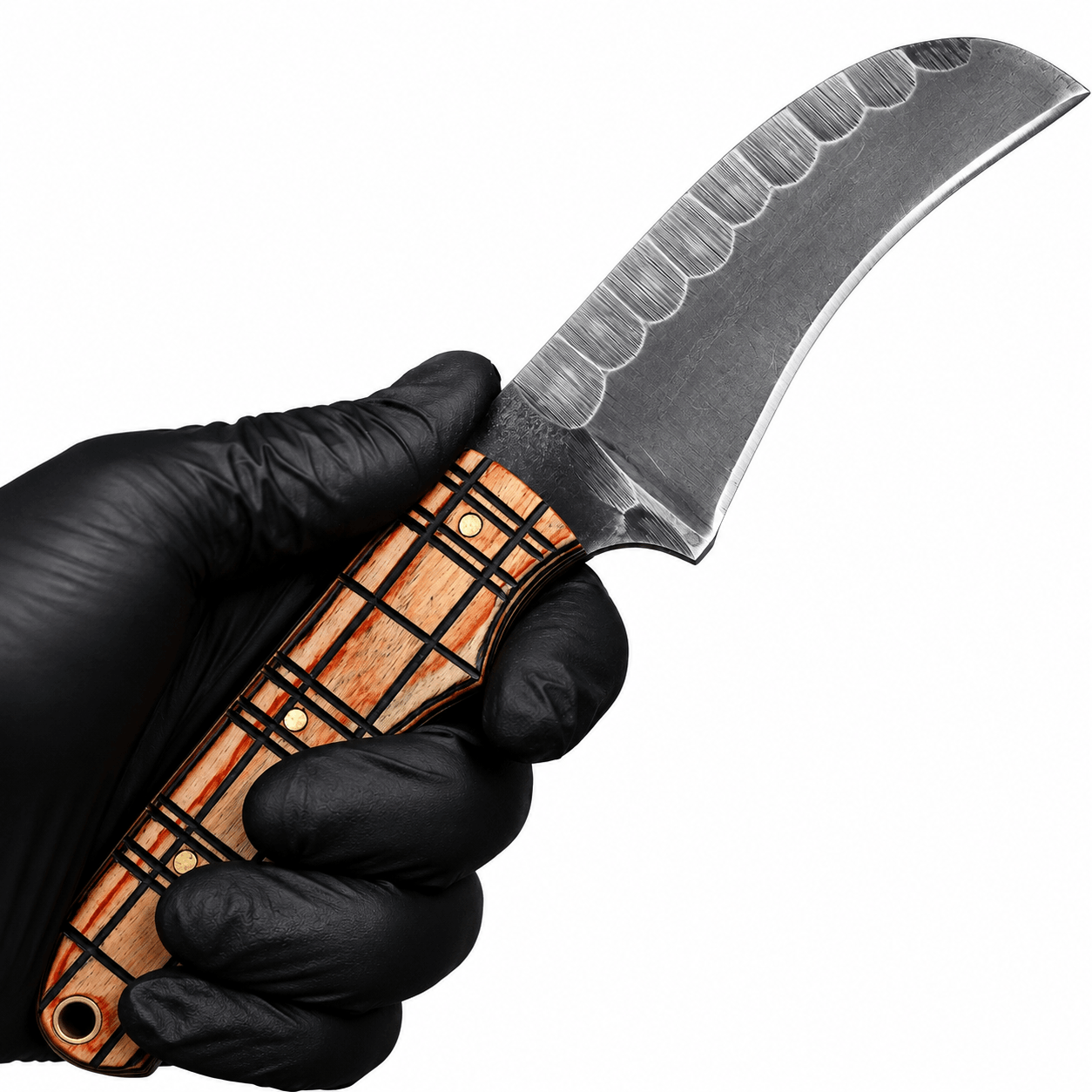
The main advantage of this model (as seen in the image above) lies in the combination of distinctive design elements.
Any claims of specific performance advantages should be supported by testing.
Product Presentation for Ecommerce
A product listing must include relevant photographs and specifications.
This particular knife can benefit greatly from a white background to emphasize the dark steel of the blade.
The pale wooden-style handle also blends well with the white background, with the warm orange-brown streaks adding to the appeal of the product.
The close-up view can highlight the intricate black inlay details and the inclusion of metallic pins and the lanyard hole.
It should also be noted that the opposite side of the knife, the details of the blade thickness, the overall profile of the handle, and the presence of a sheath (if present) should also be captured in photographs.
An accurate presentation helps the buyer to form a reliable impression of the product. It also aids in optimizing the presentation for search engines. Image filenames and alt text can also be optimized for better visibility and relevance in image searches.
Care and Maintenance
Proper care and maintenance will prolong the lifespan of both the blade and the handle.
Cleaning the blade
After appropriate use, remove any dirt or residue from the blade.
It should also be noted that the cleaning products should be compatible with the confirmed steel type and surface treatment.
Drying the blade
Make sure the blade is free of excess moisture.
Particular attention should be paid to the junction with the handle.
Sharpening the blade
Maintain the sharp edge of the blade in accordance with the specifications.
Consider professional sharpening, especially in the case of the pronounced curvature of the blade.
Care for the handle
Avoid exposing the handle to harsh chemicals and excessive moisture (especially prior to confirming the material properties).
Secure storage
Store the knife in a secure sheath or storage system, out of the reach of children and unauthorized users.
How to Choose a Quality Curved Hunting Knife
There are several factors that should be considered by a buyer interested in purchasing a quality curved hunting knife.
Blade geometry
Understand the characteristics of a curved blade.
Steel grade
Confirm the characteristics specified by the manufacturer.
Heat treatment
Review the production details, if available.
Handle material
Identify the material used for the handle.
Tang construction
Verify the construction details.
Dimensions
Consider the overall size and weight.
Sheath compatibility
Confirm the protective storage solution.
Intended use
Follow the manufacturer’s recommendations.
These factors will help the customer to make an informed choice.
Collectible Gift Considerations
A unique model may appeal to many responsible adult knife collectors.
This particular model has a blade that takes a deeply curved shape and a decorated wooden handle.
Its black geometric lines and warm wood grain tones set it apart from many other knives with a similar appearance.
When considering a knife as a gift, it is essential to keep in mind the relevant laws, the age of the recipient, and the principles of secure storage.
Any engraving, personalization, or presentation packaging should also be confirmed with the supplier.






Reviews
There are no reviews yet.