





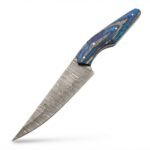


Blue Handle Trailing Point Knife with a Flowing Blade Pattern
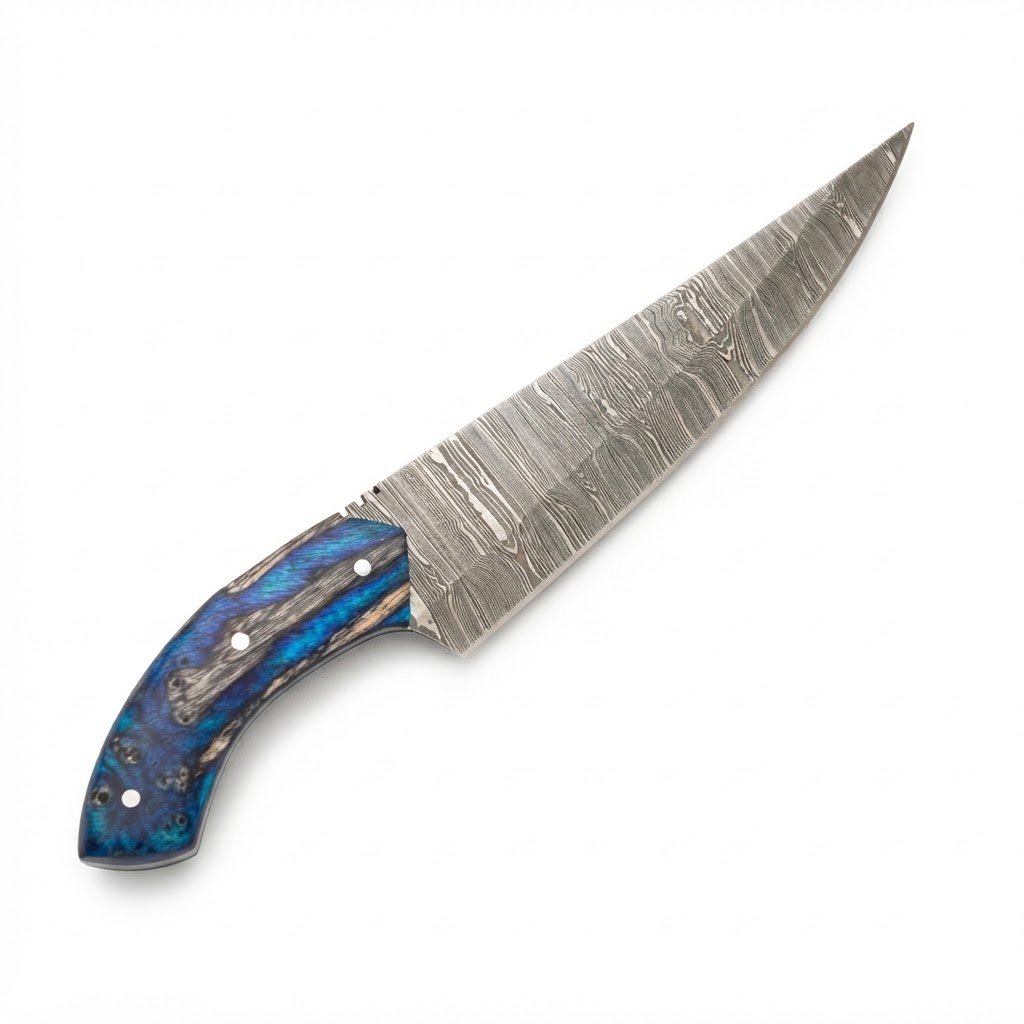
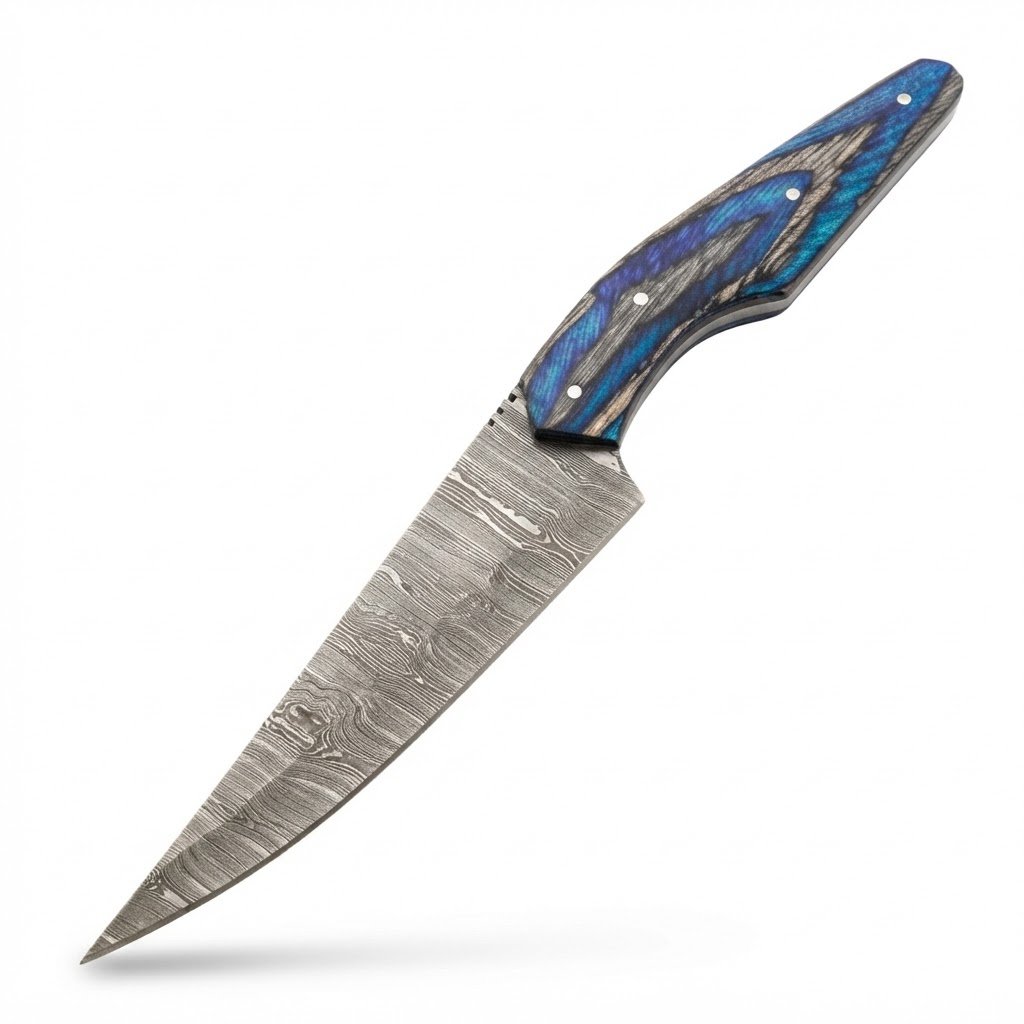
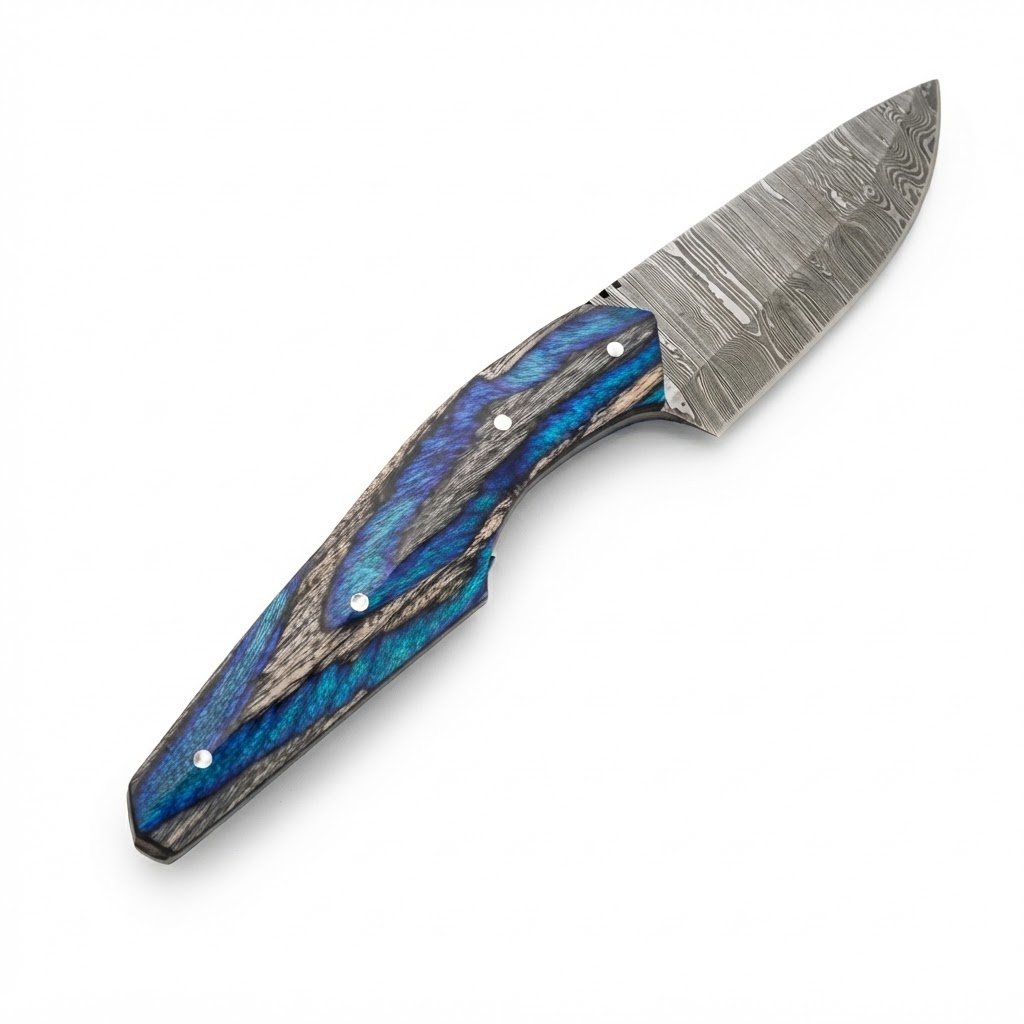
This blue handle trailing point knife combines a slender, upswept blade with a curved handle featuring blue, turquoise, charcoal, and gray grain-like markings. Four silver-tone pins run along the visible handle face, adding simple accents to its flowing colors. The blade carries fine gray patterns that give the knife a coordinated appearance from the tip to the rear of the grip.
A black stitched sheath is pictured beneath the knife. Its understated surface provides a dark background for the brighter handle and patterned blade, allowing both to stand out clearly. Decorative scalloped impressions follow part of the sheath’s border, adding detail without competing with the knife’s more prominent colors.
The overall design is elongated and gently curved. The handle narrows near the blade, while the blade gradually tapers toward a raised point. This creates a continuous outline with a different character from a broad drop-point knife or a straight-edged utility blade.
For customers who appreciate patterned blades and colorful handles, the photograph offers plenty to examine. The visible design is described here without assigning an unverified steel grade, manufacturing process, or performance rating. Those specifications should be considered alongside the appearance when deciding whether the knife suits a particular purpose.
A Slender Blade with an Upswept Point
The blade begins with a relatively broad heel and becomes progressively narrower toward the tip. Its forward section rises into a pronounced point, giving it the trailing-point appearance used in the product name. The sweep is one of the clearest features of the knife’s silhouette.
This profile makes the blade look elongated and fine toward the front. It is visually different from the squared end of a cleaver, the angular tip of a tanto-style blade, or the more central point of many general-purpose knives. Customers comparing blade shapes can use that distinction to narrow their preferences.
The photograph does not establish the blade’s thickness or how much it tapers when viewed from above. Those measurements influence how a knife behaves, and two blades with similar side profiles may feel quite different in use. The slender appearance should therefore not be treated as proof of flexibility.
The point and edge can be assessed visually, but practical suitability requires more information. Customers looking for a dedicated filleting, carving, or other specialist knife should confirm that the manufacturer supports that use for this exact model before relying on the shape alone.
Fine Gray Lines Across the Blade
Light and dark lines cover much of the visible blade face. Some run in closely spaced bands, while others bend around elongated loops and irregular enclosed shapes. Their direction changes along the blade, producing a flowing appearance rather than a repeated printed-looking motif.
Near the heel, several brighter lines stand out against the medium-gray background. Farther toward the tip, the pattern becomes finer in the photograph as the blade narrows. These changes give the surface visual depth and make different sections interesting to examine.
The appearance resembles patterns commonly associated with Damascus-style knives. However, a photograph cannot establish pattern-welded construction, steel composition, or layer count. “Gray patterned blade” accurately describes what is visible without presenting those unverified details as facts.
For someone choosing a knife partly for its appearance, the pattern is a major feature. For someone prioritizing cutting performance, material and heat-treatment information remain separate considerations. The design can be appreciated on its own while the practical specification is checked against the buyer’s needs.
A Plain Edge and Defined Heel
The visible cutting edge is continuous and appears plain rather than serrated. It follows the blade’s gradual sweep toward the raised point. This uninterrupted outline contributes to the knife’s slender appearance and distinguishes it from models with saw-like teeth along part of the edge.
At the handle end, the blade has a defined heel that projects below the front of the grip. The change in height creates a clear transition between the working section and the handle. A small bright area is also visible at the junction, though its precise construction is not established.
The photograph cannot show the exact sharpening angle or confirm the blade’s factory sharpness. It also provides only one face, so the full grind geometry cannot be assessed. Those details should come from reliable specifications or an inspection of the actual knife.
For customers comparing products online, the confirmed information is the plain edge, shaped heel, and rising tip. These are useful design characteristics. Claims about precision, effortless cutting, exceptional sharpness, or edge retention would need evidence beyond the supplied image.
Blue and Turquoise Handle Color
The handle brings the strongest color to the design. Bright blue and turquoise areas run through darker charcoal and gray sections, creating a grain-like pattern along the grip. The colors follow irregular paths rather than forming neat blocks or straight stripes.
Some parts appear more vivid blue, while others lean toward teal or turquoise. These shifts add variation without introducing a large number of unrelated colors. The darker sections connect visually with the gray blade and black sheath, keeping the overall presentation consistent.
The grain-like appearance does not confirm wood, laminated wood, stabilized wood, resin, or another material. Similar visual effects can occur in different handle constructions. The accurate description is a blue-and-gray patterned handle until the actual material is documented.
For shoppers who prefer colorful handles, this arrangement offers a more varied look than a single solid shade. It may also appeal to customers who enjoy the appearance of flowing grain but want a cooler color palette. The image shows that aesthetic clearly without requiring assumptions about its manufacture.
Four Silver-Tone Handle Pins
Four round silver-tone pins are visible along the handle face. One is positioned near the rear, two sit through the main grip area, and another is close to the blade junction. Their placement follows the length of the handle and complements its elongated shape.
The pins are simple and relatively small. They add bright points of detail without interrupting the blue and gray pattern. Their silver-colored appearance also relates naturally to the lighter markings on the blade.
The photograph does not establish the pins’ alloy or the complete method used to secure the handle. Their appearance should not be used to promise stainless steel, a particular fastening system, or a tested level of strength. What is clear is the four-pin arrangement on the visible side.
Customers who care about assembly details may find additional close-up photographs helpful. The opposite face, handle edges, and blade junction would provide more context. The supplied view already gives a good indication of the pin layout and its role in the overall design.
A Curved, Tapered Handle
The handle has a broad rear section and a narrower area closer to the blade. Its underside curves inward through the grip, while the upper outline follows a gentler sweep. This creates a shaped profile rather than a straight, uniform handle.
The colored pattern extends across the visible face and follows the changing outline. Near the rear, the handle ends in a rounded corner rather than a projecting ring or sharply angular pommel. No lanyard hole is visible in the supplied photograph.
This shape may appeal to customers who prefer contoured handles. Actual comfort depends on handle thickness, usable grip length, surface feel, and hand size. Those factors cannot be reliably judged from a single side view, even when the contour is clearly shown.
Comparing confirmed measurements with a familiar knife can make the choice easier. The photograph helps establish the style and side profile, while a top view and dimensions would help explain how substantial the grip feels. Both forms of information are useful when selecting a knife online.
Visible Handle Edge Detail
A narrow metallic-looking strip can be seen along portions of the handle perimeter. Darker bands are also visible beside it, creating a defined border around the colored face. These details are particularly noticeable along the lower edge and around the rear.
The exposed-looking edge gives the handle a layered appearance. However, it does not reveal the entire internal construction. A confirmed full-tang specification should come from the manufacturer or additional documentation rather than being assumed solely from this angle.
The photograph also does not establish whether the dark bands are liners, part of the handle material, or another component. Their visible contribution is mainly to separate the blue patterned face from the outer outline.
For buyers comparing construction styles, this is an area worth examining in additional photographs. Clear views of the spine, underside, and handle end would help explain the assembly. The current image supports a description of the visible border, but not a complete structural assessment.
Small Spine Details Near the Grip
Several shallow-looking notches are visible along the blade’s spine close to the handle. They add a small amount of detail at an otherwise straightforward junction. Their position is distinct from the patterned lines that run across the blade face.
These notches can be mentioned as a visible feature, but their intended function is not confirmed. They should not automatically be advertised as a thumb grip, a safety feature, or a source of improved control. Such benefits depend on how the actual knife is designed and used.
The front of the handle meets the blade without a large projecting guard. This keeps the silhouette relatively clean and allows the long blade profile to remain prominent. A bright transition area is visible below the junction, though its material is unknown.
Customers with a preference for a substantial guard or a particular contact surface should examine the exact product details carefully. The image makes the general arrangement clear, but it does not demonstrate how the junction feels in the hand.
Black Stitched Sheath Pictured
The sheath shown behind the knife is black, with a tapered body and rounded lower end. A line of dark stitching follows its perimeter. Just inside that line, repeated scalloped impressions form a decorative border along much of the visible face.
Its surface has a leather-like appearance, but genuine leather is not verified. The photograph does not identify its lining, construction method, or thickness. Those details matter if the sheath is being considered as part of the product’s practical value.
There is no visible snap strap or other front closure in this view. The reverse side is not shown, so a belt loop, clip, or mounting arrangement cannot be confirmed. The sheath should not be described as offering a particular carry system based on this photograph.
Most importantly, its inclusion needs confirmation. Until the package contents are known, the accurate statement is that a black stitched sheath is pictured. If supplied with the knife, its fit and intended storage arrangement should be confirmed for this specific model.
A Coordinated Combination of Color and Pattern
The knife’s visual character comes from the relationship between the handle and blade. Both feature flowing lines, but in different ways: the handle uses irregular blue and gray grain-like areas, while the blade displays much finer light and dark markings.
Four silver-tone pins provide simple points of contrast within the handle. The black sheath adds a mostly plain background, making the knife’s colors easier to see. Its scalloped border introduces decoration at a smaller scale without overwhelming the presentation.
This combination may suit customers who enjoy patterned knives but prefer a cool color palette. The blue handle is prominent, yet the gray and black elements keep the design from depending on color alone. Shape and surface detail remain important parts of its appearance.
The photograph should be treated as the reference for the displayed version. Exact color tone and pattern placement may need confirmation if the image represents a typical product rather than the individual item being sold. That distinction is useful for customers selecting a knife primarily for its visual details.
Fixed-Blade Format
The knife is shown as a fixed-blade design, with no visible pivot or folding mechanism. The blade remains extended from the handle. Fixed-Blade Knives is therefore a more appropriate website category than Folding Pocket Knives.
This format makes overall length relevant to both storage and handling. Unlike a folder, the knife does not reduce to the handle’s length when put away. A properly fitted protective sheath is therefore an important package detail to confirm.
The absence of a folding mechanism does not by itself establish a particular strength rating or intended task. Blade thickness, tang construction, material, and heat treatment still influence practical suitability. Those specifications should be evaluated separately from the fixed-blade format.
For customers browsing a collection, the format and trailing-point silhouette provide a useful starting point. They explain what kind of knife is pictured without promising specialist capabilities that have not been documented.
Intended Use and Specialist Requirements
The long tapered blade resembles designs sometimes used for filleting or slicing. However, the photograph does not confirm that this knife is flexible, food-contact suitable, or intended for those tasks. It should not be presented as a dedicated fish fillet knife without supporting information.
Customers shopping for a specialist tool should begin with their actual requirements. Blade length, thickness, flexibility, and handle material can be important depending on the purpose. A similar outline does not guarantee the same performance as another knife.
For a collector, the main attraction may instead be the combination of an upswept point, patterned blade, and blue handle. That interest can be described directly without attaching an unverified work role to the product.
If the manufacturer confirms an intended application, that information can be added to the listing alongside the relevant specifications. Until then, the clearest description remains a blue-handled fixed-blade knife with a trailing-point profile and the visible details described here.
Choosing the Right Size and Feel
There is no ruler or dependable scale reference in the photograph. The blade length, overall length, handle thickness, and weight are therefore unknown. A knife that fills the image can appear larger or smaller than it is in person.
For this elongated design, overall length and usable handle length are especially useful measurements. Blade thickness at the spine would add context about the profile, while weight would help customers compare it with knives they already know.
Balance also cannot be established from the image. The relative mass of the blade and handle can affect how a knife feels, even when two models share similar outlines. Visual proportions alone do not provide that information.
A practical comparison is to measure a familiar knife and check the figures against the confirmed product specification. The photograph then helps with style and shape, while the measurements help with fit. Together, they support a more informed purchase.
Materials and Manufacturing Information
The blade pattern does not verify Damascus steel, a particular alloy combination, or a number of layers. It also does not establish whether the blade was hand-forged. Those claims require information about this exact product rather than a resemblance to another supplier’s listing.
The same principle applies to the handle. Its grain-like pattern is visible, but the material and coloring process are not. Identifying those accurately helps customers understand feel, maintenance, and how the appearance may vary between units.
Hardness, edge retention, corrosion resistance, and flexibility are also unconfirmed. These are practical characteristics that need specifications or testing. They should not be inferred from the knife’s finish or slender shape.
The visible design remains appealing without those claims. Customers can appreciate the patterned surfaces and curved outline while requesting the material information needed for their intended use. Accurate specifications make the appearance more useful as part of a complete buying decision.
Care and Package Details
Product-specific cleaning and maintenance guidance should follow the confirmed blade and handle materials. Dishwasher suitability, oiling requirements, and recommended protective treatments have not been established for this knife. The black sheath may also require separate care instructions if it is included.
Sharpening recommendations should be based on the actual edge geometry. No sharpening angle, compatible system, or maintenance accessory is supplied with the image. Those details should come from the manufacturer or seller of this model.
The photograph contains one knife and one sheath. It does not show a presentation box, sharpening stone, cleaning cloth, or additional accessories. Package contents should be listed clearly so that customers know exactly what the purchase includes.
Custom colors, engraving, and alternative sheath options are likewise unconfirmed. Such options should only be advertised when they are available for this exact product. Similar services offered by another supplier do not establish availability here.
A Distinctive Blue-Handled Design
This knife offers a clear visual combination: a slender upswept blade, fine gray surface patterns, a curved blue-and-gray handle, and four silver-tone pins. The pictured black sheath complements the design with a simple dark surface and a decorative stitched border.
Customers drawn to cool colors and flowing patterns may find this arrangement especially appealing. The long blade profile gives the knife a different appearance from broader fixed-blade designs, while the handle provides a strong point of color.
The remaining purchase considerations are the confirmed measurements, materials, intended use, and included accessories. Reviewing those details alongside the image will help establish whether the knife matches the customer’s expectations.
Explore the photographs and available specifications, and choose this blue handle trailing point knife if its distinctive appearance and confirmed features suit your collection or intended purpose.





Reviews
There are no reviews yet.