





Bluewood Fixed Blade Hunting Knife – Curved Polished Blade with Two-Tone Handle and Brown Sheath
Introduction to the Bluewood Fixed Blade Hunting Knife
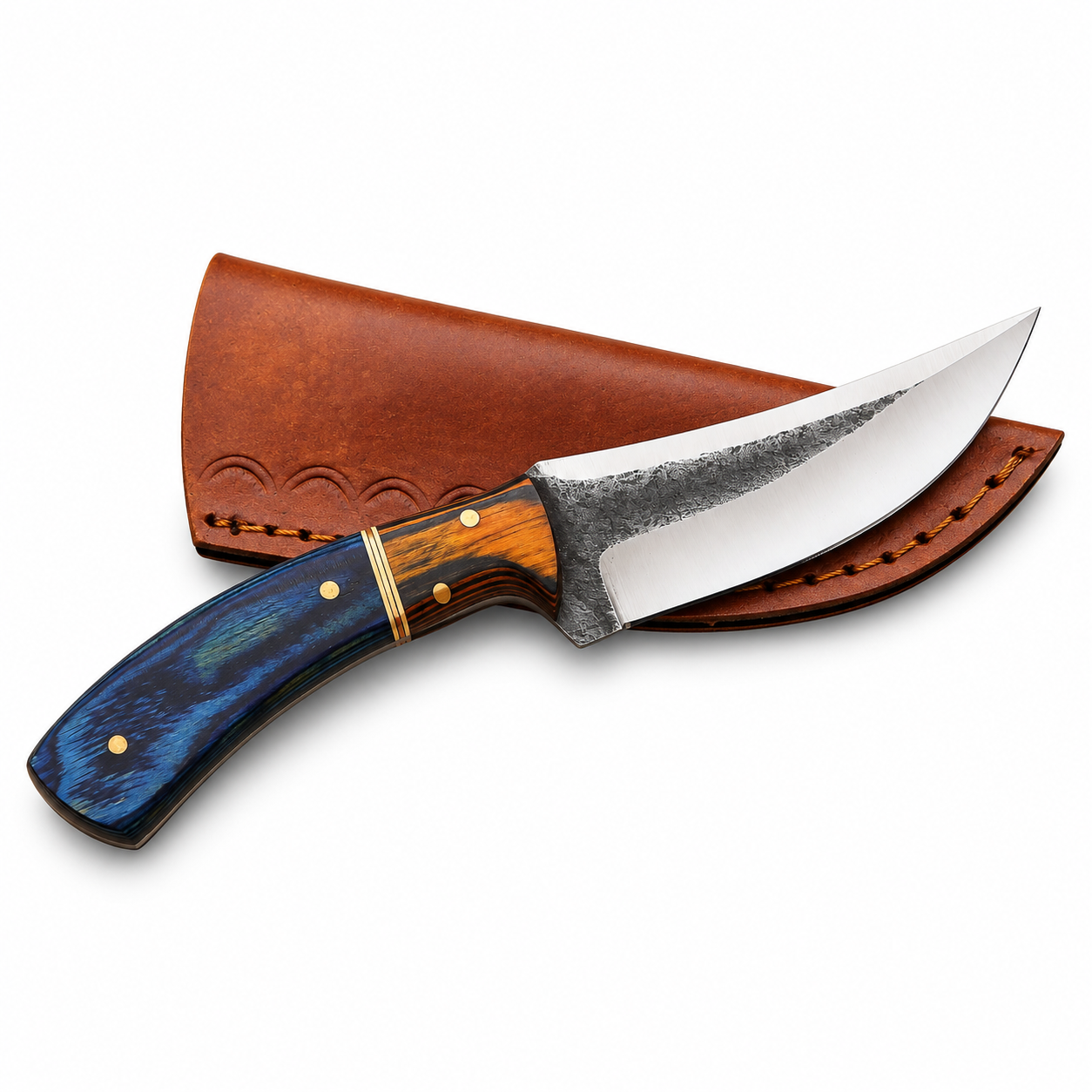
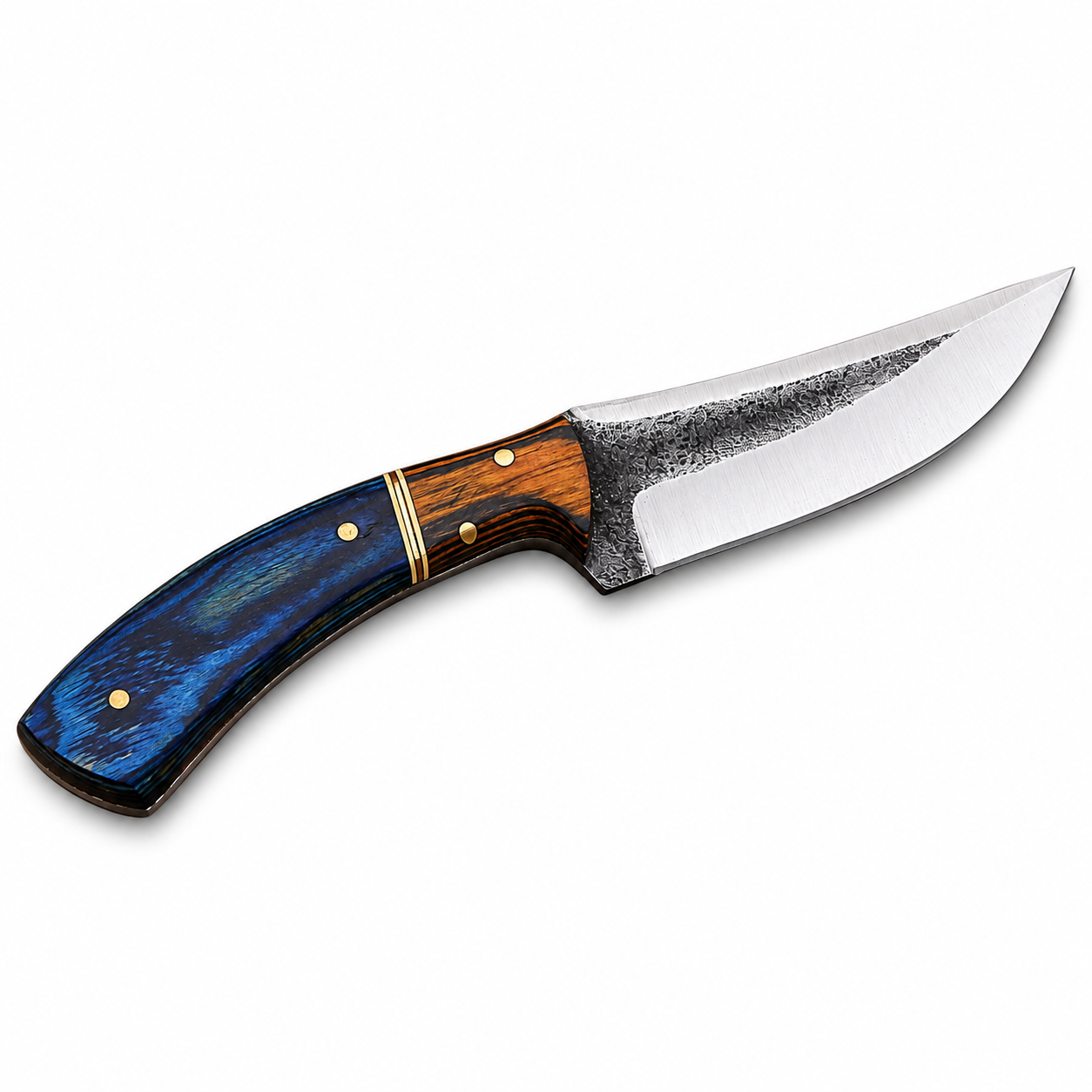
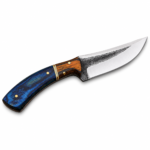
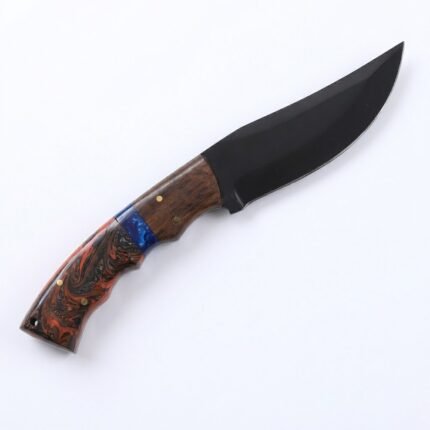
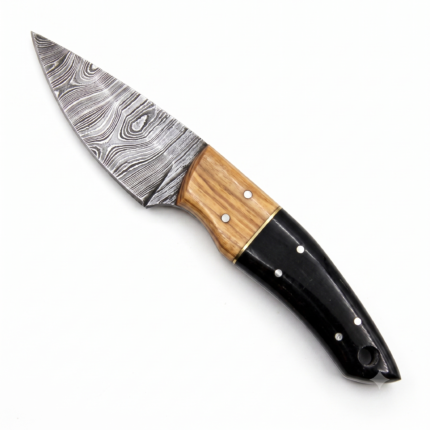
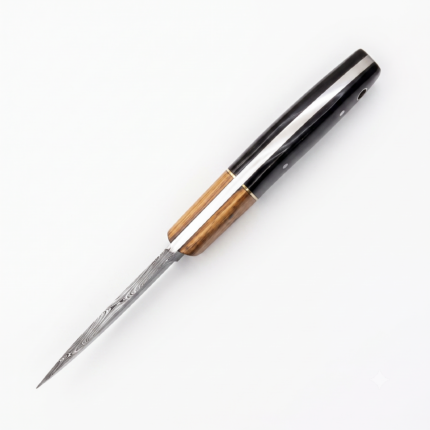
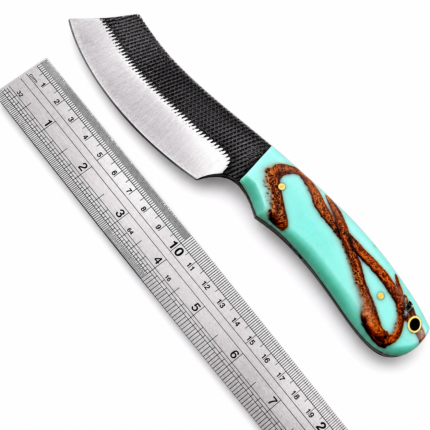
The Bluewood Fixed Blade Hunting Knife combines a broad, curved blade, distinctive two-tone handle design, and traditional sheath presentation in one visually striking piece of outdoor cutlery. Its polished silver blade, textured dark upper finish, and richly colored handle create a recognizable appearance that stands apart from simple, undecorated fixed-blade knives.
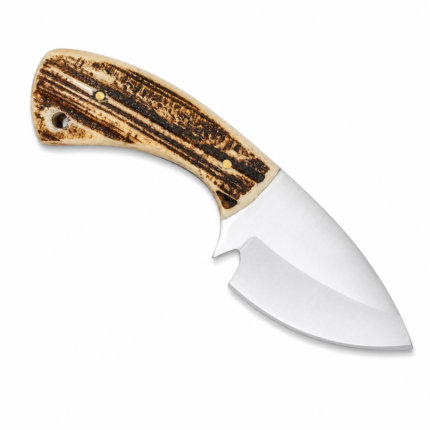
The knife is distinguished by its sweeping blade profile, which gradually narrows toward a pointed tip. A brushed silver cutting surface contrasts with the rugged, dark textured section extending along the upper part of the blade and toward the handle.
The handle features a combination of deep blue, black, and warm brown woodgrain-style patterns. Gold-tone pins and narrow decorative spacers introduce subtle metallic highlights, making the overall design more distinctive.
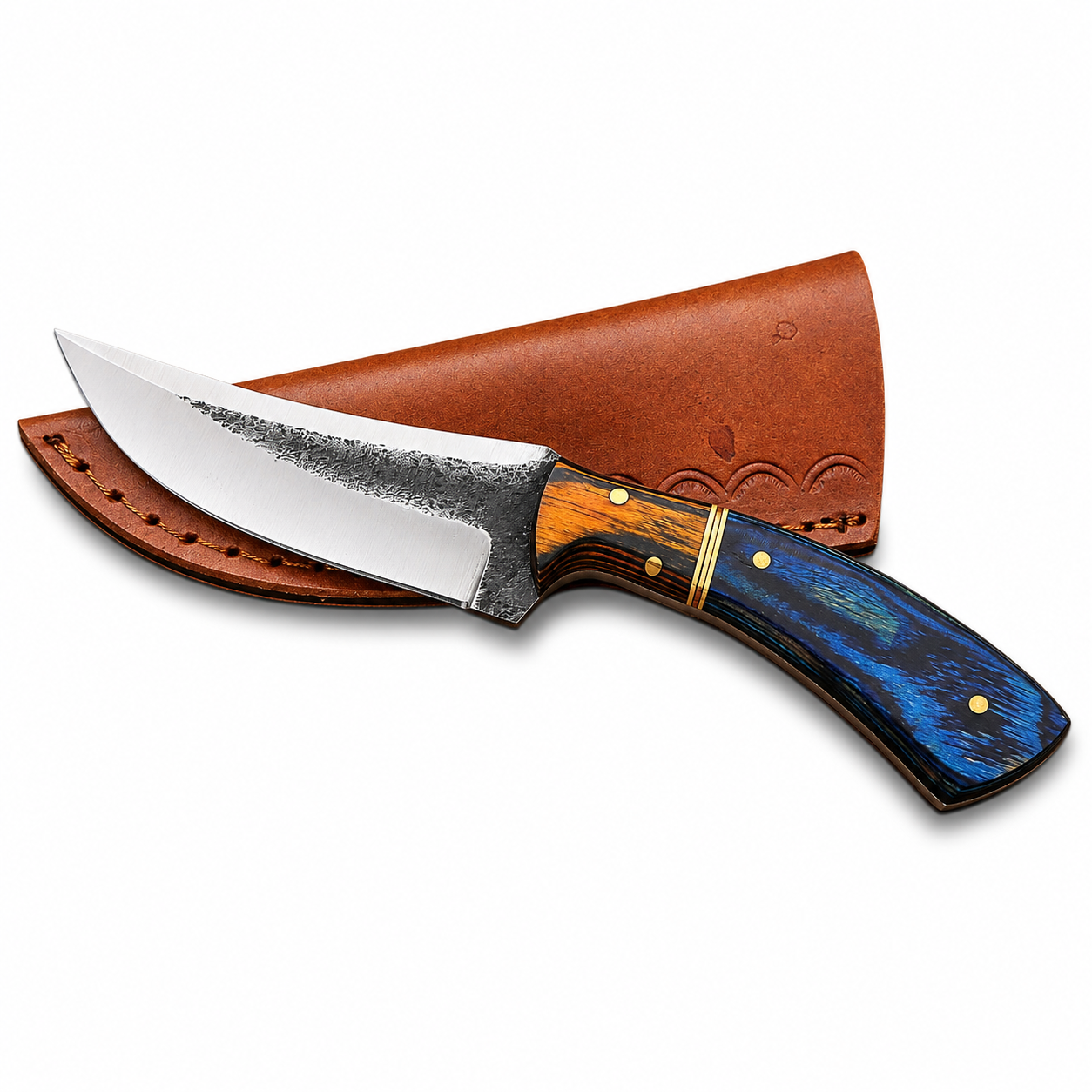
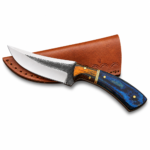
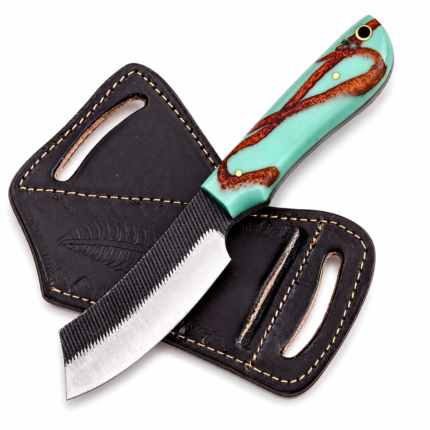
The accompanying brown leather-style sheath features a gently curved outline, visible edge stitching, and decorative embossed details.
Together, these elements create a coordinated hunting knife presentation that may appeal to outdoor enthusiasts, traditional cutlery collectors, and buyers interested in decorative fixed-blade designs.
1. Distinctive Fixed-Blade Construction
The Bluewood Fixed Blade Hunting Knife features a fixed-blade configuration rather than a folding mechanism.
The blade and handle form a continuous knife assembly without the pivot arrangement found on folding pocket knives.
This construction gives the product a traditional hunting knife silhouette.
Fixed-blade designs are commonly associated with outdoor cutlery because they do not require opening or closing before use.
The visible transition between the blade and handle is clearly defined.
The blade extends from a broad base into a gradually tapering profile, while the handle follows a gently curved shape.
The exact tang construction cannot be verified from the photographs.
For accurate technical specifications, the manufacturer should confirm whether the knife uses a full tang, hidden tang, or another attachment method.
2. Broad Curved Blade Profile
One of the most recognizable features of the Bluewood Fixed Blade Hunting Knife is its wide curved blade.
The cutting edge begins near the lower blade base and follows a sweeping curve toward the tip.
This design creates a visually balanced profile that differs from straight-edged or narrow spear-point knives.
The blade has a substantial-looking body near the handle, gradually narrowing toward its pointed end.
Its outline resembles a broad drop-point-style hunting blade, although the final classification should reflect the manufacturer’s specifications.
The smooth curve contributes to the product’s traditional outdoor knife appearance.
The visible blade shape also establishes a natural visual relationship with the curved handle.
The photographs demonstrate the blade profile from several positions, making its overall silhouette easy to recognize.
3. Polished Silver Cutting Surface
The blade features a bright silver-colored polished cutting area.
Fine linear markings are visible across the smooth metal surface.
These markings create a satin-brushed appearance.
The polished portion occupies much of the lower blade, extending from the cutting edge toward the darker textured section.
This contrast creates a distinctive division between the two finishes.
Light reflects across the smooth blade surface, emphasizing its curved outline.
The silver finish complements the metallic trim around the handle.
Its appearance is particularly noticeable against the white background used in the product photographs.
The exact polishing process, surface treatment, and edge specifications should be confirmed by the manufacturer.
4. Dark Forged-Style Upper Blade Finish
Above the polished cutting surface, the knife features a dark textured finish.
This section has an irregular hammered or forged-style appearance.
Its uneven-looking pattern creates a rugged visual contrast with the smooth silver blade.
The textured area extends along much of the blade’s upper region and becomes broader near the handle.
This finish gives the knife a traditional workshop-inspired aesthetic.
Unlike a uniformly polished blade, the combination of textures creates an additional visual dimension.
The dark section also helps emphasize the bright cutting area.
Although the texture resembles forged steel, the photographs cannot confirm the manufacturing technique.
The product should therefore be described as having a forged-style finish unless the supplier verifies the forging process.
5. A Balanced Combination of Blade Finishes
The contrasting blade surfaces are an important design feature of the Bluewood Fixed Blade Hunting Knife.
The polished silver area creates a clean and reflective appearance.
The dark textured section introduces a rugged, irregular pattern.
The boundary between the two finishes extends diagonally toward the blade tip.
This visually separates the blade into two distinct areas.
The polished portion emphasizes the blade’s curvature, while the dark section draws attention to the area near the handle.
Together, these finishes create a balance between decorative refinement and traditional outdoor knife styling.
The combination is particularly suitable for product photography that highlights blade texture and finish.
6. Bluewood Two-Tone Decorative Handle
The handle is the most colorful feature of the knife.
Its rear section displays a rich blend of blue and black tones with flowing grain-like markings.
Certain areas have an almost iridescent appearance, with blue shades changing in intensity across the surface.
The front handle section features warm brown and black layered woodgrain-style patterns.
This creates a strong contrast between the two sections.
A narrow decorative spacer separates the warm brown front section from the blue rear portion.
The arrangement gives the handle a coordinated, handcrafted-style appearance.
The actual material has not been independently identified.
The handle may use wood or another decorative composite, so the term woodgrain-style is appropriate until its composition is confirmed.
7. Rich Blue and Black Handle Finish
The rear handle section uses deep blue tones combined with darker black markings.
The flowing patterns resemble natural woodgrain or decorative stabilized material.
Different blue shades are visible, ranging from bright electric blue to darker navy-like tones.
The surface has a smooth, polished appearance.
This coloring creates a distinctive visual identity for the knife.
It also contrasts effectively with the silver blade and brown sheath.
Compared with traditional plain brown wooden handles, the blue finish introduces a more contemporary decorative element.
The material’s exact composition and coloring process should be verified with the manufacturer.
8. Warm Brown Front Handle Section
The portion of the handle nearest the blade features a warm brown and black grain-like finish.
The darker lines follow a flowing pattern across the surface.
This section complements the dark textured blade base.
Its warm coloring also creates a gradual visual transition between the silver blade and the blue rear handle.
The combination produces a balanced design rather than an abrupt change between unrelated colors.
The front section is secured with visible gold-tone pins.
Its gently shaped underside leads into a curved finger-rest area.
These details add definition to the handle.
The actual wood species or composite material should not be assumed from appearance alone.
9. Decorative Gold-Tone Spacer Rings
Thin gold-colored lines separate the brown front handle from the blue rear section.
These decorative spacer rings provide a refined metallic accent.
The narrow arrangement creates a clean visual boundary between the two handle finishes.
The gold coloring complements the visible pins.
It also introduces a warm metallic tone between the blue and brown surfaces.
Because the spacer detail is relatively narrow, it adds ornamentation without dominating the handle design.
The use of contrasting materials and finishes contributes to the product’s traditional decorative style.
The precise spacer material should be confirmed before describing it as brass or another specific metal.
10. Gold-Tone Handle Pins
Several round gold-colored pins are visible along the handle.
These small circular accents provide contrast against the blue and brown sections.
The pins are spaced across the handle surface and contribute to its finished appearance.
They visually coordinate with the narrow spacer rings.
The warm metallic color adds another layer of detail to the otherwise dark handle.
Their precise mechanical function and composition cannot be established from the images.
For product listing purposes, gold-tone handle pins accurately describes their visible appearance.
11. Curved Handle Silhouette
The Bluewood Fixed Blade Hunting Knife has a gently curved handle that follows the flowing shape of the blade.
The handle begins with a slightly narrower section near the blade.
It then extends toward a wider rear portion with a softly rounded end.
Its lower edge features a subtle inward contour near the front.
This creates a visible transition between the blade base and handle.
The curve is particularly clear in the full-length product photographs.
The handle’s shape contributes to the overall traditional hunting knife profile.
Its ergonomic suitability depends on dimensions, material finish, and the individual user’s hand size.
12. Traditional Hunting Knife Styling
The product combines several recognizable features associated with traditional hunting knife designs.
These include a broad fixed blade, sweeping cutting edge, curved handle, and matching carrying sheath.
The decorative blue-and-brown handle adds a modern visual element.
The dark forged-style blade section reinforces its rugged appearance.
The polished cutting area creates an attractive contrast.
Gold-tone pins and spacers complete the handle detailing.
The resulting knife has a coordinated outdoor-inspired aesthetic.
It is suitable for presentation in catalogs featuring fixed-blade hunting knives, traditional cutlery, and decorative outdoor knives.
13. Brown Leather-Style Carrying Sheath
The supplied photographs show a brown sheath designed around the knife’s curved blade silhouette.
Its warm brown finish complements the handle’s brown section and gold-tone accents.
The sheath has a wide opening and gradually narrows toward the tip.
This shape follows the general outline of the blade.
The exterior displays a lightly textured surface.
Visible stitching runs along the curved edge.
Decorative stamped details are positioned above the stitching.
The resulting appearance is traditional and understated.
Although the accessory resembles leather, its exact material should be verified with the manufacturer.
14. Decorative Embossing on the Sheath
A row of repeated curved decorative impressions is visible along the sheath.
These markings follow the contour of the accessory.
They create a patterned border above the stitched edge.
The embossed decoration provides additional visual detail while maintaining a classic appearance.
The brown background helps make the markings noticeable.
This simple ornamental treatment complements the knife’s decorative handle.
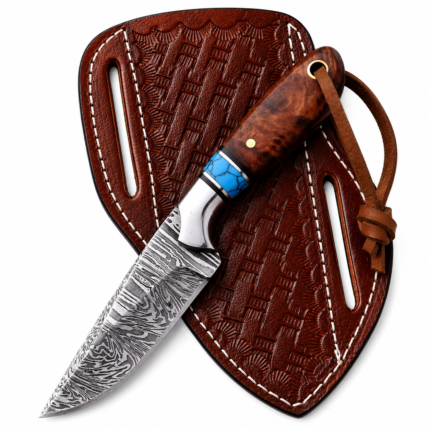
The sheath’s embossed pattern is particularly visible in photographs showing the knife placed across the accessory.
Its visual design provides a coordinated presentation for the product.
15. Contrasting Sheath Stitching
The sheath features visible stitching along its curved outer edge.
The thread has a warm brown or golden-brown appearance.
This contrasts with the darker border and main brown body of the sheath.
The stitching follows the accessory’s pointed silhouette.
It also complements the gold-colored handle pins and spacer rings.
The visible stitch pattern contributes to a traditional outdoor cutlery aesthetic.
Actual stitching construction, thread material, and durability should be confirmed with the supplier.
16. Knife and Sheath Presentation
The knife and sheath are photographed together from several angles.
Some images show the exposed knife resting over the sheath.
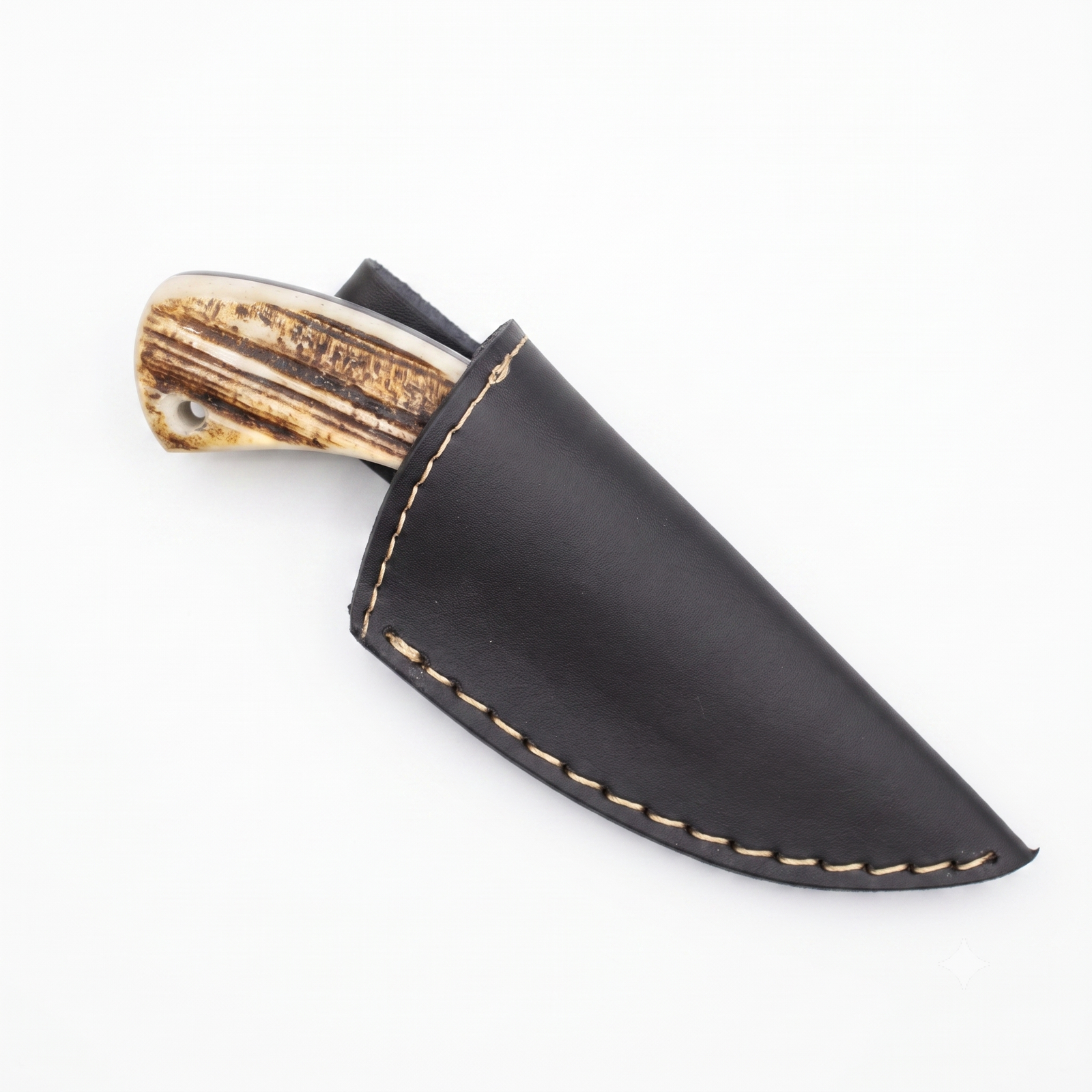
Another image shows the knife inserted into the accessory, leaving the blue handle visible.
This provides useful visual information about the relationship between the knife and its carrying accessory.
The brown sheath creates an attractive background for the silver blade and blue handle.
Its warm coloring also balances the cooler metallic finishes.
The product gallery benefits from displaying both the open blade and sheathed knife.
Before publication, the seller should confirm whether the sheath is included in the standard retail package.
17. Traditional and Contemporary Design Elements
The Bluewood Fixed Blade Hunting Knife combines two distinct design approaches.
Its broad blade, textured upper finish, and brown sheath reflect traditional hunting knife styling.
Its vivid blue handle introduces a more contemporary appearance.
The brown woodgrain-style section helps connect these elements.
Gold-tone pins and spacer rings provide a classic ornamental finish.
This combination creates a visually distinctive knife.
The design may appeal to individuals who prefer outdoor cutlery with decorative accents rather than completely utilitarian styling.
Its visual character is one of the product’s strongest identifying features.
18. Collectible Cutlery Appeal
Decorative fixed-blade knives can attract interest from collectors who appreciate distinctive handle designs and blade finishes.
The Bluewood Fixed Blade Hunting Knife offers several visible details that contribute to this appeal.
Its dark textured blade section contrasts with a bright silver cutting surface.
The blue-and-brown handle has a striking grain-like appearance.
Gold-tone accents provide subtle ornamentation.
The brown sheath completes the traditional presentation.
These features may make the knife a visually interesting addition to a collection.
However, collectible value depends on authenticity, manufacturer reputation, production history, materials, condition, and verified specifications.
19. Blade Shape and Visual Proportions
The blade is noticeably broad near the handle.
It gradually narrows toward a pointed tip.
The cutting edge forms a long sweeping curve.
The upper blade line has a more restrained curve that complements the cutting edge.
This creates a balanced profile.
The textured dark finish also follows the blade’s overall shape.
The broad base contributes to its substantial visual presence.
The pointed end provides a clearly defined termination to the curved outline.
The exact blade length, width, thickness, and edge angle should be established through physical measurement.
20. Handle-to-Blade Transition
The area where the handle meets the blade is visually distinctive.
The dark textured blade base extends toward the front brown handle section.
This produces a cohesive transition between metal and decorative material.
A slight finger-rest contour is visible beneath the front portion.
The gold-colored pins add further detail to the transition.
The contrast between silver steel, dark texture, and warm brown grain helps define the knife’s construction visually.
This section is particularly important in close-up product photography because it highlights the relationship between the blade and handle.
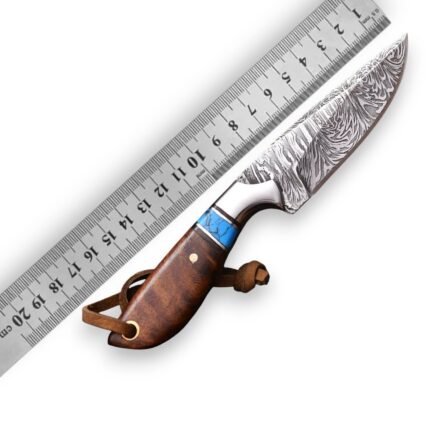
21. Product Photography and Visual Details
The supplied gallery contains five useful product views.
The primary image displays the full knife against a plain white background.
This makes the blade shape, handle colors, and overall proportions easy to examine.
The second image shows the knife positioned over the brown sheath.
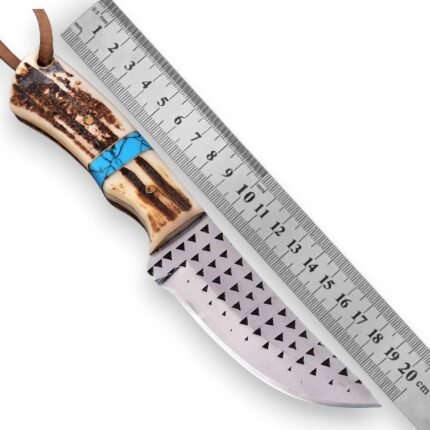
The third image offers another clean side profile emphasizing the polished blade and textured upper area.
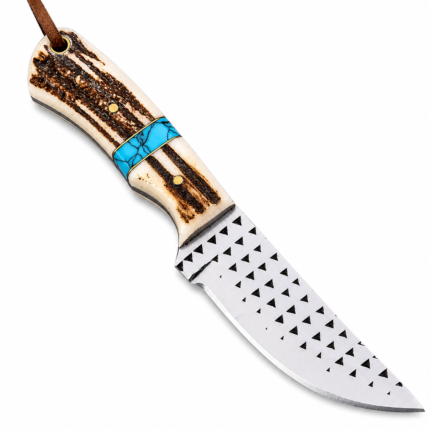
The fourth photograph presents the knife and sheath together from a slightly different angle.
The fifth photograph shows the knife inserted into the sheath.
Together, these views help visitors understand the product’s appearance.
22. Outdoor Cutlery Category Placement
The Bluewood Fixed Blade Hunting Knife fits visually within the fixed-blade hunting knife category.
Its broad curved blade and traditionally styled sheath support this classification.
It can also be included in a broader outdoor knives category.
For WooCommerce, a clear product hierarchy helps visitors navigate related designs.
A suitable category structure is:
Hunting Knives → Fixed Blade Hunting Knives
A secondary collection may focus on decorative or collectible fixed-blade knives.
The product should not be assigned to folding knife categories because it does not have a folding mechanism.
23. Material Transparency and Product Accuracy
Accurate material descriptions are important in online knife listings.
The Bluewood Fixed Blade Hunting Knife clearly displays a silver metal blade.
However, the photographs cannot establish the specific steel grade.
The textured section resembles traditional forged metal, but its production method is unverified.
Similarly, the handle has visible woodgrain-style markings, yet its precise material is unknown.
The sheath resembles leather, but the material must be confirmed.
Using accurate visual descriptions helps avoid misleading product information.
Verified specifications should replace provisional descriptions before publication.
24. Blade Maintenance and Cleaning
Proper care helps maintain the appearance of a fixed-blade knife.
After appropriate use, the blade should be cleaned according to the manufacturer’s instructions.
A soft cloth may be used to remove moisture and surface debris.
The blade should be dried carefully before storage.
Aggressive cleaning compounds may damage decorative finishes.
Special attention should be given to the contrast between the polished cutting area and textured upper section.
The correct cleaning method depends on the verified steel composition and surface treatment.
Any maintenance involving the cutting edge should follow appropriate safety precautions.
25. Preserving the Bluewood Handle Finish
The handle’s decorative blue-and-brown finish should be treated carefully.
A soft dry cloth is suitable for removing ordinary surface dust.
Strong solvents should be avoided unless approved by the manufacturer.
The handle should not be exposed unnecessarily to extreme heat or prolonged moisture.
Because the underlying material has not been verified, specialized oils and conditioners should not be recommended without supplier guidance.
The decorative gold-tone components should also be cleaned gently.
Regular visual inspection can help identify signs of wear or looseness.
26. Maintaining the Brown Sheath
The carrying sheath should be maintained according to its actual material.
Its brown exterior can be wiped gently to remove loose dirt.
The stitching should be inspected periodically.
The embossed decorative areas should be protected from abrasive cleaning.
If the sheath is confirmed to be genuine leather, appropriate leather-care products may be used according to manufacturer recommendations.
The knife should be clean and dry before being placed inside the sheath.
Long-term storage conditions should follow the supplier’s guidance for both the blade and accessory.
27. Safe Storage and Responsible Ownership
Fixed-blade knives should be handled and stored responsibly.
The cutting edge should remain protected when the knife is not in use.
The sheath should be checked for proper fit before storage or transport.
The knife should be kept away from children and unauthorized individuals.
Owners should avoid placing an exposed blade in unsecured storage areas.
Local laws concerning knife possession, transportation, and use should always be followed.
The decorative finish does not reduce the importance of standard safety precautions.
28. Key Visible Product Features
The Bluewood Fixed Blade Hunting Knife has several recognizable design characteristics.
Fixed-Blade Design: Traditional non-folding knife configuration.
Curved Blade Profile: Broad cutting area with a gradually tapering pointed tip.
Polished Blade Finish: Bright silver-colored lower blade surface.
Forged-Style Texture: Dark irregular pattern along the upper blade.
Bluewood Handle: Blue-black grain-style rear section.
Brown Handle Section: Warm brown front section with dark flowing markings.
Gold-Tone Pins: Small circular decorative metallic accents.
Metallic Spacers: Thin gold-colored lines separating handle sections.
Brown Sheath: Curved leather-style carrying accessory.
Decorative Stitching: Contrasting visible edge stitches.
Embossed Detail: Repeated curved stamped markings on the sheath.
29. Frequently Asked Questions
What is the Bluewood Fixed Blade Hunting Knife?
It is a traditional-style fixed-blade knife featuring a broad curved blade, silver polished finish, dark textured upper blade, blue-and-brown handle, and matching brown sheath.
Is this a folding knife?
No. The product has a fixed-blade design.
What makes the blade distinctive?
The blade combines a polished silver cutting area with a dark forged-style textured upper section.
Is the blade hand forged?
The textured finish resembles forged metal, but the manufacturing process requires verification.
What color is the handle?
The handle combines blue, black, and warm brown colors.
Is the handle made from genuine wood?
The handle has woodgrain-style patterns. Its precise material should be verified by the manufacturer.
Does the product have decorative metal details?
Yes. Gold-tone pins and thin metallic spacers are visible on the handle.
Is a carrying sheath shown?
Yes. A brown leather-style sheath is included in the supplied photographs.
Is the sheath made from genuine leather?
Its exact material has not been confirmed.
What type of blade does the knife have?
It has a broad curved blade resembling a drop-point-style hunting knife profile.
What is the blade length?
The exact blade length must be obtained from the manufacturer.
Is the knife suitable for collectors?
Its decorative handle and contrasting blade finishes may appeal to collectors of traditional outdoor cutlery.
30. Product Specifications
| Specification | Description |
|---|---|
| Product Name | Bluewood Fixed Blade Hunting Knife |
| Knife Type | Fixed Blade |
| Blade Profile | Broad Curved Drop-Point Style |
| Blade Color | Silver and Dark Grey |
| Blade Finish | Polished and Textured |
| Handle Color | Blue, Black and Brown |
| Handle Shape | Curved and Contoured |
| Handle Decoration | Gold-Tone Pins |
| Handle Spacers | Gold-Colored Metallic Lines |
| Sheath Appearance | Brown Leather-Style |
| Sheath Design | Curved with Embossed Border |
| Sheath Stitching | Contrasting Brown Thread |
| Blade Material | To Be Verified |
| Handle Material | To Be Verified |
| Tang Construction | To Be Verified |
| Overall Length | To Be Verified |
| Blade Length | To Be Verified |
| Blade Width | To Be Verified |
| Blade Thickness | To Be Verified |
| Weight | To Be Verified |
Conclusion
The Bluewood Fixed Blade Hunting Knife stands out through its broad polished blade, distinctive dark forged-style upper finish, and colorful two-tone handle.
Its blue-and-brown grain-style handle creates a strong visual contrast against the silver blade, while gold-tone pins and metallic spacer rings introduce refined decorative details.
The curved brown leather-style sheath completes the traditional presentation with visible stitching and embossed accents.
For buyers interested in ornamental outdoor cutlery and distinctive fixed-blade knife designs, this model offers an appealing combination of traditional styling and contemporary color.
Its most recognizable features are the polished sweeping blade, rugged textured upper section, richly colored handle, and coordinated brown sheath.
Before final publication, exact materials, dimensions, blade construction, and sheath specifications should be verified with the manufacturer.





Reviews
There are no reviews yet.