








Cleaver-Style Fixed-Blade Knife with Red and Black Layered Handle
Introduction
The Cleaver-Style Fixed-Blade Knife is an example of contemporary metalwork characterized by a broad metallic blade, a colorful layered handle, and a contrasting stitched sheath.
The most recognizable aspect of its appearance is the relationship between the substantial silver-colored blade and the elongated red-and-black handle.
The handle introduces flowing color bands and dark textured regions, while the blade maintains a relatively understated satin finish.
The photographs document the knife from several perspectives, including two complete side views, a close-up of the handle, an alternative blade orientation, and arrangements featuring its accompanying sheath.
These views provide useful information about its external appearance and decorative elements.
However, the photographs cannot independently establish its actual material composition, measurements, manufacturing process, or technical performance.
1. Overall Silhouette
The object has a fixed-blade configuration with a wide blade extending directly from the handle.
The blade’s outline is broadly rectangular, although its front end has a gently rounded profile rather than sharp square corners.
A wide surface occupies much of the blade face.
The cutting-edge outline appears relatively straight along a substantial portion of its length.
Near the handle, a curved projection extends from the metal section.
This feature creates a recognizable transition between the blade and handle.
The handle curves upward from the blade and gradually broadens toward its rounded end.
Viewed as a complete object, these components create a strongly contrasting silhouette.
2. Satin Silver-Colored Blade
The blade displays a silver-gray metallic finish.
Fine parallel lines are visible across parts of its surface, creating an appearance consistent with satin or brushed finishing.
The reflective qualities are relatively subdued.
Instead of producing a mirror-like reflection, the blade shows gentle variations in brightness.
Several photographs reveal differences in tone across the broad blade face.
These variations emphasize the visible changes in surface geometry.
The exact finishing process cannot be established from the photographs.
It would also be inaccurate to assign a particular steel grade based solely on the blade’s appearance.
3. Broad Cleaver-Style Blade Profile
The broad blade is a defining feature of the object’s design.
Its front edge has a rounded corner, producing a softer silhouette than a completely rectangular blade.
The upper and lower outlines remain comparatively straight.
An angled transition is visible across a portion of the blade surface.
This change in geometry creates a distinct visual division between the broader upper face and the region nearer the edge.
The photographs show the external profile but provide no verified dimensions.
Consequently, its length, width, thickness, and weight remain unknown.
4. Red-and-Black Layered Handle
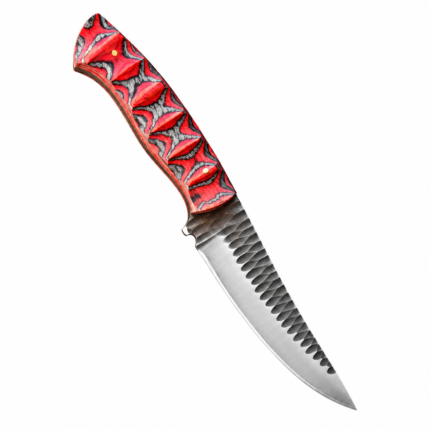
The handle features a vivid red-and-black decorative pattern.
Its surface contains irregular dark sections surrounded by brighter red bands.
Additional narrow black and red layers are visible along the outer edges.
These bands follow the handle’s curved outline.
Some dark areas resemble wood grain, while other sections have a more abstract, irregular appearance.
The overall design combines flowing organic patterns with repeated linear stripes.
Although the surface resembles colored laminated wood, the actual handle material is not verified.
5. Handle Color Arrangement
The red coloration is particularly prominent around the perimeter and between the darker sections.
Black occupies much of the central decorative area.
Thin alternating bands appear along the handle edges.
These layers create visual depth and emphasize the handle’s contours.
In the close-up photograph, the outer bands are especially clear.
The contrast between bright red and charcoal-like gray produces a recognizable color identity.
This combination also distinguishes the handle from the blade’s neutral metallic finish.
6. Three Circular Metallic Details
Three circular metallic details are visible along the handle.
Two appear gold-colored, while another near the blade appears silver-colored.
Their placement creates a sequence of small geometric elements against the irregular red-and-black background.
The circular forms are visually distinct from the elongated decorative patterns.
They resemble fastening pins, although their construction cannot be verified from the images.
The precise materials and internal arrangement remain unknown.
7. Curved Handle Profile
The handle has a flowing, curved shape.
Near the blade, it narrows slightly before widening toward the rounded end.
Its outer contour forms a smooth arc.
The black-and-red striped edges follow this curve, making the shape visually prominent.
The handle’s rounded end is also clearly visible in several photographs.
These characteristics can be documented as external design features.
Claims about ergonomic performance or internal structural strength would require additional evidence.
8. Handle Surface Texture
The central dark regions display fine directional markings.
These resemble the texture of natural wood grain or patterned composite material.
The red sections are comparatively bright and appear less heavily textured in some photographs.
Together, the surfaces create a layered decorative appearance.
The visual relationship between the colors is especially noticeable in the third image, which focuses on the handle.
This close-up provides more detail than the full-length photographs.
It remains insufficient to confirm the material composition.
9. Curved Metal Projection
A distinctive curved projection appears where the blade meets the handle.
The projection extends outward and gradually narrows toward a rounded point.
It shares the blade’s silver-colored finish.
This shape creates a visual separation between the handle and the broad blade.
It is visible in both the complete side views and the close-up photograph.
Its exact dimensions and mechanical purpose cannot be determined from photography alone.
For reference documentation, it is best identified descriptively as a curved metal projection near the blade-handle junction.
10. Tan-Brown Sheath
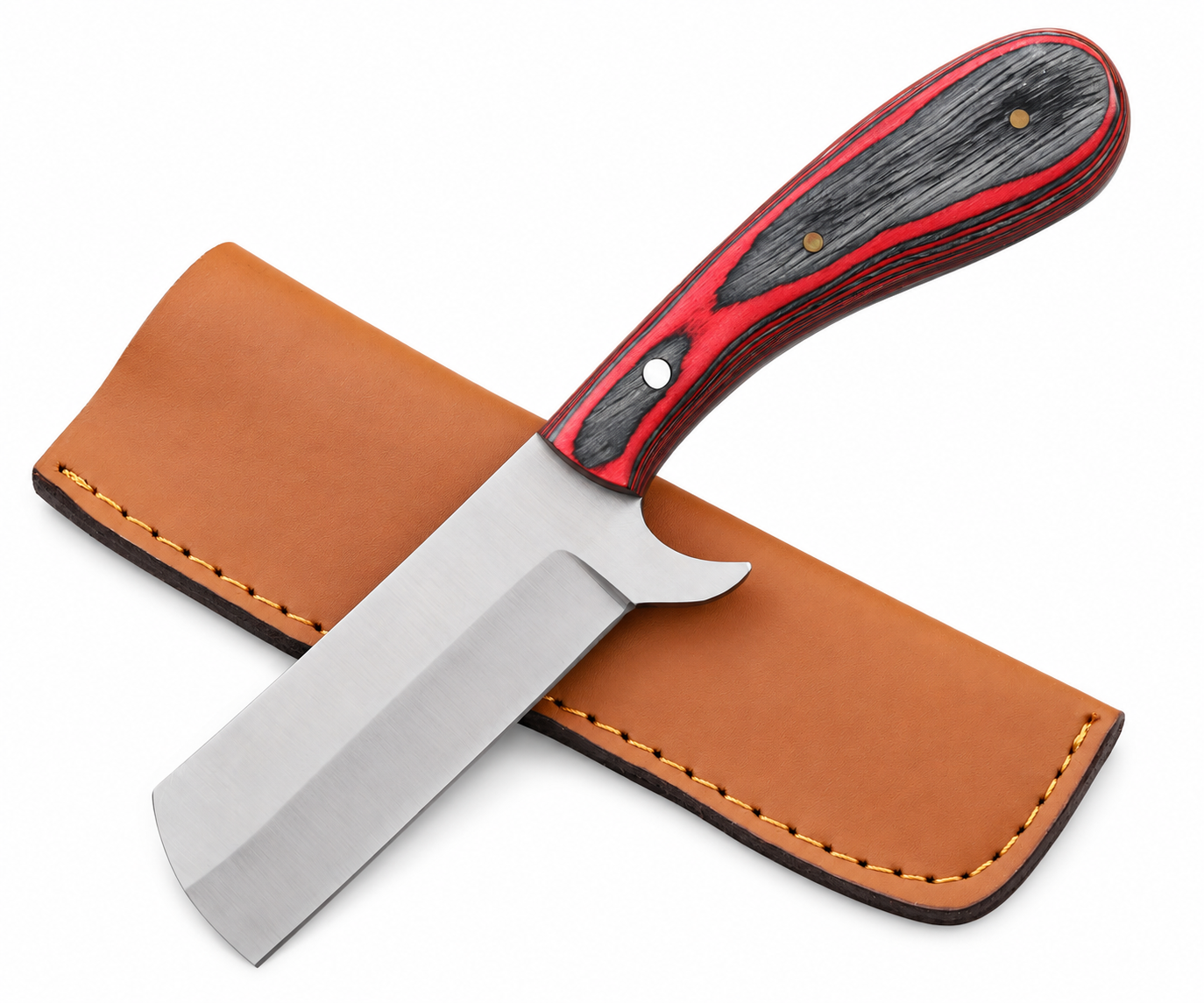
Several photographs show a tan-brown sheath.
The sheath has a smooth, leather-like exterior and a relatively simple rectangular outline with rounded corners.
Yellow-colored stitching follows much of the perimeter.
The edges appear darker than the central brown surface.
These features give the sheath a traditional-looking appearance.
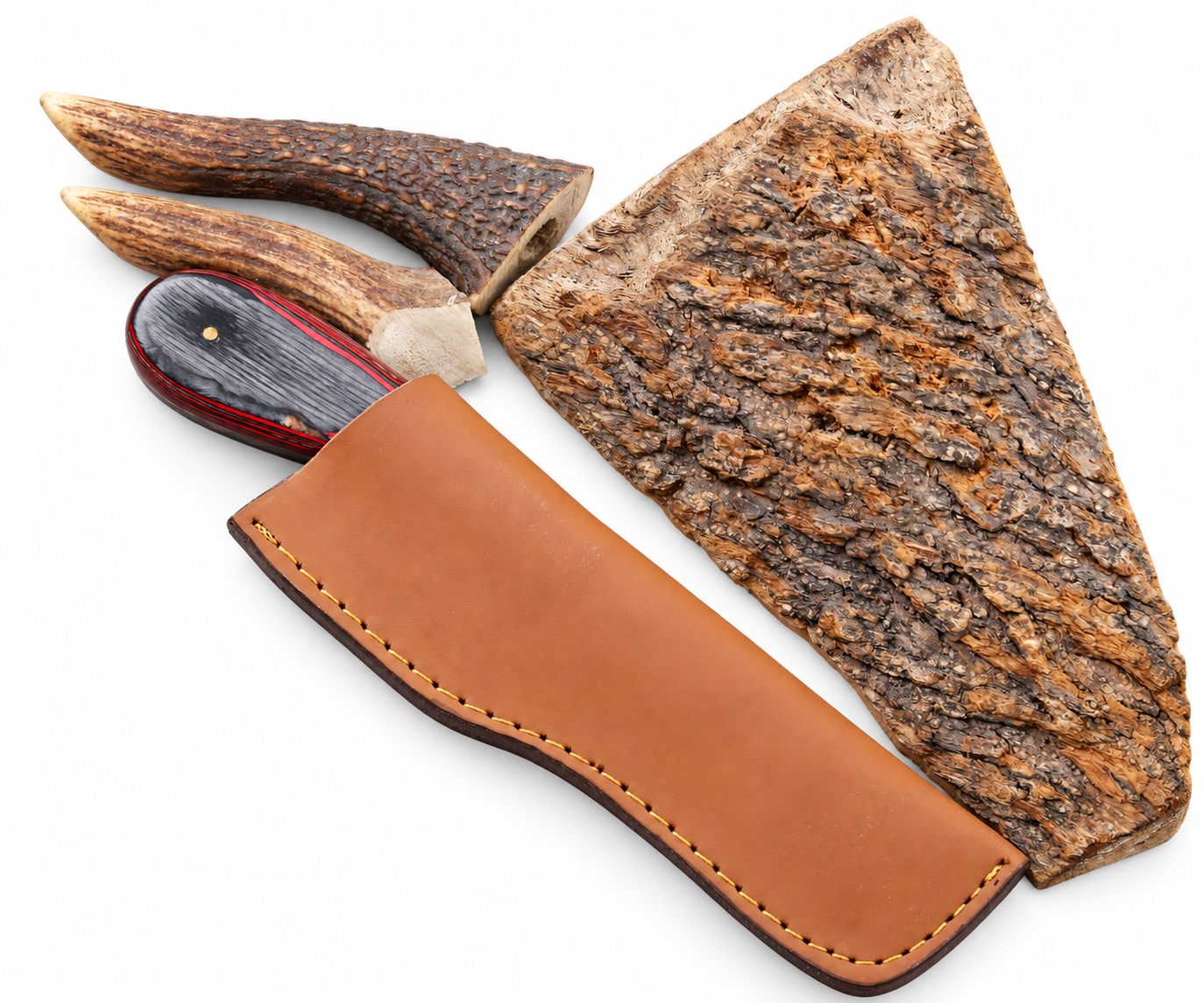
The images show the sheath positioned beneath the knife and, in another photograph, covering the blade.
The exact material cannot be confirmed through visual examination.
Although it resembles leather, identifying it as genuine leather would require manufacturer documentation.
11. Contrasting Sheath Stitching
The stitching introduces a lighter decorative line against the warm brown surface.
Individual stitches are visible around portions of the sheath perimeter.
The thread appears yellow or golden in the photographs.
A darker strip follows the outer edge.
The combination creates a clearly defined border.
This stitched outline distinguishes the sheath visually from the plain white photographic background.
12. Knife and Sheath Presentation
The first photograph shows the knife placed diagonally over the sheath.
The blade crosses the brown surface, creating a contrast between silver metal and warm brown material.
The fifth image shows the handle protruding from the sheath.
This presentation documents the appearance of the two objects together.
It also reveals the handle’s curved shape and red-and-black pattern against the neutral sheath.
The arrangement does not establish whether the sheath is supplied with every version of the object.
13. Natural-Textured Photography Props
One image includes natural-textured objects positioned around the sheathed knife.
These include antler-like forms and an irregular textured slab.
Their earthy colors complement the sheath.
The surfaces introduce rough textures that contrast with the smoother blade and handle.
Such props create an outdoors-inspired visual setting.
They should not be confused with confirmed components or materials used in manufacturing the knife.
14. Decorative Color Composition
The design uses three dominant colors.
Silver-gray forms the principal blade surface.
Red appears prominently along the handle.
Black fills the darker central sections and the thin layered bands.
Small gold-colored and silver-colored circular accents add additional variation.
The brown sheath introduces a warm neutral tone.
These colors allow the different components to remain visually distinct.
The overall combination demonstrates how color contrast can shape the appearance of a functional-form object.
15. Layered Handle Aesthetics
Layered patterns are found in many decorative craft traditions.
Colored wood laminates, polymer composites, and other manufactured materials can produce contrasting lines and bands.
The handle shown here resembles this broader design approach.
Its repeating outer stripes frame irregular central patterns.
The combination creates a visually complex surface.
However, the image does not establish which specific manufacturing technique was used.
The appropriate catalog description is therefore a red-and-black layered-looking handle.
16. Blade Surface Geometry
The blade has a broad upper face.
A distinct angled transition separates portions of the surface.
This transition creates different shades of silver depending on the photographic angle.
The resulting appearance emphasizes the blade’s geometric form.
The clean lines are visible particularly clearly in the second and sixth photographs.
These images provide complementary views of the metal surface.
They do not establish manufacturing tolerances, precise angles, or measured dimensions.
17. Complete Side-View Photography
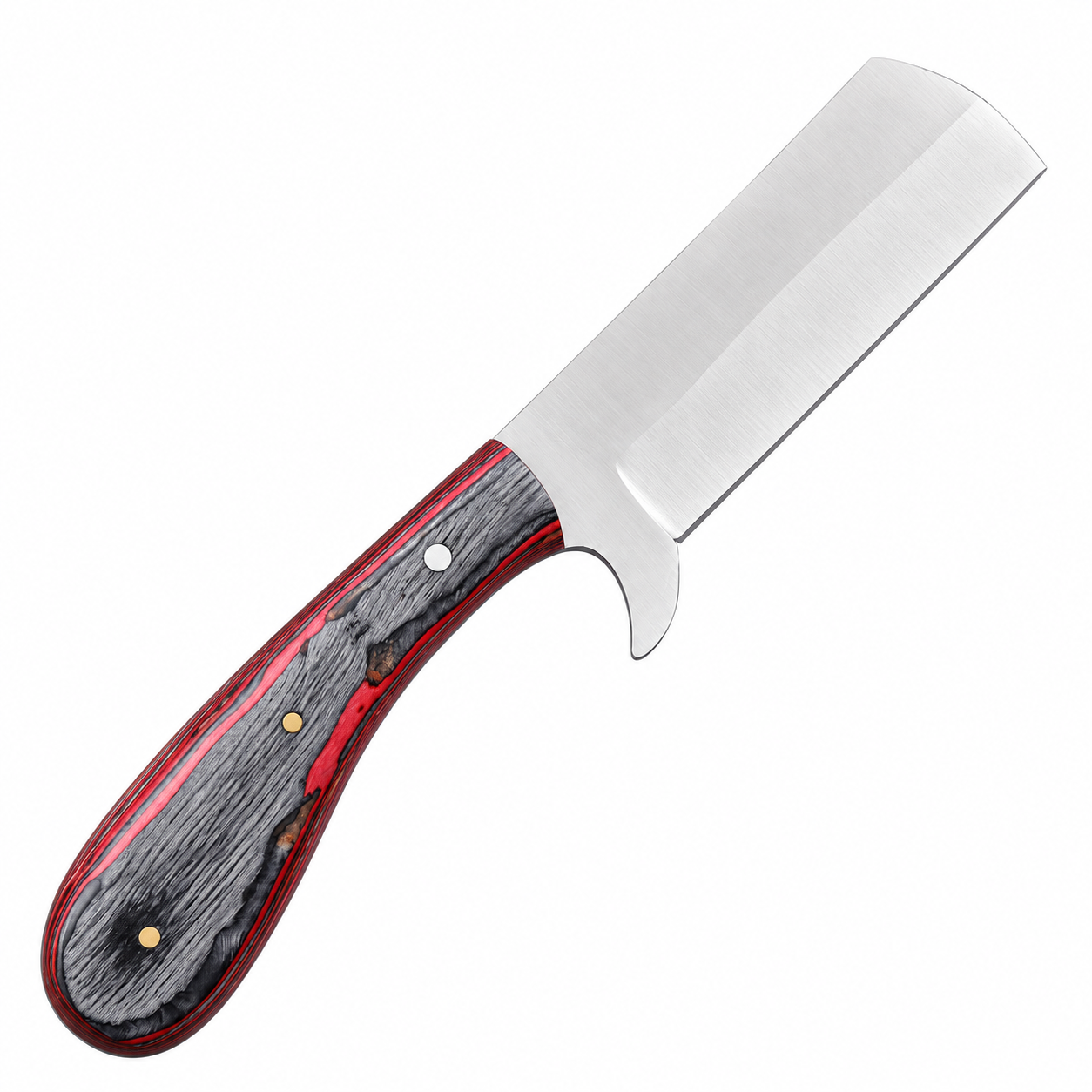
The second photograph presents the knife against a plain white background.
The blade extends diagonally toward the lower left.
The handle curves toward the upper right.
This arrangement makes the full blade and handle outline easy to observe.
The red-and-black surface is highly visible.
The white background provides separation from both the dark handle and silver-colored metal.
The fourth photograph offers a similar perspective.
Together, these images help document the external design.
18. Close-Up Handle Photography
The third photograph focuses on the handle.
It highlights the central textured black sections.
Thin red-and-black bands are visible along the perimeter.
The metallic circular details appear as small contrasting points.
The rounded handle end can be examined more clearly.
This image is especially useful for studying decorative patterns and surface finishes.
It cannot independently confirm the handle material or internal attachment method.
19. Alternative Blade Orientation
The sixth photograph shows the knife in a different orientation.
The broad blade extends toward the upper right.
The handle extends toward the lower left.
This view reveals another side of the metal surface and a variation in the handle’s decorative markings.
The blade retains the same general cleaver-style profile.
The curved projection near the handle remains visible.
The alternative perspective contributes useful visual information to the overall reference collection.
20. Fixed-Blade Classification
The object is classified visually as a fixed-blade knife.
The photographs do not show any folding mechanism.
Instead, the blade extends directly from the handle.
The internal construction remains concealed.
It would therefore be inaccurate to state whether the object has a full tang or another internal configuration without supporting documentation.
Reference descriptions should distinguish the external fixed-blade format from unverified structural specifications.
21. Material Identification Limitations
The blade appears to be metallic.
The handle has a layered, wood-grain-like pattern.
The circular details appear metallic.
The sheath resembles leather.
These visual observations are reasonable.
However, they do not establish precise materials.
The photographs cannot independently identify the steel alloy, handle substrate, pin composition, or sheath material.
Such claims require manufacturer records or other reliable evidence.
22. Unverified Technical Specifications
A complete technical description would normally include:
- Manufacturer and model designation
- Overall length
- Blade length and width
- Blade thickness
- Exact blade material
- Handle material
- Fastener composition
- Product weight
- Sheath material
- Production location
None of these details can be reliably determined from the supplied photographs alone.
They should remain unspecified until verified.
23. Role of Surface Finish in Visual Design
Surface finishes influence how objects interact with light.
The blade has a subdued satin-like metallic appearance.
The handle displays brighter red accents and darker textured sections.
The sheath appears comparatively smooth and matte.
The metallic circular details provide small reflective highlights.
These contrasting finishes create a more varied visual composition.
They also make the individual components easy to distinguish.
24. Contemporary Decorative Craftsmanship
The combination of a broad metal blade, layered-looking handle, and stitched sheath reflects several decorative approaches commonly used in contemporary crafted objects.
One approach emphasizes recognizable geometric silhouettes.
Another uses contrasting colors to distinguish different materials or components.
A third introduces surface texture through stripes, patterns, stitching, or metal finishing.
The knife shown here combines all three approaches.
The broad blade establishes its outline.
The red-and-black handle provides its most prominent decoration.
The sheath adds a contrasting accessory with a more traditional appearance.
25. Accurate Descriptive Terminology
For an informational reference page, terminology should reflect what is actually visible.
“Cleaver-style blade” describes its broad outline.
“Satin silver-colored finish” describes its metallic appearance.
“Red-and-black layered-looking handle” communicates the decorative pattern without assuming a particular material.
“Tan-brown stitched sheath” accurately describes the visible accessory.
These expressions are more reliable than unsupported statements about steel quality, manufacturing origin, or performance.
Conclusion
The Cleaver-Style Fixed-Blade Knife is distinguished by its broad satin silver-colored blade and curved red-and-black handle.
The handle’s layered-looking pattern, textured dark sections, and circular metallic accents provide additional decorative detail.
A curved projection at the blade-handle junction contributes to its recognizable silhouette.
The accompanying tan-brown sheath features contrasting stitching and dark edge trim.
Across the six photographs, the object’s external appearance is documented from several perspectives.
Further manufacturer information would be required to establish exact materials, measurements, structural specifications, and production details.





Reviews
There are no reviews yet.