

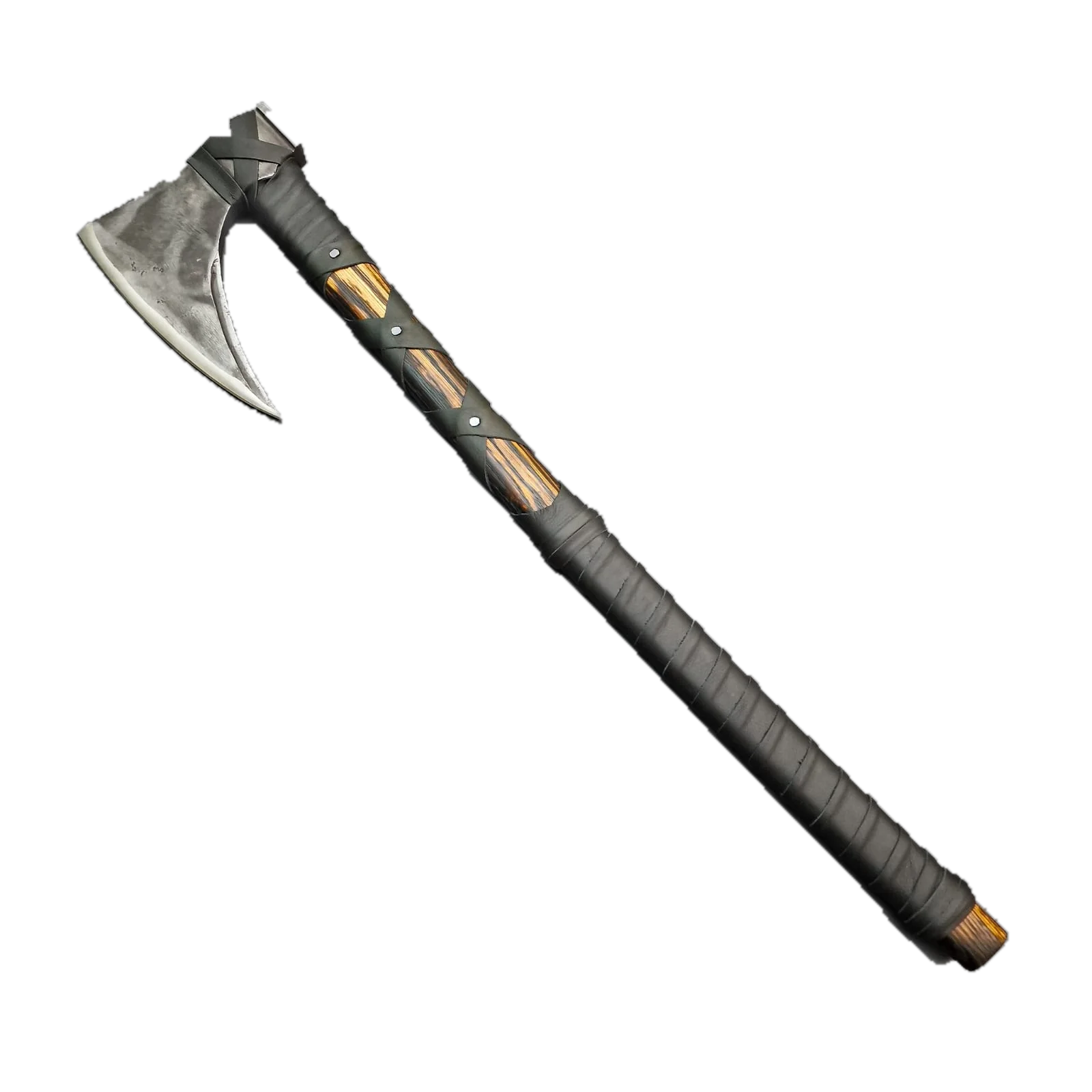
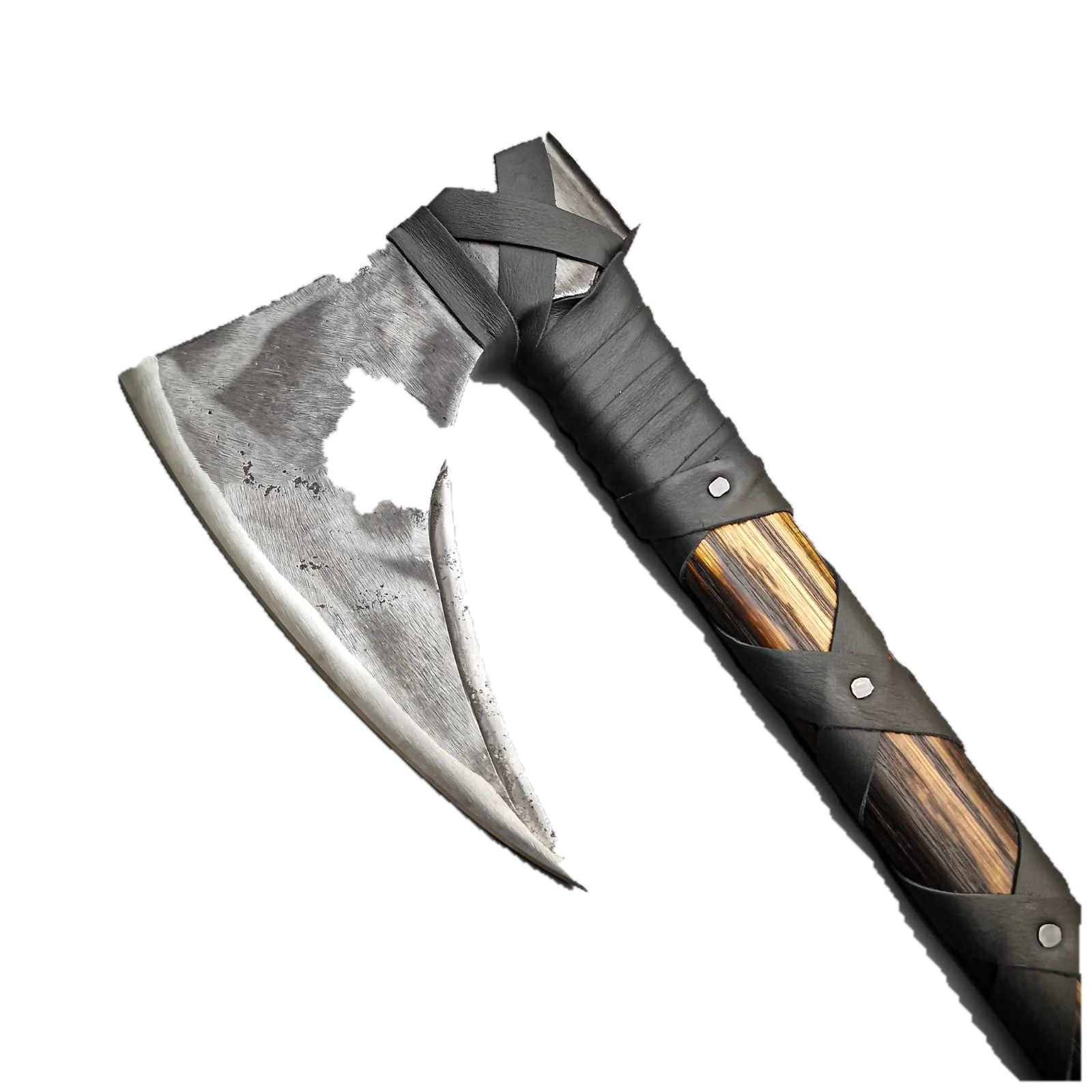
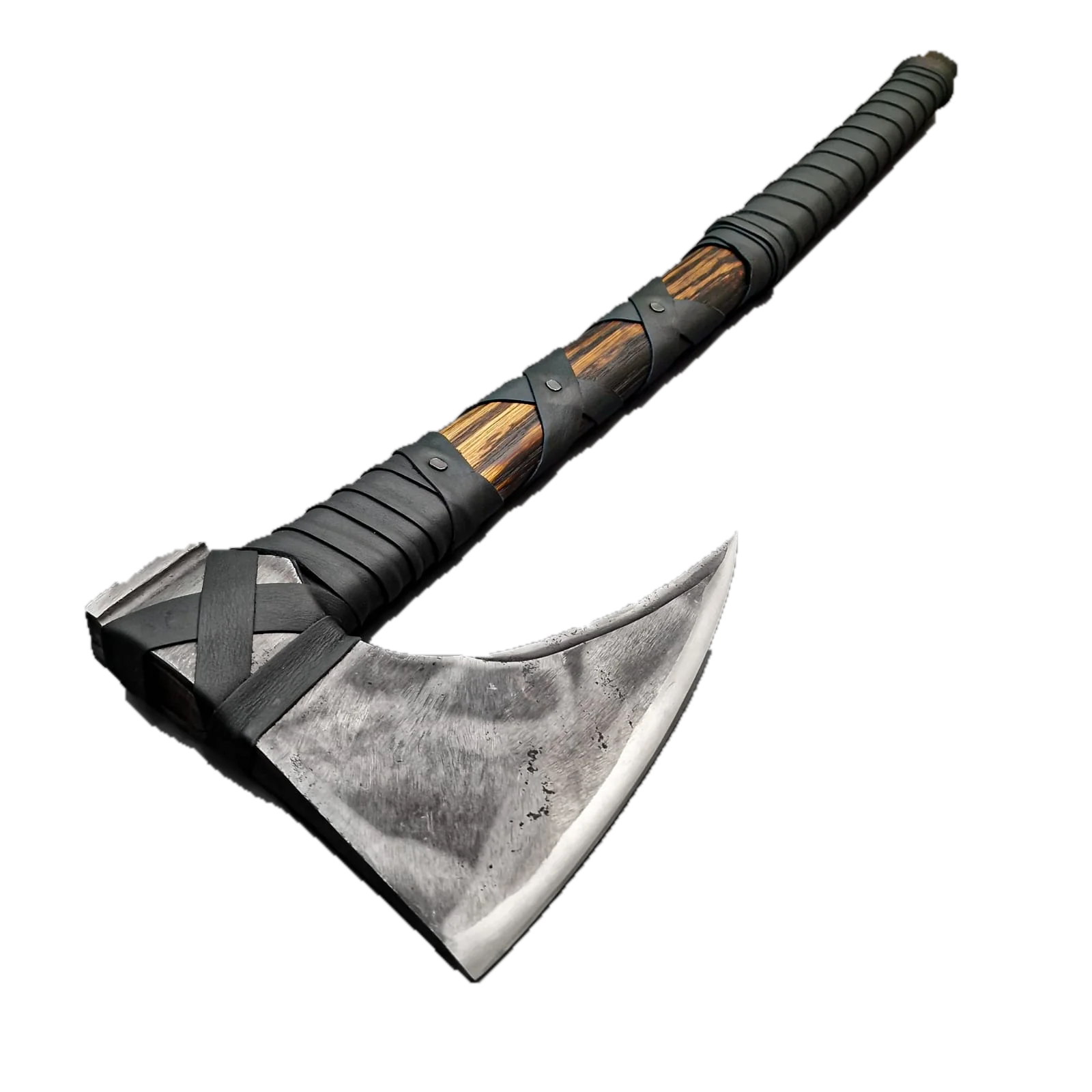
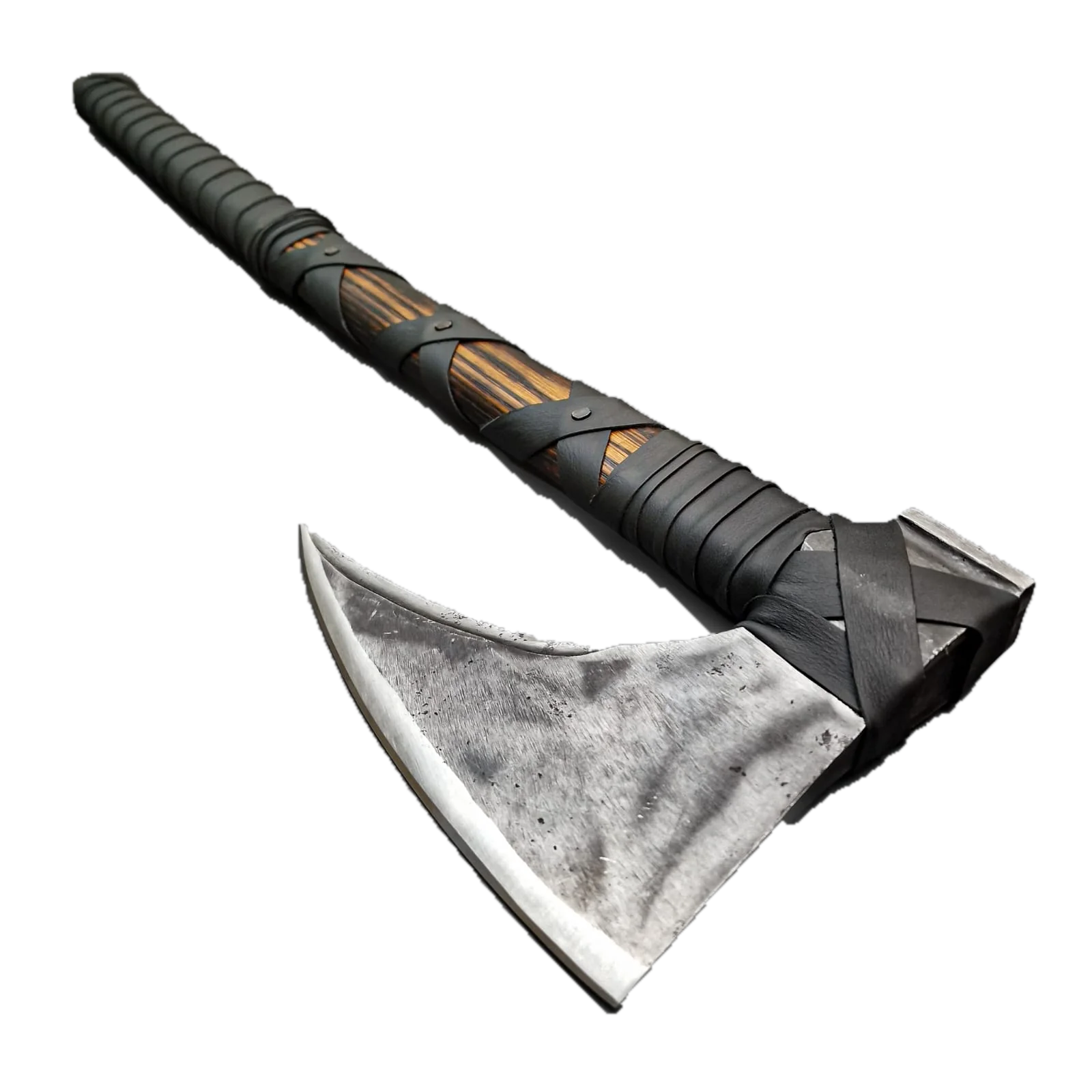
Crescent blade Viking axe with contrasting textures
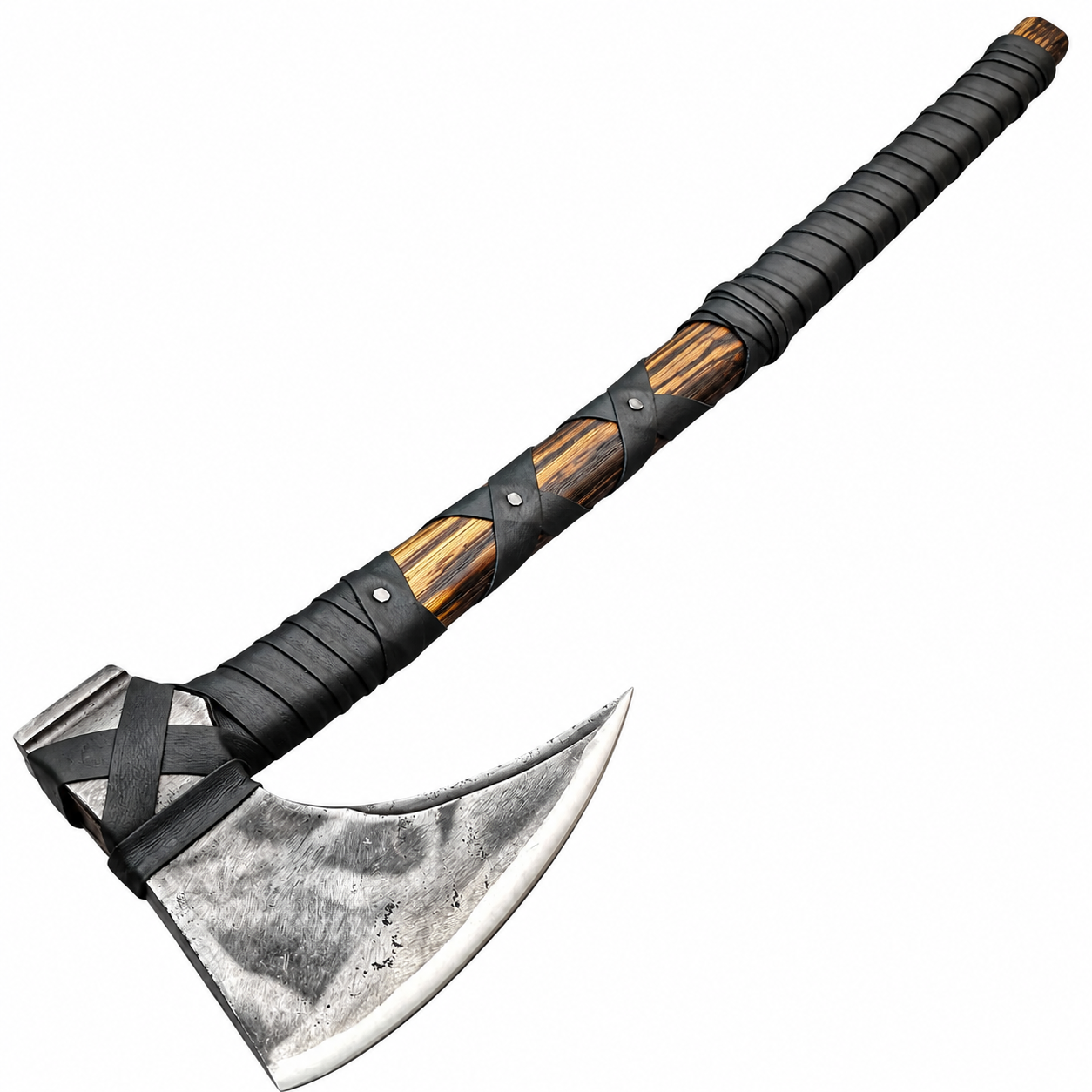
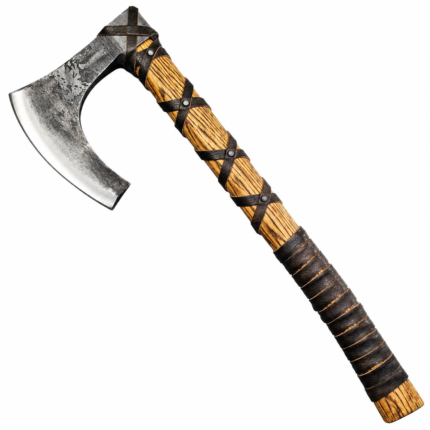
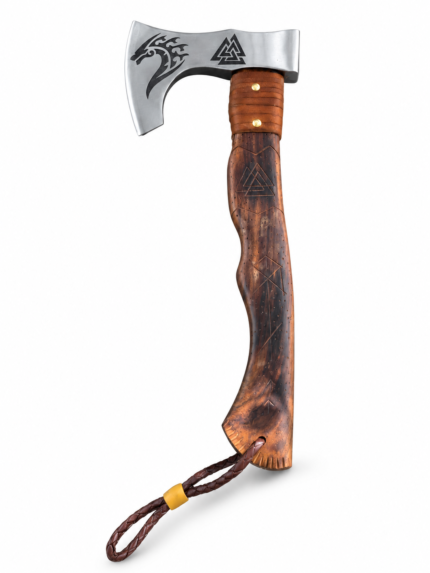
This crescent blade Viking axe combines a sweeping silver-tone head with a brown grain-look shaft, black wrapping, and crossed straps. Its appearance is defined by the contrast between the broad curved blade and the narrow handle. The exposed brown sections introduce warmth, while the black covering creates a consistent visual connection from the head attachment area to the end grip.
The design has several details that reward a closer look. The head displays irregular surface markings, the central shaft has pronounced dark streaks, and small silver-tone fasteners punctuate the crossed straps. These features give the axe a distinctive appearance without relying on colorful decoration, printed graphics, or visible branding.
For customers interested in Viking-inspired designs, the main appeal is the combination of a recognizable axe silhouette and an extensively wrapped shaft. The photograph establishes these visual characteristics, but it does not confirm materials, dimensions, sharpness, or working capability. Those specifications should be checked for the exact product before choosing it for a particular purpose.
A broad crescent-shaped blade
The head expands outward into a broad blade with a curved outer edge and a deeply concave inner outline. One end narrows into a pronounced point, giving the profile its crescent-like appearance. The shape is easy to distinguish from a compact wedge-shaped hatchet or a rectangular chopping head.
A brighter band follows the outer edge, separating it visually from the more textured face. This contrast emphasizes the curve and makes the blade outline a central feature of the design. The head appears substantial relative to the width of the shaft, although its actual thickness and weight cannot be measured from this view.
“Crescent blade” describes the visible shape rather than a performance rating. The photograph does not establish the edge angle, whether the edge is sharpened, or the type of work for which it was made. Customers seeking a functional axe should assess those details alongside the appearance.
Silver-tone head with irregular surface detail
The visible head has a silver-gray color with scattered dark markings and uneven-looking surface texture. Some areas reflect more light than others, producing a finish with visual depth. It does not have the uniform appearance of a completely smooth, mirror-polished surface.
These markings contribute to a rugged-looking style, especially beside the darker bands around the attachment area. They may appeal to customers who prefer visible texture over decorative engraving. No clearly identifiable lettering, emblem, or repeated ornamental motif appears on the main blade face in the supplied image.
The finishing process remains unconfirmed. Surface marks alone cannot prove hand forging, age, a particular steel composition, or previous use. For an accurate product description, the head is therefore identified by its visible color and texture rather than by an assumed manufacturing method or material grade.
A bright border that defines the blade
The lighter band around the outer blade edge is one of the clearest details in the photograph. It follows the broad curve and continues toward the pointed end, creating a clean visual boundary against the irregular head surface. This gives the blade a more defined outline.
The contrast works particularly well with the black wrapping near the head. The dark material frames the attachment area, while the brighter edge draws attention outward toward the blade. This arrangement gives the product a strong visual focal point without adding separate decorative components to the blade face.
The bright band should not be described as proof of a razor-sharp edge or a particular grinding process. Its appearance is visible; its geometry and condition are not established. Buyers who need a sharpened or deliberately blunt version should request a clear statement about the supplied edge.
Brown shaft with pronounced grain-like streaks
The exposed shaft has golden-brown and darker brown tones, with elongated streaks running along its length. These markings create a strong wood-grain appearance. The color is especially noticeable in the open sections between the black cross straps, where the brown surface becomes a central part of the design.
The contrast is more pronounced than on a uniformly colored handle. Light and dark lines give the uncovered sections texture and help distinguish them from the smoother-looking black wrap. A small brown section is also visible at the far end of the handle, linking that end visually with the exposed middle.
Although the shaft resembles wood, the photograph does not confirm its composition or species. It should not be labeled ash, rosewood, hickory, or another hardwood without documentation. Similarly, the dark streaks do not establish that the surface has been burned, stained, carved, or finished by any particular method.
Long black wrapping at the handle end
A substantial portion of the handle’s far end is covered with closely overlapping black bands. The wrapping follows the shaft and creates a repeated ridged appearance along the grip section. Its dark color gives this part of the product a visually consistent finish.
This longer covered section distinguishes the design from axes that have only a short band around the middle of the handle. It also creates a clear visual division between the end grip and the central area with exposed grain-like markings. The repeated overlaps add detail without competing with the blade.
The material has a leather-like appearance, but genuine leather is not confirmed. The photograph also cannot establish softness, cushioning, resistance to slipping, or how securely the wrapping is attached. Those are practical characteristics that require product specifications or inspection rather than visual inference.
Cross straps across the central shaft
Between the wrapped sections, black straps cross over the exposed brown shaft. Their diagonal arrangement creates repeated X-shaped details. Open spaces between the straps reveal the grain-like surface underneath, allowing both materials’ appearances to remain visible.
This is one of the most distinctive elements of the design. The crossed arrangement introduces a different pattern from the close horizontal overlaps at the grip. Together, the two treatments divide the handle into recognizable sections and give the shaft more visual interest than a single uninterrupted covering.
The straps can be described as visible design features, but their structural role is unknown. Their presence does not demonstrate that the shaft is reinforced or protected against impact. Buyers should confirm whether the straps are decorative, functional, or both if that distinction matters to the intended use.
Silver-tone fasteners as small accents
Small silver-tone fasteners are visible along the crossed strap section. Their bright surfaces stand out against the black bands and brown shaft. They also echo the color of the axe head, helping connect the handle details with the larger silver-colored blade.
The fasteners provide restrained decoration rather than dominating the design. Their placement draws attention to the strap arrangement, making the crossings easier to distinguish. This may appeal to customers who prefer subtle metallic accents instead of large studs or extensive hardware.
The image does not establish the fastener alloy, installation method, or depth of attachment. Describing them as silver-tone fasteners avoids assuming they are stainless steel, solid silver, or a particular type of rivet. Their appearance is clear, while their construction needs confirmation.
Wrapping around the head attachment area
Black bands also appear around the head attachment area and the nearby shaft. This connects the head visually with the crossed straps and the long end grip. Rather than leaving the neck completely exposed, the design continues its dark wrapping close to the blade.
The combination creates a layered appearance at the transition between head and handle. Portions of the silver-colored head remain visible around the bands, producing another contrast between metal-like and leather-like surfaces. This detail is useful when comparing the product with similar axes that have an uncovered attachment area.
The internal fixing system cannot be identified from this photograph. The visible wrapping does not prove the presence of a wedge, a particular socket arrangement, or a reinforced connection. Any claim about attachment strength should be supported by information for the exact item being supplied.
A coordinated black, brown, and silver palette
The product uses three main colors: black, warm brown, and silver-gray. Each appears in a different role. The head provides the broad reflective surface, the shaft introduces grain-like variation, and the black wrapping outlines and divides the handle.
This limited palette gives the axe a cohesive appearance despite the variety of textures. The brighter fasteners repeat the head’s color on a smaller scale, while the exposed handle end repeats the brown central sections. Those small connections help the different parts look visually related.
Customers choosing an axe to complement other traditionally styled pieces may find this palette easy to compare with their collection. Exact color matching should still be based on actual-stock photographs. Lighting and screen settings can change how orange the brown appears or how reflective the head looks.
Viking-inspired styling without an assumed identity
The curved head, wrapped shaft, and crossed bands support a Viking-inspired style description. That wording refers to the product’s appearance. It does not establish that the axe reproduces a documented historical object or belongs to a particular period.
Similar designs may be sold under character names, film references, or replica labels. Those associations should not automatically be applied to this product. The uploaded image does not show a brand mark, model number, licensing statement, or other evidence establishing a specific identity.
For customers who simply appreciate the style, a descriptive name is more useful than an uncertain attribution. “Crescent blade Viking axe” identifies the main shape and aesthetic while keeping the listing clear about what is visible. A verified model name can be added later if reliable product information becomes available.
Visual appeal for collectors and enthusiasts
This design may interest adult customers who enjoy axe silhouettes, wrapped handles, and traditionally inspired finishes. Its appeal is not limited to one small decorative feature. The blade shape, exposed shaft, crossed straps, and long grip all contribute to the overall appearance.
Collectors comparing different designs can use these details to identify how this example differs from shorter axes, engraved models, or axes with plain handles. The broad crescent profile offers one point of distinction, while the alternating wrapped and exposed shaft sections provide another.
If the axe is being considered as a gift, the recipient’s preferences should guide the choice. Someone who likes simple metal surfaces and extensive handle detail may appreciate this style. Packaging, personalization, and included accessories remain separate purchase details and are not established by the photograph.
Considering the product for a display
The strong outline and contrasting finishes may make this design visually interesting in a collection display. The head and handle have enough distinct detail to be appreciated as a complete piece, while the crossed bands remain noticeable when viewed more closely.
Display suitability depends on more than appearance, however. The actual length, weight, edge condition, and mounting requirements need to be known before selecting a location or support. No stand, wall bracket, or hanging system is shown, and no mounting compatibility is confirmed.
A customer planning a display should therefore obtain the dimensions and package details first. That allows the space and support to be chosen around the product rather than around an estimate from the photograph. The image can guide the visual choice, while confirmed specifications should guide the physical arrangement.
Working use requires separate confirmation
An axe-shaped product may be made for practical work, collection, or another purpose. The supplied image does not establish which applies here. A broad blade and wrapped shaft are visible, but they do not demonstrate chopping performance or durability.
Customers seeking a working axe should ask for the head material, heat treatment, edge specification, handle construction, and manufacturer-approved applications. The head-to-handle attachment is also relevant. These details help distinguish a suitable working tool from a product selected primarily for appearance.
This listing therefore makes no claim that the axe is suitable for splitting logs, throwing, heavy chopping, or contact reenactment. It also does not classify the item as a safe costume prop. Those uses require evidence about the actual product, not a resemblance to other axes advertised for similar activities.
Dimensions, proportions, and weight
The photograph shows a shaft that appears long relative to the head, but it includes no reliable measuring reference. Overall length, blade width, edge length, and grip circumference remain unknown. The diagonal presentation helps show the whole outline without establishing scale.
Actual measurements are important for customers choosing between a compact axe and a larger piece. They affect storage, display space, packaging, and handling expectations. The blade’s broad appearance should not be used to estimate its thickness or mass, since those properties are not visible from this angle.
Total weight and head weight should also be listed separately when available. Neither can be inferred from the metallic appearance of the head. A confirmed specification sheet would allow customers to compare this product with alternatives on practical terms as well as visual ones.
Grip and handling expectations
The image shows an extended wrapped area that appears intended as a grip section. Its overlapping bands provide visible texture and a consistent black surface. That is a clear design detail, but it does not by itself establish how the handle feels in use.
Comfort depends on dimensions, material, firmness, and the user’s preferences. Balance depends on the distribution of weight between the head and shaft. Neither can be evaluated reliably from a product photograph, and the presence of a wrap should not be treated as proof of improved control.
Customers purchasing for regular handling should request grip measurements and material information. If a sample can be inspected, it can provide a better understanding of finish and fit. The product image remains useful for selecting the style, while physical specifications provide the basis for handling expectations.
What the photograph includes
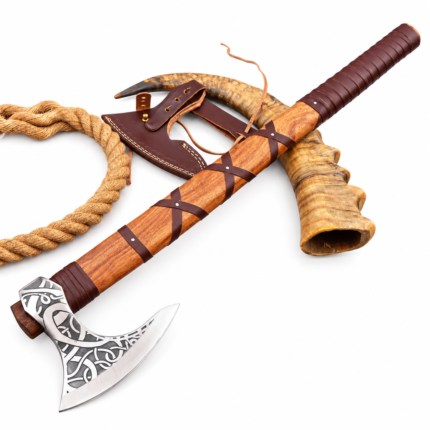
The uploaded image shows one assembled axe with its visible shaft wrapping, crossed straps, and metallic-looking fasteners. There is no separate sheath, blade guard, carrying bag, display stand, or presentation box in the frame.
That distinction matters because similar products are sometimes advertised with accessories. A sheath pictured in another supplier’s listing does not establish that one accompanies this axe. Final package contents should be confirmed against the exact offer being purchased.
The photograph also shows only one side of the product. It does not reveal the full reverse face, all strap terminations, or the internal head connection. Additional views would help buyers assess those areas and confirm that the supplied item matches the pictured configuration.
Care information should match the materials
Appropriate care depends on the confirmed head material, shaft finish, and wrapping composition. A silver-colored head is not enough to determine whether a particular metal polish or protective treatment is suitable. The same applies to products marketed as wood oils or leather conditioners.
Request care instructions that address each component individually. The head, exposed shaft, black bands, and fasteners may have different maintenance needs. A single generic instruction may overlook a finish or material that requires different treatment.
Storage guidance should also identify whether a protective cover is supplied and how the product should be kept between uses or displays. Until those instructions are available, this description does not present a specific oiling, polishing, conditioning, or sharpening routine as manufacturer-approved.
Customization and matching the pictured version
No customization service is established for this exact axe. Although similar supplier listings may offer engraving, alternative colors, or different packaging, those services should not be advertised as available here without confirmation.
For customers who want the pictured appearance, the most useful reference points are the crescent head, black end grip, crossed central straps, silver-tone fasteners, and streaked brown shaft. These details can be checked against an order confirmation or actual-stock image.
If an alternative version is offered, ask which features change. A different wrap color, shorter grip, engraved head, or modified strap layout can noticeably alter the design. Clear variant information helps ensure that a buyer selects the appearance they intended rather than relying on a broad product name.
Choosing this design with clear expectations
The strongest reason to consider this crescent blade Viking axe is its combination of a broad curved head and a detailed wrapped shaft. The silver-tone surface, warm brown sections, and black bands create contrast, while the small fasteners add measured detail.
A complete buying decision should pair that visual appeal with confirmed specifications. Materials, dimensions, weight, edge condition, approved use, and package contents are the key details still needed. They determine whether the item meets a customer’s practical requirements as well as their preferred style.
Explore the photographed design, compare its distinctive strap arrangement and blade profile, and confirm the specifications for the exact version offered. Choose this style if its sweeping outline, textured head, and coordinated handle details are the features you want in your next axe.






Reviews
There are no reviews yet.