







Damascus Folding Pocket Knife with Bone-Style Handle
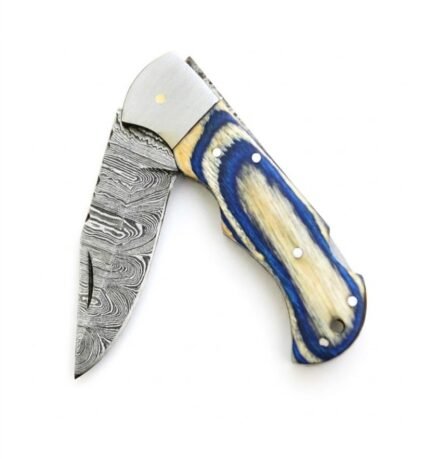
The Damascus Folding Pocket Knife features a distinctive patterned blade, a cream-colored bone-style handle, and decorative metal detailing that creates a traditional yet refined appearance. Its folding construction and carefully coordinated colors make it an interesting choice for adult pocket knife collectors, outdoor enthusiasts, and buyers who appreciate classic cutlery designs.
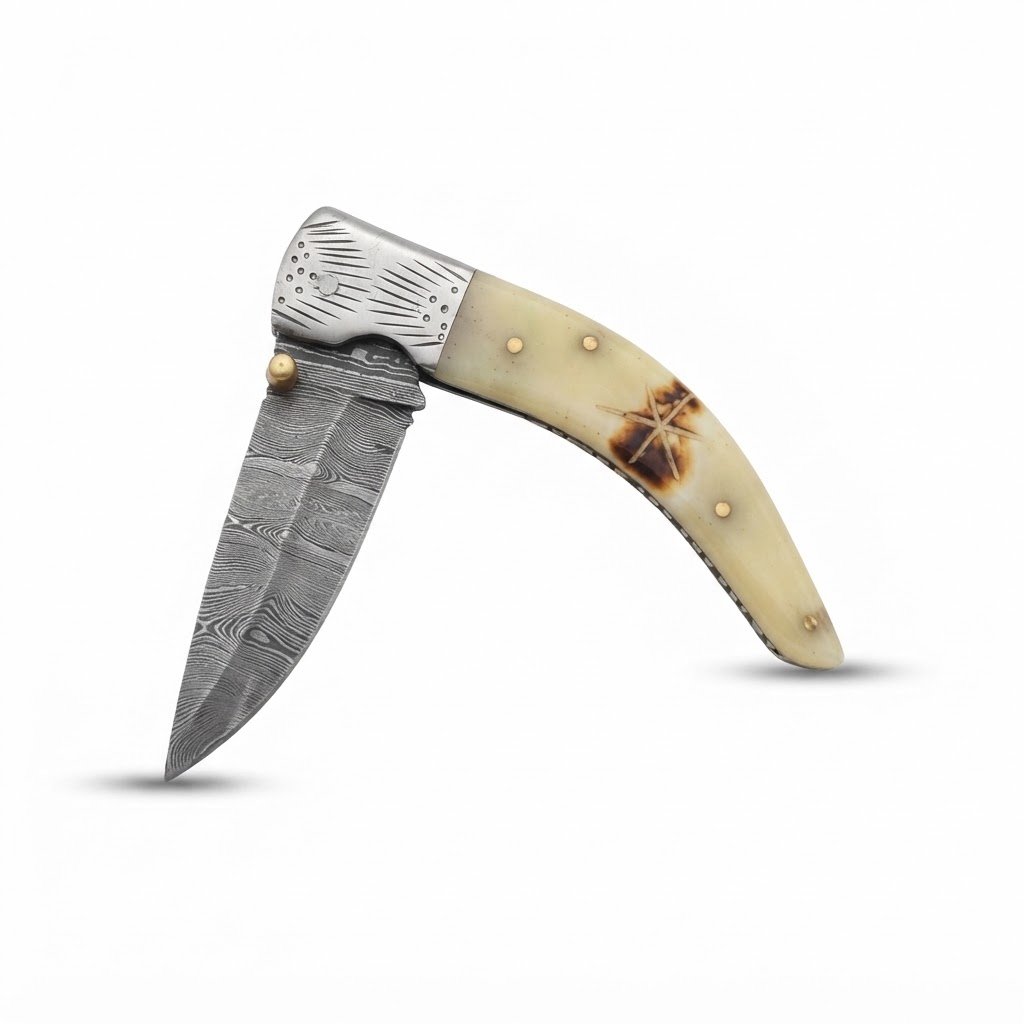
The blade displays flowing silver-gray patterns that resemble the layered appearance commonly associated with Damascus steel. A gold-colored thumb stud is positioned near the blade’s pivot, while the elongated handle features light-colored scales and a decorative metal section with dark and copper-toned accents.
Unlike ordinary plain-handle pocket knives, this design combines several noticeable visual elements. The blade pattern, contrasting handle materials, and metal fittings work together to create a cohesive appearance.
The result is a decorative folding knife with a recognizable traditional profile and distinctive detailing.
Distinctive Damascus-Style Blade Pattern
One of the most noticeable features of this Damascus Folding Pocket Knife is its patterned blade.
The visible blade surface features flowing lines, irregular shapes, and contrasting silver-gray tones. These details create an intricate appearance rather than the uniform finish found on many conventional pocket knives.
The blade pattern includes layered-looking waves that extend from the base toward the tip. Some areas appear darker, while others show lighter silver markings.
These variations give the blade depth and visual interest.
Damascus-patterned blades are popular among knife collectors because of their distinctive appearance. Depending on the manufacturing process, the pattern may be produced through layered steel construction or decorative surface treatment.
The photograph confirms that this product has a Damascus-style visible pattern. However, it does not establish whether the blade is genuine pattern-welded Damascus steel.
The manufacturer should confirm the steel composition, number of layers if applicable, and manufacturing method before these specifications are advertised as verified facts.
Traditional Folding Pocket Knife Construction
This knife has a folding blade that is shown in the open position.
A folding mechanism allows the blade to rotate around a pivot and be stored inside the handle when closed.
This design differs from fixed-blade knives, which have a permanently extended blade.
Folding pocket knives are commonly included in everyday utility, outdoor equipment, and collectible cutlery categories.
The pictured knife has a slim, elongated handle and a pointed blade that follows a gentle curve.
The blade appears proportionate to the handle, creating a traditional pocket knife silhouette.
A visible gold-colored thumb stud is positioned near the blade’s base.
Thumb studs are commonly used on folding knives to provide a contact point for opening the blade. However, the precise operation of this knife cannot be confirmed from a still photograph.
The locking mechanism, pivot construction, opening resistance, and blade retention should be checked against the supplier’s specifications.
Cream-Colored Bone-Style Handle
The handle provides a strong visual contrast to the patterned metal blade.
Its primary color is a warm cream or ivory tone with natural-looking darker markings.
The surface has a slightly irregular appearance, giving it a traditional bone-style finish.
The two light-colored handle sections extend along the length of the knife, creating a slim, gently rounded profile.
The handle has a subtle curve that follows the overall shape of the knife.
Its rear end is rounded, while the area closer to the pivot transitions into a metal section.
The handle resembles the appearance of traditional bone-handled pocket knives.
However, the actual material cannot be established from the image alone.
It may be natural bone, a synthetic material, or another material finished to resemble bone.
For an accurate product listing, the material should be verified with the manufacturer before using claims such as genuine bone, camel bone, buffalo bone, or stag horn.
Decorative Copper-Colored Metal Inlay
Another distinguishing feature is the decorative metalwork visible along the center of the handle.
This section has contrasting silver-gray, dark, and copper-colored details.
Small patterned shapes are arranged along its length, forming a decorative strip that complements the blade.
The copper-toned center provides a warmer accent between the light handle sections.
The surrounding dark markings create additional contrast.
This design gives the pocket knife a more elaborate appearance than a model with a completely plain handle.
The decorative details may appeal to customers interested in traditional cutlery, patterned metalwork, and collectible folding knives.
The image does not confirm whether the copper-colored section is solid copper, a copper alloy, an inlay, or a surface finish.
Those construction details require supplier confirmation.
Gold-Colored Thumb Stud
The blade includes a small round, gold-colored stud near the pivot.
This feature stands out against the silver-gray blade.
Its color also complements the warm tones of the handle’s decorative metalwork.
On many folding knives, thumb studs provide a convenient point of contact during blade opening.
The presence of the stud is clearly visible.
However, the photograph does not establish whether the knife can be opened smoothly with one hand or whether its mechanism has any assisted-opening features.
Customers should refer to the manufacturer’s instructions for the intended operation.
Before using the knife, the blade should be inspected to confirm that it opens, closes, and secures correctly.
Slim and Traditional Handle Profile
The Damascus Folding Pocket Knife features an elongated handle with gently rounded edges.
Its shape gives it a classic pocket knife appearance.
The handle is wider near the rear end and narrows slightly toward the central section.
The light-colored scale material covers much of the visible handle surface.
Decorative metalwork follows the upper length of the handle.
The relationship between the blade and handle creates a balanced visual design.
Although its proportions appear compact relative to larger outdoor knives, the exact overall length and folded dimensions cannot be estimated reliably from the image.
Those measurements are necessary for customers comparing pocket knife sizes.
The manufacturer’s measurements should be added before publication.
Attractive Metal and Handle Color Combination
The knife uses a carefully coordinated combination of colors.
Its blade is predominantly silver-gray, with darker patterned areas.
The handle scales are cream-colored with brown markings.
The center detailing includes copper, dark gray, and silver tones.
The thumb stud has a warm gold-colored finish.
Together, these elements create a traditional appearance.
The combination of light handle scales and patterned steel makes the knife visually recognizable.
For collectors, these finishing details are often an important part of product selection.
The patterned blade also contrasts with the relatively smooth handle.
This difference in texture makes the individual parts easy to distinguish.
The overall design is decorative without requiring an oversized or complicated handle shape.
Suitable for Adult Pocket Knife Collectors
Folding pocket knives are collected for many reasons.
Some collectors focus on blade shapes and construction methods.
Others appreciate unusual handle materials, decorative metal fittings, or traditional designs.
This knife brings several visually interesting features together in one product.
The blade has a flowing pattern.
The handle has an ivory-colored appearance.
The central metal detailing adds contrast.
The gold-colored stud creates a small but noticeable finishing accent.
These elements may appeal to adult collectors who appreciate patterned blades and traditional folding designs.
This model can also be considered by customers browsing decorative cutlery collections or looking for a distinctive knife-related gift for an adult recipient.
Before purchasing for practical use, buyers should confirm the actual materials and operating specifications.
Folding Knife Applications
Folding knives are commonly associated with general utility, outdoor activities, camping equipment, and personal tool collections.
The specific uses appropriate for any folding knife depend on its construction, blade geometry, locking system, and manufacturer guidance.
The pictured knife has a pointed blade and a traditional folding design.
Its profile resembles knives commonly marketed in pocket knife and outdoor knife categories.
However, the image does not provide sufficient information to confirm its load capacity, edge retention, resistance to corrosion, or suitability for demanding outdoor conditions.
A decorative Damascus-style pattern should not be treated as proof of superior performance.
The underlying steel composition and heat treatment are more important indicators of blade properties.
Customers seeking a knife for regular utility work should review the verified technical specifications before choosing this model.
Understanding Damascus Steel and Patterned Blades
The term Damascus steel is widely used in the cutlery industry.
Modern pattern-welded Damascus is commonly produced by combining layers of different steels and processing them to create decorative patterns.
The resulting surface may display waves, flowing lines, circular shapes, or irregular designs.
The appearance can vary depending on the materials and manufacturing process.
Some knives with Damascus-style patterns are produced using different methods, including decorative surface treatments.
Because these finishes can look similar in photographs, appearance alone is not sufficient to identify the exact blade material.
This knife visibly has an intricate layered-looking pattern.
Its actual composition remains unverified.
Buyers interested in authentic pattern-welded Damascus should ask the manufacturer for steel specifications and manufacturing details.
This information allows customers to compare products more accurately.
Handle Materials and Decorative Fittings
The handle combines multiple visible components.
Light-colored scales cover much of the handle.
The central decorative metal section features contrasting markings.
Small metallic pins and a decorative strip can be seen along the handle.
A smooth transition joins the handle to the blade pivot area.
These components create a detailed appearance.
However, their functional roles cannot all be determined from the photograph.
Some visible fasteners may contribute to assembly, while others may be decorative.
The photograph does not reveal the internal liners, frame material, or fastening system.
Customers interested in the product’s mechanical construction should request a supplier specification sheet.
Detailed product information should identify the handle scale material, liner material, pivot construction, and locking mechanism where applicable.
Knife Care and Cleaning
Proper cleaning helps preserve the appearance of a folding knife.
After use, remove dirt and moisture carefully.
Wipe the blade using a soft, clean cloth.
Pay attention to the area around the blade pivot, where small particles can accumulate.
Avoid using unnecessary abrasive cleaning products.
Aggressive polishing may affect the appearance of a decorative blade pattern.
If moisture enters the folding mechanism, follow the manufacturer’s recommended cleaning and drying procedure.
Use only suitable lubricants when recommended.
Do not apply excessive oil or cleaning products to the handle.
Before storing the knife, make sure it is clean and dry.
The correct maintenance procedure depends partly on the actual steel and handle materials, which should be confirmed with the supplier.
Caring for the Bone-Style Handle
The cream-colored handle should be cleaned gently.
A soft cloth can remove ordinary dust and fingerprints.
Avoid prolonged exposure to water.
The handle should also be protected from unnecessary heat and harsh chemicals.
If the material is genuine natural bone, it may require different care from synthetic handle materials.
Natural materials can respond differently to moisture, temperature changes, and cleaning products.
For that reason, the manufacturer should identify the material before specific conditioners or treatments are recommended.
Inspect the handle periodically for visible damage.
Check for cracks, separation, loose fittings, or excessive movement.
If damage is found, discontinue use until the knife has been inspected.
Maintaining the Folding Mechanism
The pivot area is an important part of any folding knife.
It allows the blade to move between open and closed positions.
Regular inspection helps identify looseness, debris, or irregular movement.
The blade should move according to the manufacturer’s operating instructions.
Do not force the folding mechanism if it becomes obstructed.
Do not attempt to adjust internal components without suitable technical guidance.
The photograph does not confirm the presence or type of blade lock.
Consequently, customers should not assume that this model has a liner lock, frame lock, lockback, or another specific locking system.
The supplier should confirm the opening and locking design before this information is included in the final specification table.
Product Specifications
Product Type: Folding pocket knife
Design: Traditional decorative folding knife
Blade Appearance: Silver-gray Damascus-style pattern
Blade Shape: Pointed blade with gently curved cutting edge
Handle Color: Cream, ivory, brown, and metallic accents
Handle Appearance: Bone-style scales
Handle Detail: Decorative copper-colored and dark patterned metalwork
Opening Feature: Visible gold-colored thumb stud
Blade Steel: Not verified
Genuine Damascus Construction: Not verified
Handle Material: Not verified
Blade Lock Type: Not verified
Blade Length: Not verified
Overall Length: Not verified
Closed Length: Not verified
Blade Thickness: Not verified
Weight: Not verified
Hardness: Not verified
Country of Origin: Not verified
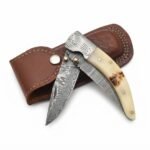
Sheath or Packaging: Not shown
Customization Options: Not verified
Responsible Handling and Storage
A folding pocket knife should always be handled as a sharp cutting tool.
Inspect the blade and folding mechanism before use.
Keep fingers clear of the blade’s closing path.
Do not place pressure on a folding blade unless the mechanism is suitable for the intended task.
Avoid using the knife as a pry bar or striking tool.
When not in use, close the blade according to the manufacturer’s instructions.
Store the knife in a secure, dry location.
Keep it away from children and unauthorized users.
Follow local regulations concerning knife possession, carrying, transportation, and use.
These precautions are important regardless of the knife’s size or decorative appearance.
Why Choose This Damascus Folding Pocket Knife?
The Damascus Folding Pocket Knife has a number of distinctive design features.
Its patterned blade creates an attractive silver-gray appearance.
The cream-colored handle brings a traditional style.
Copper-colored metalwork adds decorative contrast.
The gold-colored thumb stud provides another noticeable detail.
The folding design makes the knife different from fixed-blade alternatives.
Together, these features create a distinctive product for adults interested in decorative pocket knives and collectible cutlery.
Its visual design is the primary confirmed characteristic.
Customers interested in practical performance should review the manufacturer’s specifications before purchase.
Explore This Traditional Folding Knife
The Damascus Folding Pocket Knife with Bone-Style Handle offers an attractive combination of patterned metal, cream-colored handle scales, and decorative copper-toned details.
Its traditional folding silhouette and contrasting finishes make it an interesting addition to a pocket knife collection.
Explore this design and review its confirmed construction specifications to determine whether it meets your requirements.







Reviews
There are no reviews yet.