







Damascus Gut Hook Hunting Knife – Distinctive Design for Outdoor Enthusiasts
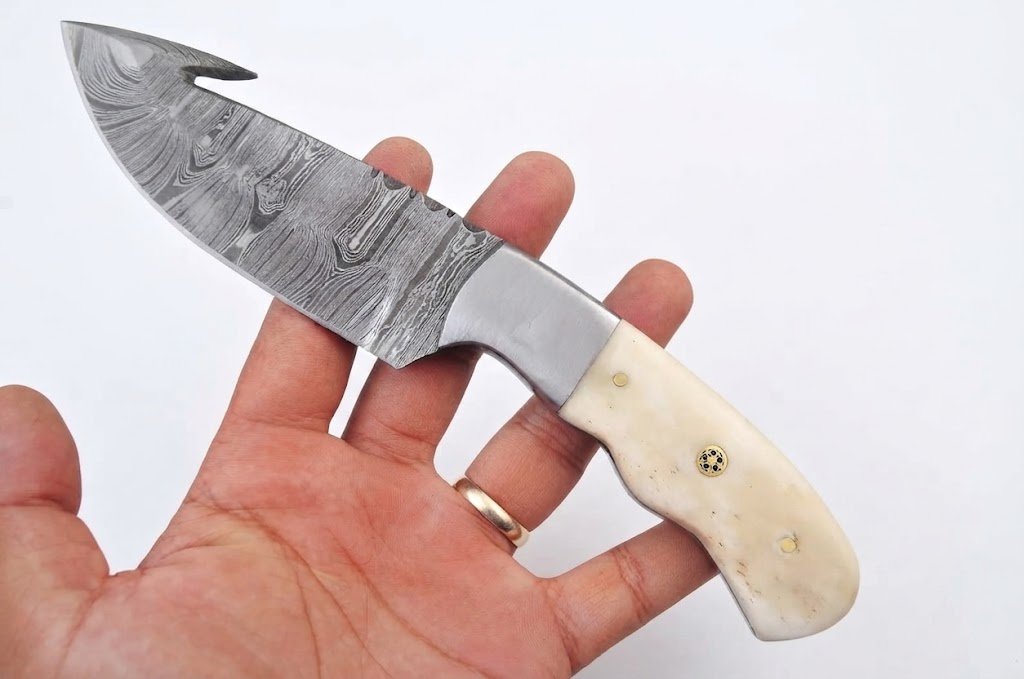
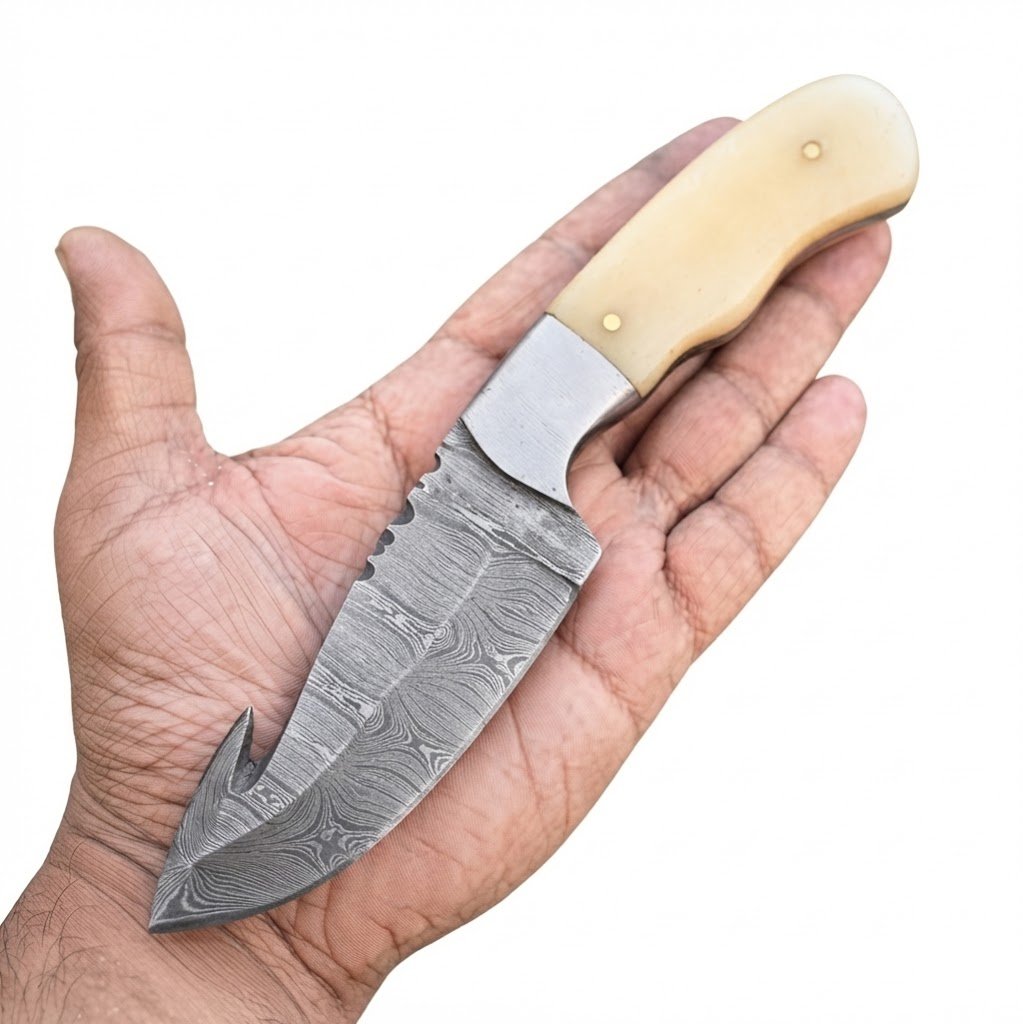
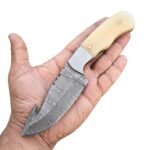
The Damascus Gut Hook Hunting Knife brings together a practical hunting-knife profile and a distinctive appearance that appeals to outdoor enthusiasts, knife collectors, and buyers who appreciate decorative cutlery. Featuring an attractive patterned blade, a gut hook near the tip, and an elegant ivory-colored handle, this knife offers a recognizable design with several carefully considered visual details.
Unlike an ordinary straight-edge hunting knife, this model features a curved, hook-shaped opening along the spine near the blade tip. This specialized feature is commonly associated with field dressing and skinning knives, making the design especially recognizable within the hunting knife category.
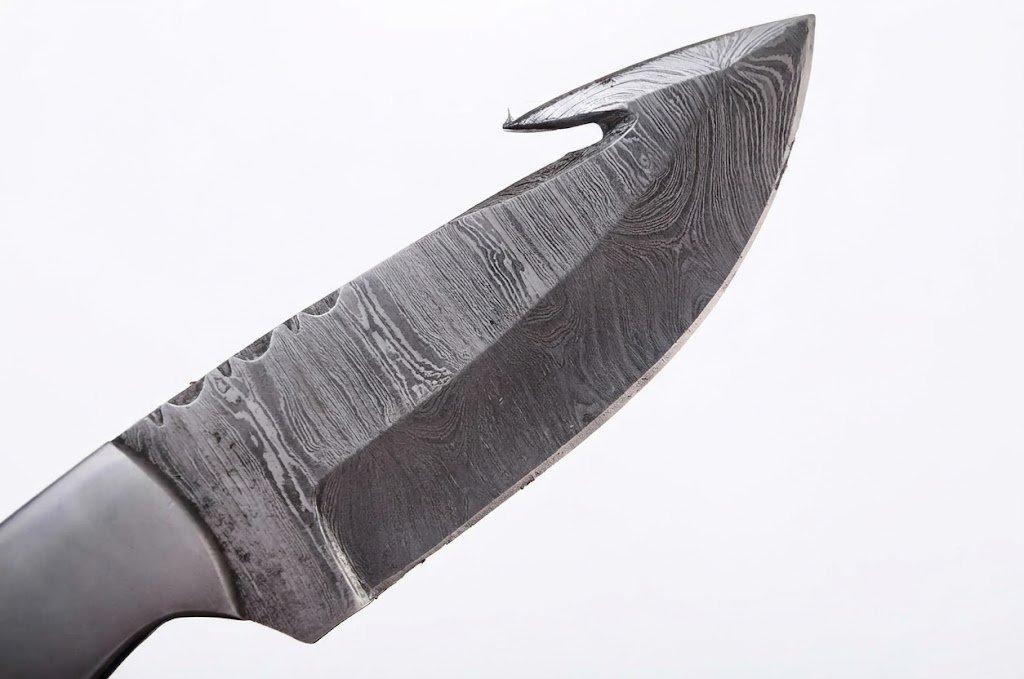
The patterned blade surface provides another defining characteristic. Its flowing gray and silver lines resemble the layered appearance traditionally associated with Damascus steel. The pattern extends across much of the blade and gives the knife an individual visual identity.
Complementing the blade is a smooth, light-colored handle, decorated with small metallic accents and a circular ornamental pin. A silver-colored bolster separates the handle from the cutting portion, creating an attractive transition between the different finishes.
Whether you are exploring hunting knife designs, selecting a piece for an outdoor equipment collection, or looking for an unusual gift, this knife offers an appealing combination of traditional styling and practical form.
Distinctive Damascus-Style Blade Pattern
One of the most noticeable characteristics of this Damascus Gut Hook Hunting Knife is its detailed blade pattern.
The surface displays overlapping curved lines and layered formations in various shades of gray. These markings create a textured visual effect, contrasting with the smoother metallic surface of the bolster and handle fittings.
Damascus-patterned knives are popular among collectors because their designs stand apart from conventional plain-finished blades.
The visible pattern on this model includes several features that contribute to its appearance.
The curved lines follow the contours of the blade and appear to change direction across different areas. Some sections show closely spaced waves, while others have broader, rounded formations.
This combination gives the knife a decorative appearance without requiring colorful coatings or additional surface ornaments.
The blade has a broad profile near the handle and gradually narrows toward its pointed tip. Its lower cutting edge follows a gently curved line, while the upper section contains the recognizable gut hook.
Although the surface resembles Damascus steel, the photograph does not establish whether the blade is pattern-welded, etched, or produced using another process. The precise steel grade, layer count, and heat treatment should be confirmed before being advertised as technical specifications.
For buyers who appreciate patterned hunting knives, the visual design is one of this product’s main attractions.
Functional Gut Hook Blade Profile
The defining feature of a gut hook hunting knife is the recessed hook positioned along the back of the blade near the tip.
In this model, the gut hook is visible as a small inward-facing opening behind the pointed tip. Its shape distinguishes the knife from a conventional drop-point hunting blade.
Gut hooks are traditionally associated with field dressing, where an appropriately sharpened and correctly used hook may assist with controlled opening cuts.
The hook is separate from the main cutting edge, which follows the curved lower portion of the blade.
This arrangement provides two distinct cutting features within a single knife profile.
The primary edge is shaped for general cutting tasks, while the hook represents a specialized feature commonly used in hunting-related applications.
Actual cutting performance depends on edge geometry, sharpness, steel composition, and proper handling. These characteristics cannot be measured from a product photograph.
The design may appeal particularly to buyers searching for a recognizable hunting knife with a specialized blade shape instead of an ordinary general-purpose knife.
Ivory-Color Handle with Decorative Details
The handle provides a striking contrast to the dark gray patterned blade.
Its smooth, creamy ivory-colored surface creates a simple and elegant appearance. Small variations in tone give the handle a natural-looking finish.
The handle is shaped with a gently curved profile and a rounded rear end.
A slight inward contour near the bolster helps define the gripping area, while the broader rear section provides a visually balanced shape.
Three metal-colored accents are visible on the handle: two small round pins and a larger circular decorative fitting. A separate lined opening is located near the rear end.
These details contribute to the knife’s appearance while adding visual interest to an otherwise minimal handle.
The pins and fitting have a gold-toned appearance, which contrasts with the pale handle.
The photograph does not confirm whether the handle is made from natural bone, horn, resin, synthetic ivory, or another material. For this reason, the product is described as having an ivory-colored handle rather than claiming a specific material.
Its traditional styling makes it suitable for customers who prefer neutral, natural-looking handle colors.
Polished Metal Bolster
Between the blade and handle is a broad, silver-colored bolster.
This component creates a clean visual separation between the patterned blade and the ivory-colored handle.
The polished surface contrasts with the decorative blade markings, contributing to a more refined appearance.
The bolster follows the shape of the handle and connects to the blade with a curved lower contour.
Bolsters are commonly used in fixed-blade knife construction to create a finished transition between the handle and cutting section. Their precise structural contribution varies by design.
On this particular knife, the bolster is a prominent visual feature.
Its smooth appearance makes the surrounding Damascus-style pattern more noticeable, while its metallic finish complements the small handle pins.
Comfortable-Looking Curved Handle Profile
The Damascus Gut Hook Hunting Knife has a contoured handle design.
Rather than using a perfectly straight handle, this model incorporates gentle curves along the upper and lower surfaces.
The handle widens toward the rear and narrows slightly near the bolster.
This familiar hunting-knife profile is often selected because it accommodates a natural hand position.
The smooth-looking surface and rounded edges contribute to its finished appearance.
However, comfort and grip security depend on hand size, surface texture, moisture, and the knife’s actual dimensions. These should be assessed in person rather than assumed from the image.
For collectors, the handle’s main attraction may be its balance of simple ivory tones, metallic fittings, and traditional shaping.
Designed Around Traditional Hunting Knife Styling
Hunting knives are available in many different blade profiles and handle designs.
Some emphasize compactness, while others feature broad blades, pronounced guards, or highly specialized cutting shapes.
This knife combines a pointed hunting-style blade with a small gut hook and decorative handle.
The result is a design that fits naturally into collections of hunting, skinning, and outdoor knives.
The patterned blade adds a decorative element, while the curved edge and hook distinguish it from ordinary display knives.
For a customer browsing online, the combination of these features makes the product easy to recognize.
The light handle also creates a clear contrast against the blade, allowing the overall design to remain visible in product photography.
A buyer interested in traditional-looking hunting equipment may appreciate the restrained color palette and detailed metal pattern.
A Distinctive Piece for Knife Collections
Collectors often look for knives with recognizable design features.
The Damascus Gut Hook Hunting Knife has several such characteristics, including its patterned blade, specialized hook, ivory-colored handle, and decorative bolster.
Together, these elements give the knife a traditional appearance with subtle ornamental details.
The blade pattern is particularly noticeable when photographed against a plain background.
Meanwhile, the pale handle makes it visually different from the dark wood, black polymer, and brightly colored handles commonly found on other hunting knives.
This contrast may appeal to customers building a varied knife collection.
The knife could also be displayed as part of a collection of patterned blades or hunting-style cutlery.
For safe display, the cutting edge should remain protected and the knife should be kept in a secure location inaccessible to children.
The photograph shows the knife alone and does not confirm that a protective sheath, display stand, or storage case is included.
Outdoor Equipment and Appropriate Uses
The general profile is consistent with knives commonly marketed for hunting-related activities and outdoor cutting tasks.
A knife of this type may be considered for field dressing or controlled utility cutting where lawful and appropriate.
Before relying on this product for actual field use, customers should verify the blade material, cutting-edge condition, dimensions, and construction.
These properties are important because visual appearance alone does not establish performance.
Users should also select equipment suited to the specific task rather than assuming that all hunting knives have identical capabilities.
The gut hook adds a specialized design feature, but its usefulness depends on correct sharpening, safe handling, and the intended application.
For camping or outdoor activities, a suitable protective sheath is important for transport and storage.
Since a sheath is not pictured, its inclusion should be confirmed with the seller.
Gift Appeal for Outdoor Enthusiasts
A hunting-style knife with a distinctive appearance can be an appealing gift for an adult who collects outdoor equipment or decorative cutlery.
The ivory-colored handle, patterned blade, and metallic fittings give this model a presentation that differs from more basic utility knives.
Its visual details make it appropriate for buyers interested in traditional hunting-knife designs.
For collectors, the decorative surface may be as important as the cutting profile.
A buyer may choose the knife specifically because of the contrast between its light handle and intricate blade markings.
Before purchasing it as a gift, check the recipient’s local laws concerning knife possession and delivery.
A presentation box or leather sheath could enhance gifting suitability, but neither should be advertised as included unless the supplier confirms it.
Product Appearance and Visible Features
The photograph provides several details that can be described confidently.
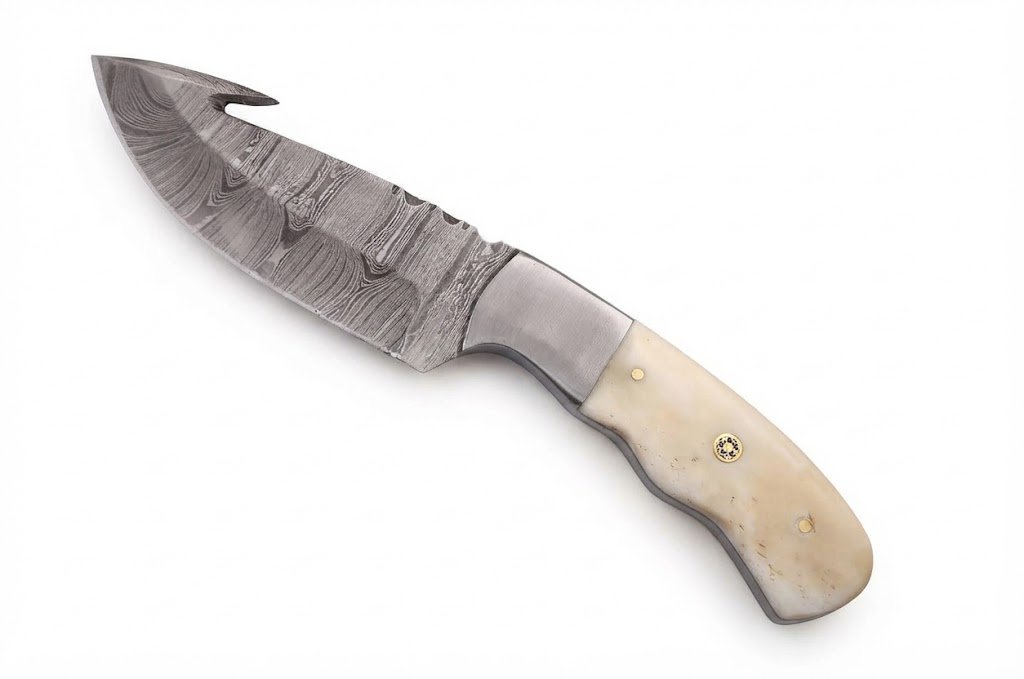
The blade has a silver and gray Damascus-style pattern with wave-like markings. Its lower edge curves toward a pointed tip, while the upper edge includes a recessed gut hook.
The handle has a creamy ivory-colored surface with a rounded rear and gently contoured shape.
A gold-toned circular opening is visible near the handle end.
Two smaller gold-toned pins and a larger decorative circular fitting appear on the handle.
A polished silver-colored bolster connects the handle area to the blade.
The image shows one knife against a plain white background.
No dimensions, weight markings, steel grade, manufacturer identification, or included accessories are visible.
This description focuses on those observable features rather than introducing unsupported specifications.
General Knife Care and Maintenance
Appropriate maintenance helps preserve the appearance and condition of a knife.
After use, clean the blade carefully and remove moisture before storage.
Avoid leaving the knife wet for extended periods, particularly when its exact steel composition and corrosion resistance are unknown.
A soft, dry cloth can be used for routine surface cleaning.
If the knife is confirmed to have carbon-steel components, additional corrosion protection may be appropriate according to the manufacturer’s recommendations.
Use suitable sharpening equipment and follow the manufacturer’s instructions for the main cutting edge and gut hook.
The hook may require a different sharpening approach from the main blade because of its recessed shape.
Avoid aggressive sharpening methods that could damage the blade profile.
Store the knife with its cutting edge protected.
If a sheath is supplied, inspect it for moisture and debris before prolonged storage.
The handle should also be cleaned using methods compatible with its confirmed material. Strong solvents or prolonged soaking should be avoided until the handle composition is known.
These general precautions are intended to support responsible ownership rather than replace manufacturer-specific maintenance instructions.
Choosing the Right Hunting Knife
When comparing hunting knives, the blade profile is only one consideration.
Customers should also review the actual blade length, overall size, handle construction, cutting-edge geometry, and included accessories.
A Damascus-style finish does not automatically indicate a particular steel grade, level of toughness, or edge-retention capability.
Likewise, decorative pins and fittings do not establish whether a knife uses full-tang construction.
For this model, those specifications should be checked with the supplier before purchase.
The image does, however, clearly establish the knife’s overall appearance and main design elements.
For customers prioritizing visual styling and a recognizable gut hook profile, it offers a distinctive combination.
For buyers focused primarily on repeated outdoor cutting tasks, verified technical specifications are equally important.
Why This Design Stands Out
Many hunting knives use dark handles and plain blade finishes.
This model takes a different visual approach.
The creamy handle creates a bright focal point, while the patterned blade adds movement and texture.
The broad silver-colored bolster provides a polished separation between these surfaces.
The decorative hardware contributes subtle accents without overwhelming the overall appearance.
Finally, the gut hook gives the blade a recognizable hunting-oriented form.
These details make the knife suitable for customers interested in both design and practical knife categories.
The Damascus Gut Hook Hunting Knife is a distinctive addition to a collection of hunting-style cutlery. Explore its patterned blade, ivory-colored handle, and specialized hook design to decide whether it is the right choice for your collection or outdoor equipment needs.




Reviews
There are no reviews yet.