






Damascus Hunting Knife with Wood and Antler-Style Handle
The Damascus Hunting Knife with Wood and Antler-Style Handle combines a traditional fixed-blade profile with distinctive decorative details. Featuring an eye-catching patterned blade, a curved metal guard, and a carefully coordinated multi-section handle, this knife offers an appealing design for knife collectors, outdoor enthusiasts, and buyers who appreciate traditional cutlery.
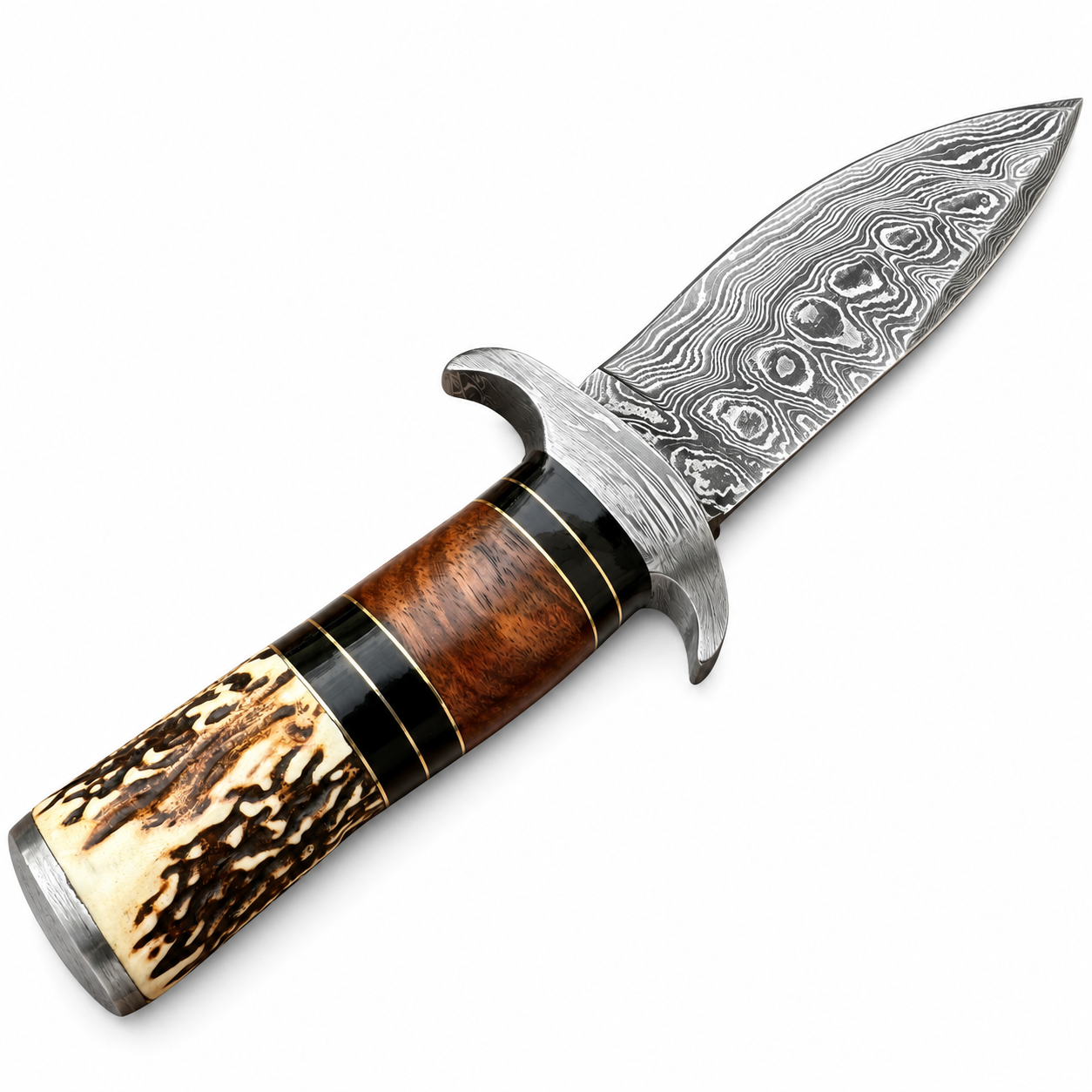
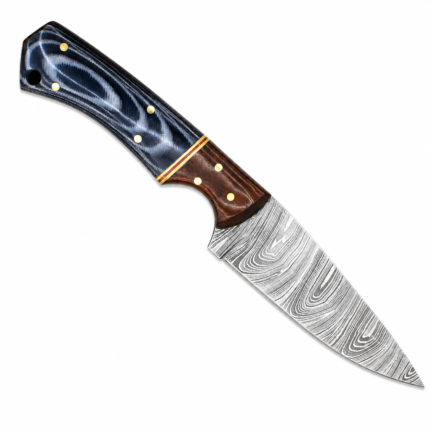
Its silver-and-grey blade features flowing, layered-looking patterns that create a striking contrast against the warmer colors of the handle. A polished, curved guard separates the blade from the grip, while dark spacers and gold-colored accents complement the brown wood-look middle section and cream-colored antler-style end.
Rather than relying on elaborate decoration across every surface, the design brings together different textures, tones, and shapes to create an attractive overall appearance.
Whether displayed as part of a knife collection or considered for appropriate outdoor cutting activities, this Damascus Hunting Knife stands out for its recognizable fixed-blade form and traditional styling.
Distinctive Damascus-Style Blade Pattern
One of the most noticeable features of this knife is its patterned blade. Fine, flowing lines extend across the blade surface, creating a combination of silver, grey, and darker tones.
These layered-looking markings are commonly associated with Damascus-pattern knives. Their visual complexity makes each section of the blade interesting to examine, especially around the curved cutting edge and pointed tip.
The blade has a broad profile near the guard before narrowing toward its point. A sweeping cutting-edge shape gives the knife a familiar hunting-knife silhouette.
The visible pattern enhances the knife’s decorative appeal while maintaining the clean outline of a traditional fixed-blade design.
Although the surface resembles Damascus steel, the exact material composition, forging method, heat treatment, and hardness cannot be determined from the photograph alone. Those specifications should be confirmed before they are included as technical product claims.
Traditional Fixed-Blade Design
The Damascus Hunting Knife follows a fixed-blade configuration, meaning the blade does not fold into the handle.
Fixed-blade knives have a long history in outdoor recreation, hunting equipment, camping accessories, and traditional cutlery collections.
Their straightforward design is popular among customers who prefer knives without a folding mechanism.
This particular design features a visibly defined transition between the blade and handle, with a substantial-looking guard separating the two sections.
The blade extends forward in a relatively broad shape before narrowing to a pointed end. Its curved cutting edge contributes to the recognizable appearance of a traditional hunting knife.
Customers interested in outdoor knives often compare blade profiles, handle shapes, materials, and overall dimensions before making a purchase.
For this model, the photograph provides useful visual information about the profile, but the actual cutting performance and suitability for demanding outdoor tasks would need to be established through verified specifications and product testing.
Brown Wood-Look Handle Section
A key visual feature of this Damascus Hunting Knife is its rich brown handle section.
The middle portion displays a warm, wood-grain appearance with darker natural-looking markings.
This brown finish provides a pleasing contrast to the silver-and-grey blade and the darker decorative spacers surrounding the handle sections.
The grip appears smoothly contoured rather than sharply angular, giving the knife a classic appearance.
Its elongated shape helps maintain a balanced visual relationship between the blade and handle.
Wooden handles have traditionally been associated with hunting knives and outdoor tools because of their natural appearance. However, the photograph alone does not establish the exact wood species or whether every brown section is made from natural wood.
The visible surface should therefore be described as wood-look or wood-grain until the manufacturer confirms its composition.
For collectors who appreciate traditional materials and styling, the brown handle section adds a familiar character that complements the patterned blade.
Antler-Style Handle End
Another distinctive design element is the cream-colored section at the rear of the handle.
This portion features dark brown, irregular markings that resemble the natural appearance of antler material.
The combination of cream, brown, and black gives the rear section a rustic outdoor character.
Antler-style details are frequently associated with traditional hunting equipment and collectible knife designs.
In this example, the cream-colored end section creates an attractive contrast with the darker wood-look middle section.
The surface also introduces another texture to the handle, adding visual interest without changing the knife’s overall traditional appearance.
Because the photograph cannot establish whether this component is genuine antler, bone, resin, or another decorative material, it should be advertised as an antler-style section until material verification is available.
This distinction is particularly important for buyers who have specific preferences regarding natural or synthetic handle materials.
Decorative Black and Gold-Colored Spacers
The handle incorporates several dark bands separated by thin gold-colored lines.
These decorative spacers appear between the wood-look and antler-style sections and near the metal guard.
Although relatively small, they contribute significantly to the knife’s visual presentation.
The black sections introduce contrast, while the thin gold-colored lines coordinate with the warmer brown and cream tones.
This arrangement creates clearly defined transitions between the different handle materials or finishes.
The overall result is a segmented handle design that looks intentional and coordinated.
These details may be especially appealing to collectors who enjoy decorative knife construction, contrasting handle components, and traditional cutlery styling.
The precise composition of the spacers and metal-colored accents has not been verified. They should not be identified as brass, precious metal, or another specific material without manufacturer confirmation.
Curved Metal Guard
Between the patterned blade and handle is a curved silver-colored guard.
This component is one of the most recognizable characteristics of the knife.
The guard extends outward on both sides of the handle, giving the knife a classic hunting-knife appearance.
Its polished-looking surface contrasts with the darker blade pattern and warm handle colors.
Guards are common design elements on traditional fixed-blade knives. Their configuration can help define the boundary between the gripping area and the blade.
However, the photograph does not establish how this particular guard performs under use or whether it has been tested against specific safety or durability standards.
From a design perspective, it adds visual definition and creates a smooth transition between the blade and the decorated handle.
For buyers comparing traditional hunting knife styles, the guard is an important feature to consider alongside the blade shape and handle profile.
A Distinctive Addition to Knife Collections
Collectors frequently look for pieces that offer recognizable blade shapes, interesting surface patterns, and unique handle combinations.
This Damascus Hunting Knife brings several of those design qualities together.
The flowing blade pattern is visually prominent, while the handle combines multiple contrasting finishes.
A traditional curved guard completes the appearance.
These details make the knife suitable for consideration as a collectible cutlery item, provided its actual materials and condition meet the buyer’s expectations.
Collectors may choose to display such a knife in a suitable cabinet, display case, or dedicated storage area.
When evaluating a collectible knife, customers should also consider the manufacturer’s identity, steel composition, material authenticity, craftsmanship, and any supplied documentation.
Photographs can provide useful evidence of design, but they do not replace confirmed product specifications.
For this reason, the visible features are described accurately without assigning an unverified manufacturing history or performance rating.
Outdoor-Inspired Traditional Styling
The design of this fixed-blade knife reflects familiar characteristics of traditional outdoor cutlery.
The pointed blade, extended grip, curved guard, and antler-style decorative section give it a recognizable hunting-knife appearance.
People interested in camping equipment, hunting accessories, and outdoor knife collections may appreciate this aesthetic.
The patterned blade also creates a decorative distinction compared with plain-finished knives.
While the design is consistent with outdoor-inspired knives, specific use claims should depend on verified information about the steel, blade geometry, tang construction, edge retention, and testing.
Customers planning to use the knife for practical cutting tasks should ensure that its dimensions, construction, and manufacturer specifications are appropriate for their intended activity.
The product should not be marketed as a heavy-duty survival knife or professional field tool without reliable supporting evidence.
Visual Balance and Handle Detailing
The knife’s design uses a combination of light and dark elements to create visual balance.
The patterned blade features predominantly silver and grey tones, while the guard has a brighter metallic appearance.
Behind the guard, darker spacers frame the brown handle section.
The antler-style end completes the contrast with lighter cream coloring and irregular dark markings.
Each section contributes a different visual quality.
The darker bands help separate the main decorative components, preventing the design from appearing overly uniform.
Thin gold-colored accents introduce additional warmth.
This combination is particularly effective because the blade and handle have different kinds of surface patterning.
The blade displays fine layered-looking lines, while the handle features broader organic-looking markings.
Together, these details give the knife its distinctive appearance.
Suitable for Traditional Knife Enthusiasts
The Damascus Hunting Knife may appeal to several types of customers.
A collector may appreciate the patterned blade and traditional profile.
An enthusiast interested in decorative cutlery may be drawn to the combination of wood-look and antler-style finishes.
Someone searching for an outdoor-themed gift may find the design appealing, depending on the recipient’s interests and local laws.
Buyers who already own fixed-blade knives may also appreciate the contrasting materials and decorative guard.
Because preferences vary, it is useful to consider the actual product dimensions, weight, blade material, and included accessories before purchasing.
For example, buyers interested in collecting may prioritize appearance and material authenticity, while customers considering practical cutting use may place greater importance on verified blade steel and construction details.
A clear and accurate product description helps both groups evaluate the knife according to their needs.
Understanding the Blade Material
The visible blade displays a pattern resembling layered Damascus steel.
Traditionally, Damascus-pattern blades can be produced through different manufacturing methods, including pattern welding. Some products also use surface treatments that create a similar visual appearance.
These methods are not interchangeable, and their technical properties cannot be determined from an image.
Therefore, the photograph should not be used as proof that the knife has been hand-forged, manufactured from a particular number of steel layers, or made using a specific combination of alloys.
Similarly, claims about Rockwell hardness, resistance to corrosion, edge retention, or flexibility require verified technical information.
Customers comparing Damascus-style knives should look for clear manufacturer details about the actual blade steel and finishing process.
Accurate disclosure helps buyers make informed decisions and understand the difference between decorative appearance and verified material performance.
Care and Maintenance
Appropriate care helps preserve the appearance of patterned blades and decorative handles.
After handling or permitted use, gently clean the blade with a soft cloth and dry it thoroughly.
Avoid leaving moisture on exposed metal surfaces, especially when the blade’s corrosion resistance has not been confirmed.
For long-term storage, keep the knife in a clean, dry location away from excessive humidity.
A suitable protective oil may be used on appropriate blade steels according to the manufacturer’s guidance.
Avoid abrasive cleaning materials that could scratch the polished guard, decorative handle sections, or patterned blade.
The handle should also be protected from prolonged exposure to water, harsh cleaning chemicals, and extreme temperature changes.
Because the exact handle materials are unknown, use gentle cleaning methods until specific maintenance instructions are available.
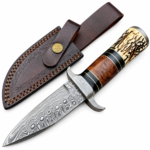
Any protective sheath used for storage or transport should fit the blade correctly. A sheath is not shown in the uploaded image, so its inclusion should be confirmed separately.
Always handle the exposed blade carefully and follow applicable local storage and transport laws.
Important Product Information
Before ordering this Damascus Hunting Knife, customers may wish to confirm several technical details with the seller.
These include the overall length, blade length, blade thickness, knife weight, steel composition, tang construction, handle materials, and the availability of a protective sheath.
The manufacturer should also confirm whether the blade pattern is produced through pattern welding or another finishing method.
Such details are especially useful for buyers comparing collectible knives with products intended for practical use.
The uploaded photograph clearly shows the product’s decorative appearance, but it does not establish the internal construction or exact measurements.
Providing verified specifications alongside the image will make the product listing more helpful and transparent.
A Traditional Design with Distinctive Detail
The Damascus Hunting Knife with Wood and Antler-Style Handle brings together a patterned blade, curved metallic guard, brown wood-grain styling, and a contrasting cream-colored end section.
Its combination of layered-looking blade markings and multiple decorative handle finishes gives it a recognizable identity.
The overall appearance is inspired by traditional hunting knives while introducing decorative elements suited to modern cutlery collections.
For buyers who appreciate patterned blades, distinctive handle designs, and outdoor-inspired craftsmanship, this knife offers an interesting option to explore.
Review the available specifications, confirm the materials and dimensions, and consider adding this Damascus Hunting Knife to your collection.


Reviews
There are no reviews yet.