








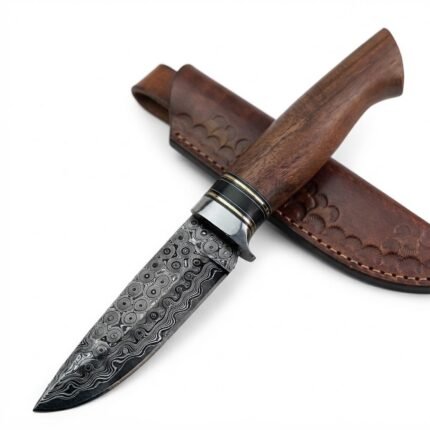
Damascus Pattern Fixed Blade Hunting Knife with Layered Handle
The Damascus Pattern Fixed Blade Hunting Knife combines a traditional outdoor knife profile with an intricate patterned blade, a distinctive layered-looking handle, and polished metal accents. Its design brings together practical fixed-blade styling and decorative features that appeal to hunting knife enthusiasts, outdoor cutlery collectors, and customers who appreciate visually detailed knife designs.
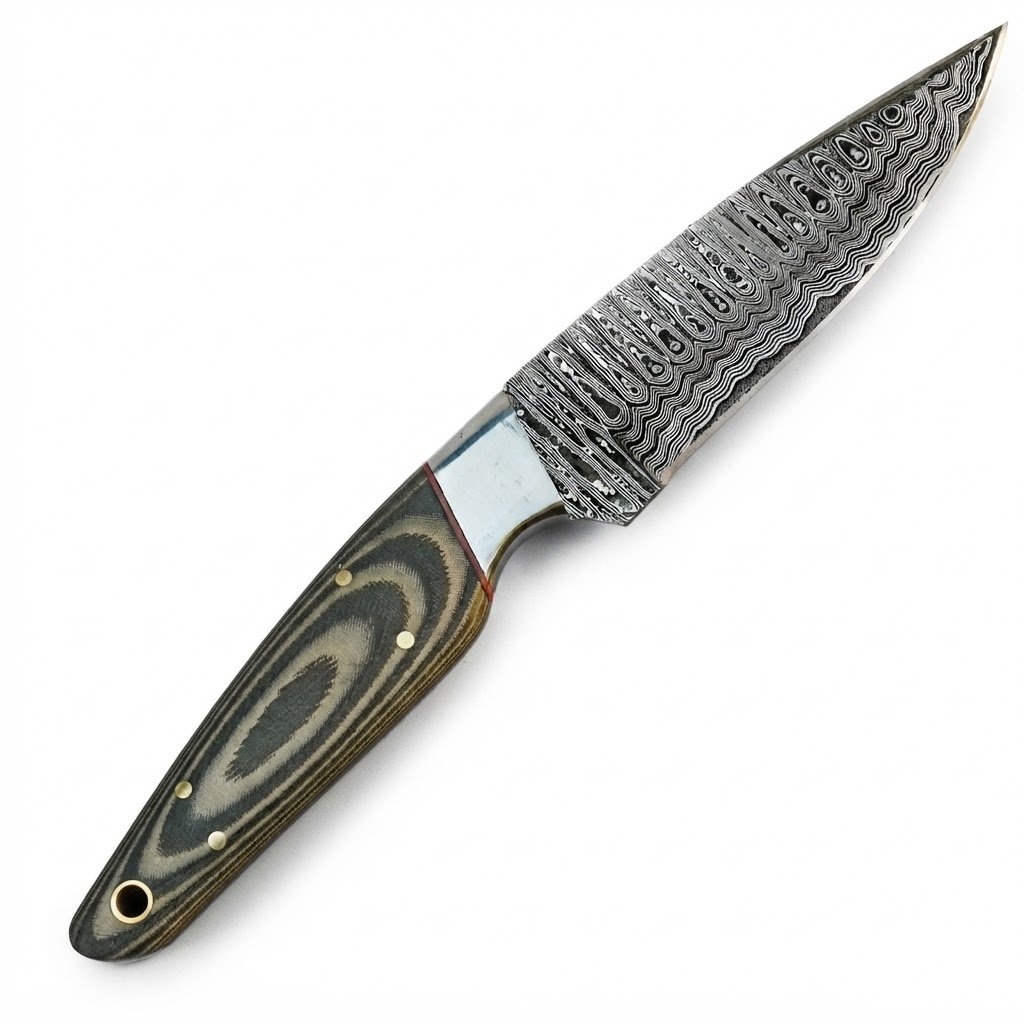
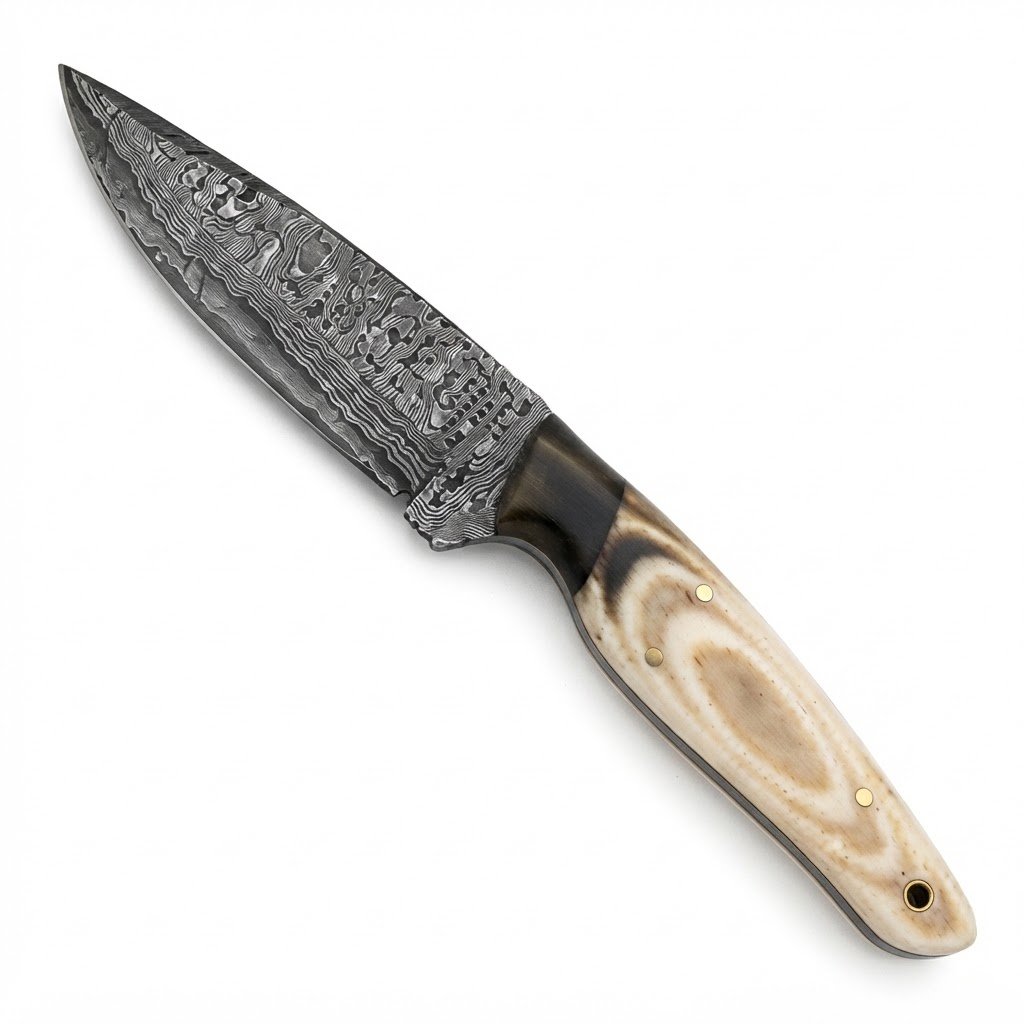
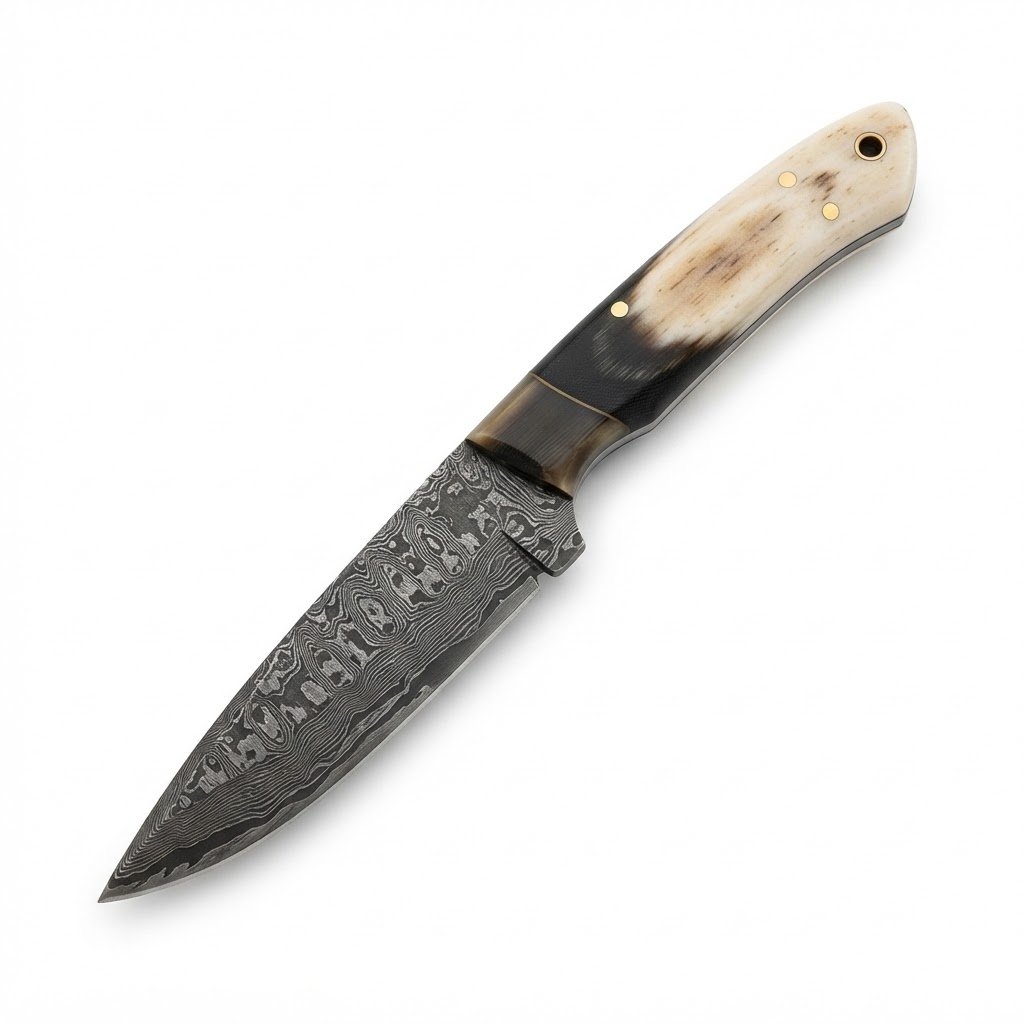
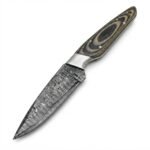
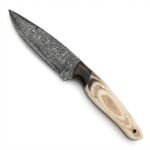
The knife features a pointed blade decorated with flowing silver and dark gray Damascus-style markings. These markings form repeating lines, elongated oval shapes, and irregular wavy patterns that extend from the base of the blade toward its tip. The contrasting surface design creates the layered appearance commonly associated with Damascus knives, although the exact blade manufacturing method has not been confirmed.
The handle has an elongated shape with dark olive, gray, and black concentric patterns. Small gold-colored pins are visible along its surface, and a circular metal-lined lanyard hole appears near the rear. A silver-colored bolster connects the handle to the blade, creating a clear transition between the patterned metal and the decorative grip.
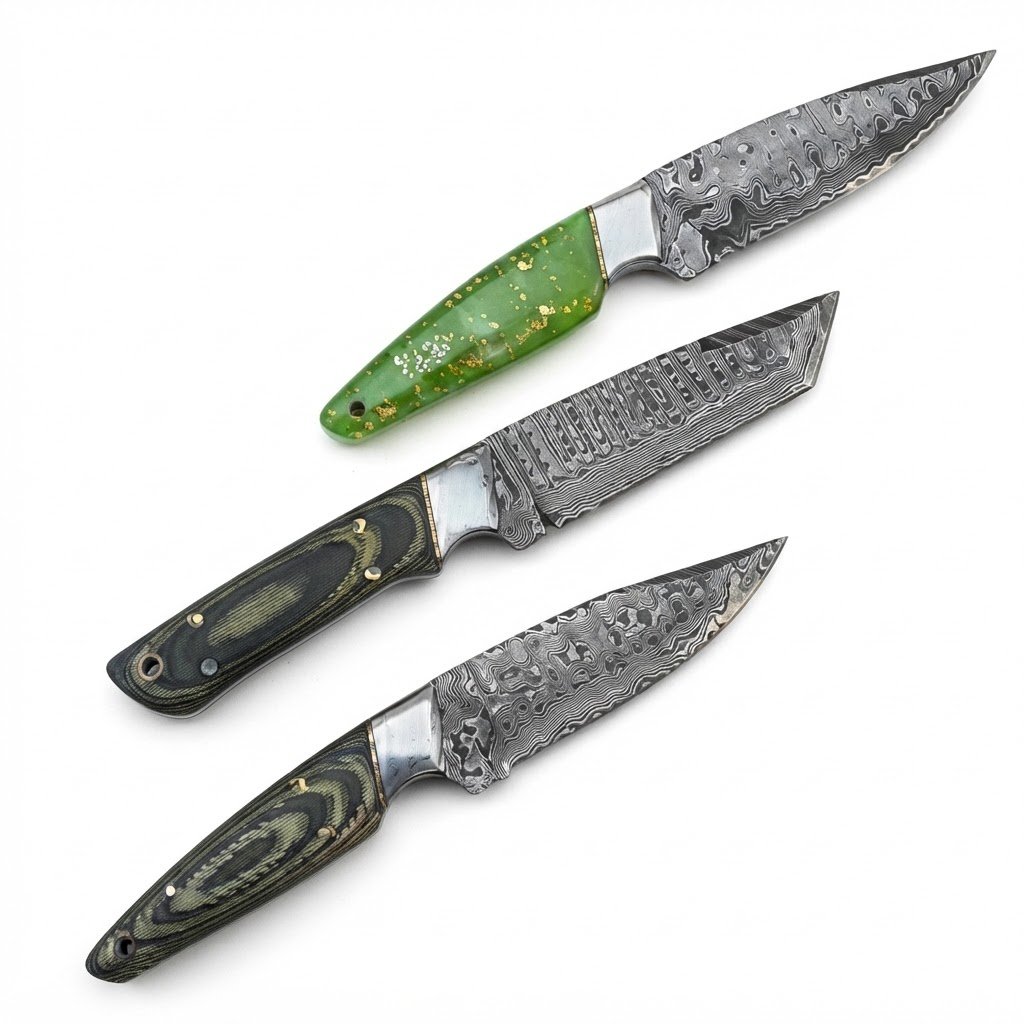
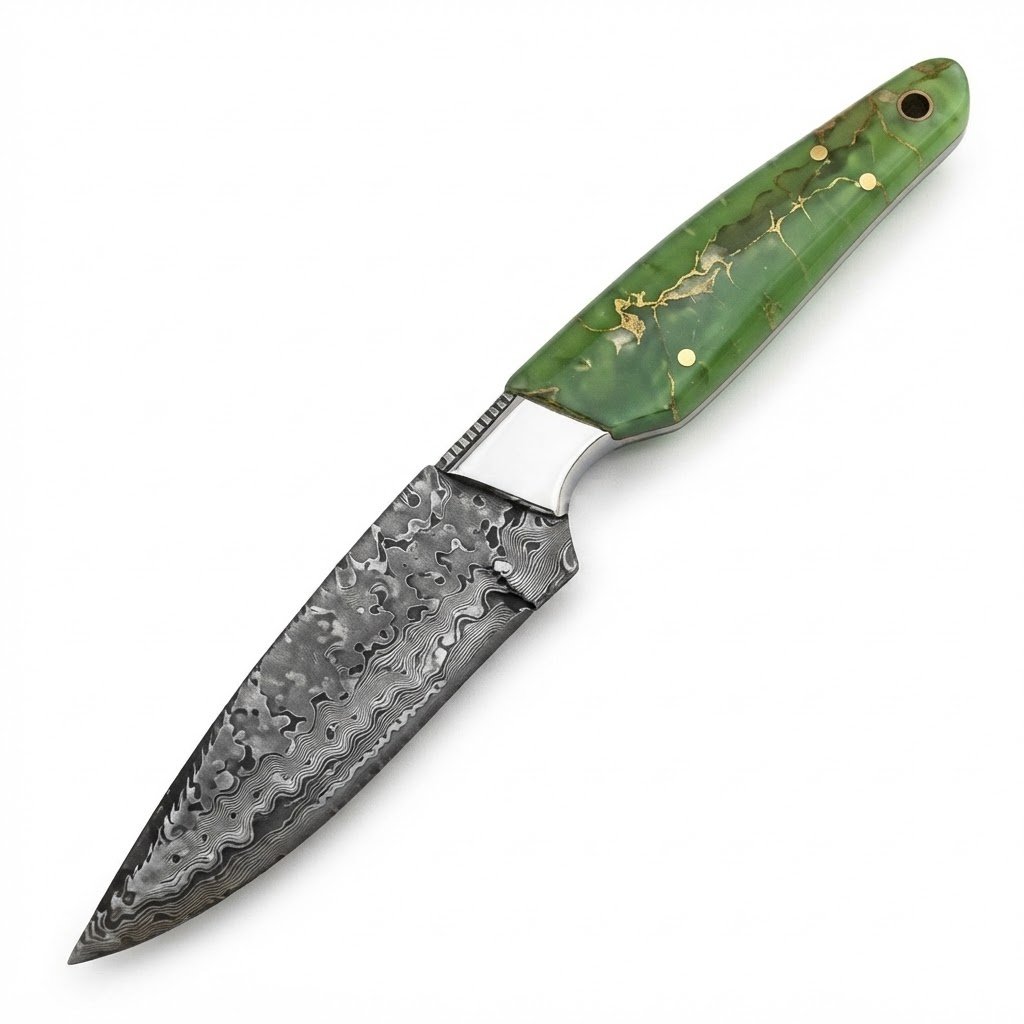
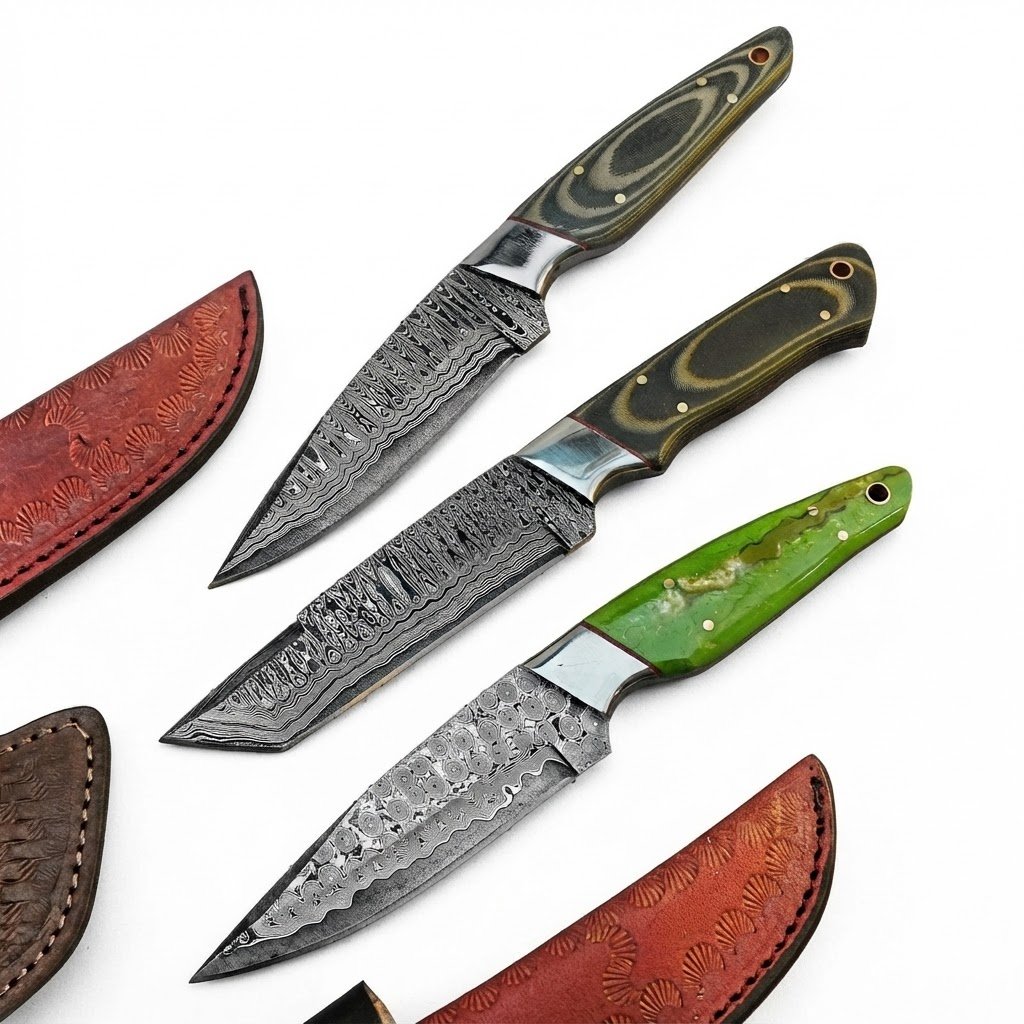
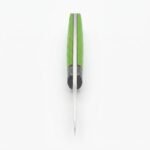
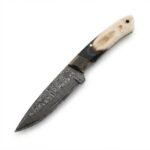
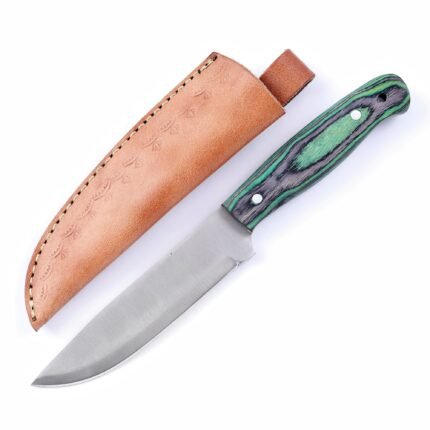
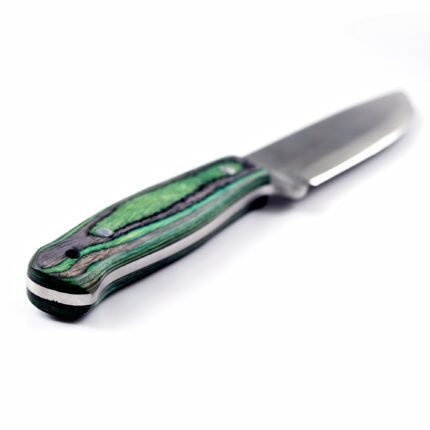
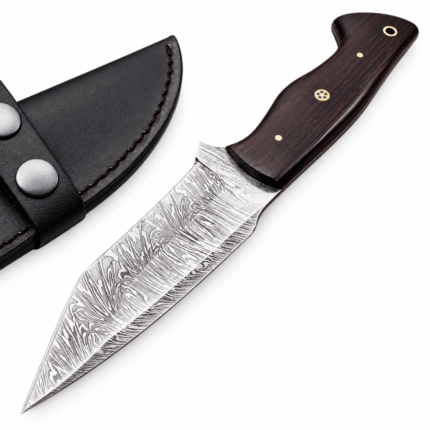
The supplied images also show two additional knife designs. One features a bright green handle with small gold-colored flecks, while another features a dark layered-looking handle and a different blade profile. These variations demonstrate the different appearances shown in the product photographs, but their availability as selectable options or as a combined set has not been verified.
The main knife is best described as a fixed-blade hunting-style knife with a Damascus-patterned blade and a layered-design handle.
Its distinctive visual features make it suitable for customers browsing traditional outdoor knife collections and decorative fixed-blade cutlery.
Damascus Pattern Fixed Blade Hunting Knife Design
The fixed-blade design is an important characteristic of this product.
Unlike folding knives, a fixed-blade knife does not use a pivoting blade that closes into the handle. Instead, the blade remains extended in its working position.
This gives the knife a recognizable outdoor utility appearance.
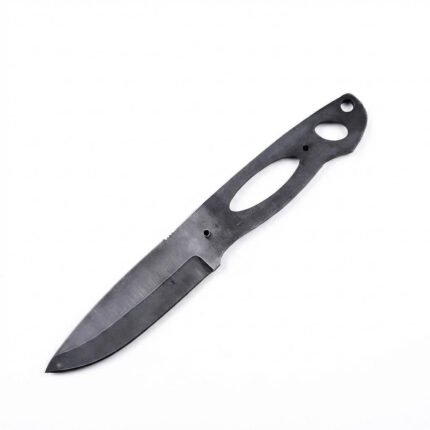
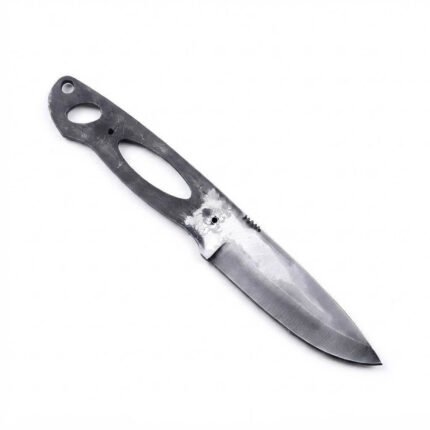
The photographed model has a pointed blade, a curved cutting edge, a defined metal bolster, and an elongated handle.
The overall silhouette is consistent with traditional hunting-style knife designs.
Its blade narrows gradually toward the tip, while the cutting edge follows a gentle upward curve.
The blade and handle are arranged along a slightly angled line, creating a balanced-looking profile.
The main knife does not have an oversized cleaver-style blade or a long, flexible fillet blade.
Instead, it features a comparatively conventional hunting-style cutting profile.
Although its shape is suitable for classification as a hunting knife, actual cutting performance depends on specifications that are not visible in the photographs.
These include steel composition, blade thickness, hardness, edge geometry, and internal construction.
Intricate Damascus Style Blade Pattern
One of the most attractive features is the blade’s intricate Damascus-style surface.
The blade displays numerous flowing lines in alternating silver and dark gray tones.
Near the base, the patterns are relatively closely arranged.
As they move toward the tip, they form longer, more pronounced curves.
The upper part of the blade features elongated oval formations that are repeated across the metal surface.
Near the cutting edge, the markings become narrower and follow the general direction of the blade.
This creates a distinctive visual effect.
The blade’s decorative pattern is clearly visible in both uploaded photographs, particularly the close-up image.
The surface design creates a contrast between lighter polished-looking areas and darker patterned sections.
The pattern is consistent with the appearance of Damascus-style cutlery.
However, visual patterning alone does not establish that the knife is manufactured from genuine pattern-welded Damascus steel.
Some knives achieve a similar appearance through alternative surface treatments.
Therefore, until the supplier confirms the production method, the accurate description is Damascus-patterned blade.
Pointed Blade Profile for Hunting Style Cutlery
The main knife has a relatively narrow blade that gradually tapers toward a pointed tip.
Its cutting edge has a continuous curved outline rather than a straight rectangular form.
The blade’s upper edge follows a gently descending line toward the tip.
This creates a pointed profile commonly found on traditional hunting-style knives.
The shape is visually different from the broad chopping blades found on cleavers and hatchets.
It also differs from knives with deeply hooked cutting edges.
The pointed profile contributes to the knife’s traditional outdoor appearance.
In the first uploaded image, the three knives have noticeably different blade shapes.
The upper green-handled knife has a broad curved blade and an elongated pointed tip.
The center knife has a more angular blade with a relatively straight section near the tip.
The lower knife has a narrower pointed blade with a flowing Damascus-style pattern.
These details should be treated as variations shown in the photograph rather than evidence that all three models are identical.
Dark Layered Pattern Handle
The close-up image highlights the distinctive handle design.
Its surface displays concentric dark olive, gray, and black patterns that resemble layered wood or laminated composite material.
The markings form broad oval shapes that extend along the handle.
Near the center, the pattern becomes lighter, creating contrast with the darker surrounding sections.
Toward the outer edges, the layers appear closely arranged.
The result is a handle with a recognizable ring-like design.
This appearance distinguishes the knife from models with plain black grips or natural single-color wooden handles.
The handle is slightly wider near the front and gradually narrows toward the rear.
Its edges appear rounded and contoured.
These visible details contribute to its traditional hunting knife silhouette.
However, the actual material cannot be established from the photographs.
The surface could be made from laminated wood, a layered composite, or another decorative material.
Specific descriptions such as Micarta, G10, stabilized wood, or hardwood should be used only after manufacturer confirmation.
Decorative Handle Pattern and Color Combination
The layered pattern creates a combination of earthy tones.
Dark charcoal and black sections surround lighter olive-gray markings.
These contrasting colors provide a natural-looking appearance.
The pattern is particularly noticeable near the center of the grip, where the lighter shapes form an elongated oval.
Toward the rear, the pattern becomes more closely layered.
The handle’s color palette complements the silver-gray blade.
Unlike the bright green handle shown on the upper knife in the first photograph, the main product has a more muted appearance.
This makes it visually suitable for collections featuring traditional or understated knife designs.
The dark handle also contrasts with the polished-looking metal bolster.
The combination of a patterned blade and patterned handle gives the knife a distinctive appearance without relying on printed graphics or large decorative symbols.
Silver Colored Metal Bolster
At the front of the grip is a smooth silver-colored bolster.
The bolster is positioned between the handle and the patterned blade.
Its surface appears comparatively plain, creating a visual break between the detailed blade pattern and layered handle finish.
A narrow reddish-brown separator is visible near the handle-side edge.
The bolster follows the natural curve of the grip and includes a concave area along its underside.
This helps define the transition between the handle and blade.
Bolsters are common features in traditional fixed-blade knife designs.
They can serve decorative and structural purposes depending on construction.
However, the photograph does not establish the exact metal used or the bolster’s internal attachment method.
It should not automatically be described as stainless steel, nickel silver, or another specific alloy.
The accurate visible description is a smooth silver-colored metal bolster.
Gold Colored Handle Pins
Small circular pins are visible along the handle surface.
The close-up photograph shows several pins distributed along the length of the grip.
They have a warm gold-colored appearance.
These fittings contrast with the dark handle and complement its layered design.
Pins are frequently used in knife manufacturing to help secure handle scales, although the exact purpose of these particular fittings is not confirmed.
The pins may contribute to the handle assembly, decorative appearance, or both.
Their visible placement helps distinguish the knife from designs that use screws or exposed bolts.
The photographed handle appears to have multiple pins, including one near the front and others toward the central section.
These details should be described as gold-colored pins rather than confirmed solid-brass fasteners.
The material and attachment method require independent verification.
Rear Lanyard Hole Design
A circular opening appears near the end of the handle.
It has a gold-colored metal lining.
Its appearance is consistent with a traditional lanyard hole.
Lanyard holes are commonly incorporated into outdoor knife handles.
They provide an attachment point for a compatible cord when the manufacturer intends them for that purpose.
In the photograph, the opening is clearly visible near the rounded rear section.
It provides another small decorative contrast against the dark layered pattern.
The opening’s diameter and internal construction are unknown.
No lanyard cord is shown.
Therefore, the product should not be advertised as including a wrist strap or attachment accessory.
The visible feature can accurately be described as a metal-lined rear lanyard-style hole.
Handle Shape and Grip Profile
The handle has an elongated, gently tapered silhouette.
It appears broader near the bolster and gradually becomes narrower toward the rear.
Its upper and lower edges follow smooth curves.
The photograph does not show aggressive finger grooves or a deeply textured gripping surface.
Instead, the handle has a relatively smooth-looking finish.
This gives the product a traditional appearance.
A contoured handle may influence how a knife feels in the hand, but physical comfort cannot be verified without handling the product.
Grip performance also depends on handle size, weight distribution, texture, and the material used.
These factors are not established by the image.
Customers comparing this knife with other outdoor models should review confirmed handle measurements when available.
The manufacturer should provide handle length, maximum thickness, and weight information.
Those specifications can help customers assess the knife more accurately.
Blade and Handle Color Coordination
The main knife combines several complementary colors.
The patterned blade features silver and dark gray tones.
The bolster has a smooth metallic silver appearance.
The handle uses dark olive, gray, and black layered-looking markings.
The small pins and lanyard fitting provide warm gold-colored accents.
A thin reddish-brown line separates the handle from the bolster.
Together, these details create a coordinated appearance.
The relatively subdued handle colors also allow the decorative blade to remain the primary visual feature.
Customers looking for traditional fixed-blade knife designs may appreciate this contrast.
The patterning is especially prominent when the product is photographed against a plain white background.
The close-up image provides a clear view of the handle details and blade surface.
Three Knife Designs Shown in the First Image
The first uploaded image contains three separate fixed-blade knives.
Although they share Damascus-style blade patterns, they are not visually identical.
The top knife has a bright green handle with small gold-colored flecks.
Its blade has flowing, irregular circular patterns and a gently curved cutting edge.
The middle knife has a dark layered-pattern handle and a comparatively angular blade shape.
The bottom knife also has a dark layered-pattern handle, but its blade is more gradually tapered and has a different pattern arrangement.
The second uploaded image provides a closer view of a dark-handled knife with a blade pattern resembling the middle knife.
These variations should be identified carefully when creating product galleries or selectable WooCommerce attributes.
The photographs do not establish whether the knives are offered as separate products, interchangeable design options, or a complete set.
It is important to verify the supplier’s selling arrangement before displaying a set quantity or assigning variation prices.
Traditional Outdoor Knife Styling
The main knife features several design characteristics commonly associated with traditional outdoor cutlery.
The blade is permanently extended.
The edge follows a gentle curve.
The handle has a slightly contoured profile.
The bolster creates a defined separation between the blade and grip.
The rear includes a lanyard-style opening.
Together, these elements form a recognizable hunting-style knife design.
Its decorative patterning makes it visually distinct from plain-finished utility knives.
This combination may appeal to customers interested in outdoor knife collections and traditional cutlery.
However, the term hunting knife describes the general design category rather than independently verified performance.
Specific hunting, camping, or field applications should be confirmed by the manufacturer.
Suitable for Decorative Knife Collections
Collectors often pay attention to the relationship between blade shape, handle design, fittings, and overall appearance.
This knife has several features that may be of interest.
The blade displays detailed Damascus-style markings.
The handle has a layered concentric pattern.
The silver-colored bolster creates contrast between the decorative surfaces.
Gold-colored pins add smaller finishing details.
A metal-lined lanyard-style hole completes the handle’s rear section.
These characteristics give the product a traditional outdoor cutlery appearance.
It can be presented in a catalog featuring hunting knives, fixed-blade knife designs, and patterned collectible cutlery.
The photographs do not establish that the knife is handmade, limited edition, or a historic reproduction.
Those claims should only be included when supported by supplier documentation.
Understanding Damascus Patterned Blades
Damascus-style knives are often recognized by their flowing metal patterns.
Traditional pattern-welded Damascus steel is produced by combining and manipulating layers of steel.
Finishing processes can reveal distinctive markings.
However, not every blade that displays these patterns is necessarily made through pattern welding.
Some products use decorative surface treatments to achieve a similar visual appearance.
The photographs show complex silver and gray markings, but they cannot confirm the production process.
The exact steel composition is not visible.
Neither is the layer count.
Therefore, the listing should not state a specific number of layers or identify the blade as genuine forged Damascus without verification.
The product should be described accurately as having a Damascus-patterned appearance.
Once the manufacturer provides reliable material information, the description can be updated.
Blade Steel and Material Verification
The steel grade is one of the most important technical details for any knife intended for practical use.
Different steels may offer different levels of toughness, edge retention, corrosion resistance, and maintenance requirements.
Heat treatment can also affect these characteristics.
A patterned appearance does not establish material quality.
The photograph cannot determine whether the blade is made from carbon steel, stainless steel, pattern-welded steel, or another alloy.
The hardness rating is also unknown.
Technical claims such as 58 HRC, high-carbon forged steel, or corrosion-resistant stainless steel should not be included without evidence.
The manufacturer should provide the blade’s composition, heat treatment, and any relevant test results.
This information would help customers understand the product beyond its appearance.
Blade Length and Overall Dimensions
There is no ruler or scale reference in either photograph.
Therefore, exact product dimensions cannot be determined.
The blade appears to have a hunting-style profile, but its actual length should not be estimated from the image.
Important specifications include overall knife length, blade length, blade width, blade thickness, and handle length.
Weight is another important factor.
These measurements help customers compare different knife designs.
They may also influence intended use, comfort, and storage requirements.
For customers purchasing online, accurate measurements can reduce confusion.
The supplier should provide specifications in both millimeters and inches when the product is marketed internationally.
Until those details are confirmed, the listing should avoid exact measurement claims.
Tang Construction
The photographs show a fixed-blade knife, but they do not reveal its internal tang construction.
The tang is the portion of the blade structure extending into the handle.
Different knife designs use different tang configurations.
Some feature full-tang construction.
Others have hidden or partial tang arrangements.
The visible handle pins do not establish which design this product uses.
The polished bolster also does not provide enough information to determine the internal assembly.
The listing should not describe the product as full tang without manufacturer confirmation.
Tang construction may be important to buyers seeking specific working characteristics.
For this reason, it is a useful specification to request from the supplier.
Choosing Between the Handle Variations
The first photograph shows different handle finishes.
The green-handled knife has a bright color that contrasts with its gray patterned blade.
The dark-handled knives feature layered-looking patterns that use more subdued colors.
These designs have different visual characteristics.
Customers who prefer a bright handle may find the green variation more appealing.
Those interested in an earthy color palette may prefer the dark olive and black layered appearance.
However, the photographs alone do not verify which variations are currently available.
A store should not promise customers a choice of handle color without confirmation.
If these products are sold as separate variants, each should have its own clearly labeled image, SKU, and specifications.
Differences in blade shape should also be disclosed.
Care of a Damascus Pattern Blade
Proper knife care depends on the blade material.
As a general precaution, the blade should be kept clean and dry.
After appropriate use, remove residue carefully with a soft cloth.
Avoid leaving moisture on the metal surface.
The manufacturer should provide specific guidance for cleaning the patterned finish.
Some blade finishes can be affected by abrasive polishing or unsuitable chemicals.
Avoid using harsh cleaning products without confirming compatibility.
If protective oil is recommended, use the type and application method specified by the manufacturer.
Routine inspection can help identify changes in the blade surface.
The cutting edge should be handled carefully during cleaning.
Keep fingers away from the edge and follow appropriate knife safety practices.
Caring for the Layered Handle
The handle has a distinctive layered-looking surface.
Its exact composition is unknown.
Different materials require different maintenance methods.
Wood, resin, and laminated composite handles may respond differently to moisture, heat, and cleaning products.
For general routine care, gently wipe away dust or loose debris with a soft cloth.
Avoid prolonged soaking.
Do not apply solvents or aggressive cleaners without manufacturer guidance.
The handle should also be protected from unnecessary impact.
Inspect the pins and fittings if the knife is used regularly.
If any part of the handle becomes loose or damaged, the knife should not be used until it has been assessed.
The manufacturer should provide specific care instructions once the material is confirmed.
Storage and Handling Recommendations
Fixed-blade knives require appropriate storage because the cutting edge remains exposed outside a protective cover.
A suitable sheath or blade guard may help protect the edge and surrounding objects.
However, no sheath is shown in the supplied photographs.
Its inclusion should not be assumed.
Store the knife in a dry, secure location.
Keep it away from children and unauthorized users.
Avoid placing it loosely among other tools.
Before handling the knife, inspect its blade, grip, and fittings.
Do not use it if any component appears damaged.
Follow the manufacturer’s intended-use instructions and local laws relating to knife ownership, transportation, and storage.
Decorative Design Versus Practical Performance
The blade pattern and handle finish are prominent selling points.
They can be evaluated visually.
However, appearance and practical performance are separate considerations.
A decorative knife may look similar to a knife intended for demanding outdoor applications.
This does not mean that both products have the same material properties.
The photographs do not demonstrate edge retention, toughness, corrosion resistance, or cutting performance.
These characteristics depend on construction and testing.
For accurate marketing, describe the visible design first.
Support technical claims with manufacturer information.
This approach helps customers understand what they are purchasing.
It also reduces the risk of misleading specifications.
Features Visible in the Product Images
The product photographs show the following characteristics:
- Fixed-blade hunting-style knife design
- Damascus-style patterned blade appearance
- Silver and dark gray flowing blade markings
- Pointed blade with curved cutting edge
- Dark olive, gray, and black layered-looking handle
- Smooth silver-colored bolster
- Thin reddish-brown separator near the bolster
- Gold-colored circular handle pins
- Metal-lined rear lanyard-style hole
- Contoured handle profile
- Multiple blade and handle variations in the first image
- Single-knife close-up in the second image
These details describe the visible product without assuming unverified specifications.
Product Specifications
Product Type: Fixed-blade hunting-style knife
Blade Finish: Silver and gray Damascus-style pattern
Blade Profile: Pointed hunting-style blade
Cutting Edge: Plain curved edge appearance
Handle Colors: Dark olive, gray, and black
Handle Appearance: Layered concentric pattern
Bolster: Silver-colored metal
Pins: Gold-colored circular fittings
Rear Opening: Metal-lined lanyard-style hole
Blade Steel Grade: Not verified
Blade Manufacturing Method: Not verified
Blade Hardness: Not verified
Blade Length: Not verified
Overall Length: Not verified
Blade Thickness: Not verified
Handle Material: Not verified
Tang Construction: Not verified
Product Weight: Not verified
Sheath Inclusion: Not verified
Product Quantity: Not verified
Available Variations: Not verified
Manufacturer Warranty: Not verified
What Customers Should Know Before Purchasing
This knife’s strongest identifiable features are its traditional fixed-blade silhouette, patterned metal surface, and layered-looking handle design.
The photographs provide useful information about its appearance.
They do not establish exact measurements or manufacturing specifications.
Customers should review blade steel, handle material, hardness, overall length, and weight before purchasing a knife for specific working applications.
They should also confirm whether the product is supplied individually or with accessories.
The first photograph features three different designs.
The second shows a closer view of one design.
These images should be organized accurately on the product page to avoid confusion.
A clear product listing should distinguish verified appearance from technical characteristics that still require confirmation.
Explore This Traditional Damascus Pattern Hunting Knife
The Damascus Pattern Fixed Blade Hunting Knife offers a distinctive combination of a flowing silver-gray blade design, dark layered-pattern handle, polished-looking metal bolster, and gold-colored fittings.
Its elongated handle and pointed blade create a recognizable traditional hunting-style silhouette.
The decorative patterning makes the knife visually appealing to outdoor cutlery enthusiasts and collectors.
For customers interested in patterned fixed-blade knives, this design provides an attractive combination of traditional form and detailed finishing.
Explore this knife for its distinctive blade appearance, carefully coordinated handle colors, and recognizable outdoor cutlery styling.








Reviews
There are no reviews yet.