




Damascus Pattern Folding Knife – Elegant Design with a Distinctive Black Handle
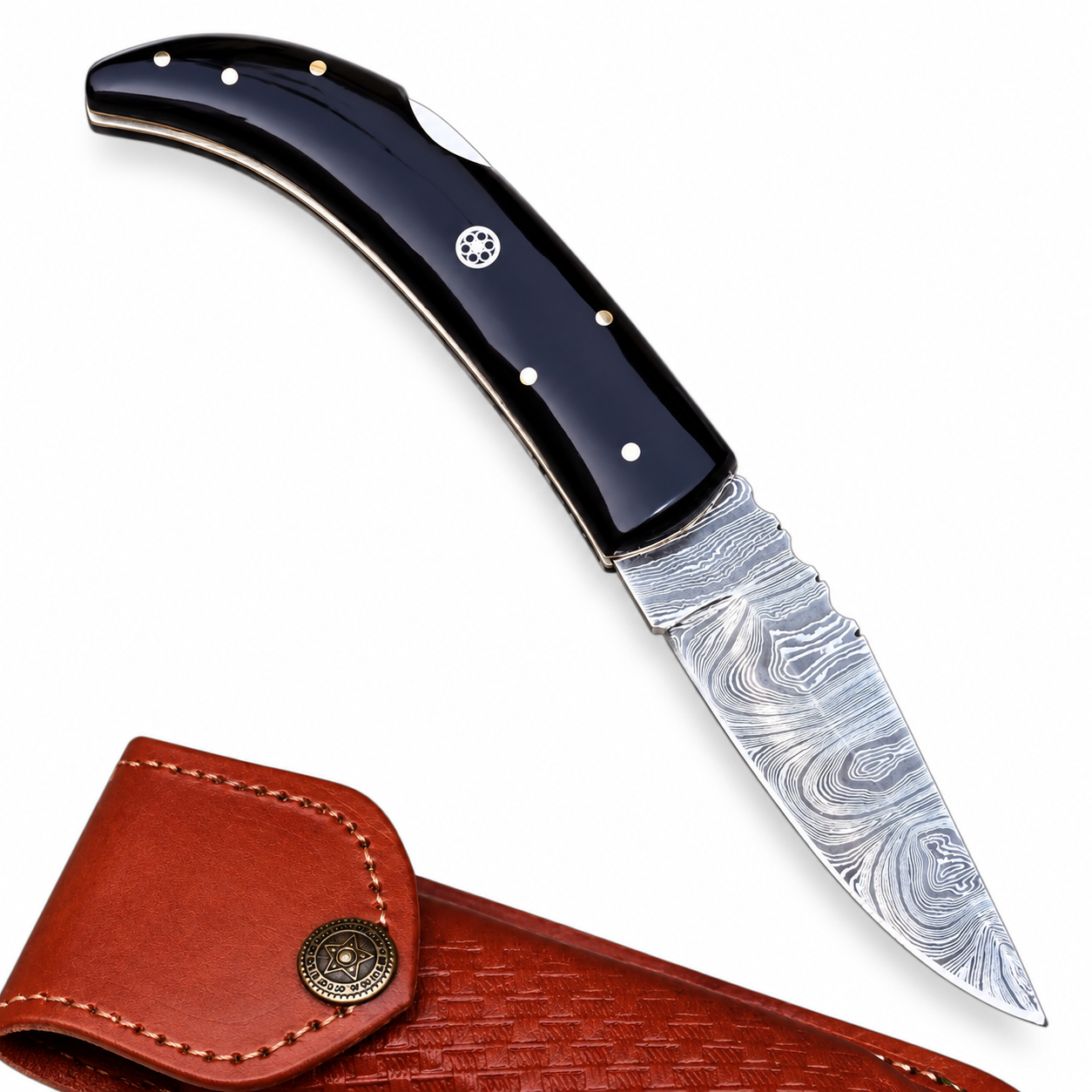
A well-designed folding knife can attract attention through its blade profile, decorative details, and overall appearance. This Damascus Pattern Folding Knife combines a flowing silver-and-charcoal blade pattern with a glossy black curved handle, creating a striking design for collectors and enthusiasts of traditional pocket knives.
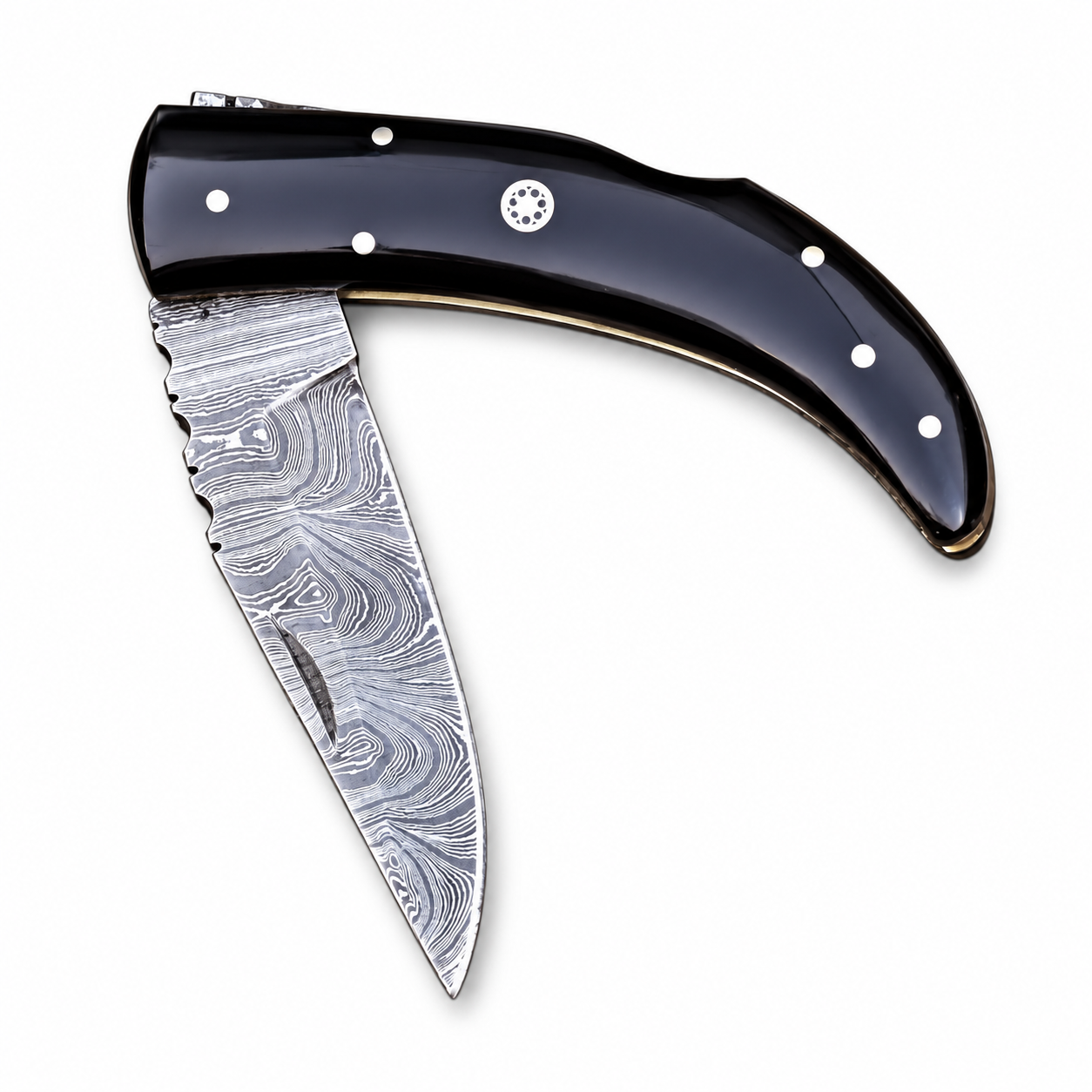
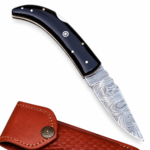
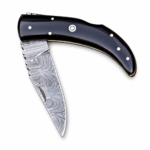
The blade has an elongated, pointed profile with a pronounced curve along its cutting-edge side. Its surface features closely arranged lines that form waves, loops, and layered-looking shapes. These patterns are especially visible near the tip and across the wider center of the blade.
The handle offers a different visual character. Its smooth, dark surface contrasts with the detailed metallic blade. Several silver-colored pins and a small circular ornamental accent add subtle decorative touches.
Together, these elements create a folding knife that looks distinctive without relying on bright colors or excessive ornamentation.
For customers interested in decorative metalwork, folding knife collections, or traditional knife designs, this product offers a combination of patterned metal and understated black styling.
1. Distinctive Damascus-Style Blade Pattern
Flowing Lines Across the Metal Surface
The most noticeable feature of this Damascus Pattern Folding Knife is its patterned blade.
The surface displays numerous narrow lines that curve and overlap in different directions. Some patterns resemble flowing waves, while others form irregular contours and tightly arranged loops.
These details create depth across the silver-gray metal surface.
Near the tip, the pattern is particularly visible, with lines extending across the blade in broad curves. Toward the handle, the pattern becomes more closely arranged.
The contrast between the lighter and darker areas makes the blade visually interesting from the side shown in the photograph.
Unlike a plain polished blade, this patterned surface offers multiple details that collectors can appreciate.
Understanding the Damascus Appearance
Damascus steel is commonly associated with metal surfaces that display visible layered patterns.
Modern Damascus steel may be created through pattern welding, which involves combining different steel materials and processing them to produce distinctive designs.
However, some knives have decorative patterns created through surface treatments or etching.
Although this blade resembles Damascus steel, its exact manufacturing method is not confirmed.
The available photograph does not verify the steel composition, number of layers, hardness, or heat-treatment process.
For this reason, the product is described as having a Damascus-style pattern rather than claiming a particular steel specification.
Customers who require genuine pattern-welded Damascus steel should confirm the materials with the supplier.
2. Elegant Black Curved Handle
Glossy Black Surface
The handle of this Damascus Pattern Folding Knife features a deep black finish.
Its surface appears smooth and reflective, creating a clean contrast with the silver-gray patterned blade.
The handle has a gently curved shape that narrows near the blade and widens slightly through the central section.
Toward the rear, the handle curves downward into a rounded end.
This distinctive outline contributes to the knife’s traditional folding-pocket-knife appearance.
The dark color also allows the silver-colored pins and circular accent to stand out.
Although the handle resembles polished horn or another dark decorative material, its composition cannot be confirmed from the photograph.
It should therefore be described as a glossy black handle until the manufacturer provides accurate material specifications.
A Balanced Decorative Appearance
The handle has relatively few decorative elements compared with the blade.
This creates a visually balanced design.
The blade provides intricate metallic patterns, while the handle offers a simpler, darker surface.
Customers who appreciate understated accessories may find this combination appealing.
The black handle also gives the knife a different appearance from folding knives featuring brightly colored grips or heavily patterned handle scales.
3. Curved and Pointed Blade Profile
A Recognizable Folding Knife Shape
The blade has a long, gradually narrowing profile.
Its pointed tip and curved lower edge create a recognizable knife silhouette.
The wider area near the handle transitions toward a slimmer front section.
This shape contributes to the knife’s appearance and distinguishes it from compact, straight-sided folding blade designs.
The knife is shown fully or nearly fully opened, allowing its blade and handle to be viewed together.
The photograph supports identifying it as a folding pocket knife, although the closed configuration is not shown.
Visible Blade Details
Several additional features can be seen on the blade.
A narrow recessed groove runs along part of its upper surface.
Small notches or scalloped areas are also visible along a portion of the spine near the handle.
These details add visual interest to the blade’s profile.
Their functional purpose has not been established, so they should not be advertised as verified opening aids, grip features, or technical performance enhancements.
The photograph also does not confirm the blade’s thickness or cutting-edge condition.
4. Decorative Silver-Colored Handle Pins
Visible Metallic Fasteners
Several small silver-colored circular details are positioned along the black handle.
They appear near the front, center, and rear sections.
The contrast between these bright metallic points and the dark handle gives the knife a clean decorative finish.
Some may be structural pins or fasteners, but their exact construction cannot be determined from the visible side alone.
The product listing should therefore describe them as silver-colored pins rather than claiming a particular fastening system.
Circular Ornamental Accent
Another distinctive feature is the circular accent positioned near the middle of the handle.
It has a silver-colored outer shape with several darker openings or markings.
This detail adds a decorative focal point without dominating the overall handle design.
The accent appears different from the smaller circular pins surrounding it.
Its material and function remain unverified.
For customers interested in traditional-style knife detailing, this small ornament provides an additional visual element.
5. Folding Pocket Knife Construction
A Compact Design Concept
Folding pocket knives are designed with a blade that pivots toward the handle.
This construction differs from fixed-blade knives, which have blades that remain permanently extended.
The uploaded photograph shows the knife in its open position.
The blade is connected to the handle through a section near the pivot.
While folding construction is evident, the image does not establish the precise locking mechanism.
It should not be described as a liner-lock, back-lock, or frame-lock knife without supplier confirmation.
Practical Considerations
The convenience of any folding knife depends on its actual dimensions and mechanical construction.
A folding mechanism can allow the blade to be stored within the handle, but safe operation requires suitable design and maintenance.
Before promoting this knife for practical utility tasks, the supplier should confirm its blade material, pivot construction, lock type, and intended application.
These details are important because decorative knives and functional utility knives may have different construction requirements.
6. A Distinctive Design for Knife Collectors
Traditional Appearance with Patterned Metalwork
Collectors often appreciate knives with recognizable shapes and interesting surface finishes.
The Damascus Pattern Folding Knife offers both.
Its pointed, sweeping blade creates a traditional profile, while the patterned metal adds visual detail.
The black handle keeps the overall design relatively restrained.
Rather than depending on large graphics or colorful decorative sections, the knife draws attention through its metallic pattern and distinctive shape.
This combination may appeal to people who collect folding knives, decorative blades, or traditional metalwork.
An Interesting Display Piece
The knife may be suitable for secure display within an adult collection.
The open configuration reveals the patterned blade and glossy handle together.
Display lighting can help emphasize the contrast between the light and dark areas.
A suitable stand or enclosed display should hold the knife securely and prevent contact with the blade.
Because the actual edge sharpness is unknown, it should always be handled as though it may be sharp.
7. Black and Silver Color Combination
A Classic Metallic Appearance
The knife features two dominant colors: black and silver-gray.
The blade carries the silver-and-charcoal pattern, while the handle has a glossy black surface.
Small silver-colored elements across the handle create a connection between the two sections.
This color arrangement gives the product a coordinated appearance.
The contrast also makes individual details easier to notice in photographs.
For collectors who prefer monochromatic designs, the combination offers an alternative to brightly colored pocket knives.
Detailed Without Excessive Ornamentation
The surface pattern adds complexity to the blade, but the handle remains comparatively simple.
This balance allows the knife to have a decorative appearance without requiring additional colored materials.
The small circular accent and metallic pins introduce detail without overwhelming the design.
Overall, the knife presents an understated style with a particularly intricate blade finish.
8. Understanding the Handle Shape
Sweeping Ergonomic-Looking Profile
The handle has a noticeable curve.
Its inner edge follows a concave line, while the outer edge forms a broader arc.
This shape gives the knife a recognizable profile.
The rounded rear section helps distinguish it from folding knives with straight or rectangular handles.
Although the handle appears shaped for hand use, comfort and grip security cannot be verified from an image.
Actual handling characteristics depend on the dimensions, surface texture, weight, and balance.
Customers interested in regular utility use should confirm these details before purchasing.
Handle Materials Require Verification
Glossy black knife handles can be manufactured using several materials.
Examples within the broader knife industry include horn, synthetic composites, resin, and other polished materials.
However, the photograph does not establish which material was used here.
The surface appearance should not be treated as proof of genuine buffalo horn or another natural material.
For accurate product specifications, the supplier should identify the handle composition.
9. Blade Spine and Decorative Groove
Notched Spine Detail
The blade has several visible notches near its rear section.
These notches form an irregular decorative outline along part of the spine.
They add another point of interest to the knife’s appearance.
It is possible for similar features on other knives to serve functional purposes, but this photograph does not establish their role.
The product should therefore be described according to what is visible.
Recessed Blade Feature
A narrow recessed detail can also be seen along the upper portion of the blade face.
Its elongated shape follows part of the blade profile.
This contributes to the visual complexity of the metal surface.
Because the recess’s exact purpose is unknown, it should not be presented as a confirmed mechanism or performance feature.
10. Suitable Customers and Collection Interests
Folding Knife Collectors
Customers who collect folding pocket knives may appreciate the blade’s pattern and the handle’s distinctive curved shape.
The product combines recognizable knife construction with decorative details.
Patterned Steel Enthusiasts
People interested in Damascus-style patterns may find the blade particularly attractive.
The closely arranged flowing lines offer a more detailed appearance than a plain-finish blade.
Traditional Design Enthusiasts
The knife may also appeal to buyers who prefer traditional pocket knife styling.
The curved handle and long blade profile create a familiar appearance with decorative metalwork.
Adult Gift Buyers
For an adult who collects decorative folding knives, this product may be considered as a gift.
Before ordering, confirm the exact specifications, packaging, accessories, and applicable local regulations.
11. Care and Maintenance
Cleaning the Patterned Blade
Proper cleaning depends on the blade’s steel composition and surface finish.
After handling, gently wipe the metal surface with a clean, soft cloth.
Avoid leaving fingerprints or moisture on the blade for extended periods.
If the manufacturer confirms that the blade contains corrosion-prone steel, it may recommend a suitable protective oil.
Avoid aggressive polishing compounds or harsh chemicals unless their suitability has been verified.
Some patterned finishes may be affected by abrasive cleaning.
Caring for the Black Handle
The glossy black handle should be treated according to its confirmed material.
For ordinary dust, a soft cloth is a sensible cleaning option.
Avoid exposing the handle to excessive heat or prolonged moisture.
Do not apply specialized horn, wood, or resin treatments until the actual material has been confirmed.
Different handle materials can require different maintenance methods.
Folding Mechanism Maintenance
The pivot and folding mechanism should be kept free from dirt and debris.
If the manufacturer recommends lubrication, follow its maintenance instructions.
Do not disassemble the mechanism without appropriate technical guidance.
Because the locking system is unknown, users should verify how the knife opens, closes, and locks before handling it.
12. Safe Handling and Storage
Any folding knife should be handled carefully.
The blade may be sharp, even if the knife is purchased mainly for decorative purposes.
Keep fingers clear of the blade’s movement path when opening or closing it.
Before using the knife, confirm whether it has a locking mechanism and how that mechanism operates.
Never force the blade if the folding action feels obstructed.
Store the knife securely in a dry location.
When closed, the blade should remain properly seated within the handle according to the manufacturer’s design.
Keep it inaccessible to children and comply with applicable laws regarding possession, transport, and importation.
13. What to Confirm Before Buying
When selecting this Damascus Pattern Folding Knife, consider both its appearance and technical specifications.
Collectors may prioritize its blade pattern, curved handle, and decorative metal details.
Customers planning to use the knife as a utility tool should request additional information about its steel, cutting-edge condition, blade thickness, and mechanism.
The supplier should confirm whether the patterned surface is genuine pattern-welded Damascus steel or a decorative finish.
The handle material also requires clarification.
Accurate measurements are especially important when comparing this knife with other folding pocket knives.
A second photograph showing the closed configuration would help customers understand its size and folding design.
14. A Distinctive Addition to a Folding Knife Collection
The appeal of this knife lies in its combination of detailed blade patterns and understated handle styling.
Its silver-and-charcoal blade features flowing lines and a pointed, sweeping profile.
The glossy black handle adds contrast, while the silver-colored pins and decorative circular accent provide subtle finishing details.
Together, these characteristics create an attractive design for collectors and enthusiasts of traditional folding knives.
Explore this Damascus Pattern Folding Knife for its recognizable shape, patterned blade, and elegant black appearance, and confirm the material specifications and available options before purchasing.




Reviews
There are no reviews yet.