






Damascus-Pattern Hunting Knife with Wooden Handle
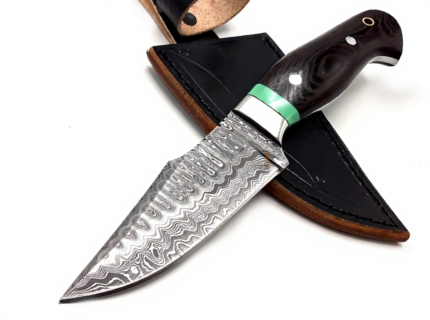
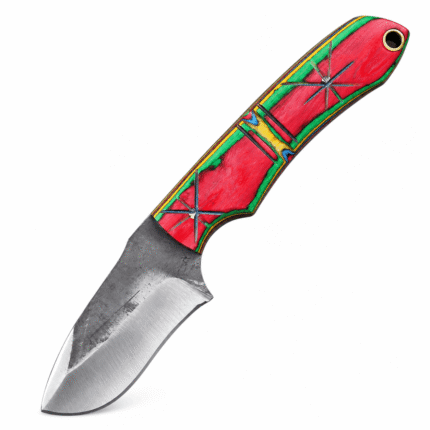
The Damascus-Pattern Hunting Knife combines a distinctive layered blade appearance, a polished reddish-brown wooden handle and a traditional fixed-blade profile. Designed in a classic hunting-knife style, this piece has an attractive combination of patterned metal, natural-looking handle tones and carefully defined contours.
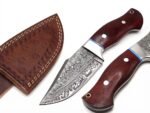
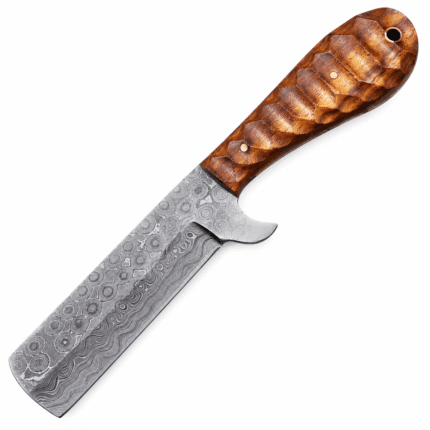
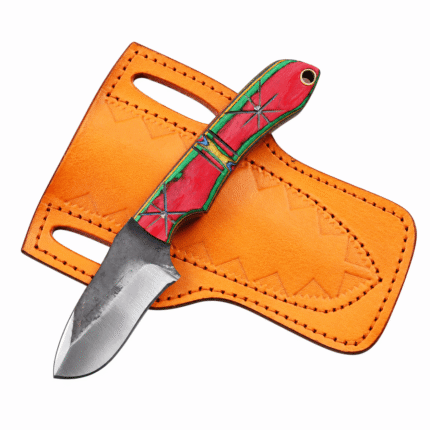
The blade features flowing silver and charcoal-colored lines that create the familiar visual character associated with Damascus-style knives. A polished metal bolster separates the patterned blade from the wooden handle, giving the knife a balanced appearance. The accompanying brown stitched sheath complements the warm handle color and adds a traditional finishing touch.
This design will appeal to adult knife collectors, outdoor-gear enthusiasts and customers who appreciate traditional hunting-style cutlery. Its visual details make it suitable for display, collection and consideration as a practical outdoor knife, subject to confirmation of the manufacturer’s steel specifications, construction and intended uses.
Distinctive Damascus-Pattern Blade
The main attraction of this Damascus-Pattern Hunting Knife is its eye-catching blade.
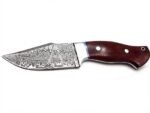
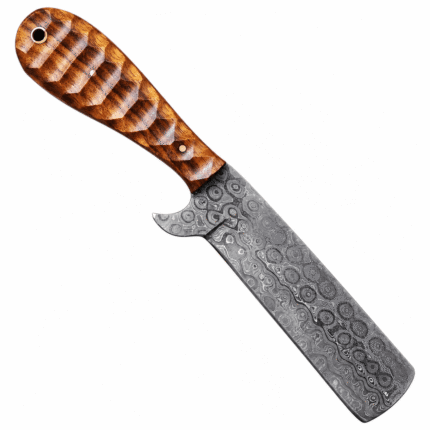
Across the visible surface, irregular flowing lines form an intricate combination of silver, dark gray and charcoal-colored patterns. Some sections display rounded, almost circular formations, while other areas feature closely spaced waves extending toward the cutting edge.
This layered appearance adds depth and visual interest to the blade.
Unlike a plain polished blade, the Damascus-style finish creates a decorative surface that stands out in product photography and close-up viewing.
The blade has a broad profile near the handle and gradually narrows toward a defined point.
Its cutting edge follows a gently curved line, giving the knife a familiar hunting-style silhouette.
The particular finish and pattern are among the most recognizable features of this product.
Although the image displays Damascus-like markings, it does not prove the steel’s composition or forging process. Buyers requiring genuine pattern-welded Damascus steel should request material confirmation from the supplier.
Traditional Fixed-Blade Design
The knife has a fixed-blade configuration, meaning the blade is not designed to fold into the handle.
This gives the product a traditional appearance associated with hunting knives, field knives and outdoor cutlery.
The visible design includes a broad blade, a distinct transition into the bolster and an elongated handle.
The overall shape is straightforward, without the mechanical components commonly associated with folding pocket knives.
Fixed-blade knives are often selected by customers who prefer a traditional, uncomplicated design.
However, the photograph does not establish the blade’s internal tang configuration, exact construction or mechanical strength.
For this reason, specifications such as full-tang construction, heavy-duty capability and impact resistance should be confirmed by the manufacturer before publication.
The knife’s visible form is best described as a classic fixed-blade hunting-style design.
Reddish-Brown Wooden Handle
The handle adds warmth and contrast to the patterned metal blade.
It appears to feature a polished reddish-brown wooden surface with darker natural-looking grain markings.
The rich color gives the knife a traditional character.
The handle is slightly curved rather than completely straight, following a shape commonly seen in outdoor cutlery.
Its profile includes a gradual widening toward the rear, creating a distinctive handle outline.
Two round, silver-colored fasteners are visible along the handle.
Near the end of the grip is a circular opening with a metallic-looking border.
This opening is consistent with a lanyard hole, although a lanyard is not shown.
The wooden appearance complements the gray blade and polished bolster.
While the surface resembles finished hardwood, the exact wood species and any stabilizing treatment cannot be established from the image.
The supplier should verify the actual handle material before specific wood types are advertised.
Polished Metal Bolster
A prominent polished metal bolster is positioned between the blade and handle.
Its bright silver appearance provides contrast with the darker blade patterns and reddish-brown grip.
The bolster has a shaped profile rather than a simple flat rectangular form.
It curves into the lower handle area and produces a visually defined transition from the blade to the grip.
A thin blue-toned accent is also visible close to the handle.
This small decorative detail adds another layer of contrast to the overall design.
The bolster contributes to the knife’s traditional appearance.
Its exact material, attachment method and structural characteristics remain unverified.
It should therefore be described as a polished metal-look bolster until the manufacturer provides confirmed material specifications.
Curved Blade Profile
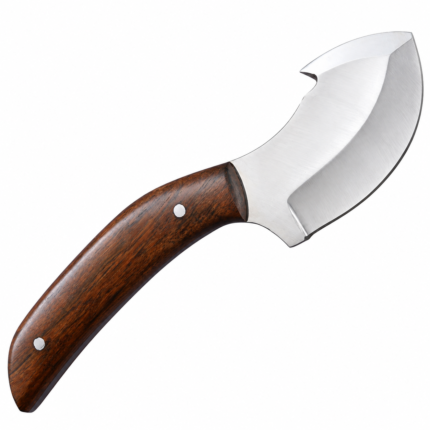
The Damascus-Pattern Hunting Knife has a broad cutting section that gradually tapers toward its tip.
The visible edge follows a curved outline.
This shape is associated with traditional hunting-style knife designs, where blade geometry can influence general cutting characteristics.
The blade appears relatively wide close to the bolster, with a narrowing profile toward the front.
The upper edge slopes toward the tip, producing a balanced-looking outline.
This design is visually distinct from narrow dagger blades, straight utility blades and large chopping knives.
The photographed knife is better categorized as a hunting-style fixed blade rather than a kitchen knife or folding pocket knife.
Its exact cutting performance cannot be evaluated from the photograph.
Blade sharpness, edge retention, hardness and suitability for specific cutting activities require physical testing or verified technical information.
Coordinated Brown Protective Sheath
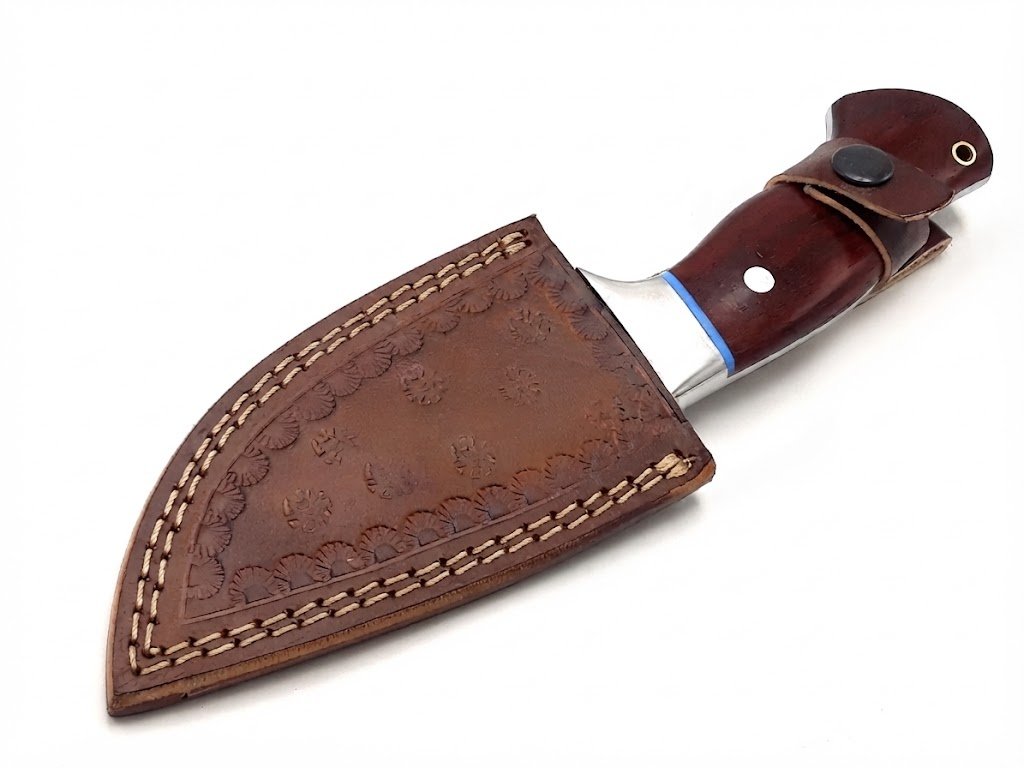
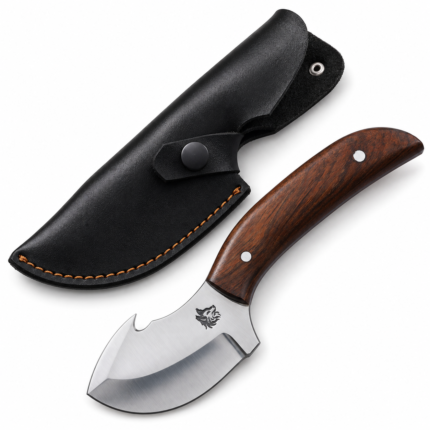
The image includes a brown sheath positioned behind the knife.
It has a leather-like surface, visible decorative impressions and contrasting light-colored stitching.
The sheath is shaped to accommodate a pointed knife blade.
Its warm brown color coordinates with the handle and gives the complete presentation a traditional appearance.
The stitching follows the outer contour of the sheath, creating an attractive border.
A longer upper extension is also visible.
The image does not clearly establish the sheath’s complete carrying system or method of attachment.
For accurate website information, the supplier should confirm whether the sheath is genuine leather, synthetic leather or another material.
Customers should also confirm whether the photographed sheath is included with every order.
The presence of the sheath in the image is a useful visual feature, but its exact construction and carrying compatibility need confirmation.
An Appealing Choice for Knife Collectors
Collectors often appreciate knives with distinctive surface patterns, traditional handle shapes and decorative metalwork.
This product brings these features together in one design.
The contrast between the patterned blade and polished wooden handle makes it particularly interesting as a display piece.
The flowing metallic markings offer more visual variation than a conventional plain blade.
The shaped bolster and brown sheath further reinforce its traditional appearance.
For collectors building a display of hunting-style knives, this design can provide variety in both color and blade finish.
It may also appeal to customers interested in the visual history of patterned-metal cutlery.
A knife collection can include different handle colors, blade profiles and decorative finishes.
This particular model is distinguished by its reddish-brown grip and wave-patterned silver-and-dark blade.
Hunting-Inspired Outdoor Styling
The Damascus-Pattern Hunting Knife reflects the appearance of traditional outdoor knives.
Its fixed-blade design, curved cutting edge and contoured grip are recognizable characteristics of hunting-style cutlery.
Such knives are often associated with outdoor activities and field equipment.
However, the photographed product has not been verified for a particular outdoor task.
Its suitability for food preparation, field dressing, campsite cutting or other activities depends on the actual steel properties, edge geometry, construction quality and manufacturer’s instructions.
Customers intending to use the knife outdoors should confirm those details before purchase.
A visually attractive design does not automatically establish performance under demanding conditions.
The item can confidently be described as hunting-inspired, while specific working capabilities should remain dependent on verified manufacturer specifications.
Attention to Decorative Details
Several smaller features contribute to the overall appearance.
The handle surface has a glossy finish that highlights the reddish-brown coloration.
Two circular fasteners create a symmetrical visual arrangement along the grip.
A metal-lined hole near the handle end adds another recognizable feature.
The bolster has a polished silver-colored surface.
A narrow blue accent separates the bolster area from the handle.
The blade displays varying line thicknesses, including circular patterns and flowing waves.
The brown sheath features stitched edging and embossed decorative markings.
Each detail contributes to a coordinated presentation.
Together, these elements create a knife with a traditional shape and visually elaborate finish.
The overall design is particularly suitable for buyers who appreciate patterned metal and natural-looking handles.
Understanding Damascus-Style Steel
Damascus steel is a term often used to describe blades that display characteristic layered or flowing patterns.
Historically, different methods have been associated with Damascus and patterned steels.
Modern suppliers may use pattern-welded steel, etched steel or other decorative finishing processes.
These methods are not necessarily equivalent.
The visible pattern alone cannot confirm the steel type.
For this knife, the photograph supports describing the surface as Damascus-patterned or Damascus-style.
It does not establish the number of layers, steel alloys or forging method.
Claims such as 1095/15N20 steel, 256 layers, 400 layers or a particular Rockwell hardness should not be used without supplier documentation.
Reliable material information is important because different steels have different maintenance requirements and performance characteristics.
A professional product listing should distinguish visible appearance from confirmed technical specifications.
Handle Shape and Visual Ergonomics
The wooden handle has a shaped profile with gentle curves along its length.
Its upper and lower contours are not perfectly parallel.
This produces an organic appearance associated with traditional fixed-blade knives.
The curved rear section gives the grip a visually defined ending.
The polished finish highlights the darker streaks within the reddish-brown material.
The metal fasteners provide additional decorative details.
While the shape suggests attention to grip design, comfort and ergonomics cannot be confirmed without handling the actual knife.
Grip suitability depends on factors such as dimensions, surface finish, balance and the user’s hand size.
For buyers comparing knives, accurate handle length, thickness and circumference measurements would provide useful additional information.
These measurements should come from the manufacturer rather than estimates based on the photograph.
A Traditional Presentation for Gifting
Decorative fixed-blade knives are sometimes selected as collectible gifts for adults who appreciate outdoor equipment and traditional metalwork.
The Damascus-style blade, wooden handle and matching sheath give this design an attractive presentation.
Its contrasting materials create a recognizable appearance without relying on oversized decorative elements.
The patterned blade provides a central visual feature.
The polished bolster adds a bright transition between the blade and handle.
The brown sheath completes the coordinated look.
For gift purchases, customers should confirm the actual packaging, included accessories and any available presentation options.
A gift box, certificate or customization option should not be assumed unless explicitly offered.
Knife gifting and possession are also subject to local laws and age restrictions.
Cleaning and Care Recommendations
Proper care helps maintain the appearance of a decorative knife.
After handling, wipe the blade with a clean, soft cloth.
Remove moisture before storage.
Avoid leaving the knife in damp environments.
If the blade contains carbon steel, it may require additional corrosion-prevention care.
Use only maintenance products suitable for the manufacturer’s confirmed blade material.
Avoid harsh abrasive cleaning methods that could alter the decorative surface pattern.
The wooden-looking handle should also be kept away from prolonged moisture exposure.
Do not soak the entire knife in water.
For long-term storage, follow the supplier’s recommendations regarding protective oil, blade covering and environmental conditions.
A leather sheath may retain moisture, so long-term storage arrangements should be selected according to the materials involved.
Routine visual inspections can help identify changes in the finish or signs of corrosion.
Safe Handling and Storage
This is a pointed fixed-blade knife and should be treated as a potentially sharp cutting tool.
Handle it carefully.
Keep fingers clear of the cutting edge.
Use a suitable protective sheath when transporting or storing the knife, provided the sheath fits securely.
Keep it away from children and unauthorized users.
Avoid placing the exposed blade on unstable surfaces.
Do not use the knife for prying, striking or other activities outside its manufacturer’s specified purpose.
Users should comply with applicable laws concerning ownership, transportation and use.
The photograph cannot establish whether the blade has undergone functional or safety testing.
Customers who intend to use the knife for demanding outdoor activities should obtain verified product specifications before doing so.
Important Product Information
Before ordering the Damascus-Pattern Hunting Knife, confirm the exact blade length, overall length, blade thickness and weight.
The steel grade and manufacturing method should also be verified.
Ask whether the blade is sharpened and whether its cutting edge has been factory finished.
Confirm the handle material, including the actual wood species if applicable.
The supplier should specify whether the bolster is stainless steel or another metal.
The sheath material and inclusion should also be confirmed.
Other useful information includes packaging, finish variations, maintenance instructions and any applicable product warranty.
These details help customers make informed comparisons.
They also prevent confusion between decorative knives and manufacturer-rated working knives.
Why Choose This Damascus-Pattern Hunting Knife?
The Damascus-Pattern Hunting Knife offers a distinctive combination of traditional styling and decorative metalwork.
Its flowing blade pattern creates visual interest across the cutting section.
The reddish-brown wooden handle provides warmth and contrast.
The polished bolster gives the knife a refined transition between metal and grip.
The brown stitched sheath complements the overall design.
For adult collectors who appreciate hunting-style knives, this product offers an attractive appearance and recognizable fixed-blade profile.
Buyers looking for a patterned metal knife with a classic wooden handle may find this design especially appealing.
Review the confirmed material specifications and intended uses before purchase, and explore this Damascus-Pattern Hunting Knife as an addition to your knife collection.







Reviews
There are no reviews yet.