







Damascus Pattern Knife with a Contrasting Handle
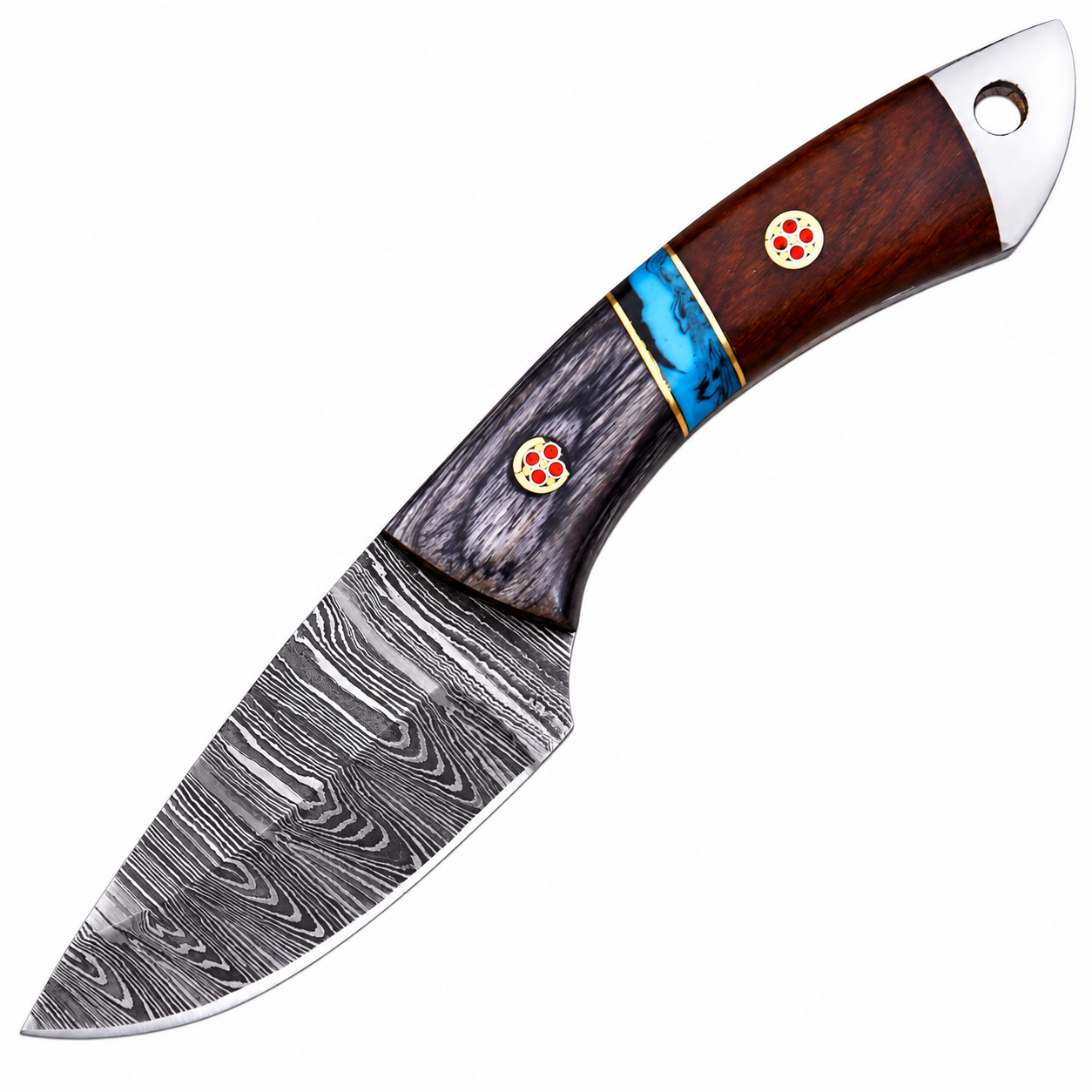
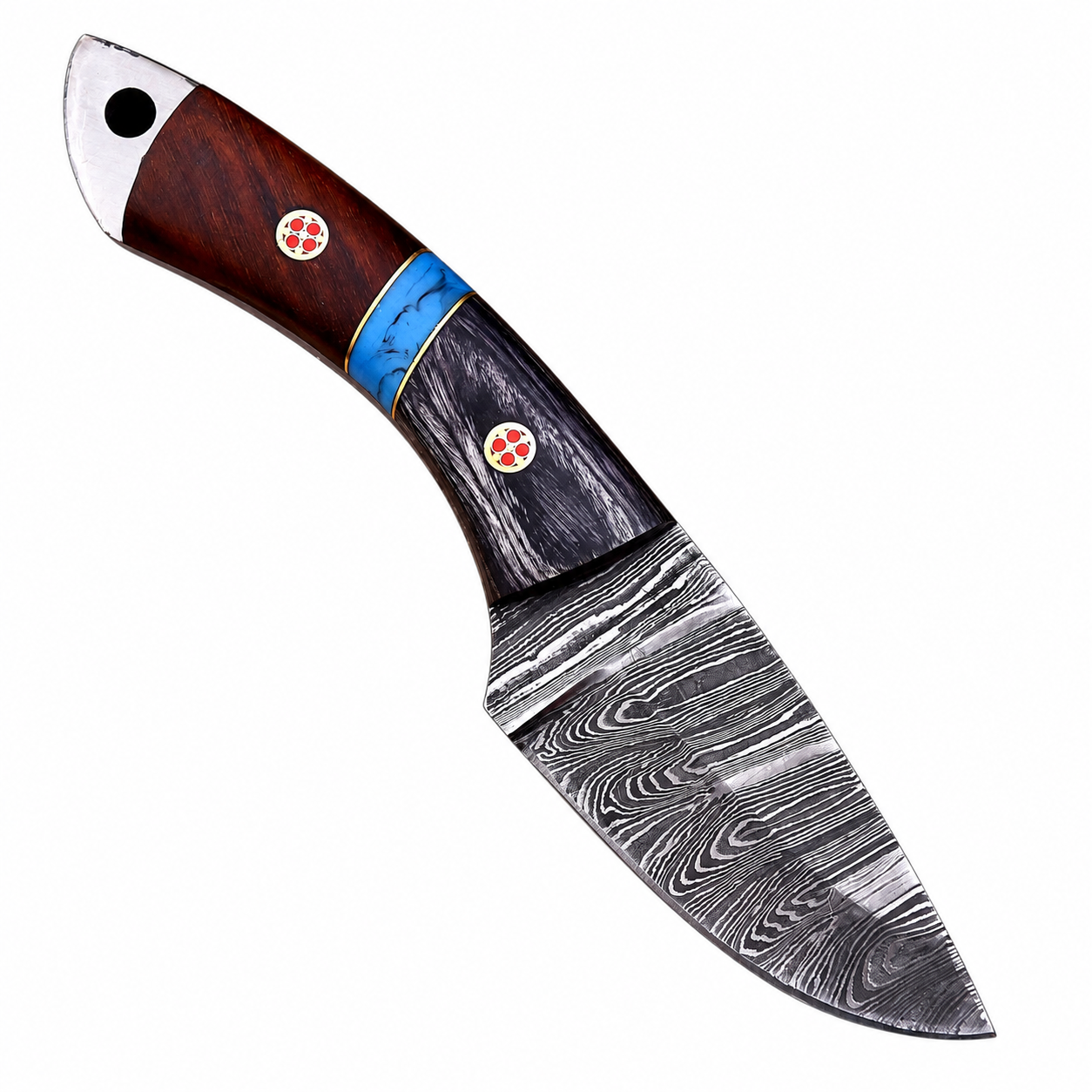
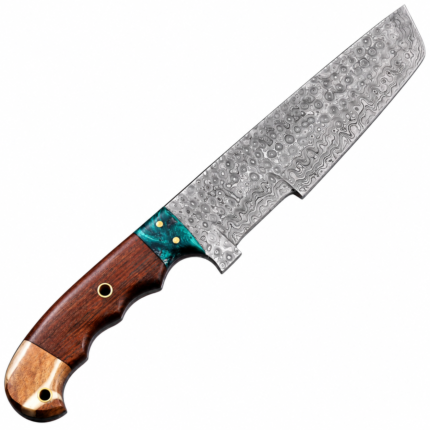
This Damascus pattern knife brings together a boldly patterned blade and a handle with several contrasting colours and decorative details. The blade displays flowing silver-grey lines against a darker background, while the handle combines a dark front section, a reddish-brown rear section, and a bright blue accent between them. Two circular mosaic-style pins complete the design.
The knife has a fixed blade format, a plain cutting edge, and a pointed tip. At the rear, a silver-tone section extends beyond the coloured handle and contains a round lanyard hole. These visible features give customers several useful points of comparison when browsing knives with decorative handles and patterned blades.
The term “Damascus pattern” describes the appearance shown in the photograph. It does not independently confirm the steel composition, manufacturing process, or number of layers. Those technical details should be checked against the supplier’s specifications before choosing the knife for a particular task.
A Blade Pattern with Strong Visual Contrast
The blade is the most prominent part of the design. Its surface shows closely spaced lines that curve, repeat, and form irregular nested shapes across the blade face. Light and dark areas alternate throughout the pattern, making the detail visible from the handle junction toward the tip.
Unlike a plain blade finish, this patterned appearance gives the surface a decorative role. Customers who enjoy examining blade designs can see several changes in the direction and spacing of the lines within the same photograph. The result is a more visually detailed blade than one with a uniform silver or black finish.
The pattern should be considered an aesthetic feature unless its construction is documented. A visible pattern alone cannot establish whether a blade is pattern-welded, surface-decorated, or produced using another process. It also does not provide evidence of sharpness, hardness, or edge retention.
Plain Cutting Edge and Curved Blade Profile
The knife has a plain edge without visible serrations or saw teeth. A narrow, bright strip follows the cutting edge and stands out against the darker patterned face. The lower blade profile curves upward toward the tip, while the upper outline slopes toward the same point.
This combination creates a broad blade with a curved forward section. When comparing product photographs, the relationship between blade width, edge curvature, and tip shape can help you distinguish this design from narrower utility blades or knives with more angular profiles.
The photograph shows the overall outline clearly, but it does not establish blade thickness, bevel angle, or the condition of the cutting edge. For practical use, those measurements and finishing details matter alongside the visible shape. Choose according to confirmed specifications rather than assuming that a particular profile guarantees a particular level of performance.
Fixed Blade Layout
This model is shown as a fixed blade knife. There is no visible folding joint, thumb stud, or opening mechanism, and the blade remains extended from the handle. The uninterrupted layout keeps the patterned blade and decorative handle visible together.
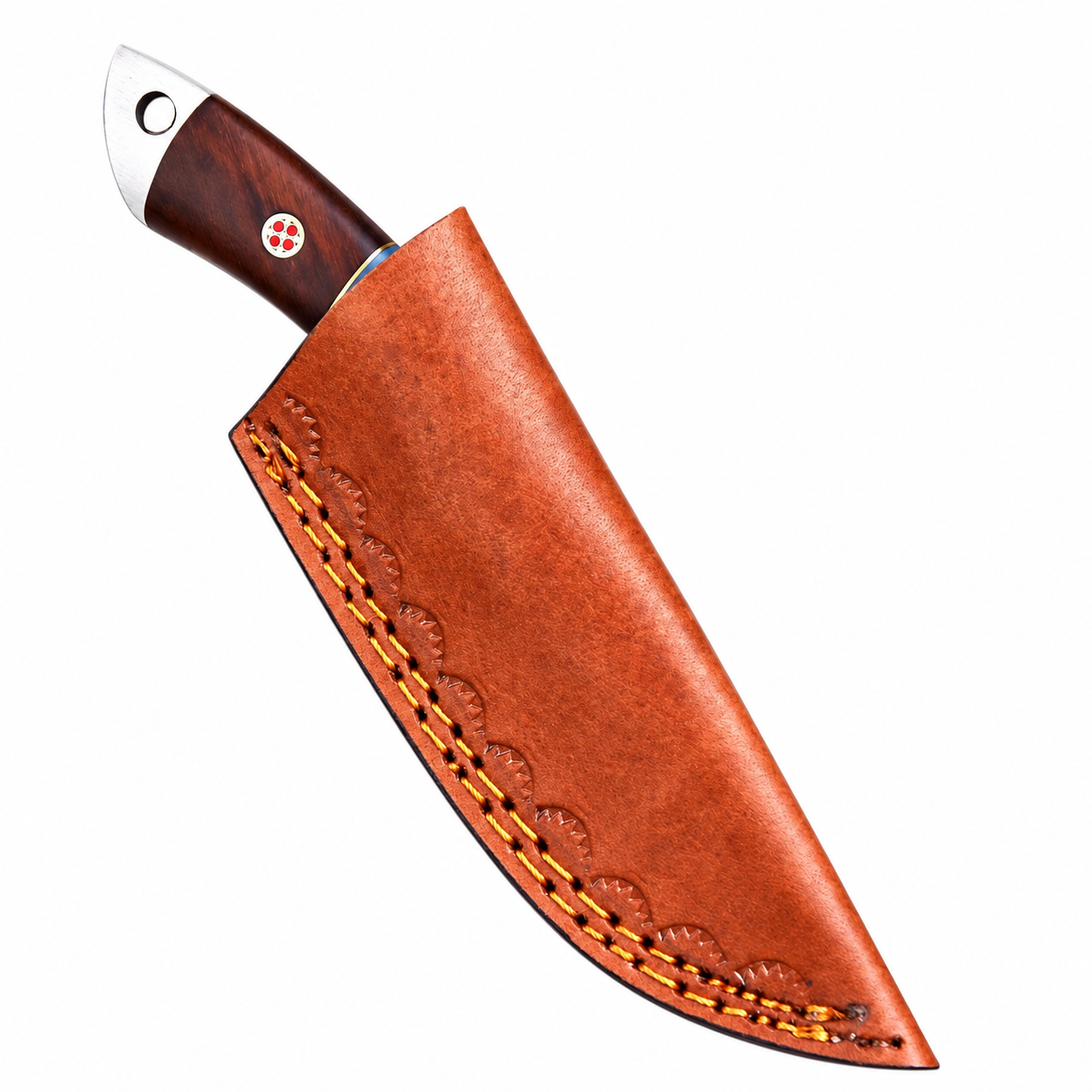
For customers comparing fixed and folding designs, storage is an important difference. A fixed blade needs a suitable protective covering because the cutting edge does not fold into the handle. A correctly fitted sheath should therefore be considered as part of the overall purchase.
No sheath appears in the supplied photograph. Its inclusion, material, attachment method, and fit need separate confirmation. The fixed blade format also does not establish the internal construction of the knife. Although a silver-tone rear extension is visible, the photograph alone is insufficient to verify how the blade continues through the handle.
Dark Front Handle Section
The front portion of the handle has a near-black appearance with lighter grey streaks running through it. This section sits directly behind the patterned blade and creates a darker visual transition between the blade and the brighter centre accent.
Its streaked finish adds another type of surface detail without repeating the blade pattern exactly. The contrast is subtle compared with the blue band, but it remains noticeable in the close-up product image. One of the two decorative pins sits within this dark section.
The handle narrows near the blade junction and then broadens farther back. That contour contributes to the overall shape, although the photograph cannot establish how the handle feels in use. Its material, surface texture, thickness, and finish should be confirmed if grip characteristics are important to your buying decision.
Bright Blue Centre Accent
A vivid blue band separates the dark front section from the reddish-brown rear section. Dark, irregular markings run across the blue surface, giving it a marbled appearance. Thin gold-tone borders frame the band on both sides.
This accent is the strongest colour contrast on the knife. It breaks up the darker handle sections and makes the design easy to identify among knives with a single-colour grip. It also provides a useful reference point when comparing photographs of similar products.
The blue section has a turquoise-like colour, but colour does not establish material. It should not be described as natural turquoise, gemstone, resin, or another specific substance without supporting information. For customers choosing primarily by appearance, the verified detail is its bright blue colour, dark markings, and narrow contrasting borders.
Reddish-Brown Rear Handle Section
The rear portion of the handle has a warm reddish-brown tone with visible wood-grain-like markings. This warmer colour balances the black, grey, and blue elements toward the front. It also creates a clear visual distinction between the two main handle sections.
The rear outline broadens before meeting the exposed silver-tone end. Its side profile appears curved, with a gradual change in width rather than a straight rectangular shape. The second decorative pin sits within this brown section.
The appearance may appeal to customers who enjoy traditional wood-grain styling combined with brighter decorative accents. However, the actual handle material and any wood species remain unconfirmed. If natural wood, a particular species, or a stabilised material is essential to your purchase, request that information specifically rather than relying on the photograph.
Two Decorative Mosaic Pins
Two round mosaic-style pins are visible on the photographed side of the handle. Each contains red circular details within a light metallic-looking surround. One is positioned in the dark front section, and the other is placed in the reddish-brown rear section.
Their repeated design connects the two handle sections visually. The red centres also introduce a smaller colour accent that differs from the larger blue band. Together, these details give the handle a decorative appearance without visible lettering or a prominent logo.
The photograph confirms the pin arrangement on this side only. It does not show whether the opposite side has the same design. The pins’ metal composition, method of installation, and structural role are also unverified. They are best described by their visible shape, colour, and mosaic-style appearance.
Silver-Tone Rear Extension and Lanyard Hole
At the end of the handle, an exposed silver-tone section follows the curved outline of the knife and contains a round opening. This lanyard hole is separate from the decorative pins and is positioned beyond the brown handle section.
Customers who prefer a rear attachment point may find this detail useful when comparing designs. It provides an opening through which a compatible cord could be fitted, subject to the actual hole dimensions and the supplier’s guidance.
No cord or lanyard is shown, so an accessory should not be assumed to be included. The hole diameter also cannot be measured accurately from the image. If you already own a particular attachment, check compatibility before ordering. The visible rear extension should not be treated as proof of a specific tang construction or a verified striking feature.
Choosing the Knife for Your Collection or Equipment
The combination of a patterned blade, contrasting handle sections, and decorative pins may interest customers who choose knives partly for their design. Each area offers a different visual detail, making the product worth examining closely rather than judging only by its outline.
For a collection, consider how its colours and blade pattern fit with the pieces you already own. The bright blue centre band distinguishes it from designs that rely entirely on dark handles or plain metal finishes. The two mosaic pins provide another recognisable feature.
If you are considering the knife for outdoor or general cutting use, confirm its intended applications with the supplier. Appearance alone does not establish suitability for camping tasks, food preparation, carving, or demanding work. The correct choice depends on the product’s documented materials, dimensions, construction, and care requirements.
Handle Shape and Personal Fit
The handle has a shaped side profile, including a narrowed area near the blade and a broader rear section. This is useful visual information, but a side photograph cannot show the complete grip geometry. Handle thickness and the shape of its edges are equally important to how it sits in the hand.
Before ordering for regular use, consider your preferred handle length and whether you normally work with gloves. A handle that looks proportionate in a product photograph may feel different once its actual measurements are known.
Ask for overall handle dimensions if they are not included in the specification. Additional photographs from above and behind can also help explain the shape. Avoid assuming that a curved handle is automatically comfortable, non-slip, or suitable for every hand size; those qualities require more information than this image provides.
Dimensions and Accessories to Check
There is no ruler or other reliable measurement reference in this photograph. The image therefore does not establish overall length, blade length, handle length, or blade thickness. Its close-up presentation should not be used to judge whether the knife is compact or large.
Confirm each measurement separately when comparing it with another product. Overall length describes the complete knife, while blade length and handle length help answer different questions about storage, grip, and intended use.
Weight is another useful specification that cannot be determined visually. Also check exactly what is supplied with the order. The photograph shows one knife against a white background; it does not confirm a sheath, storage case, presentation box, maintenance accessories, or spare parts. Knowing the package contents makes it easier to compare the complete purchase.
General Cleaning and Finish Care
The correct maintenance routine depends on the blade composition and the materials used throughout the handle. Follow the manufacturer’s instructions once those details are available. The following considerations are general guidance rather than verified care instructions for this specific model.
Remove residue after use and dry the knife before storage. Avoid prolonged soaking when the handle materials are unknown. Do not assume dishwasher compatibility, and check before applying chemical cleaners, oils, waxes, or polishing products.
The patterned blade and coloured handle sections may require different care. Abrasive cleaning can change a surface’s appearance, so confirm which products are suitable before attempting to restore or polish the finish. If maintenance of the pattern is important to you, ask how the pattern was produced and what cleaning method the supplier recommends.
Edge Maintenance and Protective Storage
Sharpening requirements depend on the actual blade material and edge geometry. The photograph does not provide a sharpening angle or identify a recommended sharpening system. Obtain those details before carrying out edge maintenance, particularly if you want to preserve the visible finish near the cutting edge.
A suitable sheath or blade cover should fit the knife’s actual dimensions and retain it appropriately. A sheath advertised for a similar-looking knife may not fit this model, even when the blade profiles appear close in photographs.
For storage, keep the knife dry, protected, and securely positioned. If it is displayed as part of a collection, choose a holder that supports it without leaving the edge exposed to accidental contact. Storage accessories are a separate compatibility decision and should be selected using measurements rather than appearance alone.
Comparing Similar Patterned Knives
When browsing similar products, look beyond the general description “Damascus knife.” Compare the blade outline, handle proportions, centre accent, pin design, and rear extension. These details help distinguish this particular appearance from other knives with patterned blades.
The most useful visual identifiers here are the blue centre band with gold-tone borders, the dark front handle section, the reddish-brown rear section, and the two red-centred mosaic pins. A product with only one of these details may be a related design rather than the same item.
Specifications should then be compared separately. Similar photographs do not guarantee the same steel, handle material, dimensions, or accessories. If a particular feature is essential, obtain confirmation for the exact item being ordered. This is especially helpful when suppliers offer several variations under one product listing.
A Detailed Design to Explore
This Damascus pattern knife combines several distinct decorative elements in one fixed blade design. The flowing blade lines provide the main visual texture, while the black and brown handle sections, vivid blue accent, and small red pin details create contrast along its length.
Its appeal is easiest to assess through the visible design: a broad plain-edge blade, shaped handle, two mosaic-style pins, and a rear lanyard hole. Technical performance and material claims should come from confirmed specifications rather than from the decorative appearance.
Explore the product image alongside the available measurements and material details to decide whether this patterned knife matches your preferences and intended use.






Reviews
There are no reviews yet.