



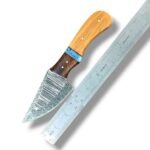


Damascus Pattern Mini Skinning Knife – Compact Blade with Two-Tone Wooden Handle
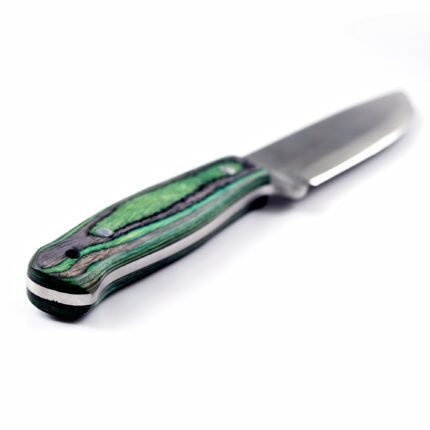
The Damascus Pattern Mini Skinning Knife brings together a compact fixed-blade design, a distinctive patterned blade, and an attractive two-tone wooden-style handle with a turquoise-blue accent. Its short, broad blade and gently curved cutting edge give it the appearance of a traditional small skinning knife, while the contrasting handle colors add a decorative finish.
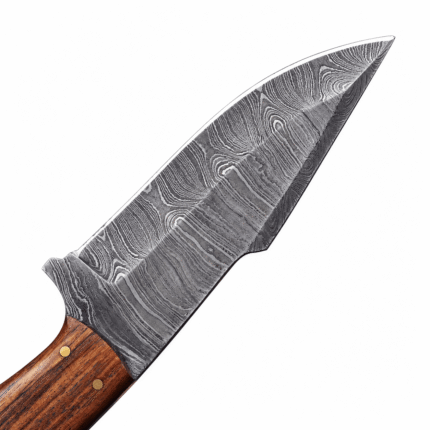
The blade features flowing silver and dark-gray lines that resemble the distinctive layers commonly associated with Damascus steel. These intricate markings cover much of the blade’s visible surface and create a striking contrast against the smooth-looking cutting edge.
Moving toward the handle, the design transitions into a dark brown wood-grain section decorated with two gold-colored pins. A bright blue spacer separates this section from the light honey-colored rear handle, which also displays two gold-colored pins.
The combination gives the knife a recognizable appearance that may appeal to outdoor knife enthusiasts, collectors, and customers interested in compact fixed-blade knives.
Its visible profile suggests a skinning or small utility-knife design. However, the exact intended application and material specifications require manufacturer verification.
Distinctive Damascus-Style Blade Pattern
One of the most noticeable features of this knife is its intricately patterned blade.
The blade displays closely spaced flowing lines, curved formations, and irregular wave-like markings. The patterns are particularly noticeable near the upper part of the blade, where multiple silver-colored lines contrast against darker areas.
Toward the cutting edge, the design becomes more fluid, with layered shapes extending toward the pointed tip.
These decorative markings give the blade an appearance commonly associated with Damascus-pattern knives.
Modern Damascus steel may be produced through pattern welding or other specialized manufacturing techniques. However, similar-looking patterns can also be created by surface treatments.
Because the manufacturing process cannot be confirmed from an image, this product is described as having a Damascus-style blade pattern rather than verified genuine Damascus steel.
The actual blade material, hardness, heat treatment, and steel-layer count should be confirmed directly with the supplier.
Compact Skinning-Style Blade
The knife has a short, relatively broad blade with a pronounced curved cutting edge.
Its cutting profile begins near the handle and gradually curves toward a pointed tip.
This shape resembles the blade geometry used on some compact hunting and skinning knives.
Skinning-style knives are commonly designed for controlled cutting and detail-oriented outdoor tasks.
The broad section of the blade creates a visually substantial cutting surface despite its relatively compact appearance.
The cutting edge sweeps gently upward toward the tip, giving the knife a smooth, curved profile.
A small transition between the blade and handle provides a defined separation between the cutting section and the grip.
Actual cutting performance depends on verified factors such as edge geometry, blade thickness, hardness, sharpness, and balance.
These characteristics cannot be established from the photograph alone.
For customers interested in a small outdoor knife, the blade profile is an important design detail to consider alongside the confirmed dimensions.
Two-Tone Wood-Grain Handle
The handle is another defining feature.
Unlike knives with a single-color grip, this model features two contrasting wood-grain sections.
The rear section is light honey-brown with long, visible grain lines.
These natural-looking markings extend across the handle and provide a warm finish.
The front section, positioned closer to the blade, is significantly darker.
Its deep brown color creates a contrasting transition between the blade and the lighter rear grip.
Both sections have a smooth-looking, polished appearance.
The exact handle material is not verified. While it resembles wood, the photograph alone cannot confirm whether the sections are natural hardwood, stabilized wood, or wood-grain composite.
The visible finish gives the knife a traditional appearance suitable for customers who appreciate contrasting natural-style materials.
Turquoise-Blue Decorative Spacer
Between the light and dark handle sections is a bright turquoise-blue decorative spacer.
This narrow band introduces a distinct accent color that stands out against the brown tones.
The blue section features darker irregular lines, giving it a stone-like or resin-like appearance.
Its actual material cannot be identified confidently from the photograph.
The spacer creates a clear visual separation between the two handle sections.
This small detail is especially noticeable because the rest of the knife primarily uses neutral metallic and natural brown colors.
For customers choosing a decorative knife, the turquoise-blue accent helps distinguish this design from more conventional wooden-handle models.
Four Gold-Colored Handle Pins
Four small gold-colored circular pins are visible on the handle.
Two are positioned in the darker front section, while two appear in the lighter rear section.
These pins create a consistent metallic accent across the contrasting handle materials.
Pins are commonly used in knife-handle construction, although their precise role depends on the internal assembly.
The photograph does not show the complete tang or the fastening method.
For this reason, the knife should not be advertised as full-tang unless the manufacturer confirms that specification.
The visible pins can accurately be described as gold-colored handle pins.
They complement the two-tone design without overpowering the visual detail of the handle.
Curved Handle Profile
The handle has a gently contoured shape.
Its front portion narrows near the blade, while the central and rear areas form a wider grip profile.
The overall appearance suggests a design intended to fit naturally within the hand.
However, comfort and grip security cannot be guaranteed from product photography.
Actual handling depends on the knife’s dimensions, weight, surface texture, and the user’s hand size.
A smooth or polished handle may behave differently under wet conditions than a textured handle.
Customers should consider the intended working environment and obtain accurate handle measurements before selecting the knife for regular outdoor use.
The light and dark wood-grain sections make the handle visually prominent, while the blue spacer creates an attractive central detail.
A Traditional Outdoor Knife Appearance
The overall design combines several familiar characteristics of traditional outdoor knives.
The fixed blade gives the product a straightforward, non-folding profile.
The curved edge resembles small hunting and skinning knife shapes.
The wood-grain handle introduces a classic appearance.
The Damascus-style pattern adds decorative detail across the blade.
Together, these features create a design that may appeal to people interested in hunting knife collections, outdoor equipment, and decorative cutlery.
Its size and silhouette make it visually different from large hunting knives and broad kitchen knives.
Rather than featuring an oversized blade, the model presents a compact cutting profile with a proportionally longer handle.
This combination makes the knife especially recognizable in close-up product photography.
Suitable Applications and Intended Customers
The knife’s appearance suggests several potential customer interests.
Collectors may appreciate its patterned blade, contrasting handle colors, and decorative spacer.
Outdoor knife enthusiasts may be interested in the small fixed-blade profile.
Customers browsing skinning-style knife collections may also recognize the broad, curved cutting edge.
However, suitability for field dressing, skinning, camping, or other outdoor cutting tasks depends on the verified technical specification and actual product testing.
The blade should be used only for purposes approved by the manufacturer.
A knife’s appearance does not establish its strength, edge retention, impact resistance, or suitability for demanding work.
Before purchasing, customers should confirm the material specification and intended use.
Blade Shape and Cutting Edge
The cutting edge is visibly curved rather than straight.
The blade appears broadest near the handle and gradually narrows toward the tip.
This creates a compact shape with a distinctive sweeping edge.
Curved cutting edges are found on many utility and skinning knives.
Their effectiveness depends on how the blade geometry is matched to the task.
The precise cutting bevel and blade thickness are not measurable from the uploaded photograph.
Similarly, the visible edge does not establish the knife’s actual sharpness.
These details should be provided by the manufacturer when describing the product’s practical performance.
The blade’s patterned surface is primarily a visible design feature until the underlying material and production method are confirmed.
Decorative Appeal for Knife Collectors
For collectors, the combination of blade pattern and handle design is an important consideration.
This knife has several distinctive details within a relatively compact form.
The Damascus-style surface includes numerous flowing lines, while the wooden-style handle offers two contrasting colors.
The turquoise-blue spacer introduces a bright accent rarely found on plain-handle utility knives.
Four gold-colored pins complete the decorative arrangement.
These elements make the knife suitable for display as part of a collection, subject to safe storage and applicable regulations.
Collectors who value authenticity should request documentation concerning the blade material, manufacturing process, and handle composition.
A decorative finish alone is not proof of traditional hand-forging or a particular number of steel layers.
Understanding Damascus-Style Steel
Damascus is a term frequently used in knife manufacturing and marketing.
Historically, the name has been associated with distinctive patterned blades.
Modern pattern-welded steel generally involves combining different steel types to produce visible patterns.
However, the physical properties of a completed blade depend on the specific alloys and manufacturing process.
The appearance of this knife resembles a layered or pattern-welded blade.
That resemblance is not sufficient to confirm the exact steel.
The blade may be made using genuine pattern-welded construction or another decorative technique.
A complete product specification should identify the blade material, hardness, manufacturing process, and any protective finish.
Until such information is provided, the most accurate description is Damascus-pattern or Damascus-style.
General Blade Care
Proper maintenance helps preserve the appearance of specialty knives.
The blade should be cleaned according to the manufacturer’s care instructions after approved use.
Remove dirt, moisture, and residue before storage.
Dry the metal surface thoroughly.
Avoid prolonged exposure to water or corrosive substances.
Depending on the steel composition, the manufacturer may recommend a suitable protective treatment.
A specialty patterned blade may have different maintenance requirements from a conventional stainless-steel knife.
Avoid abrasive cleaning materials that could damage the visible pattern or surface finish.
The knife should not be placed in a dishwasher unless the manufacturer explicitly confirms that this is suitable.
Handle Care and Maintenance
The two-tone handle should also receive appropriate care.
Because the precise material is not confirmed, cleaning recommendations should remain general.
Use a soft cloth to remove surface dirt.
Avoid prolonged soaking in water.
Keep the handle away from unnecessary exposure to harsh cleaning chemicals.
If the supplier confirms that the handle uses natural wood, follow its recommended conditioning procedure.
If it is stabilized wood or composite material, different maintenance instructions may apply.
The turquoise-blue decorative section should be cleaned gently to avoid damaging the surface.
Check the visible pins periodically for any signs of loosening.
Safe Storage
Store the knife in a secure, dry location away from children.
The uploaded photograph does not show a sheath or protective blade cover.
A suitable protective cover should be used when the knife is not being handled.
Avoid placing an exposed blade loosely among other tools.
For collectors, secure display storage can help protect both the knife and anyone nearby.
Outdoor transportation should follow applicable knife laws and regulations.
If a sheath is included by the manufacturer, its material and retention method should be verified before advertising it as part of the package.
Product Features and Specifications
| Feature | Description |
|---|---|
| Product type | Mini fixed-blade skinning-style knife |
| Blade pattern | Damascus-style flowing pattern |
| Blade profile | Broad, curved, pointed blade |
| Blade color | Silver and dark gray |
| Handle appearance | Two-tone wood grain |
| Handle colors | Honey brown and dark brown |
| Decorative accent | Turquoise blue |
| Handle pins | Four visible gold-colored pins |
| Blade steel | Not verified |
| Handle material | Not verified |
| Blade length | Not reliably determined |
| Overall length | Not reliably determined |
| Blade hardness | Not verified |
| Tang construction | Not verified |
| Included sheath | Not shown |
| Customization | Not verified |
Why Choose This Design?
The most recognizable characteristic of this knife is the combination of its broad patterned blade and contrasting handle.
Its light and dark wood-grain sections create a warm appearance.
The turquoise-blue spacer adds a colorful decorative element.
The gold-colored pins introduce subtle metallic accents.
The compact fixed-blade profile also distinguishes it from folding pocket knives and larger outdoor blades.
For buyers seeking a decorative mini hunting-style knife, these visible details make the model worth considering.
Customers who intend to use the knife for practical cutting tasks should first verify its dimensions, blade material, construction, and intended applications.
Final Thoughts
The Damascus Pattern Mini Skinning Knife with Two-Tone Wooden Handle and Blue Accent offers a distinctive combination of flowing blade patterns, contrasting wood-grain colors, and carefully positioned decorative details.
Its compact appearance makes it an interesting option for knife collectors and outdoor blade enthusiasts who appreciate traditional styling.
Explore this Damascus-style mini skinning knife and review its verified specifications before choosing it for your collection or intended application.



Reviews
There are no reviews yet.