



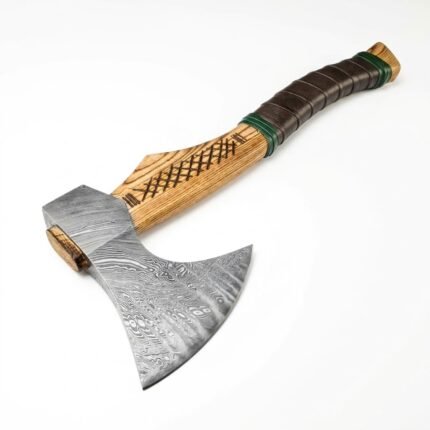
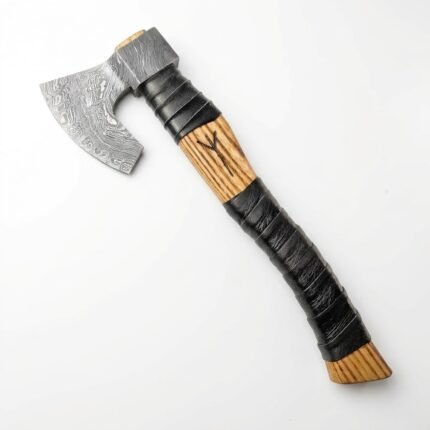
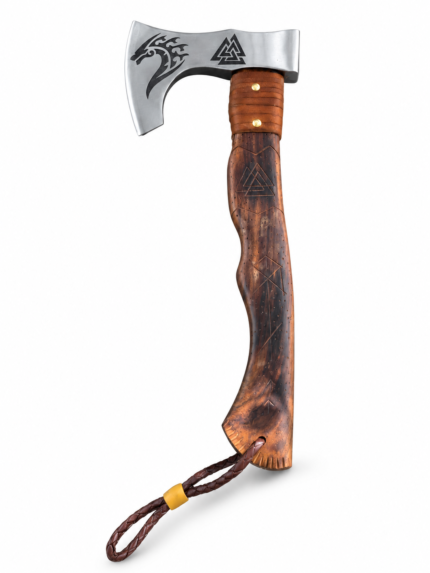
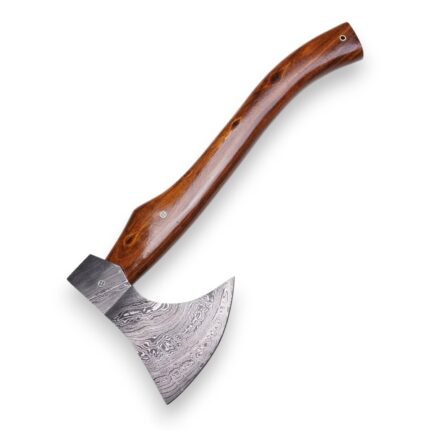
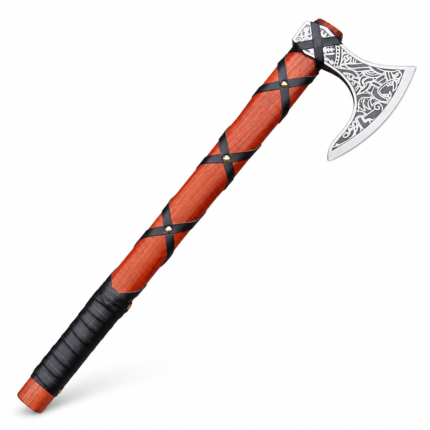
Damascus Pattern Viking Bearded Axe with Wrapped Wooden Handle combines traditional Nordic-inspired styling with a distinctive patterned metal head and a rustic wood-grain handle. Its broad, curved blade profile, extended lower cutting edge, and dark wrapped grip create a recognizable bearded axe silhouette.
The axe stands out through its contrasting materials and decorative detailing. The visible head features flowing silver and dark gray patterns resembling layered Damascus steel, while the handle displays natural-looking brown and black wood grain. A simple angular marking near the head adds a historical-inspired touch, and the dark wrapping provides a strong visual contrast.
This Viking-style axe is especially appealing to enthusiasts of traditional Nordic designs, collectors of decorative axes, and customers interested in historically inspired outdoor equipment.
Traditional Viking Bearded Axe Design
The Viking bearded axe is recognized by its distinctive blade profile, particularly the extended lower portion of the axe head.
This feature gives the blade a longer downward projection than many conventional straight-edged hatchets.
The photographed axe displays this recognizable design, with a broad cutting edge that curves toward the lower point.
The head also features an inward-curving section between the handle and the extended blade.
This combination creates a bold and traditional appearance associated with Nordic-inspired axe designs.
The visible profile makes the product different from ordinary modern camping hatchets, which often feature simpler, more compact head shapes.
Although the design resembles historical bearded axes, its exact historical origin or accuracy cannot be determined from the image alone.
Distinctive Damascus-Style Patterned Axe Head
One of the most noticeable features of this axe is its decorative metal head.
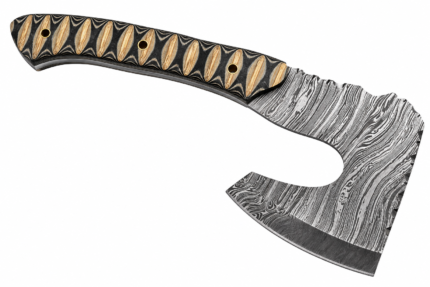
The surface displays detailed flowing lines in different shades of silver and gray.
These patterns resemble the layered appearance commonly associated with Damascus steel.
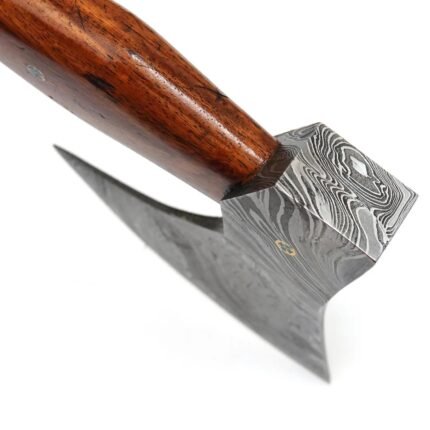
The pattern continues across much of the visible blade surface, including the upper section near the handle and the extended lower edge.
Fine curved lines, irregular swirls, and contrasting darker areas give the axe head a distinctive appearance.
The design provides a more decorative finish than a plain metal axe head.
Each visible section shows a slightly different arrangement of lines, creating visual interest throughout the blade.
The photograph does not confirm whether the pattern is produced through genuine pattern welding, surface etching, or another finishing method.
For this reason, the product is described as having a Damascus-style pattern until the steel composition and manufacturing method are verified.
Broad Curved Cutting Edge
The axe features a broad, curved blade profile with a noticeable downward extension.
This design is commonly referred to as a bearded axe shape.
The extended lower edge creates a distinctive silhouette and separates this model from many standard utility hatchets.
The curved edge meets the lower section at a defined point, while the upper part of the head transitions toward the wooden shaft.
The image shows a clearly defined blade outline, although the exact cutting-edge geometry cannot be measured.
The cutting-edge length, thickness, and sharpness should be confirmed through physical inspection.
Buyers looking for a practical cutting tool should also verify that the manufacturer approves this model for woodcutting or other intended outdoor tasks.
Natural Wooden Handle Appearance
The handle adds warmth and traditional character to the overall design.
Its surface shows prominent dark grain markings running through a golden-brown wooden-looking shaft.
The grain appears especially noticeable near the head, where the handle remains uncovered.
The darker markings contrast with the lighter brown surface, producing a rustic appearance.
The shaft has a relatively straightforward shape, with a slightly shaped end and a wider section close to the axe head.
This gives the handle an attractive traditional silhouette.
Wooden handles have been used on axes for centuries because of their familiar construction and natural appearance.
However, the specific wood used in this product cannot be identified from the photograph.
Materials such as ash, hickory, oak, or other hardwoods should only be listed after confirmation from the supplier.
Dark Wrapped Handle Design
The upper grip area features dark wrapping that extends toward the end of the handle.
The material appears dark brown or charcoal-colored and is arranged in overlapping diagonal bands.
Several layers cross the grip area, producing an irregular textured appearance.
The wrapping gives the axe a rugged look and complements the traditional design of the head.
Its darker color contrasts with the exposed golden-brown wood near the blade.
The arrangement also creates a visual separation between the exposed wooden shaft and the wrapped handle section.
Although the material resembles leather, its exact composition cannot be confirmed visually.
It may be genuine leather or another flexible grip material.
The product should therefore be described as having a leather-style wrapped handle until the material is verified.
Decorative Nordic-Inspired Handle Marking
An angular dark marking is visible on the exposed section of the wooden handle.
The design resembles intersecting straight lines.
It adds a subtle decorative element without making the overall handle overly elaborate.
The marking works well with the wood grain and the patterned axe head.
Its simple design contributes to the rustic Nordic-inspired appearance.
Traditional Viking-themed products frequently incorporate geometric symbols, markings, and decorative patterns.
However, the marking on this particular axe should not be described as an authentic historical rune unless its meaning and origin have been documented.
For customers who enjoy historically inspired equipment, the marking is an attractive visual detail.
Contrasting Materials and Finishes
The axe combines several distinctive surfaces.
The head has a bright metallic appearance with darker flowing lines.
The exposed handle section displays warm golden-brown wood grain.
The wrapped grip has a darker, textured finish.
Together, these elements create a balanced contrast between metal, wood, and wrapping.
The patterned head is the most visually prominent feature, while the handle adds a traditional rustic character.
The decorative marking near the head provides another interesting detail.
This combination makes the axe visually distinctive when displayed alongside other traditional hatchets and Viking-inspired tools.
Classic Nordic-Inspired Appearance
The shape of the axe head is closely associated with historical bearded axe designs.
The extended lower blade creates a recognizable outline.
The wooden shaft adds a traditional element, while the dark grip wrapping gives the product a rugged finish.
The overall appearance is suitable for customers interested in Nordic-style equipment and traditional craftsmanship.
The visible pattern on the head adds a decorative character that distinguishes the axe from models featuring plain steel surfaces.
The product combines modern visual presentation with historical design inspiration.
However, it should be presented as Viking-inspired rather than an authenticated historical reproduction.
Suitable for Axe Collectors
The Damascus Pattern Viking Bearded Axe offers several details that may appeal to collectors.
Its broad blade creates a distinctive silhouette.
The layered-looking head displays intricate decorative patterns.
The wooden handle introduces natural grain and warm coloring.
The dark wrapping adds texture and contrast.
Together, these features produce an attractive design for a collection of Nordic-style axes.
Customers who enjoy traditional tools, decorative metalwork, and historical-inspired items may appreciate these characteristics.
The axe can be displayed as part of a curated collection, provided it is mounted or stored securely.
Its actual suitability for reenactment, sporting activities, or practical cutting must be confirmed separately.
Viking-Themed Display and Decoration
Traditional axe designs are often used as decorative elements in historical-themed collections.
This model has a recognizable bearded axe profile that contributes to its distinctive appearance.
The broad patterned head can serve as a visual focal point.
The wood-grain shaft and wrapped handle complement the metallic surface.
Customers interested in Viking-themed rooms, workshops, or collections may appreciate its decorative style.
For safe display, the axe should be secured in an appropriate mount or storage arrangement.
The cutting edge should remain inaccessible to children and other unauthorized users.
Decorative presentation does not remove the need to handle the axe carefully.
Understanding the Axe Head Construction
A reliable product listing should explain the materials and construction of the axe head.
The photograph shows a metal head with a Damascus-style pattern, but several important specifications remain unknown.
The precise steel grade has not been established.
There is also no verified information about heat treatment, hardness, or head weight.
The pattern cannot be used as proof that the axe is made from genuine Damascus steel.
Some axes feature pattern-welded steel, while others use etched decorative surfaces.
These construction methods differ significantly.
The manufacturer should confirm the head material and manufacturing method before technical claims are added.
Such information is particularly important for buyers comparing collector pieces with functional outdoor axes.
Wooden Shaft and Head Attachment
The image shows the axe head fitted around the upper end of the wooden shaft.
The exposed wooden area near the head displays strong natural-looking grain.
A small portion of the wood is visible at the back of the axe head.
The photograph does not clearly establish the entire attachment method.
Head fit and attachment are important considerations for any functional axe.
Customers should therefore verify whether the manufacturer has tested the axe for its intended use.
If the model is intended for practical cutting, the head must be securely attached and the handle free from structural defects.
Any loose, cracked, or damaged components should be inspected before use.
Appearance of the Wrapped Grip
The wrapped handle is one of the axe’s defining visual features.
Its dark material creates several overlapping layers around the shaft.
The wrapping appears concentrated toward the upper end of the handle, opposite the axe head.
The exposed wooden section remains visible between the blade and the wrapped grip.
This arrangement makes the natural grain an important part of the design.
The darker grip gives the overall axe a strong rustic appearance.
Although the wrapping could potentially affect handling, grip comfort and traction cannot be reliably assessed from the photograph.
Buyers should evaluate these characteristics using actual product specifications or physical inspection.
A Distinctive Bearded Axe Profile
The design of the axe head deserves particular attention.
The lower edge projects downward to create the characteristic beard.
The upper region is comparatively compact, while the cutting edge becomes noticeably wider.
This produces an asymmetrical silhouette commonly associated with bearded axes.
The head’s curved outline creates a different appearance from standard rectangular chopping axe designs.
Its surface pattern follows the contours of the broad head, making the design particularly noticeable.
The profile appeals to buyers who prefer traditional-looking axes over conventional modern utility hatchets.
However, the image does not provide a reliable scale.
The overall length, blade width, edge length, and weight should be listed only after measurement.
Decorative Metal Patterning
The flowing metal pattern contributes significantly to the axe’s appearance.
The head features numerous wavy lines and layered-looking shapes.
Some sections are tightly patterned, while others contain larger curved formations.
The combination produces a visually complex surface.
The design is especially noticeable across the broader cutting area.
Customers interested in patterned metalwork may appreciate this decorative quality.
A close inspection of the physical product would be needed to determine the exact manufacturing technique.
The finish should not be represented as hand-forged, pattern-welded, or acid-etched without supplier documentation.
Important Information About Functional Use
The Viking-inspired shape does not automatically establish that the axe is suitable for chopping or outdoor tasks.
Functional performance depends on several factors.
These include the steel grade, edge geometry, heat treatment, head attachment, and handle construction.
The image cannot confirm these characteristics.
Customers intending to use the axe for cutting should obtain confirmation from the manufacturer that the model is designed for that purpose.
They should also inspect the product before use.
A decorative axe should not be used for chopping simply because it has a sharp-looking edge.
Similarly, the axe should not be advertised as battle-ready or suitable for historical combat activities without verified testing and appropriate certifications.
General Axe Care and Maintenance
Keeping the axe clean and dry can help preserve its appearance.
After handling, wipe moisture and dirt from the metal head with a clean cloth.
Avoid leaving the axe exposed to rain or prolonged humidity.
The correct corrosion-prevention treatment depends on the verified steel composition and surface finish.
Customers should follow the manufacturer’s maintenance recommendations.
The wooden handle should also be protected from prolonged moisture exposure.
Avoid soaking it in water or storing it in excessively damp conditions.
If the wood has a protective finish, use cleaning products compatible with that finish.
The dark wrapping should be cleaned gently.
Harsh chemicals may damage certain leather or synthetic materials.
Regular inspection is advisable, particularly if the axe is intended for practical use.
Safe Storage
A traditional axe requires careful handling and storage.
Keep the cutting edge protected whenever the axe is not in use.
Use a properly fitted axe-head cover if one is supplied or purchased separately.
Store the axe securely in a dry location.
Do not leave it unattended in areas accessible to children.
If the axe is displayed, secure it to prevent accidental falls.
Inspect the head and handle periodically for visible damage.
Do not use a functional axe when the head is loose or the handle has cracks.
The current photograph does not show a sheath, so a protective cover should not be described as included unless the supplier confirms it.
Product Specifications to Confirm
For customers comparing Viking axes, detailed technical information is valuable.
A complete product specification should identify the head material and manufacturing method.
It should also provide overall length, head width, cutting-edge length, head weight, and total weight.
The handle wood species and wrapping material should be clearly identified.
Additional information about sharpening, hardness, and intended use may be relevant if the product is sold as a functional tool.
These details cannot be reliably determined from the photograph alone.
Confirming them will help customers understand the product and make a better-informed purchasing decision.
Why Choose This Damascus Pattern Viking Bearded Axe?
The main appeal of this axe is its distinctive combination of traditional design and decorative detailing.
The broad bearded head creates a recognizable Nordic-inspired shape.
The flowing metal pattern adds visual complexity.
The wooden handle provides a warm, natural-looking finish.
The dark wrapping creates contrast and gives the grip a rugged appearance.
The angular marking near the head adds a subtle decorative accent.
These features make the axe suitable for customers who appreciate Viking-themed designs and collectible axes.
Its exact performance characteristics should be verified before being marketed for functional outdoor applications.
Explore a Traditional Viking-Inspired Axe
The Damascus Pattern Viking Bearded Axe with Wrapped Wooden Handle is an attractive choice for customers who appreciate the appearance of classic Nordic axes.
With its broad patterned head, distinctive bearded profile, wood-grain handle, and dark wrapped grip, it offers a recognizable combination of traditional styling and decorative detail.
Explore this Viking-inspired axe as an addition to your collection of traditional axes and Nordic-style equipment.







Reviews
There are no reviews yet.