







Damascus-Style Knife Blank – Patterned Metal Design with Exposed Tang
Introduction
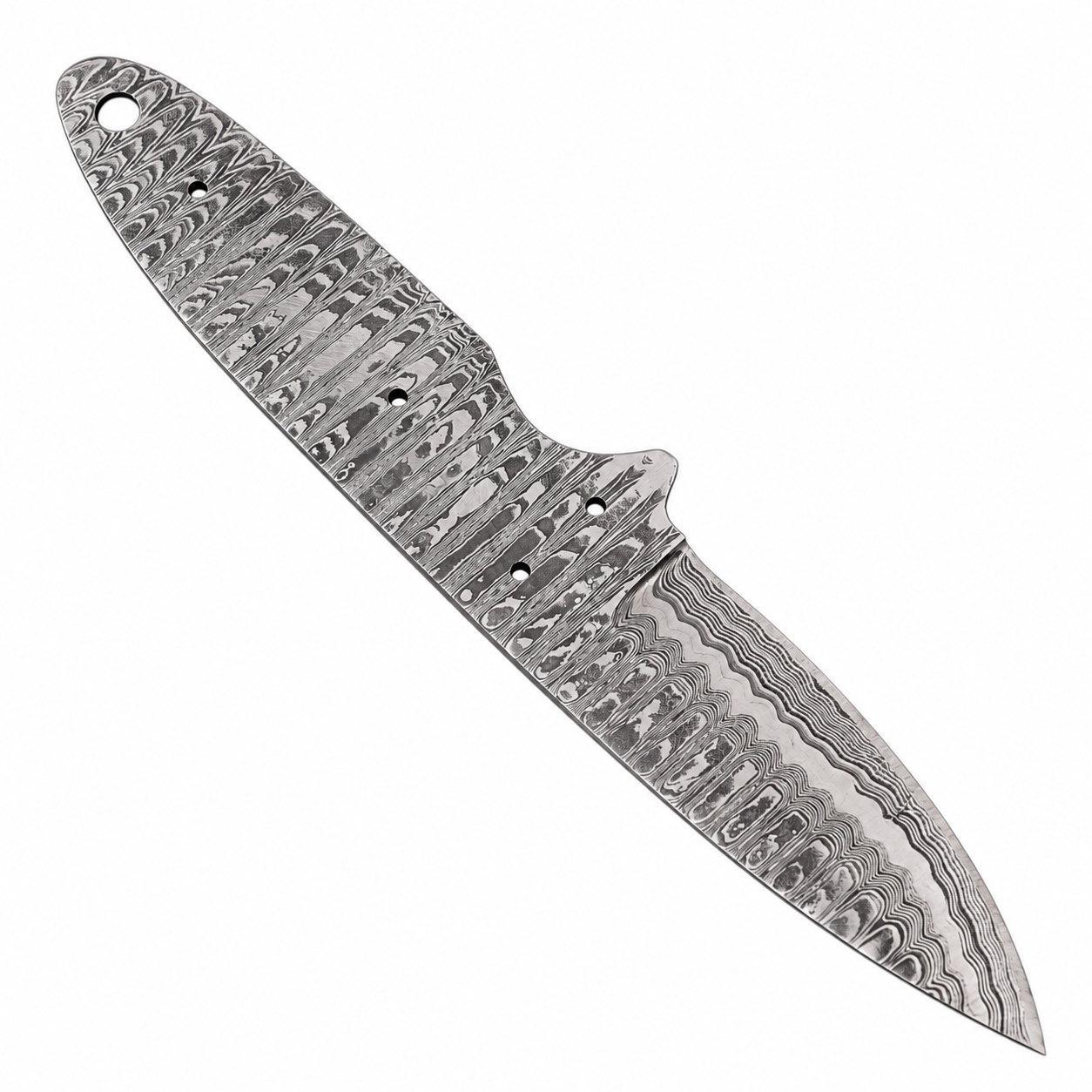
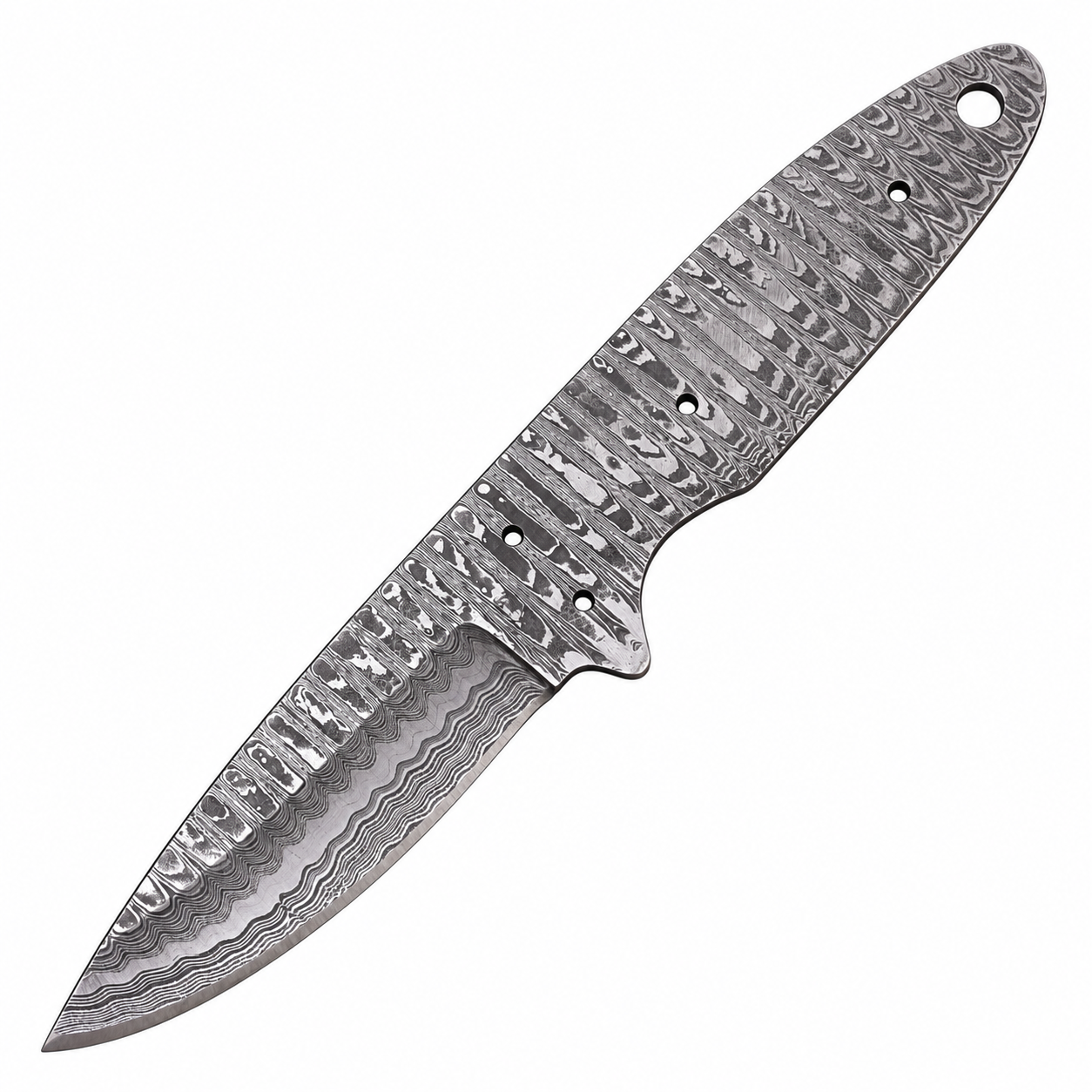
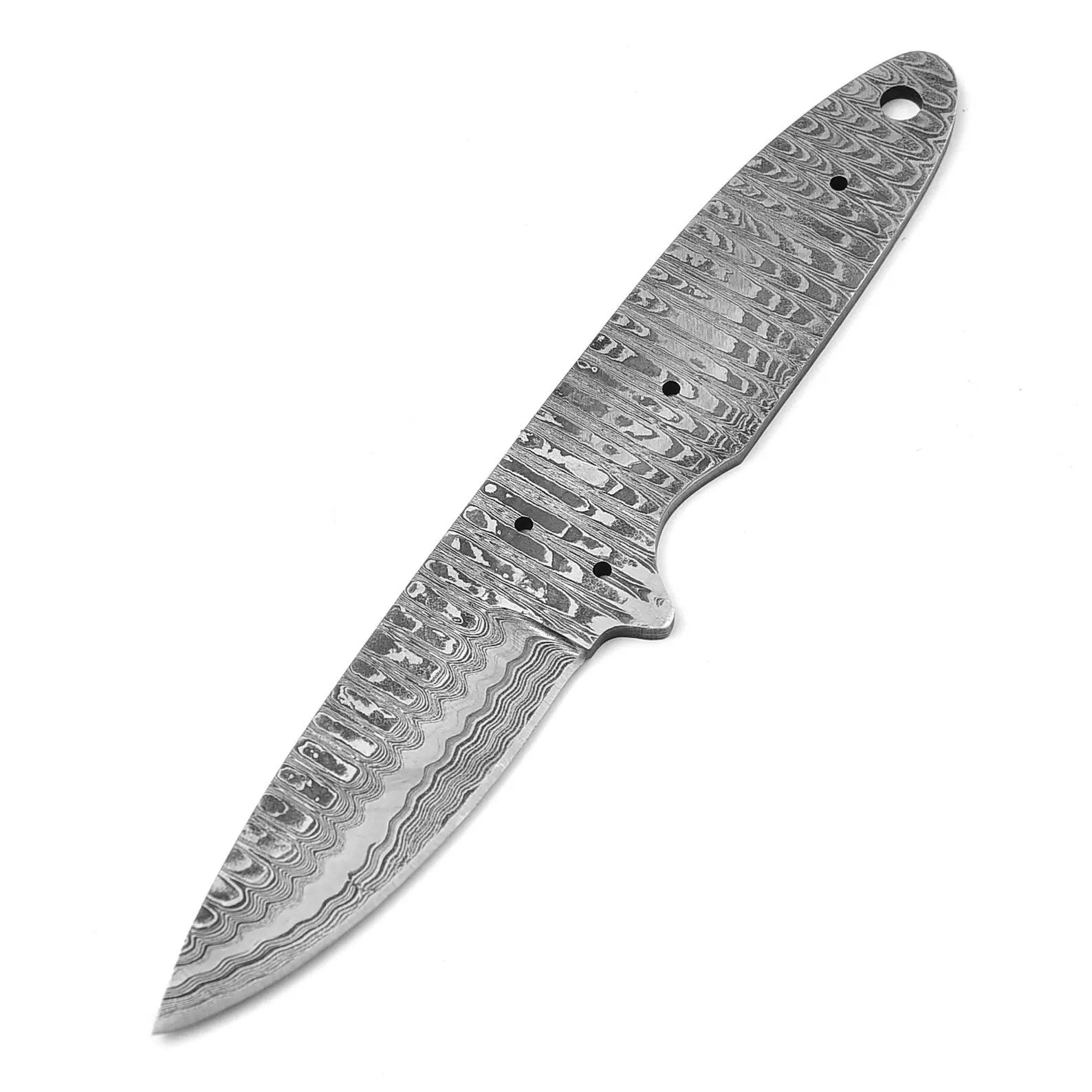
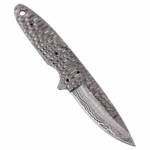
The Damascus-Style Knife Blank features a distinctive patterned metal surface, an exposed handle section, and a classic fixed-blade silhouette. Its silver-gray appearance is highlighted by flowing, layered-looking patterns that extend across both the blade and the handle area.
Unlike a finished knife with an attached grip, this product is shown as a single metal component. Its handle section remains exposed, displaying several circular openings and an elongated outline that follows the natural shape of a traditional knife handle.
The most noticeable feature is the intricate surface pattern. Fine waves, curved lines, and darker contrasting markings create a decorative appearance across the visible metal.
The knife blank is photographed diagonally against a plain white background, providing a clear view of its overall profile.
While the surface resembles Damascus steel, the exact metal grade and manufacturing process have not been confirmed.
Distinctive Damascus-Style Surface Pattern
One of the defining visual features of this Damascus-Style Knife Blank is its elaborate metallic pattern.
The surface displays alternating light and dark lines, creating the appearance of multiple flowing layers.
These markings appear across nearly the entire visible face of the metal component, including the blade section and exposed tang.
Some areas feature narrow, closely spaced lines, while others display broader curved shapes and irregular patterns.
The resulting design resembles the decorative appearance traditionally associated with Damascus-style metalwork.
The contrast between the lighter silver-gray sections and darker markings helps the pattern remain visible from different parts of the photographed surface.
It is important to distinguish this visual appearance from a verified manufacturing specification.
A Damascus-style pattern does not independently establish that the product is manufactured from genuine pattern-welded steel.
Confirmation would require additional information about its composition and production process.
Traditional Fixed-Blade Silhouette
The product features a recognizable fixed-blade outline.
Its blade section extends outward from the metal handle area and gradually narrows toward a pointed end.
The visible cutting-edge outline follows a gentle curve rather than a completely straight line.
This curved profile creates a smooth transition along the lower portion of the blade.
The opposite side of the blade displays a different contour, resulting in an asymmetrical but balanced-looking shape.
Near the transition between the blade and tang, the profile includes a small inward curve and projecting metal section.
These details contribute to the recognizable outline of the product.
The photograph clearly establishes the general blade shape, although its exact dimensions, thickness, and edge condition remain unverified.
Exposed Metal Tang Design
The Damascus-Style Knife Blank includes an extended metal section where a handle would ordinarily appear.
This section is commonly described as a tang.
The visible tang has an elongated profile with a gradually changing width.
Its outer edges are slightly curved, creating a handle-shaped silhouette.
The tang appears to form part of the same continuous metal profile as the blade.
No wooden, polymer, bone, or other grip material is attached in the supplied photograph.
The exposed metal allows the surface pattern to remain visible along the full length of the component.
This uninterrupted appearance is one of the notable characteristics of the photographed design.
The exact internal construction and manufacturing process cannot be established from the image alone.
Multiple Circular Openings
Several circular openings are visible along the tang.
Four smaller openings appear at different points along the metal handle section.
A larger circular opening is located near the rounded end.
The smaller openings vary in position and are distributed across the length of the exposed tang.
Their circular shapes provide additional visual detail against the patterned metallic surface.
The larger opening near the end is particularly noticeable because of its contrasting white center in the product photograph.
The photograph does not establish the precise diameter of these openings or their manufacturer-specified purpose.
As a result, technical claims about hole dimensions, hardware compatibility, or particular attachment systems should not be made without supporting measurements.
Silver-Gray Metallic Appearance
The product has a predominantly silver-gray appearance.
Lighter metallic sections are combined with darker gray lines that create contrast across the surface.
The blade area displays a combination of subtle gray shading and prominent decorative markings.
The tang also features dark and light patterns, giving the entire component a visually consistent appearance.
The colors remain relatively neutral, allowing the patterned surface to become the main visual feature.
Unlike products with brightly colored handles, this design relies almost entirely on variations in its metallic finish.
The absence of an attached handle also means that no additional material interrupts the visible pattern.
This creates a simple, coordinated appearance across the component.
Detailed Blade Surface
The blade contains some of the most intricate patterns in the image.
Near the cutting-edge outline, fine parallel lines follow the contour of the blade.
Above these lines, broader shapes form irregular waves and layered-looking markings.
The contrast between these regions gives the metal surface a textured visual appearance.
The pattern is especially prominent toward the wider section of the blade.
The pointed end also displays visible lines that continue toward the tip.
This variation gives different parts of the blade slightly different visual characteristics.
The exact surface texture cannot be determined through photography alone.
Some markings may be physical surface variations, while others may result from finishing or decorative processing.
A close examination of the actual product would be necessary to verify these details.
Curved Handle-Shaped Profile
The exposed tang follows a gently changing outline.
Its end is rounded rather than square.
The upper and lower edges gradually converge toward the narrower section closer to the blade.
The transition into the blade includes an inward curve that creates a clear distinction between the two sections.
This shape gives the component an identifiable handle area even though no separate grip is installed.
The pattern continues across this section without a visible change in overall color.
The rounded end contains the largest circular opening shown in the photograph.
Together, these details distinguish the component from a plain rectangular piece of patterned metal.
Pattern Distribution Across the Surface
The decorative pattern varies across the length of the Damascus-Style Knife Blank.
The blade area features flowing, wave-like lines that follow parts of its curved outline.
The tang contains broader contrasting shapes arranged in a more irregular pattern.
Near the center, light and dark sections create a layered appearance.
Toward the rounded end, the pattern becomes more closely spaced in some areas.
This variation makes the surface visually detailed without introducing additional colors or decorative accessories.
The pattern’s appearance may also be influenced by the lighting and viewing angle used in the photograph.
The supplied image provides a useful visual reference, but it cannot establish how every marking would appear under different lighting conditions.
Blade and Tang Transition
The area between the blade and tang includes a distinctive change in shape.
The blade becomes broader as it extends away from the handle-shaped section.
A curved recess helps define the boundary between the blade and the exposed tang.
The metal also includes a small protruding contour near this transition.
These features contribute to the overall appearance of the product.
The patterned finish continues through this region, maintaining visual consistency.
No separate guard, bolster, or attached handle hardware is visible.
The photograph therefore presents the product as a patterned metal blank rather than a fully assembled knife.
Unfinished Product Appearance
An important distinguishing characteristic of this product is its unfinished handle configuration.
The Damascus-Style Knife Blank is shown without attached handle scales or other grip components.
This is an important detail for accurate product identification.
Images of completed knives may include wooden handles, decorative pins, colored spacers, or protective sheaths.
None of those additional parts are visible in this photograph.
The component should therefore be described as a knife blank rather than a complete knife with a finished grip.
The photograph does not establish whether any additional accessories would be supplied separately.
Package contents would need to be confirmed through the original manufacturer or product documentation.
Decorative Metalwork Character
The wavy metallic finish gives the blank a decorative appearance.
Its visual style resembles patterns commonly seen in traditional metalwork.
Closely spaced lines, irregular curves, and contrasting shades create an intricate surface.
The product’s appearance is defined primarily by these markings rather than by added decorative fittings.
The combination of patterned blade and exposed tang creates a continuous visual design.
The circular openings also contribute to the appearance of the tang, introducing small breaks in the otherwise uninterrupted metallic surface.
These characteristics can be described accurately without making unsupported claims about historical origin, handmade construction, or particular manufacturing techniques.
Visible Construction Details
The photograph shows a single continuous-looking metal component.
Its blade section, transition area, and tang share a similar patterned finish.
The exterior profile changes gradually across the length of the product.
The tang features multiple round holes.
The blade has a pointed end and a curved lower outline.
The surface includes darker patterned markings over a lighter metallic background.
These are the principal visible construction details.
The image does not establish the precise steel type, actual thickness, material hardness, heat treatment, or manufacturing tolerance.
Such specifications require measurement or documentation rather than visual estimation.
Material and Finish Verification
The term Damascus-style describes the visible pattern without making a definitive claim about the metal’s composition.
Genuine Damascus or pattern-welded steel can have distinctive layered appearances, but similar-looking patterns can also be produced by other methods.
The uploaded photograph is not sufficient to distinguish between these possibilities.
The safest factual description is therefore patterned steel-look metal or Damascus-style patterned metal.
Likewise, no claim should be made about corrosion resistance, hardness, or durability without verified manufacturer data.
Even when two products have similar patterns, their materials and construction methods may be different.
Accurate catalog descriptions should reflect this distinction.
Dimensions and Weight
The image does not contain a measurement scale or specification label.
For this reason, the overall length cannot be reliably calculated from the photograph.
The blade length, tang length, thickness, and weight are also unknown.
Although the product occupies much of the image, the photograph’s dimensions do not represent the actual physical size of the component.
A listing should not assign exact measurements based on appearance alone.
Verified technical measurements would be needed to complete a full specification sheet.
Until those details are available, it is more accurate to leave them unspecified than to present estimates as confirmed facts.
Product Photography Details
The product is shown against a plain white background.
The pointed blade extends toward the lower-left corner, while the rounded tang extends toward the upper-right.
This diagonal arrangement provides a clear view of the full visible outline.
The white background creates strong contrast with the darker metallic markings.
The circular openings are also easy to distinguish because the background is visible through them.
There are no visible brand names, measurements, logos, or packaging details in the photograph.
Only one side of the component is shown.
The reverse-side finish and appearance cannot therefore be confirmed.
Product Specification Summary
Product Type: Knife blank
Design: Fixed-blade profile with exposed tang
Surface Appearance: Damascus-style layered pattern
Color: Silver-gray with dark contrasting markings
Blade Profile: Curved outline with pointed end
Tang Profile: Elongated and rounded at the end
Visible Openings: Four smaller holes and one larger end opening
Accurate Product Identification
The Damascus-Style Knife Blank is distinguishable through its patterned metallic surface, pointed blade outline, and exposed handle-shaped tang.
The lack of attached grip material is especially important when comparing the image with finished fixed-blade products.
The decorative pattern extends across both major sections of the component.
Its curved outline and circular openings provide additional identifying features.
A complete technical product description would require manufacturer confirmation of the metal grade, dimensions, surface treatment, and package contents.
Without that information, the photographed appearance remains the most reliable basis for identification.
Final Overview
The Damascus-Style Knife Blank combines a silver-gray patterned surface with a classic fixed-blade outline and exposed metal tang.
Its flowing decorative lines, rounded tang end, and multiple circular openings create a recognizable visual profile.
The product is accurately identified as a knife blank because no handle is attached in the supplied image.
The distinctive surface resembles Damascus-style metalwork, although its exact manufacturing method and material specifications remain unverified.
These visible features provide a factual foundation for cataloging the product without relying on unsupported technical claims.





Reviews
There are no reviews yet.