





Double Handle Damascus Pattern Ulu Knife with Decorative Turquoise Inlay
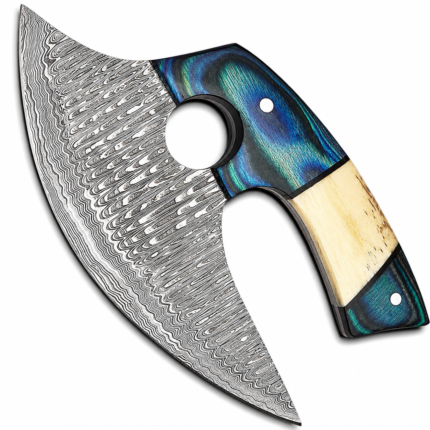
The Double Handle Damascus Pattern Ulu Knife combines a traditional crescent-shaped blade with an eye-catching double-handle design. Its broad, curved cutting profile, wood-grain handles, turquoise-colored center panel and matching brown sheath create an attractive piece for adult knife collectors and enthusiasts of traditional culinary tools.
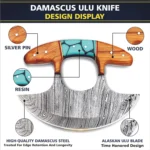
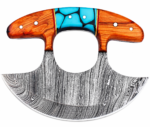
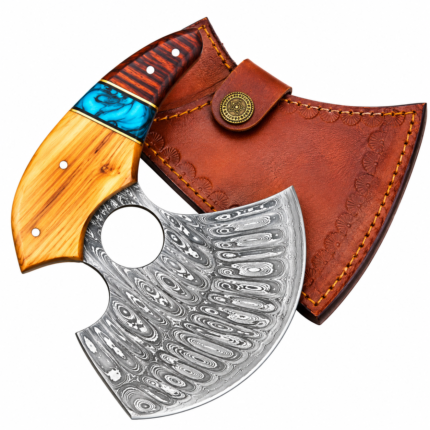
Inspired by the familiar shape of ulu and mezzaluna knives, this design features a continuous curved cutting edge beneath two separate grip sections. The blade has a striking black-and-silver pattern resembling the layered appearance associated with Damascus steel.
The handles are positioned above the blade, one near each outer end. They have warm reddish-brown tones with visible grain-like markings. Between them is a decorative turquoise-colored section featuring irregular black dividing lines.
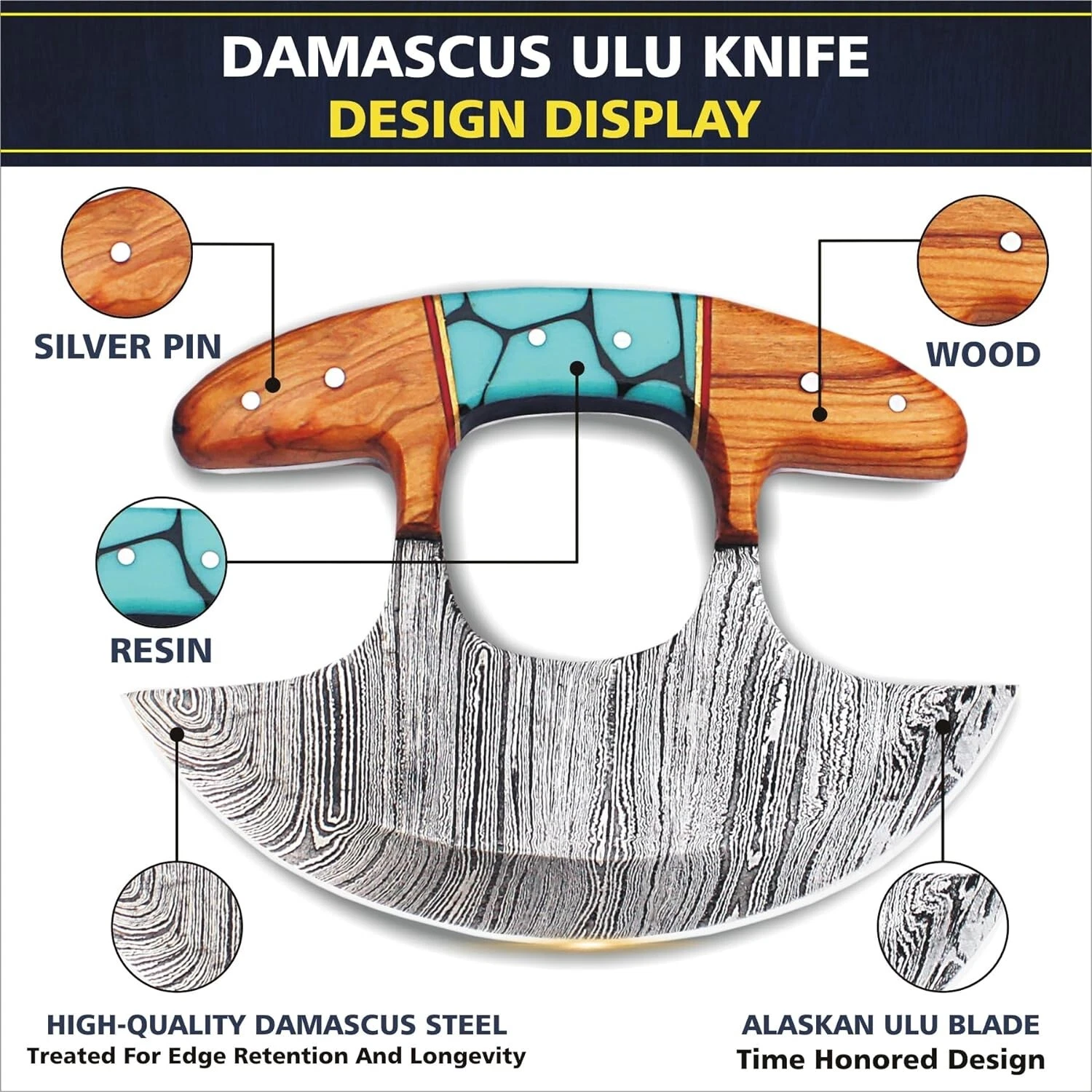
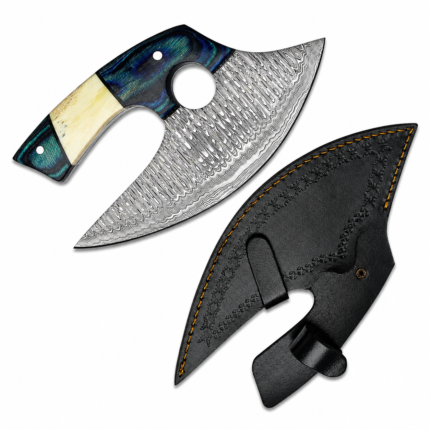
A curved brown protective sheath completes the presentation. Its surface features decorative impressions, contrasting stitching and a central tab.
The knife stands out for its unusual shape and traditional styling. Its combination of decorative features makes it a distinctive addition to a curated knife collection.
Distinctive Crescent-Shaped Blade Design
The most recognizable feature of this ulu-style knife is its broad crescent-shaped blade.
Unlike conventional kitchen knives that have a long straight handle attached to one end, this knife places its two handle sections above the blade.
The cutting edge extends along the lower curved section.
The blade has a wide central area and rises toward both ends, creating an almost semicircular silhouette.
This characteristic shape is associated with rocking-style chopping knives.
The curvature allows the knife to be identified as part of the ulu and mezzaluna family of cutting tools.
However, the exact category depends on the manufacturer’s intended design.
The photograph provides a clear view of its shape, but it does not establish the blade’s cutting performance.
Specifications such as sharpness, thickness, hardness and edge geometry require direct verification.
Beautiful Damascus-Style Blade Pattern
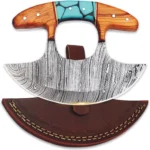
The Double Handle Damascus Pattern Ulu Knife features a decorative blade surface with intricate black and silver lines.
These markings follow the blade’s overall shape.
Some areas have long, flowing lines, while others display rounded and irregular layered patterns.
The pattern is especially noticeable across the broad central section.
The contrasting light and dark tones create visual depth.
This finish resembles the distinctive appearance commonly associated with Damascus steel.
The blade also has a brighter-looking edge that follows its curved profile.
The difference between the patterned surface and the lighter cutting edge adds another visual detail.
Although the blade resembles Damascus steel, its composition cannot be established from the image.
It may feature pattern-welded steel, another layered material or a decorative surface treatment.
For accurate product specifications, the seller should confirm the steel grade and manufacturing method.
Until those details are available, Damascus-style or Damascus-pattern is the most accurate description.
Traditional Ulu and Mezzaluna Inspiration
Ulu knives are traditionally associated with curved blades and handles positioned above the cutting edge.
Mezzaluna knives also feature a characteristic curved profile and are commonly associated with rocking cutting movements.
This knife combines elements recognizable from both styles.
The wide blade is complemented by two extended handle sections.
Its overall design resembles a double-handle crescent chopper.
Traditional rocking choppers are associated with food-preparation tasks such as chopping herbs and vegetables.
However, this particular product’s suitability for food preparation has not been established.
Before advertising it as a functional kitchen knife, the manufacturer should verify blade sharpness, intended use, material suitability and any applicable food-contact requirements.
The product can nevertheless be accurately presented as a traditional ulu-style knife with a decorative crescent-blade design.
Warm Brown Wood-Grain Handles
The knife includes two separate handle sections.
Each extends outward from the turquoise-colored central section.
Their surfaces display warm brown and reddish-brown tones.
Visible grain-like lines give the handles a natural appearance.
The outer ends are rounded, and the lower surfaces feature a contoured transition toward the blade.
The overall handle arrangement is relatively symmetrical.
The wood-grain appearance adds warmth to the knife’s predominantly metallic design.
Several small, bright circular pins are visible across the handle sections.
These details create contrast against the darker brown surfaces.
The exact handle material remains unverified.
Although the handles appear wooden, the image does not establish whether they are natural wood, stabilized wood, laminated wood or another material.
The manufacturer should confirm the handle composition before publication.
Turquoise-Colored Decorative Center Panel
One of the most distinctive elements is the turquoise-colored panel connecting the two handle sections.
Its bright blue-green color contrasts with the warm wooden tones.
Irregular black lines divide the panel into different shapes, creating a stone-inlay-inspired appearance.
The decorative pattern resembles a mosaic.
Several small silver-colored circular details are visible within the turquoise section.
Thin contrasting borders separate the panel from the wooden handle sections.
This center area creates a strong focal point when the knife is viewed from the front.
Its color combination makes the product visually different from standard wooden-handle ulu knives.
The exact material cannot be determined from the photograph.
It may be a stone-look composite, resin, decorative inlay or another manufactured material.
For accuracy, it should be described as a turquoise-colored decorative inlay rather than genuine turquoise stone unless verified.
Balanced Visual Composition
The Double Handle Damascus Pattern Ulu Knife features a distinctive arrangement of curved metal and contrasting handle materials.
Its blade forms a broad semicircular profile.
The two handle sections extend above the blade and frame the turquoise-colored center.
This creates a symmetrical appearance.
The black-and-silver patterned blade adds visual texture, while the wood-grain handle sections create a warmer finish.
The turquoise-colored panel introduces a brighter accent.
Each part contributes to the overall decorative presentation.
The knife has the kind of recognizable silhouette that makes traditional blade designs visually interesting.
Actual weight distribution, balance and ergonomic comfort cannot be assessed from an image.
These characteristics depend on dimensions, material density and construction.
Buyers intending to use the knife regularly should request verified measurements and weight information.
Brown Protective Sheath
The knife is photographed with a matching curved sheath.
Its shape follows the broad crescent profile of the blade.
The sheath has a deep brown appearance with darker edges.
Decorative stamped markings are visible across the surface.
Yellow-gold stitching runs along the curved outer section.
This stitching provides a noticeable contrast with the darker brown material.
A central brown tab is also visible.
The sheath complements the traditional appearance of the knife.
Its shape is especially important because a crescent-shaped blade requires different coverage from a conventional straight knife.
The exact sheath material has not been verified.
Although it resembles leather, genuine leather should not be claimed without supplier confirmation.
The image shows both items together; the product package contents should also be confirmed.
Decorative Craftsmanship and Design Details
The design includes several visual elements that distinguish it from ordinary kitchen knives.
The layered-looking blade finish creates a detailed metallic surface.
The curved blade profile contributes to its traditional character.
The two wood-grain handle sections provide a natural-looking appearance.
The turquoise-colored decorative panel adds a contrasting central accent.
Small metal pins contribute to the handle detailing.
The brown sheath includes decorative impressions and prominent stitching.
Together, these elements create a cohesive presentation.
The finished product appears designed to attract customers interested in unusual knife shapes and traditional-inspired cutlery.
The photograph does not prove that the product is handmade.
Its manufacturing process, forging method and assembly techniques should be confirmed before using terms such as hand-forged or handcrafted.
Appeal to Knife Collectors
Collectors often look for knives with distinctive blade shapes, decorative features and unusual handle arrangements.
This model offers several elements that make it visually recognizable.
Its wide crescent blade differs from straight hunting and utility knives.
The black-and-silver surface pattern provides additional visual interest.
The two-tone handle arrangement combines brown grain-like markings with a blue-green decorative section.
The curved sheath also contributes to the product’s overall appearance.
These details make the knife suitable for consideration by adult collectors interested in traditional ulu-style and mezzaluna-style knife designs.
Collectors who require proof of steel composition, production origin or handmade construction should obtain written product specifications.
A photograph can demonstrate appearance but cannot establish material authenticity.
Traditional Styling with Modern Decorative Accents
The knife draws inspiration from an established cutting-tool shape while incorporating modern decorative details.
The broad curved blade is characteristic of traditional crescent knives.
The two separate handles create a visually prominent upper section.
The turquoise-colored panel provides a contemporary contrast to the brown handle surfaces.
The Damascus-style pattern gives the blade a layered appearance.
This combination makes the product distinctive without relying on oversized lettering or elaborate external branding.
The knife can be presented as an unusual variation of a traditional rocking-style blade.
For customers browsing a collection of ulu knives, its two-handle layout and turquoise-colored center are especially useful identifying features.
Understanding the Blade Material
Blade material is an important consideration when purchasing any knife.
Different steels have different characteristics related to maintenance, sharpening and corrosion resistance.
The visible blade pattern alone does not establish these characteristics.
Damascus steel is often associated with layered patterns, but visually similar appearances can be created using different processes.
For this reason, the manufacturer’s material specification is essential.
Customers should request the exact steel grade before relying on claims about hardness, corrosion resistance or edge retention.
Other relevant details include blade thickness and heat treatment.
These specifications provide more meaningful information than decorative appearance alone.
Without those details, the blade is best described according to its visible shape, color and surface pattern.
Appropriate Use and Product Verification
The knife’s design resembles traditional rocking choppers.
Such designs are associated with food preparation and other controlled cutting applications.
However, the uploaded image does not establish that this particular model is intended for commercial kitchens or demanding outdoor tasks.
Its intended purpose should be confirmed with the manufacturer.
If the product is designed for food preparation, the supplier should confirm appropriate material suitability and provide care instructions.
If it is sold as a decorative or collectible knife, the product page should describe it accordingly.
The description should not claim professional-grade cutting performance without evidence.
Accurate classification helps customers understand what they are purchasing.
It also prevents decorative features from being confused with verified technical capabilities.
General Care and Maintenance
Proper care can help preserve the knife’s appearance.
After handling, wipe the metallic surfaces with a clean, dry cloth.
Remove moisture promptly.
Avoid leaving the blade wet for extended periods.
Once the steel grade has been confirmed, follow the manufacturer’s recommended cleaning and corrosion-prevention instructions.
Do not use harsh abrasive cleaners on decorative blade surfaces.
The brown handle sections and turquoise-colored panel should also be cleaned carefully.
Avoid unnecessary exposure to water, solvents and high temperatures.
The appropriate cleaning method depends on the actual handle and inlay materials.
Keep the sheath clean and dry.
Avoid storing a moisture-sensitive blade inside a damp sheath for long periods.
Inspect the knife regularly for signs of corrosion, damaged fittings or surface wear.
Safe Handling and Storage
A wide curved knife requires careful handling.
Always keep hands clear of the cutting edge.
Avoid placing fingers beneath the blade.
Do not assume that the visible handles provide a particular level of grip security without manufacturer testing.
When the knife is not being used, store it with suitable blade protection.
Keep it away from children.
Use the product only for applications approved by its manufacturer.
Do not attempt cutting tasks that exceed its verified capabilities.
Knife ownership, transportation and use may be regulated depending on location.
Customers should follow applicable local laws and responsible knife-handling practices.
Important Specifications to Confirm
The manufacturer should provide accurate measurements before the final product page is published.
Relevant specifications include overall width, blade width, blade height, thickness and product weight.
The exact steel composition should also be verified.
Additional information should cover the handle material, decorative center material, sheath composition and packaging contents.
If customization is offered, the supplier should confirm available options.
Possible services should not be advertised unless they are actually available for this model.
Reliable specifications help customers compare similar products and make informed buying decisions.
Why Choose This Ulu-Style Knife?
The Double Handle Damascus Pattern Ulu Knife combines a recognizable crescent blade with a distinctive decorative handle arrangement.
Its black-and-silver patterned blade creates a layered visual appearance.
The two brown wood-grain handles complement the turquoise-colored center.
Small metallic accents add subtle detailing.
The curved brown sheath completes the traditional-inspired presentation.
For adult collectors who appreciate unusual knife designs, this product offers an eye-catching combination of classic form and contrasting colors.
Explore the Double Handle Damascus Pattern Ulu Knife for a distinctive addition to a collection of traditional-inspired cutting tools.









Reviews
There are no reviews yet.