





Green Burl Wood Damascus Style Hunting Knife – Patterned Fixed Blade with Brown Sheath
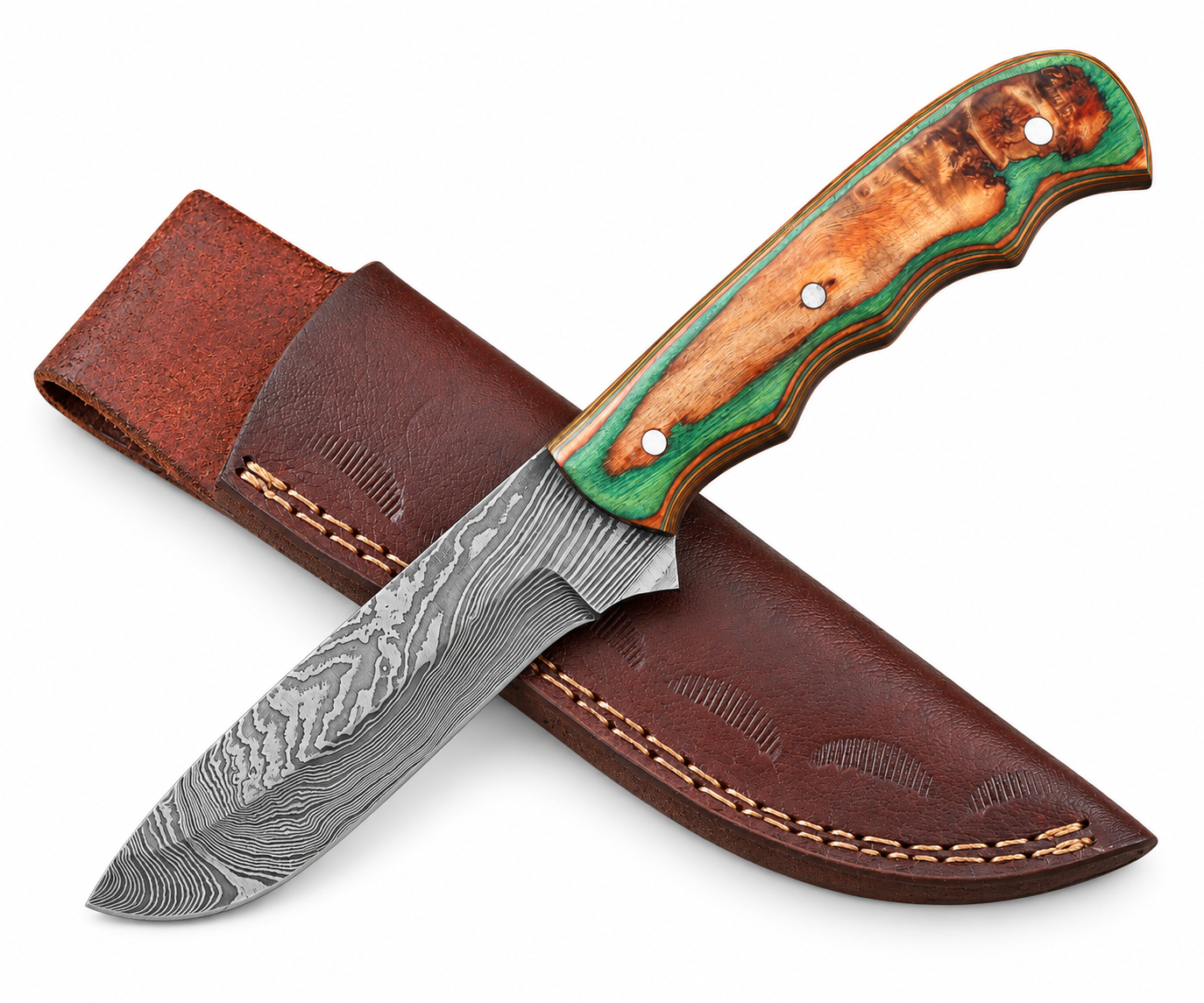
The Green Burl Wood Damascus Style Hunting Knife brings together decorative blade patterning, nature-inspired handle colors, and the traditional silhouette of a fixed-blade hunting knife. Its silver-gray blade features intricate flowing lines, while the contoured handle combines warm brown burl wood-like markings with vibrant green accents. A reddish-brown protective sheath completes the presentation.
For collectors and adult outdoor enthusiasts, appearance is often an important part of choosing a knife. This particular design stands out because of its contrasting colors, layered handle construction, and distinctive metallic pattern.
Unlike a plain-bladed knife with a single-color handle, this model offers several visual details to appreciate. From the curved blade profile to the patterned handle edges, each component contributes to its recognizable appearance.
The photographs show the product from multiple angles, making it possible to examine its fixed-blade construction, decorative features, and accompanying sheath.
1. Distinctive Green Burl Wood Damascus Style Hunting Knife
The first noticeable feature of this knife is its combination of natural-looking wood grain and bright green color.
The handle has a warm brown central section with irregular darker markings resembling burl wood. Around this central area, green-toned material creates a contrasting border.
Multiple dark, green, and warm brown layers are also visible along the handle edges.
These details give the knife a distinctive appearance without relying on a uniform or artificial-looking color scheme.
The patterned blade complements this unusual handle design. Silver and gray lines form complex waves across the blade surface, establishing a visual relationship between the organic-looking handle and decorative metal.
Together, these elements create a hunting knife design that is suitable for display, photography, and inclusion in a curated knife collection.
2. Detailed Damascus-Style Blade Pattern
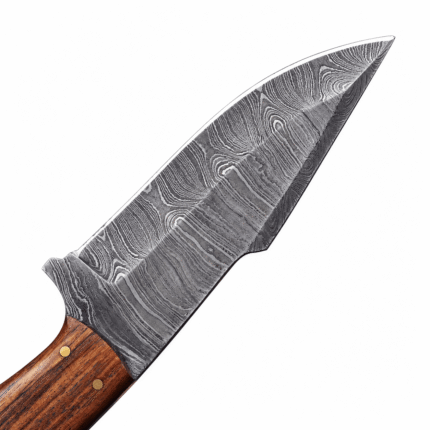
One of the most striking elements of the Green Burl Wood Damascus Style Hunting Knife is the pattern visible across its blade.
Fine layered-looking lines extend along the blade’s length. Near the cutting edge, the markings form tightly spaced parallel curves, while the upper section displays broader irregular shapes.
The combination resembles the flowing grain patterns associated with traditional Damascus steel.
Some sections appear lighter silver, while others contain darker gray outlines.
This visual contrast makes the blade pattern particularly noticeable against a white background.
The actual steel composition cannot be determined from photographs alone. The blade should therefore be described as Damascus-style until the manufacturer confirms that it is genuine pattern-welded Damascus steel.
The visual pattern also does not establish hardness, edge retention, or corrosion resistance.
Those properties depend on the actual steel grade, heat treatment, finishing process, and construction.
For an accurate online listing, the patterned appearance should be distinguished from verified metallurgical specifications.
3. Classic Fixed-Blade Construction
This product uses a fixed-blade design rather than a folding mechanism.
The blade extends directly from the handle, and no folding pivot is visible.
Fixed-blade knives are a recognized category in outdoor and hunting equipment, offering a different construction format from folding pocket knives.
This model has a compact, gently curved blade profile and a broader section near the handle.
The blade narrows toward a pointed tip, creating a traditional hunting-knife-inspired outline.
A shaped transition between the handle and blade is also visible.
Unlike folding knives, fixed-blade models do not require an opening movement before the blade is exposed.
This makes suitable storage, protective handling, and secure transportation particularly important.
The product includes photographs of a fitted-looking sheath, but the manufacturer’s package details should be checked before confirming that the sheath is included with every purchase.
4. Green and Brown Burl Wood-Look Handle
The handle gives this hunting knife much of its visual character.
Its central section has a natural brown appearance with areas of darker irregular grain.
These markings create a burl wood-like effect.
Green sections follow the outer contours and surround portions of the brown central area.
The green color varies slightly in tone, producing a natural-looking contrast with the warmer brown sections.
The combination is especially noticeable near the handle’s rear end, where the brown grain becomes darker and more detailed.
The handle’s wood-like texture and color transitions make it visually different from standard black, walnut-colored, or uniformly dyed handles.
However, the images alone cannot confirm whether the material is genuine stabilized burl wood, dyed wood, resin, or a composite.
Customers should receive the manufacturer’s verified material description.
5. Layered Handle Edge Design
An additional decorative element is visible along the edges of the handle.
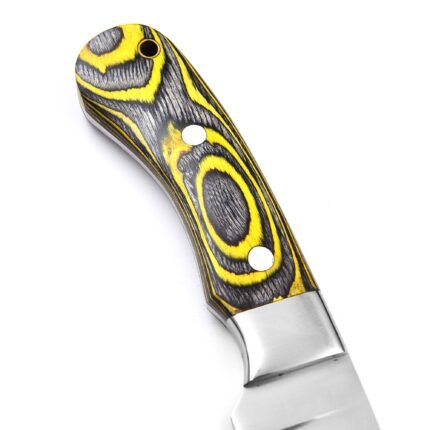
Several narrow colored layers run parallel to the outer profile.
These layers appear in green, brown, black, and warm orange-like tones.
The layered construction creates a striped border that follows the handle from its front connection toward the rounded rear section.
This detail is particularly clear in the close-up photograph.
The narrow lines add depth to the handle’s appearance, separating the green exterior color from the brown wood-grain-like center.
This type of decorative edging can help distinguish the product from simpler hunting knife designs.
The material used for each layer should be confirmed by the supplier before publishing technical specifications.
6. Contoured Grip with Finger Recesses
The Green Burl Wood Damascus Style Hunting Knife features a shaped handle with visible finger recesses.
Along the underside, three curved sections create a scalloped profile.
These contours give the handle a distinct silhouette and visually separate it from a straight cylindrical grip.
The handle also becomes wider toward the rear, finishing in a rounded end.
Its overall profile includes gentle curves rather than sharp rectangular corners.
Such shaping can influence how a knife feels in the hand, but actual comfort and grip security depend on individual hand dimensions, surface material, and the knife’s weight.
These qualities cannot be confirmed from photographs.
For customers who need an exact fit, verified handle length, width, thickness, and overall weight are useful specifications.
A clear image of the handle from the side can also help illustrate its shape.
7. Three Silver-Colored Handle Pins
Three circular silver-colored fittings are visible on the handle.
One is positioned near the front, another toward the middle, and the third close to the rounded rear end.
Their metallic finish contrasts with both the green and brown sections.
These round details create a consistent decorative pattern along the handle.
The pins also provide recognizable visual markers when viewing the product from different angles.
Although similar pins are often used in knife-handle assemblies, their specific material and attachment function should not be assumed.
They may be accurately described as three silver-colored handle pins or fittings.
The exact alloy and construction method require confirmation.
8. Traditional Hunting Knife Blade Shape
The blade features a gently curved cutting-edge profile and a pointed tip.
Its body is wider near the handle and becomes narrower toward the front.
The spine has a subtle curve, while the cutting edge follows a more pronounced flowing line.
The result is a traditional-looking fixed-blade profile with decorative surface markings.
The transition between the handle and blade is relatively compact, allowing the layered blade pattern to remain prominent.
Its shape is one of the primary reasons the product is visually recognizable.
However, no exact measurements have been supplied.
Blade length, thickness, cutting-edge length, and overall dimensions should be measured and verified before publication.
These specifications help buyers compare products reliably.
9. Reddish-Brown Protective Sheath
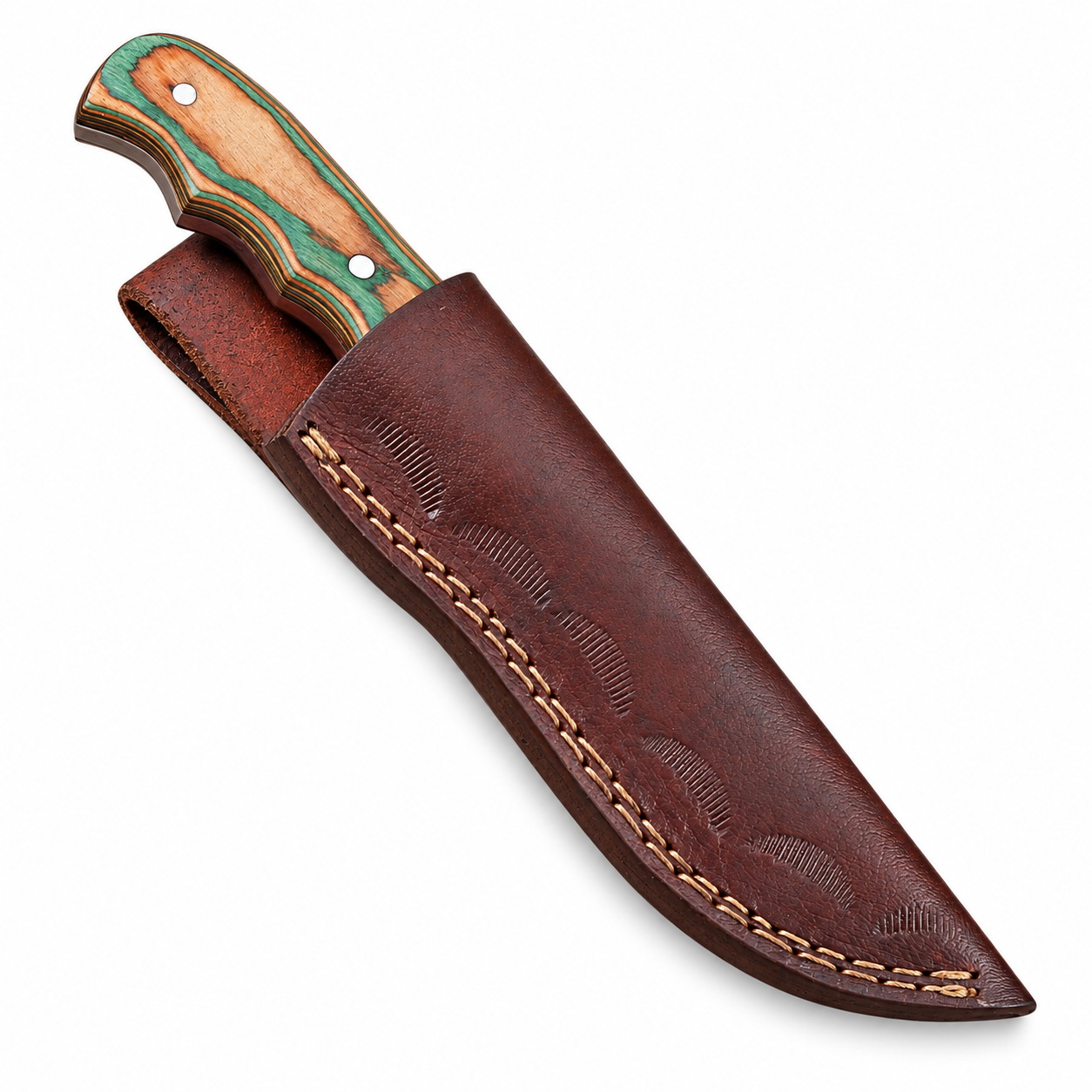
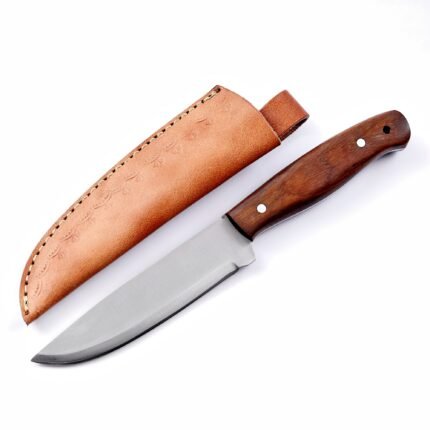
The product photographs show a reddish-brown sheath with a textured surface.
A line of contrasting light-colored stitching follows its curved lower edge.
The sheath has a pointed lower profile that corresponds visually with the knife’s blade shape.
Its surface also displays decorative pressed or embossed-looking markings.
A belt-loop attachment is visible on the reverse side.
The sheath’s brown color complements the natural-looking handle while contrasting with the green sections.
This gives the entire product a cohesive presentation.
The exact sheath composition should be verified.
Although it resembles leather, photographic appearance is not sufficient to establish whether it is genuine leather or a synthetic alternative.
The seller should also confirm package inclusion, closure method, fit, and retention before describing its protective performance.
10. A Unique Knife for Adult Collectors
Many knife enthusiasts appreciate products with distinctive design characteristics.
This model combines several unusual visual elements within one fixed-blade format.
Its patterned blade offers flowing metallic lines, while the handle provides a contrasting organic-looking surface.
The combination of green, brown, silver, and darker layered accents creates a recognizable appearance.
The silver-colored pins provide additional decorative detail.
The reddish-brown sheath adds a traditional finishing element.
For adults interested in collecting knives, these features may offer an alternative to conventional single-color designs.
The product can also be photographed or displayed as part of a personal knife collection, subject to safe storage practices.
Its visual features should be described accurately without making unsupported claims about rarity, historical origin, handcrafted production, or authenticity.
11. Decorative Blade and Handle Contrast
The visual appeal of the Green Burl Wood Damascus Style Hunting Knife comes largely from the relationship between its blade and handle.
The blade uses cool metallic shades.
Its fine gray lines create a detailed, flowing appearance.
The handle introduces warmer brown tones alongside vivid green accents.
These colors create contrast while maintaining a nature-inspired style.
The layered edge details visually connect the different handle sections.
Small silver-colored pins further complement the blade’s metallic appearance.
A brown sheath brings another warm tone into the overall product presentation.
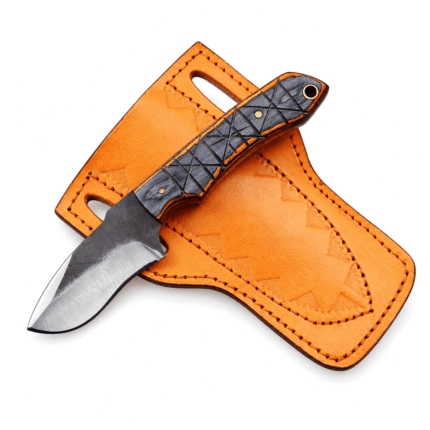
The combination is particularly noticeable in photographs showing the knife positioned across its sheath.
For an online store, accurate color reproduction is essential so customers know what appearance to expect.
12. Evaluating the Blade Material
When purchasing a patterned knife, buyers should understand the difference between appearance and verified construction.
The Damascus-style pattern visible in this product resembles layered steel.
Traditional pattern-welded Damascus steel is commonly produced by combining and working different steel layers.
However, similar-looking patterns can also be produced using other finishing methods.
Therefore, a photograph does not establish the manufacturing process.
To accurately describe the blade, request the steel grade, production method, and relevant supplier documentation.
If the knife is confirmed to be made from genuine pattern-welded steel, the final listing can be updated accordingly.
Similarly, performance statements about hardness, toughness, and edge retention should rely on verified testing or manufacturer specifications.
This approach helps maintain accurate product information and builds confidence in the listing.
13. Understanding the Handle Material
The handle combines brown wood-like sections with colored green material.
Its markings resemble the irregular grain commonly associated with burl wood.
Burl wood is known for unusual grain formations that can create decorative patterns in finished products.
However, the handle shown may contain natural wood, stabilized wood, synthetic material, or several combined materials.
The exact composition remains unknown.
If the supplier confirms stabilized wood, the listing should identify the wood species and treatment where available.
If the material is a composite, it should be labeled accordingly.
Buyers should not have to rely on appearance alone when evaluating product materials.
Accurate specifications are especially important for customers who specifically want natural wood.
14. Cleaning the Patterned Blade
Regular cleaning helps maintain the appearance of a decorative knife blade.
After appropriate use or handling, follow the manufacturer’s cleaning instructions.
Remove surface residue using a soft cloth.
Avoid abrasive pads that could scratch or alter the visible blade pattern.
Do not leave moisture on exposed metal surfaces.
Dry the knife thoroughly before storing it.
If the manufacturer recommends a protective oil, use a product suitable for the confirmed blade material.
Because the exact steel composition is unknown, corrosion resistance should not be assumed.
Inspect the blade for staining, discoloration, or damage during routine maintenance.
If unusual corrosion or structural defects appear, obtain professional advice before further use.
15. Caring for the Green and Brown Handle
The handle should be maintained according to its verified material composition.
For routine dust removal, a clean, soft cloth is generally appropriate.
Avoid prolonged exposure to excessive moisture or unnecessary heat.
Do not apply solvents, strong detergents, or wood-conditioning treatments unless they are compatible with the actual handle material.
Different woods, resins, and composites may require different care.
Inspect the edges of the colored layers for separation or damage.
Also examine the visible pins and the connection between the handle and blade.
If the handle becomes loose or damaged, discontinue use until the problem has been evaluated.
Proper storage can help preserve the handle’s attractive green and brown finish.
16. Maintaining the Brown Sheath
The sheath shown in the images has a textured reddish-brown surface with contrasting stitching.
Regular inspection helps identify wear around the seams and belt-loop area.
Remove dust using an appropriate soft cloth.
The correct cleaning method depends on whether the sheath is genuine leather or a synthetic material.
Avoid soaking it or exposing it to prolonged moisture.
Allow it to dry naturally if it becomes damp.
Check that its structure remains intact and that the knife fits appropriately.
Do not rely on a loose or damaged sheath for safe transportation.
For extended storage, follow the manufacturer’s recommendations regarding whether the knife should remain inside the sheath.
17. Product Specifications
Product Name: Green Burl Wood Damascus Style Hunting Knife
Product Type: Fixed Blade Hunting Knife
Blade Style: Curved Hunting Knife Profile
Blade Finish: Silver-Gray Damascus-Style Pattern
Blade Tip: Pointed
Blade Pattern: Layered-Looking Flowing Lines
Handle Appearance: Natural Brown Burl Wood-Look with Green Accents
Handle Profile: Curved, Contoured Grip
Finger Recesses: Three Visible Recesses
Handle Pins: Three Silver-Colored Pins
Handle Edges: Decorative Layered Color Detail
Sheath Appearance: Reddish-Brown, Textured
Sheath Stitching: Contrasting Light-Colored Thread
Sheath Attachment: Visible Rear Belt Loop
Blade Steel: To Be Confirmed
Handle Material: To Be Confirmed
Sheath Material: To Be Confirmed
Overall Length: Not Provided
Blade Length: Not Provided
Handle Length: Not Provided
Blade Thickness: Not Provided
Product Weight: Not Provided
Brand: Not Specified
These specifications are based on visible features. Material composition and dimensions should be verified by the supplier.
18. Product Photography and Online Presentation
High-quality photography helps customers evaluate the unique appearance of this product.
A clear full-length photograph should show the blade and handle together.
Another image can feature the knife positioned across the reddish-brown sheath.
A dedicated close-up should highlight the green and brown burl wood-look handle.
An additional photograph can display the blade’s silver-gray pattern and its curved profile.
The sheath should also be photographed separately.
Images should preserve the actual product colors and visible details.
Avoid unnecessary filters that exaggerate the green handle or metallic contrast.
White backgrounds are useful for showing the shape of the blade and the layered handle construction.
Descriptive image alt text helps explain each photograph for users of assistive technology.
19. What to Consider Before Purchasing
Before choosing a fixed-blade knife, customers should review its verified dimensions and materials.
The steel grade is particularly important for understanding the blade’s maintenance requirements.
Handle composition helps determine appropriate cleaning and storage.
Overall size and weight can influence how the product feels during handling.
The sheath should fit the actual knife securely and be appropriate for its intended storage arrangement.
Potential buyers should also check local laws governing knife ownership, transportation, and carrying.
This model’s decorative green and brown handle is a significant visual feature, but buyers should not assume functional specifications based solely on its appearance.
Clear product information helps make comparisons easier.
20. Frequently Asked Questions
What is a Green Burl Wood Damascus Style Hunting Knife?
It is a fixed-blade hunting knife design featuring a patterned silver-gray blade, green and brown burl wood-look handle, and a reddish-brown sheath.
Is the blade genuine Damascus steel?
The blade displays a Damascus-style pattern. Its steel composition and manufacturing method require supplier confirmation.
What colors are used in the handle?
The handle combines green accents, natural brown wood-like markings, and darker layered edges.
Is the handle genuine burl wood?
The material resembles burl wood, but its exact composition has not been verified.
Does the knife fold?
No. The photographs show a fixed-blade construction.
How many handle pins are visible?
Three silver-colored handle pins are visible.
Is a sheath included?
A reddish-brown sheath is photographed with the knife. Actual package inclusion should be confirmed before listing it as included.
Does the sheath have a belt loop?
Yes. A rear belt-loop attachment is visible in the product photographs.
What is the blade length?
The exact blade length has not been supplied by the manufacturer.
Is the knife suitable for collectors?
Its decorative blade pattern and distinctive colored handle make it visually appealing to adult knife collectors. Buyers should evaluate its verified construction and specifications for their individual requirements.
21. Final Product Overview
The Green Burl Wood Damascus Style Hunting Knife offers an eye-catching combination of decorative metal patterning and natural-looking handle colors.
Its fixed blade features fine, layered Damascus-style lines extending toward a pointed tip. The curved handle combines green accents, brown burl wood-like markings, and three silver-colored pins.
Decorative layers along the handle edges provide additional character, while the reddish-brown stitched sheath complements the overall appearance.
For adult collectors and outdoor knife enthusiasts, the product stands out through its distinctive design and traditional fixed-blade format.
Confirming the exact steel grade, handle composition, dimensions, and sheath details will help complete an accurate, professional product listing.







Reviews
There are no reviews yet.