

Green Handle Bowie Hunting Knife with Silver Blade and Brown Sheath
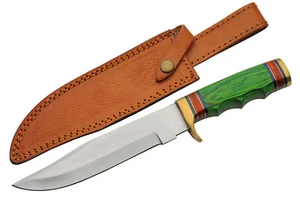
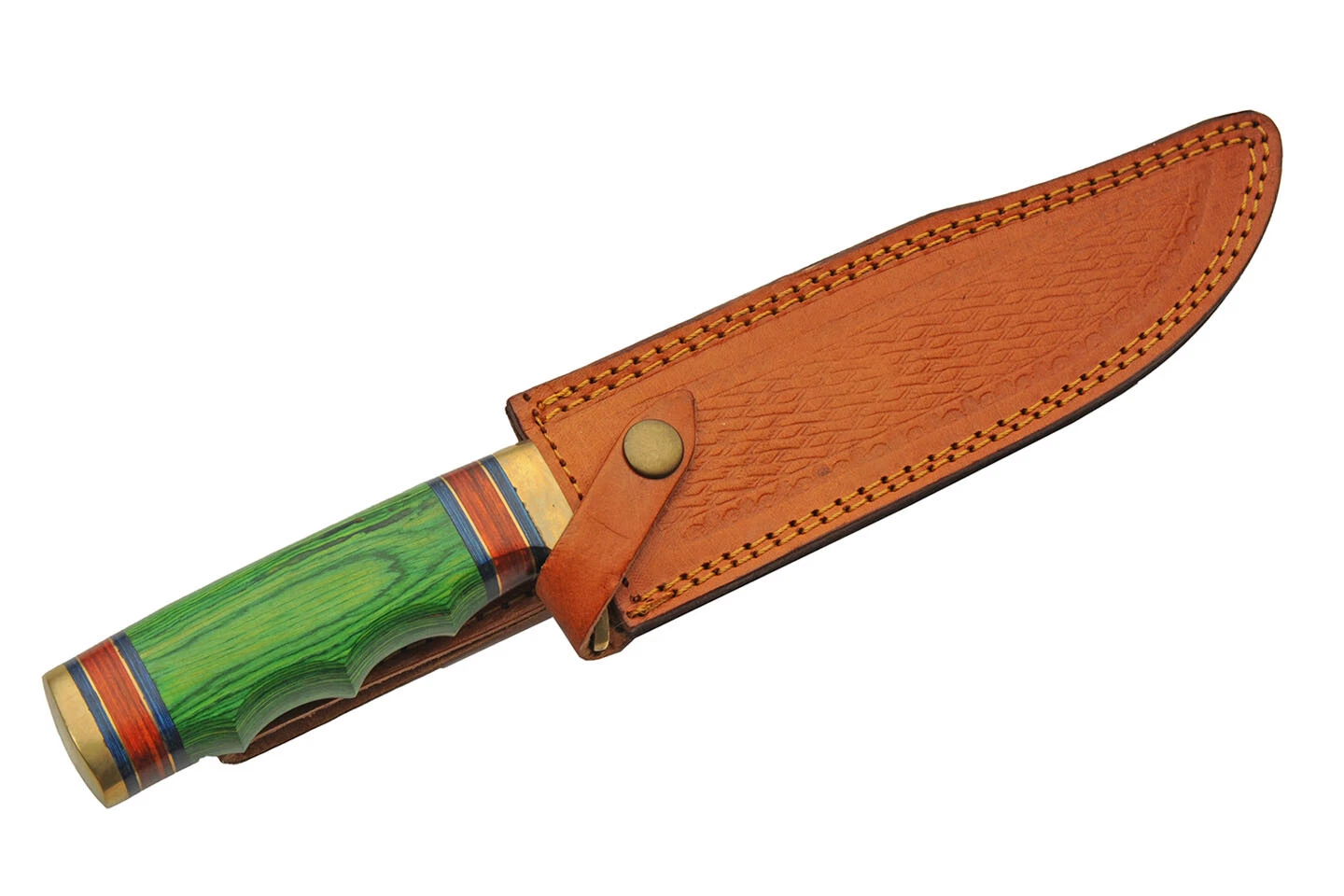
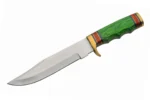
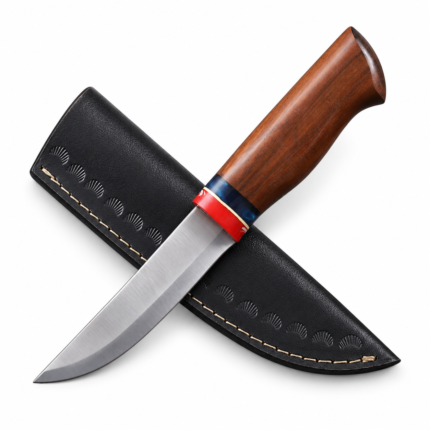
The Green Handle Bowie Hunting Knife combines a traditional fixed-blade profile with a distinctive green contoured handle, a smooth silver-colored blade, and a classic brown carrying sheath. Designed in the recognizable style of a Bowie hunting knife, this model brings together practical-looking outdoor knife features and an attractive color combination that distinguishes it from more conventional hunting knife designs.
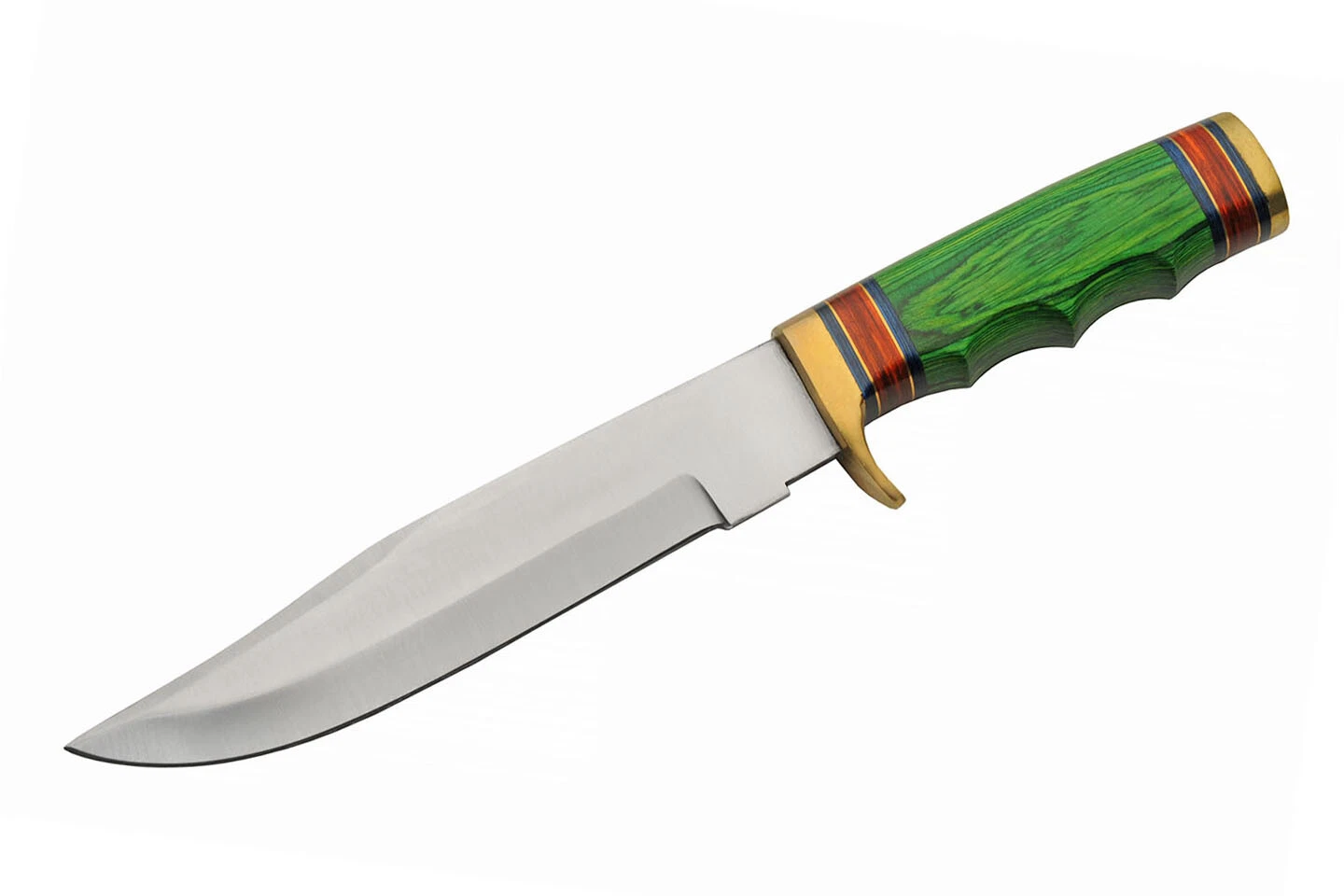
Its blade features a long, slightly curved cutting edge that gradually rises toward a pointed tip. The surface has a bright metallic appearance, creating a clean contrast with the green handle. A small gold-colored guard separates the blade from the grip, while decorative colored spacers add character near both ends of the handle.
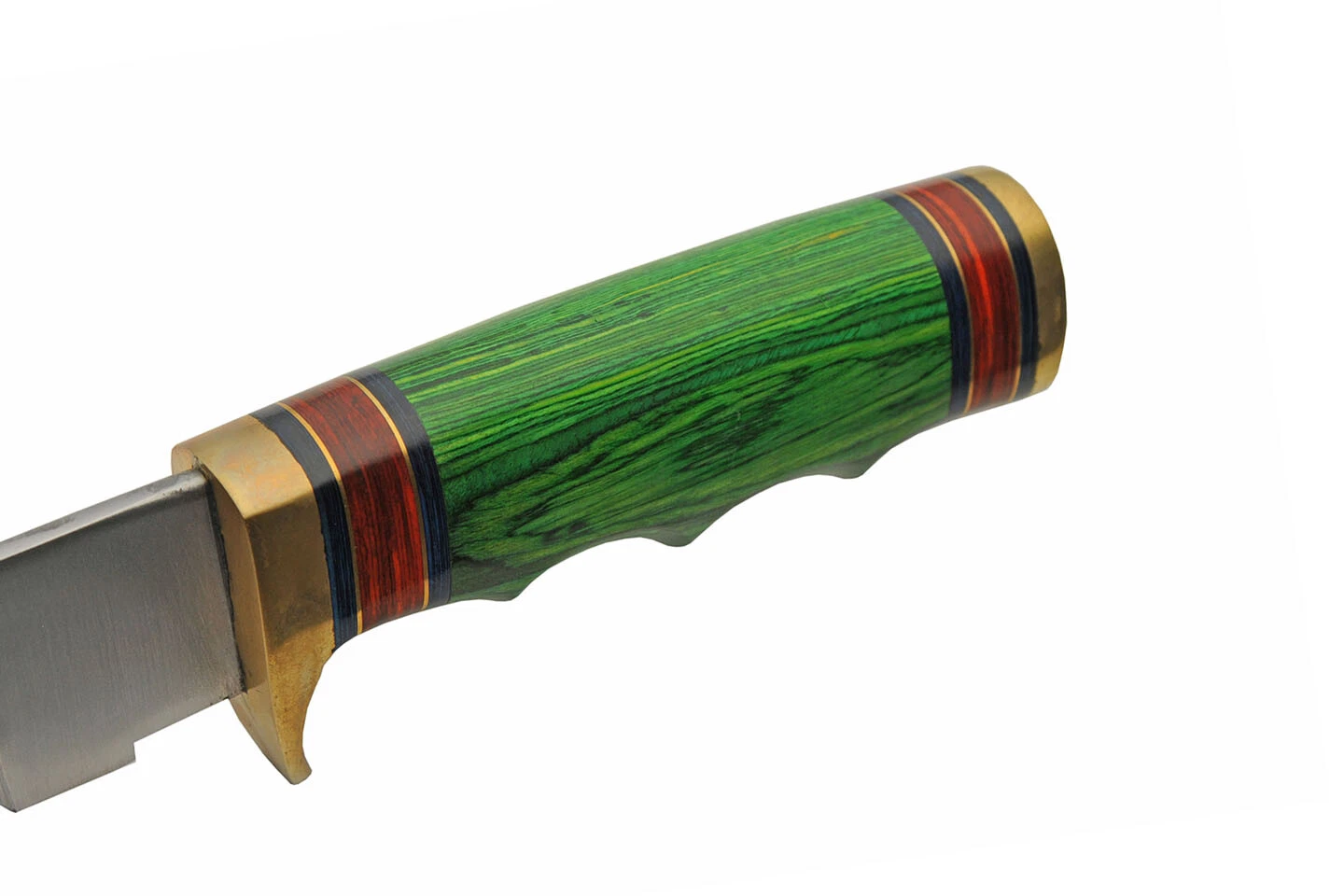
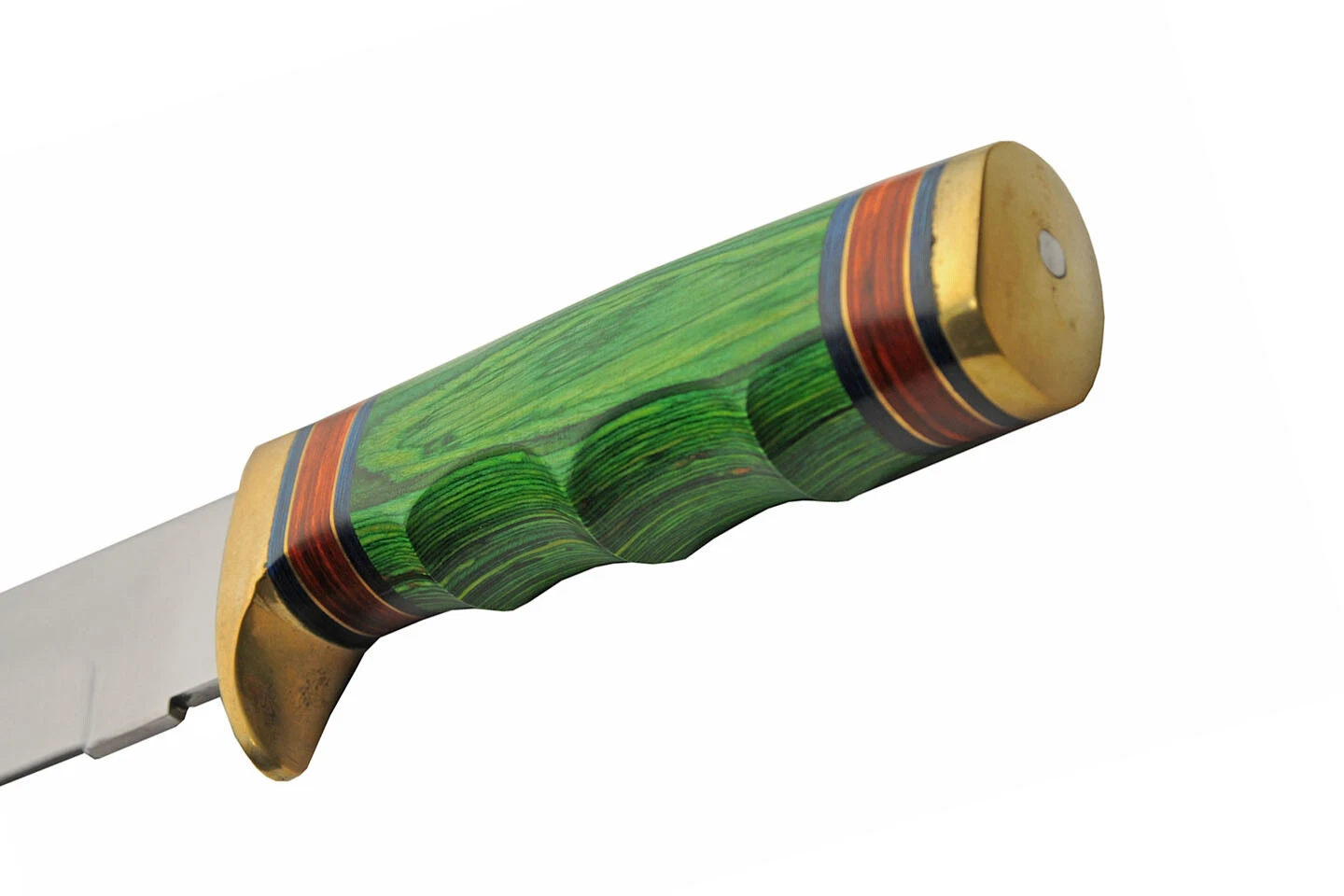
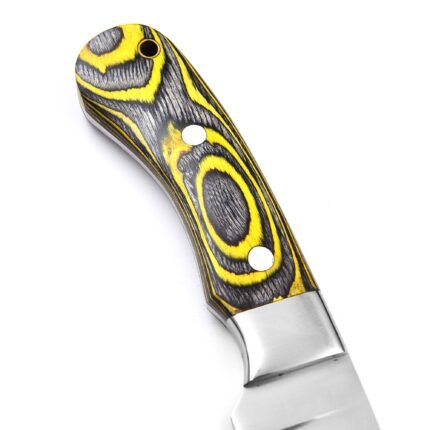
The handle is one of the most noticeable parts of the knife. Its vibrant green appearance and finger-contoured lower edge give it a distinctive profile. These features create a visually interesting alternative to traditional black or brown knife handles.
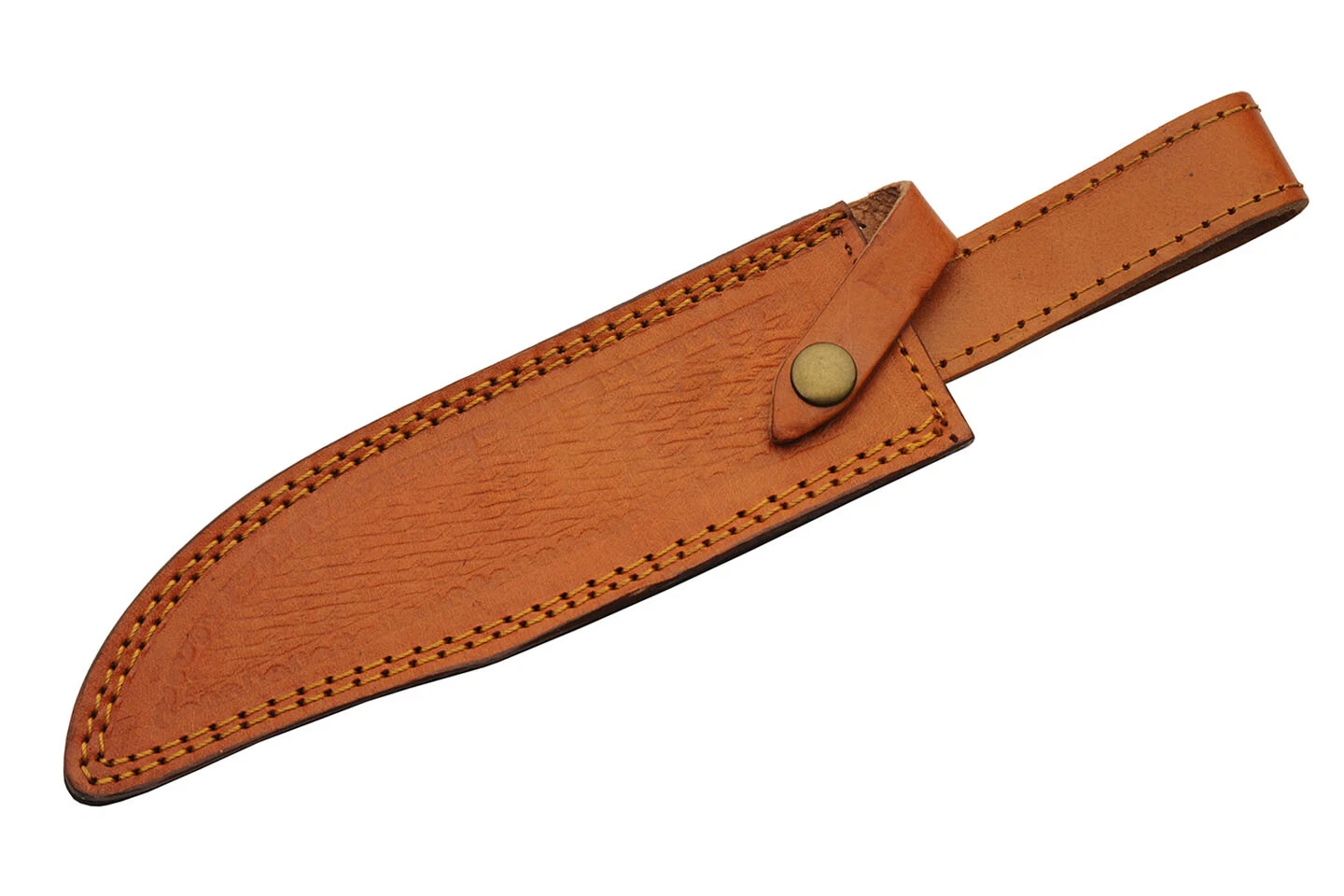
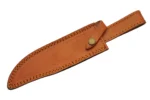
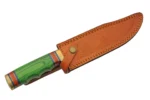
A matching tan-brown sheath is displayed alongside the knife. The sheath features visible stitching around its perimeter and a retaining strap with a round snap fastener. Its simple traditional appearance complements the silver blade and green handle.
The result is an appealing Bowie-style hunting knife for customers interested in traditional fixed-blade designs, distinctive handle colors, and coordinating outdoor knife accessories.
Traditional Bowie Hunting Knife Design
Bowie knives are commonly recognized for their fixed blades, prominent profiles, and traditional outdoor styling. Although individual Bowie knife designs can vary considerably, many share a long blade, a shaped handle, and some form of guard near the blade’s base.
This model follows that general design language.
Its blade extends directly from the handle, without a visible folding mechanism. The cutting edge curves gently before reaching a pointed front section.
The knife has an elongated blade profile rather than a short, compact utility blade. This gives it the familiar appearance of a traditional outdoor hunting knife.
The handle is positioned behind a small guard and features an eye-catching green finish.
The overall design is suitable for classification within a Bowie knife or fixed-blade hunting knife collection.
Its exact dimensions and performance characteristics require manufacturer confirmation, but the visible silhouette clearly distinguishes it from folding knives, kitchen knives, and cleaver-style blades.
For customers who appreciate traditional outdoor cutlery, the combination of classic blade styling and colorful handle detailing makes this knife visually distinctive.
Smooth Silver-Colored Blade
The blade features a relatively smooth silver-colored surface with a bright metallic appearance.
Unlike patterned Damascus-style blades, this model displays a comparatively uniform finish.
The reflective blade surface creates a clean and understated appearance that contrasts with the vibrant green handle.
Its pointed front section follows the curved cutting edge, while the upper portion of the blade appears relatively straight across much of its length.
The blade also features a visible transition near the handle, creating a defined separation between the main cutting section and the guard.
These details contribute to its recognizable Bowie-style profile.
The photograph does not reveal the specific steel grade.
Although many similar hunting knives are manufactured from stainless steel or high-carbon steel, the exact material used in this product cannot be determined from its appearance alone.
For this reason, the product is described as having a silver-colored metallic blade rather than a verified stainless-steel construction.
The steel composition, hardness, edge retention, and corrosion resistance should be confirmed with the manufacturer.
Long Pointed Blade Profile
The knife features an elongated blade with a gradually curved cutting edge.
Its edge rises toward the pointed tip, creating a traditional hunting-style silhouette.
The blade appears relatively broad near the handle and narrows toward the front.
This gradual change in shape gives the knife a balanced visual profile.
The tip is pointed rather than rounded, distinguishing the design from certain utility and kitchen knives.
Different Bowie knives may feature clip-point, drop-point, or other blade profiles.
The photograph does not establish enough precise geometry to assign a highly specific blade classification confidently.
However, the visible design is clearly consistent with a traditional pointed Bowie-style hunting knife.
Customers comparing knife shapes should consider the blade dimensions and manufacturer’s intended application before purchasing.
Blade shape alone does not establish a knife’s durability, cutting performance, or suitability for particular tasks.
Those characteristics depend on material specifications, edge geometry, construction, and testing.
Bright Green Contoured Handle
The green handle creates the most prominent color feature of this knife.
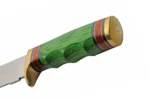
Its surface has a vivid green appearance with visible darker areas that create a subtle grain-like effect.
The lower side of the grip includes multiple finger contours.
These contours create a sculpted profile rather than a completely straight handle.
This design distinguishes the knife from traditional smooth wooden handles.
The handle’s bright color provides a striking contrast against the silver-colored blade.
The upper edge of the handle appears relatively smooth, while the lower portion features a series of curved finger recesses.
These visible details give the handle an identifiable silhouette.
The material cannot be verified from the photograph.
The handle could be manufactured from dyed wood, a laminated material, a synthetic composite, or another substance.
Without supplier confirmation, it should not be described as genuine wood, Micarta, G10, or a specific resin.
The accurate description is a green contoured handle with finger grooves and decorative multicolored accents.
Finger-Grooved Handle Design
Finger grooves are a recognizable feature of many outdoor knife handles.
They create individual recesses along the lower grip.
On the pictured knife, several rounded grooves are visible.
These give the handle a sculpted appearance and distinguish it from knives with completely smooth grips.
The grooves are integrated into the overall handle shape.
The result is a visually detailed design that complements the blade’s traditional profile.
Customers often consider handle shape when selecting fixed-blade knives.
The positioning of finger grooves can affect how a handle feels, although comfort varies according to hand size, grip preference, and the material used.
The photograph confirms the grooves’ appearance but does not establish tested ergonomic performance.
It is therefore appropriate to describe the handle as finger-contoured without making unsupported claims about slip resistance or fatigue reduction.
The actual fit should be assessed using verified handle dimensions and, where possible, direct inspection.
Decorative Multicolored Handle Spacers
Another noticeable feature is the arrangement of colored bands near the handle’s ends.
These bands display contrasting tones, including warm orange or reddish shades and darker accents.
Their placement gives the handle a more detailed appearance.
Near the blade, the colored spacers visually separate the green grip from the guard.
Similar decorative bands are visible near the rear of the handle.
These details enhance the knife’s traditional styling without requiring an elaborate blade pattern.
The spacers also help create a coordinated transition between the different colors.
The exact materials used in these decorative sections are unknown.
They may be made from laminated components, resin, wood, or other materials.
The product description should not assign a particular material without verification.
Their visible appearance can be accurately described as multicolored decorative handle spacers.
Gold-Colored Guard
A small gold-colored guard is located between the blade and handle.
The guard is an important visual component of the knife.
It creates a defined transition between the metallic blade and the colorful grip.
Its warm tone complements the orange and reddish handle spacers.
The guard extends beyond the handle’s immediate outline, creating a recognizable traditional hunting knife detail.
Many fixed-blade knives include guards as part of their overall design.
The exact protective function of a particular guard depends on its shape, assembly, and structural construction.
The uploaded image does not establish these characteristics through testing.
The guard should therefore be described primarily by its visible shape and color.
The metallic component appears gold-toned, but the photograph does not establish whether it is brass, plated steel, or another alloy.
Supplier confirmation is required before advertising a specific guard material.
Traditional Fixed Blade Construction
The Green Handle Bowie Hunting Knife features a fixed-blade design.
A fixed-blade knife has a blade that remains extended rather than folding into the handle.
This is a recognizable characteristic of traditional hunting knives.
The visible product consists of a continuous knife silhouette with a separate grip behind the blade.
However, the image does not show its internal construction.
It cannot establish whether the knife uses a full tang, hidden tang, or another mounting method.
The external guard and handle spacers do not independently confirm the tang design.
For buyers comparing different fixed-blade constructions, tang configuration is a specification worth reviewing.
The manufacturer should provide accurate details regarding blade-to-handle assembly.
Information about material thickness and joining methods would also help customers understand the knife’s construction.
Until those details are available, the listing should describe the product simply as a fixed-blade Bowie-style hunting knife.
Tan-Brown Protective Sheath
A tan-brown sheath is shown beside the knife.
Its long, tapered shape follows the general outline of the blade.
The sheath has a warm brown surface and darker stitched detailing along its edges.
The color gives the accessory a traditional appearance.
Its simple design contrasts with the bright green handle while complementing the knife’s overall outdoor styling.
The sheath appears to be made from a leather-like material.
However, the photograph cannot establish whether it is genuine leather, synthetic leather, or another material.
The appropriate description is a brown leather-style sheath.
Its exact construction, thickness, and durability should be confirmed by the manufacturer.
The sheath is an important part of the pictured product presentation.
It offers a coordinating accessory for covering and storing the blade, subject to confirmation that its fit and retention are suitable.
Stitched Sheath Edges
The sheath includes visible stitching along its outer edge.
The stitching follows the sheath’s tapered shape.
Small, evenly spaced stitches create a defined border around its perimeter.
This detail contributes to the accessory’s traditional appearance.
It also provides a visual indication of how the outer sections have been assembled.
The thread color appears darker than the brown surface.
This creates subtle contrast along the edges.
Stitched sheaths are commonly associated with traditional fixed-blade knives.
However, the stitching method, thread material, and structural strength cannot be established from the photograph.
Those details require physical inspection or manufacturer documentation.
Customers should check the stitching condition when receiving the product.
Any loose threads, damaged seams, or poorly fitting sections should be addressed before regular use.
Snap-Fastened Retaining Strap
A retaining strap is visible near the upper portion of the sheath.
The strap crosses over part of the sheath and includes a round gold-colored snap fastener.
This creates a traditional closure detail.
The strap appears intended to help secure the knife when it is inserted into the sheath.
The photograph shows the strap in its fastened position.
Its exact retention strength cannot be evaluated visually.
Buyers should confirm that the sheath fits the knife correctly and that the strap closes securely.
A decorative snap fastener should not be assumed to provide a particular level of retention without testing.
The visible strap also adds to the sheath’s appearance.
Its simple design complements the rest of the accessory.
Coordinated Blade, Handle, and Sheath
The knife combines three primary visual elements.
The first is its smooth silver-colored blade.
The second is its vibrant green contoured handle.
The third is its warm brown decorative sheath.
Together, these elements create a recognizable traditional hunting knife presentation.
The silver blade offers a neutral metallic finish.
The bright handle introduces color.
The brown sheath adds a classic outdoor accessory appearance.
Small gold-colored accents and multicolored handle spacers connect the different parts visually.
This coordinated styling helps distinguish the knife from plain fixed-blade models.
For customers who prefer traditional designs with colorful details, the combination is particularly noticeable.
Outdoor Knife Collection Appeal
Fixed-blade knives are available in numerous styles.
Some feature minimalist black handles and coated blades.
Others have natural-looking wooden handles and polished metal finishes.
This particular knife combines a traditional blade profile with a more colorful grip.
Its green handle makes it easy to distinguish visually from conventional brown-handled models.
The sheath completes the presentation with familiar traditional styling.
For adult knife collectors, the combination of a smooth blade, guard, colored handle spacers, and stitched sheath may be appealing.
The knife can be considered as part of a collection of traditional hunting-style fixed blades.
Any practical suitability for outdoor work must be assessed against the verified material, structural, and performance specifications.
Appearance alone should not determine the intended use.
Comparing Bowie Knives with Other Fixed Blade Designs
The Bowie knife category includes many different blade shapes and handle configurations.
Some examples have large pronounced guards.
Others feature smaller guards and simpler handles.
Blade profiles may also vary considerably.
The pictured model has a relatively streamlined silhouette.
Its guard is visible but not excessively large.
The blade features a gently curved cutting edge and pointed tip.
The handle has finger recesses and a decorative green finish.
These details distinguish it from more compact utility knives.
They also separate it visually from knives designed primarily for kitchen preparation.
When comparing different fixed-blade products, customers should consider more than appearance.
Accurate measurements, materials, construction details, and intended applications are important considerations.
Importance of Blade Steel Information
The steel used in a knife influences its technical characteristics.
Different steel grades may behave differently depending on their composition and heat treatment.
Some steels require more attention to corrosion prevention.
Others have different sharpening and maintenance characteristics.
The photograph does not establish the steel grade used in this knife.
A polished silver surface is not sufficient evidence that a blade is stainless steel.
Similarly, it cannot establish hardness or edge retention.
Customers who want the knife for specific practical applications should request the manufacturer’s material specifications.
Useful information includes steel grade, hardness, blade thickness, and construction details.
Once confirmed, these specifications can be added to the product page.
Until then, the listing should avoid unsupported claims about toughness, rust resistance, and cutting performance.
Blade Length and Size Considerations
Blade length is an important specification for buyers.
The knife appears relatively long compared with the handle.
However, the photograph provides no reliable measurement scale.
The actual blade length cannot be confirmed.
Its overall length, width, thickness, and weight are also unknown.
These details should be measured directly or obtained from the supplier.
When reviewing hunting knife listings, customers should compare the complete dimensions.
Two knives with similar photographs can have substantially different sizes.
Handle length and blade thickness are particularly relevant when evaluating how a knife may feel and perform.
Accurate dimensions help reduce uncertainty before purchase.
The product page should therefore include measurements only after they have been verified.
Understanding Handle Materials
Green knife handles can be produced using several different materials.
Some manufacturers use dyed or stabilized natural wood.
Others use laminated composites or molded synthetic materials.
These materials can have similar appearances in photographs.
The specific handle material affects maintenance requirements and other characteristics.
For example, some materials require different cleaning products.
Certain materials also have different reactions to moisture or temperature.
Because the handle material is unverified, the product should be described using visible design features rather than an assumed composition.
Its green color, contoured shape, and decorative spacers are clearly observable.
These details provide a useful product description without introducing unsupported claims.
Caring for the Silver Blade
Proper cleaning helps preserve a knife’s appearance.
After handling, wipe the blade with a clean, soft cloth.
Remove visible moisture and surface residue.
Avoid leaving the blade wet during storage.
Do not use aggressive abrasive cleaners unnecessarily.
Harsh polishing may alter the blade’s original finish.
The appropriate care routine depends on the actual steel composition.
If the manufacturer confirms a carbon-steel blade, additional corrosion prevention may be recommended.
If the blade is stainless steel, maintenance requirements may differ.
In either case, follow the supplier’s care instructions.
Inspect the blade regularly for changes in surface appearance.
Store it in a clean and dry environment when it is not in use.
Maintaining the Green Handle
The handle should be kept clean and free from accumulated dirt.
Use a soft cloth to remove dust and loose surface residue.
The finger grooves may require additional attention because their recessed shape can collect particles.
A soft brush can help clean these areas gently.
Avoid exposing the handle to harsh chemicals unless they are approved for its material.
Excessive heat and prolonged moisture exposure should also be avoided until the handle composition is known.
The decorative colored spacers should be treated carefully.
Do not attempt to polish or refinish them without appropriate product information.
The manufacturer should provide material-specific cleaning guidance.
Sheath Care and Storage
The brown sheath should be kept dry and clean.
Remove surface dust with a soft cloth.
Avoid prolonged exposure to moisture.
If the sheath is verified as genuine leather, use suitable leather care products according to the supplier’s instructions.
If it is synthetic, different products may be required.
Do not apply leather conditioner to an unidentified material.
Inspect the stitched edges regularly.
Check that the retaining strap and snap fastener function correctly.
The sheath should cover the cutting edge appropriately when the knife is stored.
For extended storage, follow the manufacturer’s guidance on whether the knife should remain inside the sheath.
Avoid storing a damp blade in direct contact with sheath material.
Responsible Handling and Storage
A fixed-blade knife should be handled carefully.
Keep the blade covered when it is not being inspected or used.
Avoid leaving the knife in locations accessible to children or unauthorized individuals.
Store it securely.
Before carrying or transporting the knife, check the relevant laws and regulations.
Different jurisdictions may have different requirements concerning knife length, carrying methods, and permitted use.
The included sheath should be checked for correct fit before relying on it for transportation.
Never assume that a sheath is secure solely because it is included in a product photograph.
Responsible handling is an important consideration for every fixed-blade knife owner.
Knife Collectors and Traditional Design Enthusiasts
Collectors often appreciate products with distinctive visual details.
This knife includes several features that may attract that interest.
The smooth metallic blade offers a traditional appearance.
The green handle introduces an unusual color.
The gold-colored guard and decorative spacers add contrast.
The brown sheath complements the overall design.
Together, these elements create a recognizable visual identity.
Collectors comparing different Bowie-style knives may appreciate the relationship between the classic blade silhouette and the more colorful handle.
The product does not need extravagant ornamentation to stand out visually.
Its appearance is defined by the contrast between simple metallic surfaces and decorative handle details.
No limited-edition status, historical provenance, or handmade manufacturing process is claimed without verification.
Gift Considerations
Traditional hunting-style knives can be of interest to adult collectors and outdoor equipment enthusiasts.
The green handle and brown sheath create a distinctive presentation.
This may appeal to buyers looking for a knife with a more colorful appearance than conventional black-handled models.
Before purchasing the item as a gift, consider the recipient’s preferences and applicable legal requirements.
The photograph shows a knife and sheath.
It does not show a gift box, certificate, display stand, or other accessories.
Those items should not be included in the product description unless supplied.
The product’s confirmed packaging should be stated separately once available.
Buying a Green Handle Bowie Hunting Knife
When selecting a Bowie-style hunting knife, buyers should consider several product details.
The blade shape and handle design are immediately visible.
The knife’s green grip and tan sheath can be assessed from the photograph.
However, accurate purchasing decisions also require information that cannot be observed visually.
Blade material is one example.
Tang construction is another.
Dimensions, weight, and sheath composition are also relevant.
Customers should review verified manufacturer information before purchasing for a specific application.
The product’s visual design is an important part of its appeal, but appearance should not substitute for technical specifications.
For sellers, providing accurate information can help customers compare products and understand their options.
Product Design Details
The following characteristics can be identified from the uploaded photograph:
Product Type: Bowie-style fixed-blade hunting knife
Blade Shape: Long pointed blade with a gently curved cutting edge
Blade Finish: Smooth silver-colored metallic appearance
Handle Color: Bright green
Handle Shape: Contoured grip with multiple finger grooves
Handle Details: Multicolored decorative spacers
Guard: Small gold-colored guard
Sheath Color: Tan brown
Sheath Design: Long tapered shape with visible stitching
Sheath Closure: Retaining strap with round snap fastener
Visible Components: One fixed-blade knife and one sheath
The blade steel, precise construction, handle material, sheath material, dimensions, hardness, weight, and manufacturing process require confirmation.
Product Photography Recommendations
Additional product photographs would help customers understand the knife more completely.
A close-up of the blade could show its finish and edge profile.
A photograph of the opposite side could show additional handle details.
A view of the knife inside the sheath could demonstrate its fit.
A measurement image could help establish accurate dimensions.
These details would improve the product page without requiring exaggerated marketing claims.
Photographs should show the actual product being sold.
Any color adjustments should preserve the true appearance of the green handle and brown sheath.
Accurate photography is particularly important when the product’s visual identity depends on color.
Why Choose This Green Handle Bowie Hunting Knife?
The Green Handle Bowie Hunting Knife offers an attractive combination of traditional blade styling and distinctive handle detailing.
Its smooth silver-colored blade has a classic pointed hunting-style profile.
The bright green handle features finger grooves.
Decorative colored spacers add contrast.
The gold-colored guard creates a defined transition between blade and grip.
A coordinating brown sheath with stitched edges and a snap-fastened retaining strap completes the presentation.
These visible details distinguish the knife from plain fixed-blade designs.
For collectors and customers interested in Bowie-style hunting knives, its traditional silhouette and colorful handle provide an appealing combination.
The knife’s technical suitability should be evaluated using verified manufacturer specifications.
Final Overview
The Green Handle Bowie Hunting Knife brings together a pointed silver-colored blade, bright green contoured grip, multicolored handle accents, gold-toned guard, and traditional brown sheath.
Its appearance combines familiar fixed-blade hunting knife styling with distinctive decorative details.
The smooth blade finish and colorful handle create contrast, while the sheath offers a coordinating accessory for blade coverage and storage.
Explore this Green Handle Bowie Hunting Knife as part of a traditional fixed-blade collection, and review its confirmed specifications before choosing it for your intended application.








Reviews
There are no reviews yet.