

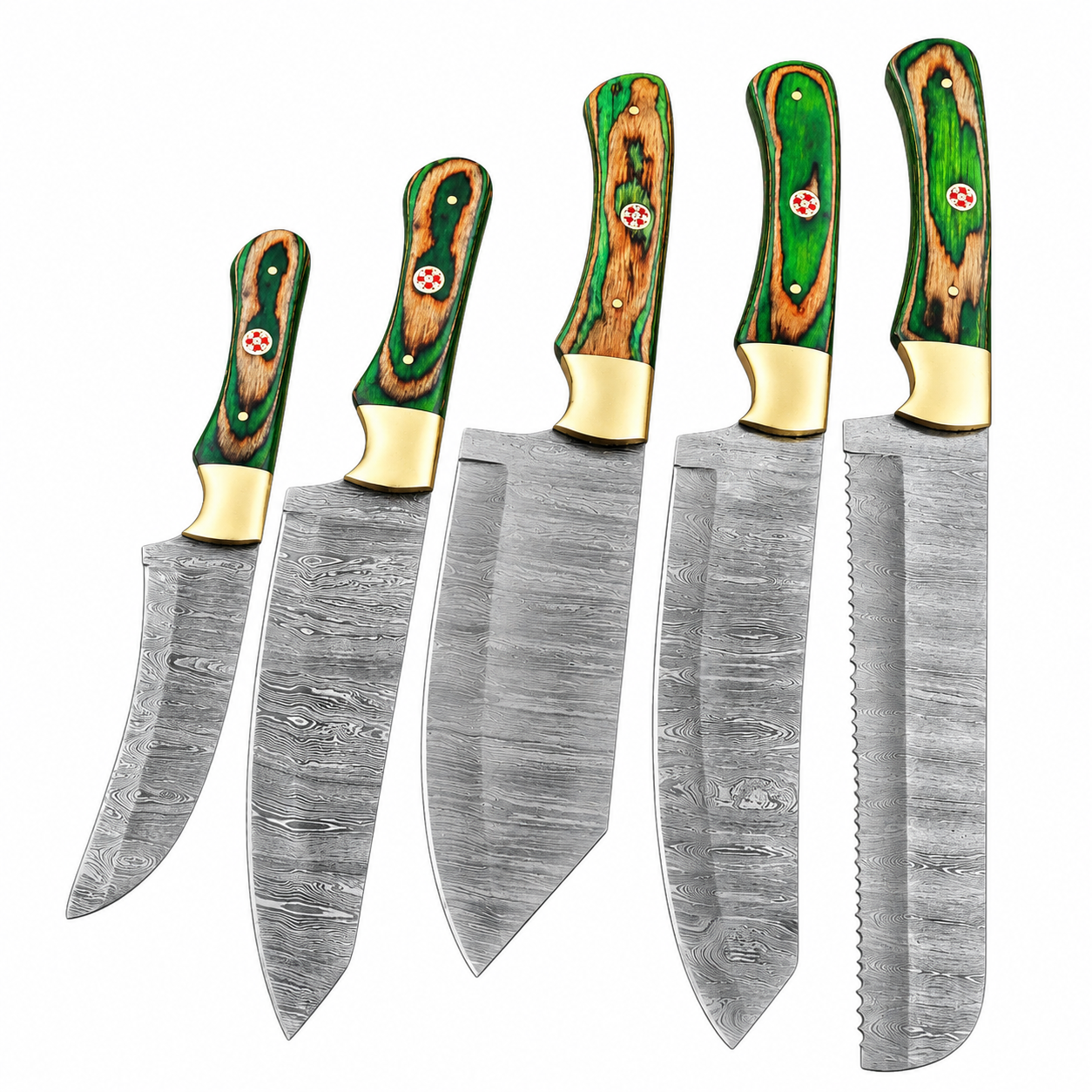

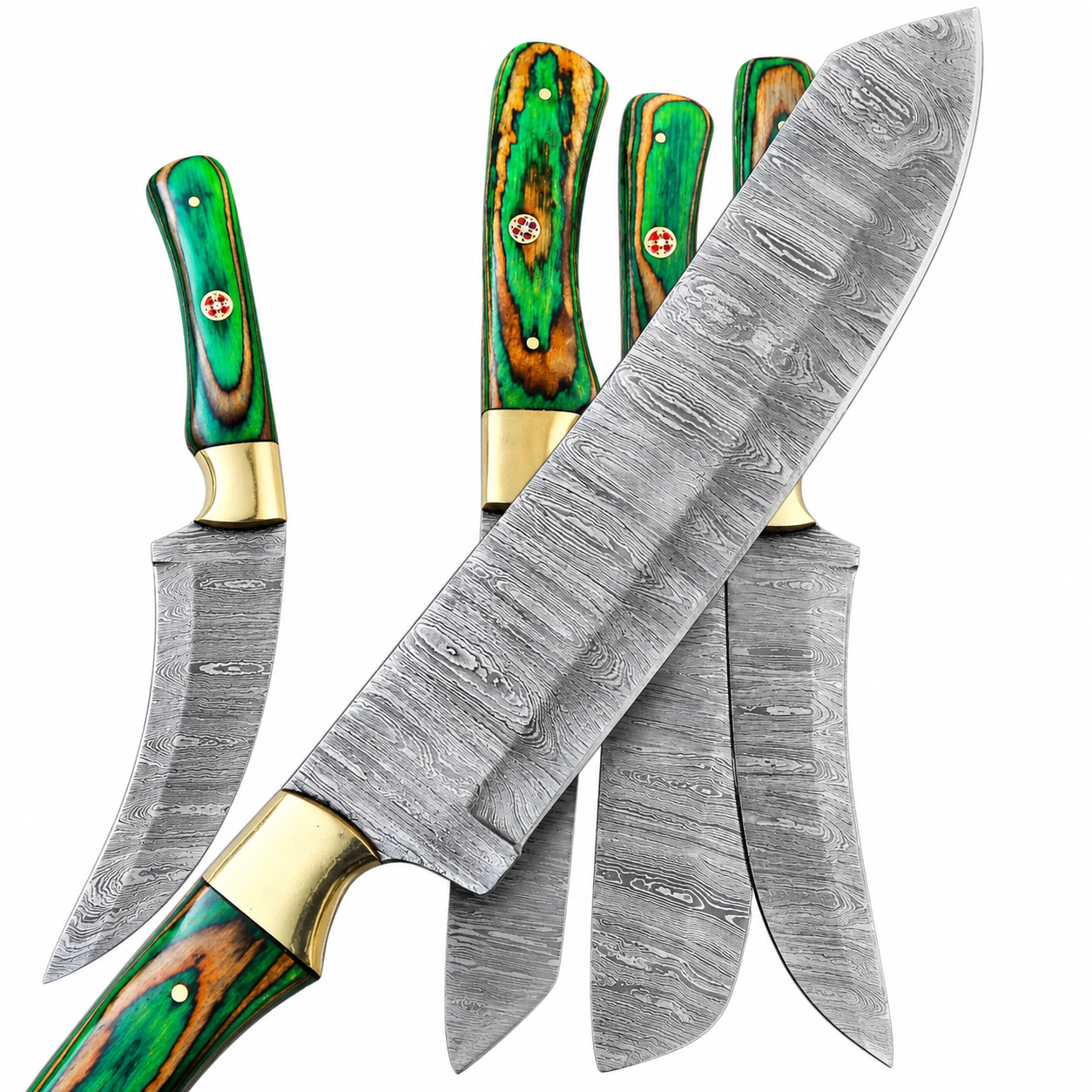

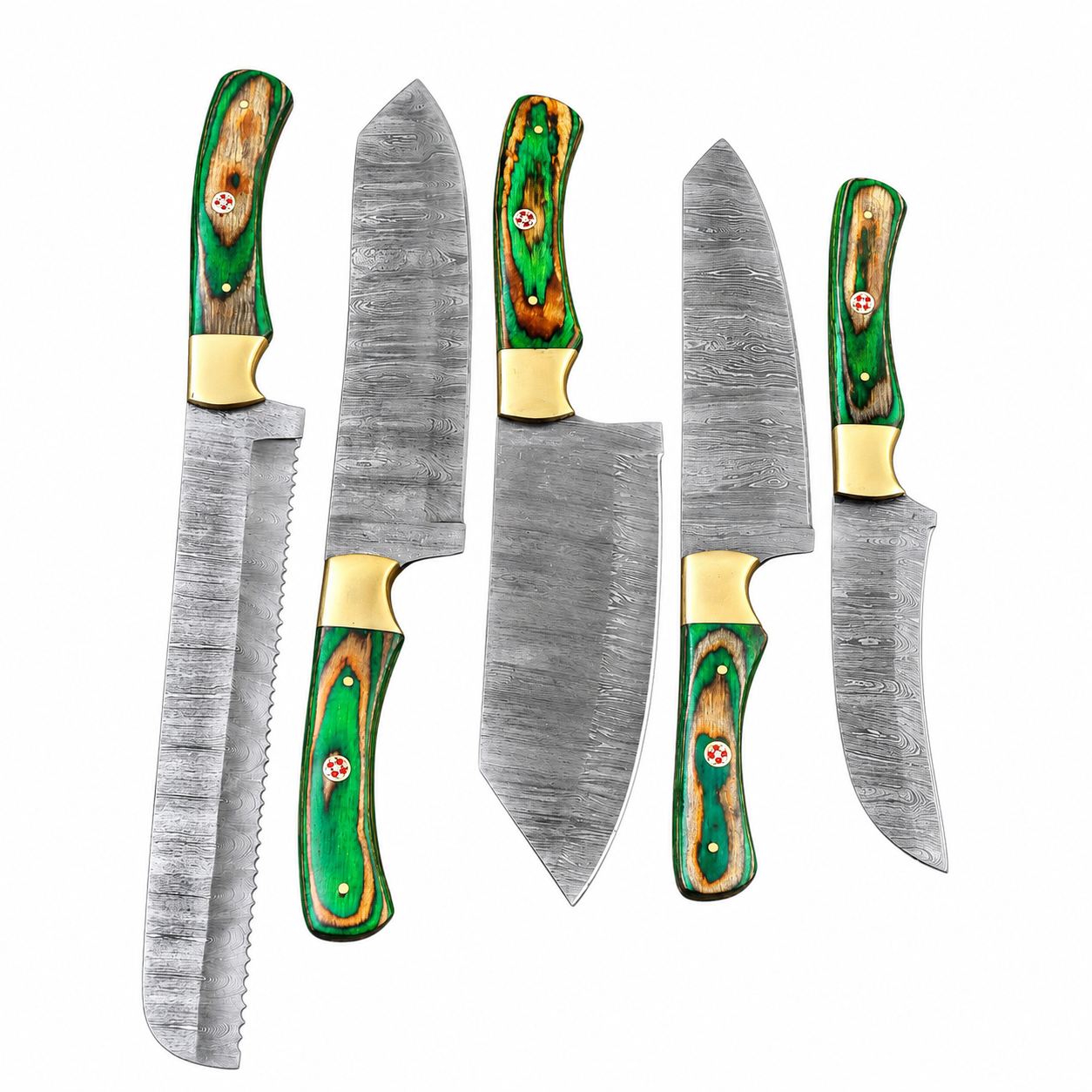
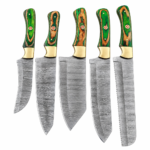
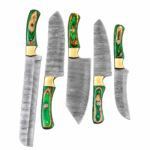
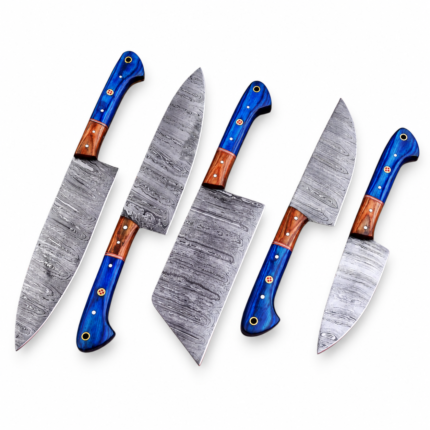
This five-piece green kitchen knife set pairs four pointed prep blades with a long serrated bread knife. The smallest knife has a short, curved profile for working with smaller ingredients. The three blades in the middle offer more width for cutting-board prep, while the bread knife at the far right has a scalloped edge and a rounded tip. All five have flowing gray blade patterns, green and honey-brown grain-look handles, and gold-tone bolsters.
The green is the first thing you notice, but the reason to choose this particular assortment is the mix of shapes. There is a knife you can reach for when a broad blade feels awkward beside a strawberry, several options for chopping vegetables, and a serrated blade for the loaf that accompanies the meal. All five pieces shown are knives. A block, sharpening rod, pair of scissors, or storage roll is not counted as part of the pictured five.
Meet the five knives
Read the set from left to right in the product image. The first knife is visibly shorter through the blade than its neighbors. The central knife has the widest face. The last is the only one with teeth along its cutting edge. Those distinctions are more useful when choosing a knife than assuming that each piece has a particular trade name or standard length.
| Position | What distinguishes the blade | Where the shape may be useful |
|---|---|---|
| Far left | Short, narrow blade with a pronounced curve toward the point | Trimming small fruit, dividing a shallot, or working on a small board |
| Second | Longer pointed blade, narrower than the center knife | General slicing when you want length without the widest blade |
| Center | Broadest face, with a long straight section and an angular taper toward the tip | Chopping vegetables and working through a batch of ingredients |
| Fourth | Broad, elongated blade with a pointed front | Longer slicing cuts and general cutting-board prep |
| Far right | Long scalloped edge and rounded front | Slicing bread, rolls, and similar baked goods |
These are practical descriptions of the profiles shown. Individual blade lengths, weights, and manufacturer-assigned knife names are not available. In particular, the center blade’s width does not establish that it is a heavy cleaver for chopping bone.
The short curved blade
The far-left knife is a useful place to start because its shape differs so clearly from the rest. Much of the lower edge curves into the point, and the face is relatively narrow. Beside a small ingredient, there is less blade extending beyond the area you are working on. That can be an advantage when the task is trimming a pepper, halving a strawberry on a board, or cutting a few thin pieces from a small apple.
Its handle still carries the same details as the larger knives: a green and brown patterned face, two small gold-colored pins, a red-centered circular decoration, and a gold-tone section at the blade end. You do not lose the visual character of the collection when you move down to its smallest blade. On this particular handle, a long green patch runs through the center, framed by bands of brown.
Consider this piece if your usual chef knife feels oversized for the last few jobs in a recipe. A broad knife might be your first choice for a whole onion, for example, while this shorter profile may be more appealing when you only need to divide a shallot for a dressing. Whether it fills the role of a paring knife or a small utility knife for you will depend on its actual dimensions and the way you prefer to work.
Three different choices for board work
The second knife from the left has a longer, pointed silhouette. Its blade carries fine gray ripples, with some of the most pronounced dark lines appearing across the middle. Toward the front, the two sides of the profile draw together into a clear point. It offers an alternative to the center knife for cooks who like a longer blade but prefer less width in front of them.
The center knife makes the strongest visual statement. Its face remains broad through much of its length, and one side turns through a distinct angle before meeting the tip. The pattern is more understated here than on the second knife: close gray lines cross a comparatively open face. Its shape is especially relevant if you like a wide blade for everyday onion, cabbage, or herb prep. The blade height and thickness still need to suit your hand and board; width in a photograph tells only part of that story.
The fourth knife carries its width farther toward the front before tapering into a point. Its length makes it worth considering for a larger ingredient or a slice that benefits from a longer path across the board. The difference between this knife and the short one is obvious. The choice between it and its two neighbors is more personal: some cooks like the deep face of the center blade, while others prefer a more elongated shape for the same ingredient.
That overlap can be useful. You do not need a different recipe for each knife, and there is no reason to switch blades simply because another one is available. Instead, choose the middle profile that feels most natural for your regular prep. The other two give you alternatives when moving between small portions, a full board of vegetables, or ingredients that call for a longer slice.
A dedicated serrated bread knife
The far-right knife is identifiable by its edge rather than its size. A row of visible scallops extends along the blade toward a rounded front. The other four blades have smooth-looking edge profiles and end in points. If a bread knife is one of your reasons for buying a set, this is a meaningful distinction: not every assortment of five kitchen knives includes one.
Bread puts different demands on a blade than a peeled onion does. On a crusty loaf, a serrated edge can start the cut at the crust with a gentle back-and-forth motion. On softer bread, using that motion rather than pressing straight down helps preserve the shape of the slice. The long profile is also easy to identify among the other four knives when breakfast or sandwich prep is the first task of the day.
The image shows no ruler, so the usable serrated length is worth confirming if you bake large round loaves. Compare that length with the width of the bread you most often slice. A knife that suits a baguette or a small sandwich loaf may not give you the reach you prefer for a wide sourdough boule. That measurement is more informative than the product’s overall length, which includes the handle.
How the set fits an ordinary meal
Take a simple lunch of vegetable soup and crusty bread. A broad knife is a sensible choice for cutting the onions and carrots on the board. The short curved blade offers another option for trimming the end of a pepper or dividing a small garnish. At serving time, the serrated knife has a distinct job of its own. Three different blade shapes have earned their place in the meal without requiring a complicated technique or a specialist recipe.
Now consider a kitchen where most meals start with a large board of produce. The middle three knives become the focus. You might prefer the center knife when cutting a batch of vegetables and the narrower second knife when slicing one piece at a time. A second cook helping with the meal also has a choice of broad prep blades rather than having to wait for the only chef-style knife.
For someone who bakes often but cooks on a modest work surface, the priorities may be the opposite. The short knife and bread knife could become the most frequently used pieces, with a broader knife reserved for larger prep sessions. That is a useful way to assess the value of this set: choose it for the blade mix that matches your habits, rather than assuming that a larger piece count automatically makes a better collection.
Green and honey-brown handles
The handles do not have a flat, uniform green finish. Their color shifts between bright leafy green, deep green, honey brown, and darker outlines. On the first knife, a vivid green center is bordered by brown. On the second, a darker green patch sits within a much warmer brown area. The middle handle shows a strong streak of honey brown, while the fourth and fifth have larger fields of green.
Those differences give the set character without making the knives look unrelated. Each grip has a similar rounded end, a gently curved outline, and the same arrangement of decorative details. The green is consistent enough to connect the pieces, while the individual markings give you another way to recognize the knife you use most.
The color is particularly suitable if you want cutlery that looks distinctive even when only the handles are visible. In a block, for example, the grain-like markings and decorative circles would remain on view while the blade patterns would be concealed. On a rack that shows the entire collection, the gray blade faces play a much larger part in the appearance. No block or rack is shown with the knives.
“Grain-look” describes what is visible. The photograph does not establish whether the handles are solid wood, laminated material, stabilized wood, resin, or another construction. If natural wood or a particular timber species is a deciding factor, obtain the material specification for this set rather than using the green pattern to identify it.
Gold-tone bolsters and decorative pins
Each handle meets the blade at a broad gold-tone bolster. This is the smooth section between the green grip and the gray blade face. Its lower edge follows the top of the blade, while one side curves inward. That plain area provides a clear visual break between two busy surfaces: the handle has irregular grain-like markings, and the blade has closely spaced waves.
Two small gold-colored pins are visible on each handle, one toward either end. Between them is a larger pale circular detail with several red dots arranged in a flower-like pattern. It is a small feature, but it ties the five knives together more clearly than the green markings alone. The center handle can be mostly brown in places and still look unmistakably part of the same collection.
The photograph supports describing the bolsters and pins as gold-tone; it does not identify them as brass or gold. Nor does the presence of pins establish the tang construction beneath the grips. For a buyer choosing primarily by design, the relevant point is simpler: the fittings repeat across all five knives, including the short prep knife and the serrated bread knife.
The pattern on the blades
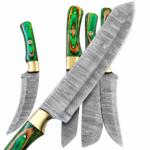
The blade faces have a silver-gray base crossed by fine bands, elongated loops, and darker ripples. The pattern varies with the shape of each blade. It is easy to see on the second knife, where several bands cross the face in strong contrast. On the center knife the lines are closer in tone, giving the broad face a quieter appearance. The bread knife carries a similar pattern even though its outline and edge are different.
This is a Damascus-style appearance, not confirmation of Damascus steel. A photograph cannot establish whether the visible pattern comes from the steel construction or a surface process. It also cannot establish layer count, hardness, or edge retention. If you like the flowing gray design, it is clearly visible here. If you are choosing specifically for a particular steel or production method, those details need separate confirmation for the pictured set.
The distinction is useful when comparing prices as well as appearance. Two collections can look similar in a small product image while differing in materials, blade thickness, finish, and what is included. For this set, the verified selling points are the five visible profiles, patterned faces, green and brown grips, gold-tone bolsters, and coordinated decorative centers.
Choosing the set for your kitchen
Start with the knife you use most. If you already own a chef knife you like, measure its blade length and height at the heel. Then compare those numbers with the seller’s measurements for the second, third, and fourth knives. Height matters because it affects how much space there is between the handle and cutting board. Length matters because an otherwise appealing blade can feel cumbersome on a small work surface.
Next, consider how much use you would get from the two ends of the assortment. The far-left knife is the only notably short blade. The far-right one is the only serrated blade. A household that prepares fruit in small portions and slices its own bread has clear uses for both. If you already have those tasks covered, the decision turns on whether you want the three larger profiles and the coordinated handle design.
Handle dimensions deserve their own comparison. A side view shows the rounded end and inward curve near the bolster, but it does not tell you how full the grip feels. Usable grip length, thickness, and each knife’s weight are especially useful if the set will be shared by cooks with different hand sizes. The image does not verify balance, handedness, or an ergonomic performance claim.
Storage, package contents, and care
If you plan to use a block you already own, count the wide slots as well as the total slots. The center knife needs room for a broad face, while the serrated knife needs enough depth for its long blade. A five-slot block designed for slender knives may have the right number of openings but still be the wrong fit. For a drawer organizer, overall length and handle height matter in addition to blade width.
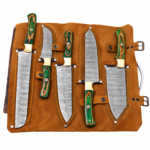
The picture shows the knives without guards, a roll, a sharpener, or gift packaging. That makes the set straightforward to count, but it does not establish what will be packed alongside it. If you are buying a gift or need storage from the first day, confirm the package contents before ordering an additional accessory or assuming one is supplied.
Care instructions depend on the actual blade and grip materials. There is no verified dishwasher rating, handle oil, or sharpening angle for this product. In particular, the bread knife should not be treated as interchangeable with the four plain-edge profiles when selecting sharpening equipment. Ask for the maker’s guidance for the serrated edge, the patterned blade finish, and the colored handles.
What makes this green kitchen knife set worth a closer look is the assortment itself: a short curved knife for small prep, three broader choices for the board, and a serrated knife for bread. If those are the shapes you reach for, the green grain-look handles and patterned blades offer a distinctive way to bring them together in one kitchen.






Reviews
There are no reviews yet.